avatarAvi Kotzer

Free AI web copilot to create summaries, insights and extended knowledge, download it at here

2911

Abstract

ke a closer look:</p><figure id="954a"><img src="https://cdn-images-1.readmedium.com/v2/resize:fit:800/0*7D2OuMebHwJNz4CF.JPG"><figcaption>Photo: Drow_male</figcaption></figure><p id="5d89">Yep, one petal looks like a naked dude. Here, take a closer look:</p><figure id="025c"><img src="https://cdn-images-1.readmedium.com/v2/resize:fit:800/0*M5g_O-mg2bH5Lz3f.JPG"><figcaption></figcaption></figure><p id="88b2">I hope Medium does not suspend my account on account of too much nakedness in one article.</p><p id="547a">Anyway, that’s it as far as sexy times. It’s back to boring science.</p><p id="435c">The <i>labellum</i> is a modified petal and can be distinguished from the other petals by its larger size and its irregular shape. The orchid <i>labellum</i> is sometimes divided into three or more lobes. Some have modified fleshy lumps on the upper part, called the <i>callus</i>. <i>Callus</i> too has an irregular plural, <i>calli</i>, which I’m sure is also <b>not</b> accepted by the editors of the Spelling Bee puzzle.</p><p id="8129">Its basic function is to attract insects, serving as a landing platform for them. The insects then pollinate the flower, and orchid growers get ecstatic.</p><p id="e60d">The <i>labellum</i> in orchids can be so big and complex that it gets its very own set of terminology: the <b>hypochile</b> is the basal portion nearer the connection with the rest of the flower, the <b>mesochile</b> is the middle portion, and the <b>epichile</b> is the distal portion.</p><p id="5c64">Okay! Enough of this boring plant science. Let’s move on to something else. Like the boring science of insects.</p><h2 id="c88d">Double the pleasure</h2><p id="aa79">In insects, the term <i>labellum</i> can refer to one of two things:</p><ol><li>The extension of the <b>labrum</b>, or “upper lip” in certain insects, such as beetles and true bugs.</li><li>The fleshy prolongations of the <b>labium</b>, or “lower lip”, notably in flies.</li></ol><p id="a57e">Now, if that weren’t confusing or contradictory enough, the <i>labella</i> vary depending on the type of haircut the fly sports.</p><p id="4c07">In houseflies, who like to keep their <b>antennae</b> crew cut, the labella are fused into one structure.</p><figure id="4665"><img src="https://cdn-images-1.readmedium.com/v2/resize:fit:800/0*s8CBHtn_36QbMcv4"><figcaption>Screenshotted by Iva Reztok</figcaption></figure><p id="6b3e">That’s Jeff Goldblum in the awesome 1986 remake of the <i>The Fly</i>. Directed by David Cronenberg and also starring Geena Davis, who gets to say the very memable and giffable phrase: “Be afraid. Be very afraid”.</p><p id="20ab">Jeff is about to develop a serious case of the <i>labellas</i>, but he doesn’t know it yet. But watch:</p><figure id="4b95"><img src="https://cdn-images-1.readmedium.com/v2/resize:fit:800/0*opQpkCMGgGe6RhSb"><figcaption>Credit: universalmonstersunivers.com</figcaption></fig

Options

ure><p id="340e">You can clearly see the <i>labella</i> in both bottom-right pictures. Well, you’d be able to see them if you uncovered your eyes. Also, you’ll notice Jeff liked to keep his <b>antennae</b> trimmed short, as most self-respecting flies do.</p><p id="4961">Mosquitoes, however, are hippies who just love to parade their very long and luscious pair of <b>feelers</b>. Their <i>labella</i> are separate, with each one attached at the base to the proboscis, or insect snout.</p><p id="198e">Are you as shocked as I am?</p><p id="aecf">No, not by the fact that mosquitoes are remnants of the 1960s hippy culture. By the fact that they are flies. I never realized that until today. Or in any case, I hadn’t expended any energy thinking about it. But they are.</p><p id="ede8">Flies belong to the order Diptera. Mosquitoes belong to a suborder called Nematocera. That suborder includes crane flies, gnats, love bugs, and even midges. Now, all these in the previous sentence sort of make sense as part of the fly family. I just had never thought of mosquitoes as flies.</p><p id="c5d4">But it explains a lot, right? Like what? Actually… I have no idea.</p><p id="538a">It must explain something, though. Right?</p><p id="08bc">In any case, whether you want to discuss orchids or flies or mosquitoes, you can talk about a lot of things… except their <i>labella</i>.</p><p id="17fd">Because the editors of the Spelling Bee puzzle decreed that <i>labella</i> is a <a href="https://www.merriam-webster.com/words-at-play/dord-a-ghost-word"><b>dord</b></a><b>.</b></p><p id="2aee">You can check out my previous entry on another <b>dord </b>here:</p><div id="9714" class="link-block"> <a href="https://readmedium.com/wold-15264e17b62c"> <div> <div> <h2>Wold</h2> <div><h3>What in the weld is this word?</h3></div> <div><p>medium.com</p></div> </div> <div> <div style="background-image: url(https://miro.readmedium.com/v2/resize:fit:320/0*LHTMHFnAccwghKaA.jpg)"></div> </div> </div> </a> </div><p id="120c">*What the heck is a <b>dord, </b>you ask? Here’s the answer:</p><div id="18aa" class="link-block"> <a href="https://www.merriam-webster.com/words-at-play/dord-a-ghost-word"> <div> <div> <h2>'Dord': A Ghost Word</h2> <div><h3>One of the questions people like to ask lexicographers is this: Can you sneak something into the dictionary? Can you…</h3></div> <div><p>www.merriam-webster.com</p></div> </div> <div> <div style="background-image: url(https://miro.readmedium.com/v2/resize:fit:320/0*Ev6hHtwVB8eDYuRb)"></div> </div> </div> </a> </div></article></body>

Labella

A fly and an orchid walk into a bar… to share a drink and a word
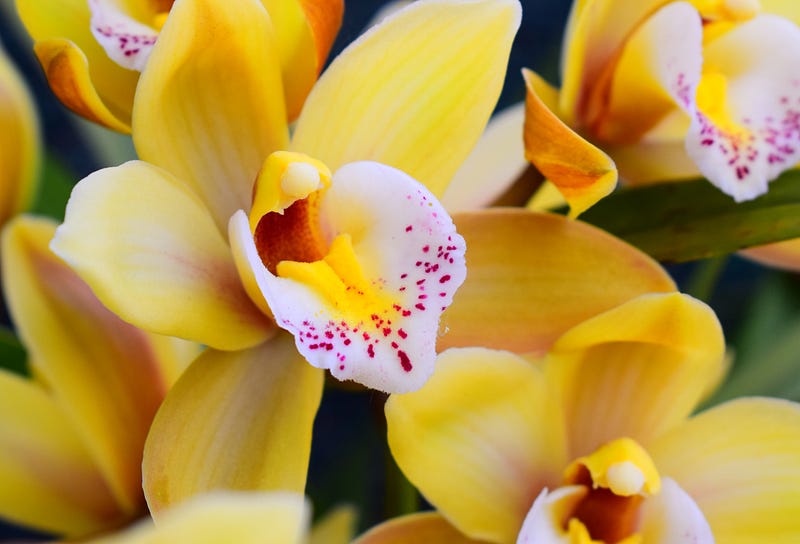
Photo by Chris Barbalis on Unsplash

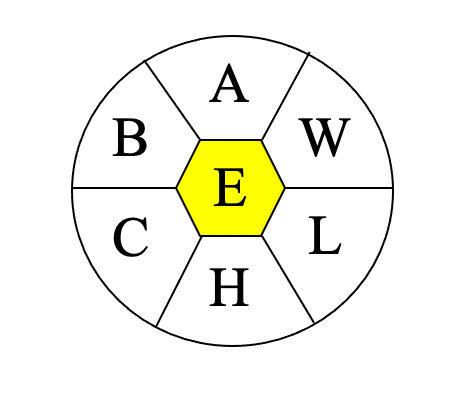
Today’s New York Times Spelling Bee letters:
Art: Iva Reztok

A, B, C, H, L, W, and center E (all words must include E).

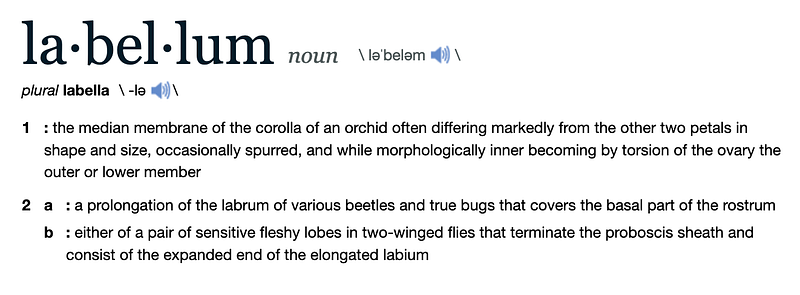
Merriam-Webster says…
Credit: merriam-webster.com

Silly little dictionary! Don’t you know labella can’t possibly be a word if the New York Times says it ain’t?

For further fascinating facts, check out the Spelling Bee Master.

What’s your favorite dord* from today’s puzzle?

My Two Cents

I have come to the conclusion that the New York Times does not like irregular plurals, at least not when it comes to their Spelling Bee puzzle. I’ve seen a ton of irregular plurals clued in their crossword puzzle over the years.

Labella, our word of the day, is the plural of labellum. Not that I think that labellum would have been accepted as a word if today’s letters had included “u” and “m”.

Don’t you give me any lip

Labellum is New Latin. Which is still a dead language… I think. And in Latin that word was a diminutive form of labrum, which means “lip”.

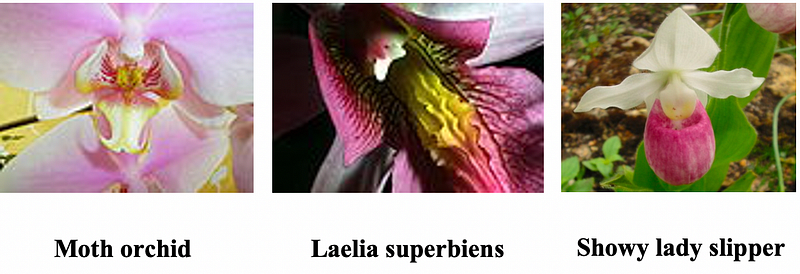
That’s sort of what the labellum looks like in orchids. Here are a few examples.
Screenshot art: Iva Reztok

Oh, yeah, it also looks like something else. I’ll let your imagination run free on each of these suggestive photos.

Then there’s the Orchis italica, commonly known as the Italian orchid. Which makes sense, since that’s what Orchis italica probably means in Latin. Doh!

But… it also has a weird nickname. The “naked man orchid”. Why? Not because it’s favored by men as a chivalrous gesture to women in nudist colonies. Here, take a closer look:
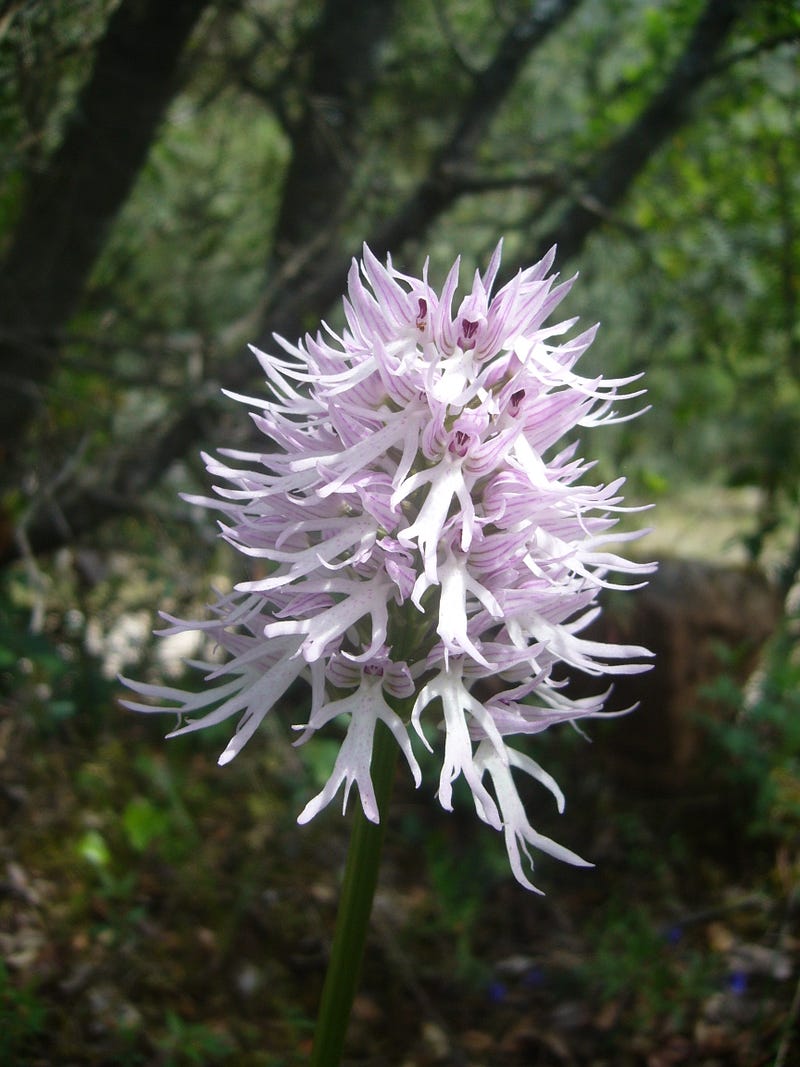
Photo: Drow_male

Yep, one petal looks like a naked dude. Here, take a closer look:
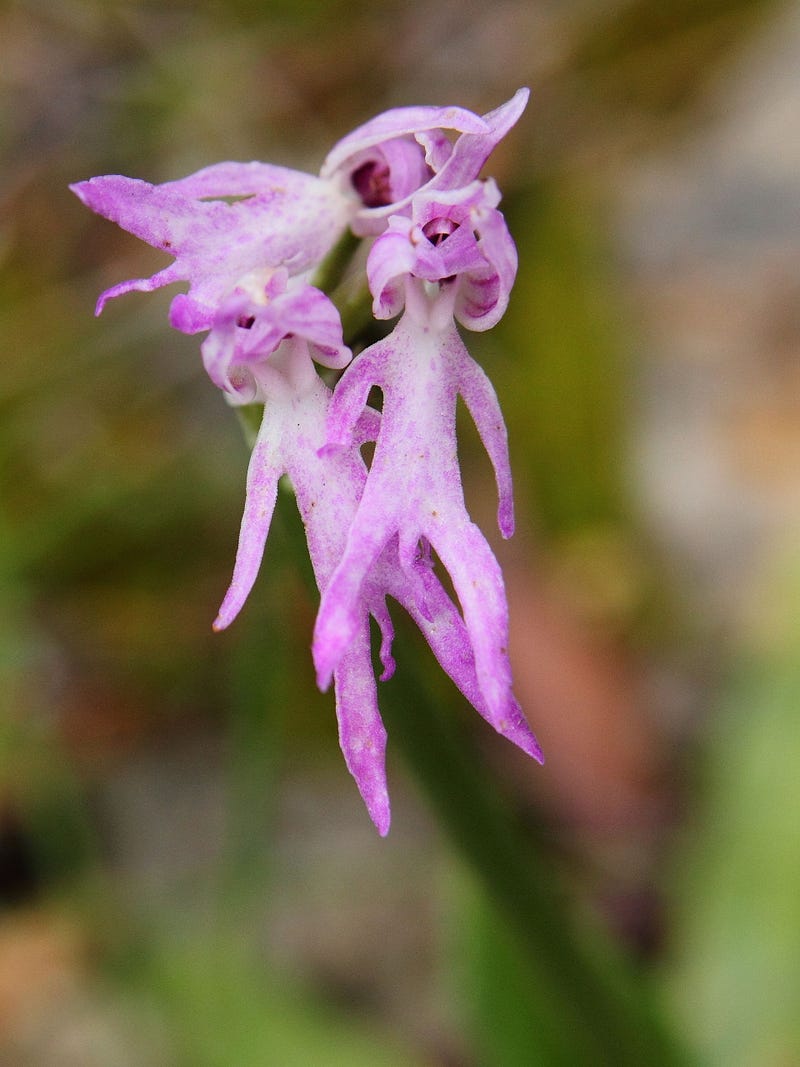
I hope Medium does not suspend my account on account of too much nakedness in one article.

Anyway, that’s it as far as sexy times. It’s back to boring science.

The labellum is a modified petal and can be distinguished from the other petals by its larger size and its irregular shape. The orchid labellum is sometimes divided into three or more lobes. Some have modified fleshy lumps on the upper part, called the callus. Callus too has an irregular plural, calli, which I’m sure is also not accepted by the editors of the Spelling Bee puzzle.

Its basic function is to attract insects, serving as a landing platform for them. The insects then pollinate the flower, and orchid growers get ecstatic.

The labellum in orchids can be so big and complex that it gets its very own set of terminology: the hypochile is the basal portion nearer the connection with the rest of the flower, the mesochile is the middle portion, and the epichile is the distal portion.

Okay! Enough of this boring plant science. Let’s move on to something else. Like the boring science of insects.

Double the pleasure

In insects, the term labellum can refer to one of two things:

  1. The extension of the labrum, or “upper lip” in certain insects, such as beetles and true bugs.
  2. The fleshy prolongations of the labium, or “lower lip”, notably in flies.

Now, if that weren’t confusing or contradictory enough, the labella vary depending on the type of haircut the fly sports.

In houseflies, who like to keep their antennae crew cut, the labella are fused into one structure.

Screenshotted by Iva Reztok

That’s Jeff Goldblum in the awesome 1986 remake of the The Fly. Directed by David Cronenberg and also starring Geena Davis, who gets to say the very memable and giffable phrase: “Be afraid. Be very afraid”.

Jeff is about to develop a serious case of the labellas, but he doesn’t know it yet. But watch:
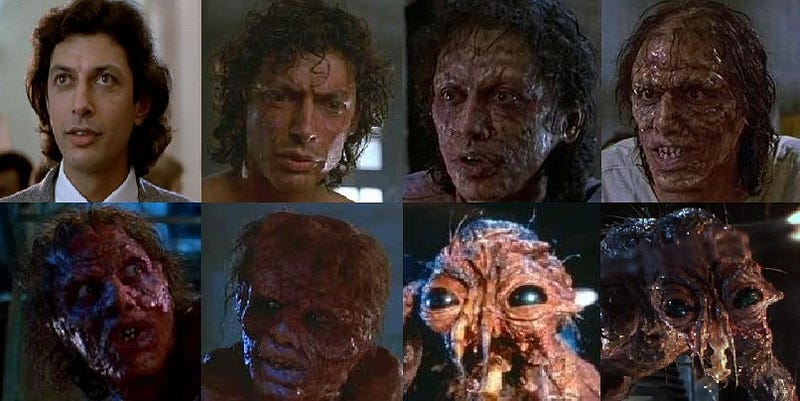
Credit: universalmonstersunivers.com

You can clearly see the labella in both bottom-right pictures. Well, you’d be able to see them if you uncovered your eyes. Also, you’ll notice Jeff liked to keep his antennae trimmed short, as most self-respecting flies do.

Mosquitoes, however, are hippies who just love to parade their very long and luscious pair of feelers. Their labella are separate, with each one attached at the base to the proboscis, or insect snout.

Are you as shocked as I am?

No, not by the fact that mosquitoes are remnants of the 1960s hippy culture. By the fact that they are flies. I never realized that until today. Or in any case, I hadn’t expended any energy thinking about it. But they are.

Flies belong to the order Diptera. Mosquitoes belong to a suborder called Nematocera. That suborder includes crane flies, gnats, love bugs, and even midges. Now, all these in the previous sentence sort of make sense as part of the fly family. I just had never thought of mosquitoes as flies.

But it explains a lot, right? Like what? Actually… I have no idea.

It must explain something, though. Right?

In any case, whether you want to discuss orchids or flies or mosquitoes, you can talk about a lot of things… except their labella.

Because the editors of the Spelling Bee puzzle decreed that labella is a dord.*

You can check out my previous entry on another dord* here:

*What the heck is a dord, you ask? Here’s the answer:

Spelling Bee
Language
Science
Outdoors
Plants
Recommended from ReadMedium