
Koine
We’re not talking about kool kurrency here
Today’s New York Times Spelling Bee letters:
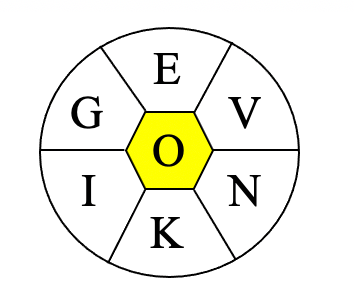
E, G, I, K, N, V, and center O (all words must include O).
Merriam-Webster says…
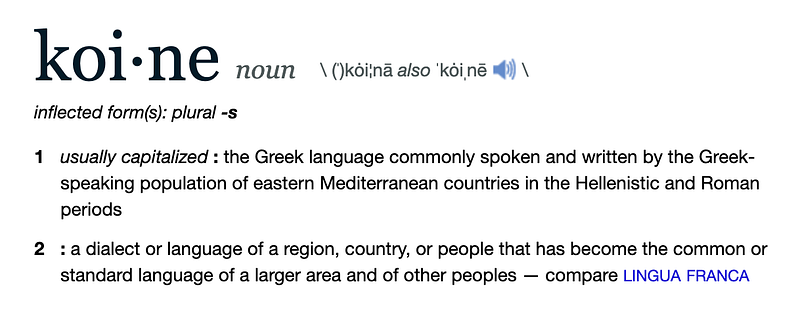
Silly little dictionary! Don’t you know koine can’t possibly be a word if the New York Times says it ain’t?
For further fascinating facts, check out the Spelling Bee Master.
What’s your favorite dord* from today’s puzzle?
My Two Cents
Definition one, referring specifically to the Greek language that lasted some 600 years, is usually capitalized and surnamed: Koine Greek. The second definition, “a dialect or language of a region, country, or people that has become the common or standard language of a larger area and of other peoples”, is usually spelled with an accent on the “e”: koiné.
(Interestingly, the link I provided for Merriam-Webster, which is the Collegiate version, flips the order of the definitions. The screenshot corresponds to the Unabridged version.)
That’s Greek to me
Koine in Greek simply means “common”. It derived from the term ἡ κοινὴ διάλεκτος. For those of us who can’t decipher Koine Greek, that transliterates to: hē koinḕ diálektos. And, for those of us who still can’t decipher what that is, it means “the common dialect”.
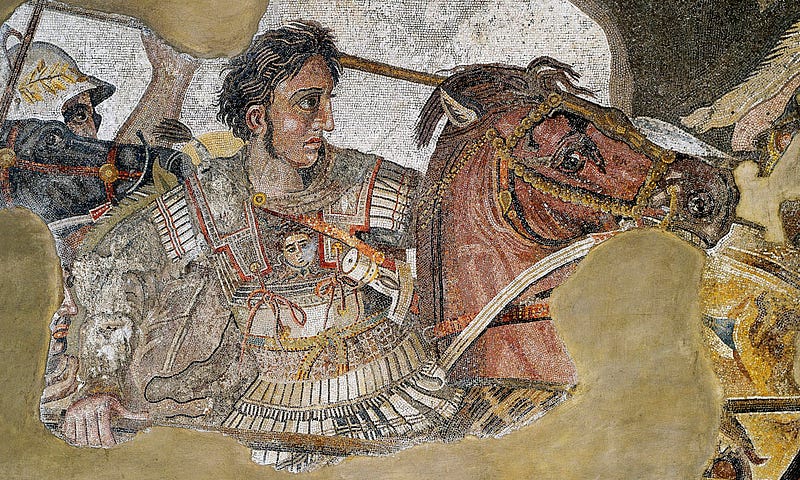
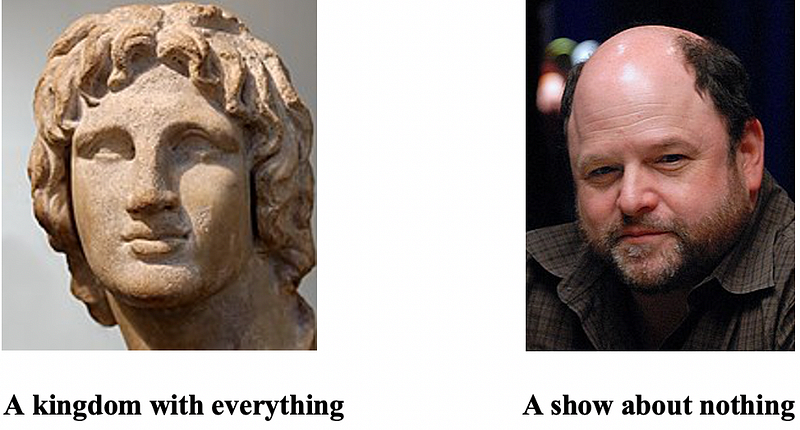
This “common dialect” arose after the conquests of Alexander the Great — the Macedonian king who played a humongous role across Europe and Asia, not the Jersey-born actor who played a humongous role on Seinfeld.
Koine Greek was spoken and written during throughout the history of three important eras: the Greek Hellenistic, the Roman Empire, and the Byzantine empire. In the latter, it was officially in use until the 15th century and evolved into Medieval Greek and eventually Modern Greek, still used today in… you guessed it! Greece!
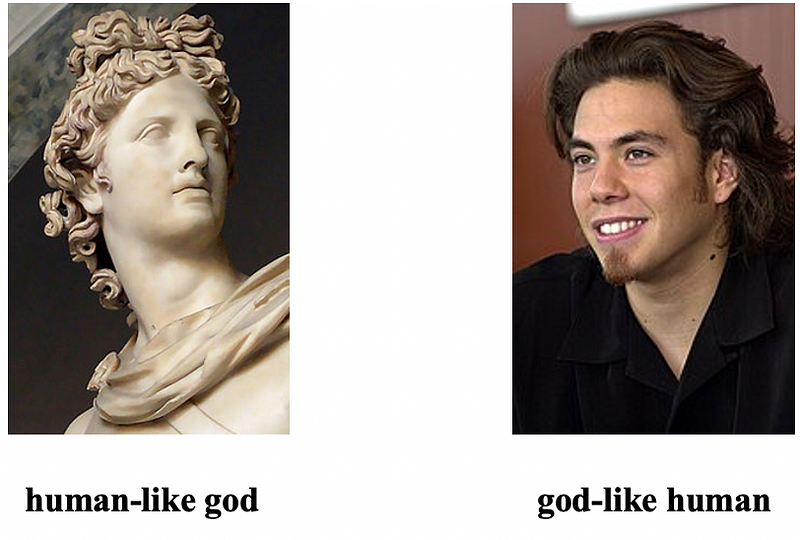
This language was used, for example, by the awesome Plutarch, a polymath who lived between the years of 46 and 119. He was a philosopher, historian, biographer, essayist and, in his spare time, a priest at the Temple of Apollo. And by Apollo, I mean the ancient Greek god of the Sun and music, not the relatively-young god of Winter Olympics and skating (spelled with only one “l”, by the way).
Koine Greek was used for the 3rd-century BC translation of the Old Testament, known as the Septuagint, as well as the being the original language of the New Testament. When someone says “Biblical Greek” or “ecclesiastical Greek”, they are referring to Koine Greek.
The famous Meditations, a collection of thoughts by Roman Emperor Marcus Aurelius, was scribbled in Koine Greek, too. These became one of the pillars of Stoicism, on which the book The Obstacle is the Way — written by Medium’s own Ryan Holiday — is based. Fortunately, Holiday decided to write his best-seller in English, not Koine Greek.
Frankly, that’s no lingua franca
A koiné language usually arises because two or more varieties of one language are combined, mixed, blended, and pureed into a third language that is understood by the speakers of the first two. Because of this process, people who speak the koiné language don’t stop using their own original version.
Dialects and koiné languages are not the same; neither are pidgin and creole, which follow a different process of creation (creole is considered a “fully developed” pidgin) and also imply one group of speakers becoming the “target” of the new language.
Koiné languages tend to be confused with lingua francas, also known as bridge languages or trade languages. The term came from the sabir language, a pidgin used in the Mediterranean Basin between the 11th and 19th centuries by traders and seamen. Sabir was also known as “lingua franca”, which then became the generic term used to describe this type of language.
The famous Esperanto, a constructed language invented by Polish ophthalmologist L.L. Zamenhof, was created as a potential worldwide lingua franca. Unfortunately, it did not catch on, and today we have English as one of the most important languages serving that function. However, there are others, such as Arabic, Hebrew, French, and Spanish.
English is not only a lingua franca, but one of its varieties, Australian English, is a koiné. Technically speaking, apparently it’s a koiné dialect, but still. It developed as a blend of Cockney and Irish English. First generation Australian-born children were exposed mostly two these two versions of English, and ended up creating their own variety, which has given us such wonderful expressions as:
- outback: the backcountry of Australia
- bush: see outback
- dinkum: fair and square
- dingo: baby-eating wild dog
- boomerang: a stick that doesn’t need a dog to fetch it back
- wallaby: kangaroo, but not as cute
Well, now you know what a koiné is, even though you may not know how to speak one. But don’t tell this to the New York Times in any language. Because the editors of the Spelling Bee puzzle decided that koine is a dord.*
Please check out my previous entry on another dord*:
*What the heck is a dord, you ask? Here’s the answer: