
Know Power, Know Responsibility: How to Unleash the Potential of Every Child in America
Introduction
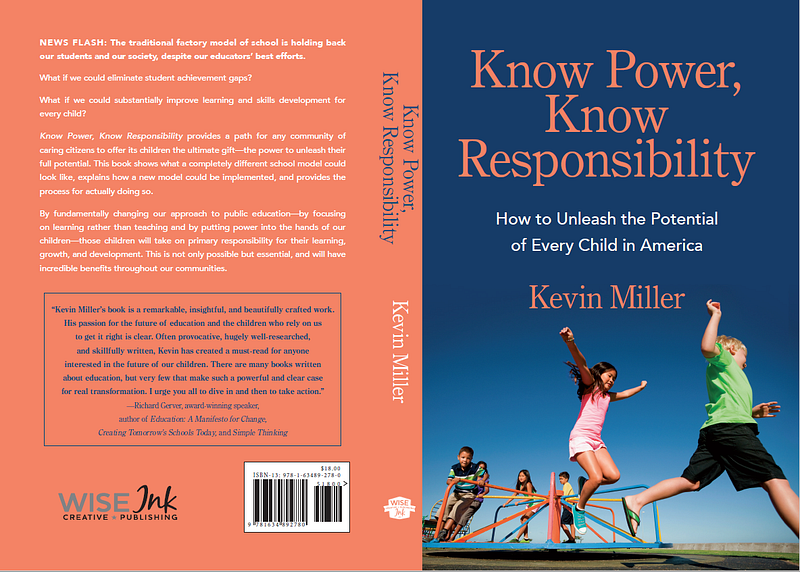
Author’s Note: I will publish additional sections of this book each week. You can find previously posted sections at the following links: Note to Parents of School Age Children and Note to Teachers, School Administrators, and Other School Staff here.
How to read this book
Prior to publication, some of this book’s reviewers recommended shortening it to so it would appeal to a broader audience. I seriously considered doing so. At the same time, I wanted the book to be comprehensive. I wanted to address, to the greatest degree possible, all those “What about . . . ?” queries that such a book is likely to prompt. So, at the risk of scaring away some readers, I have erred on the side of being comprehensive.
I expect, therefore, that many will not want to read the book in its entirety, and that is fine. While I believe there is value throughout and benefits for reading it cover-to-cover, some may want to focus on certain sections. The book is not an end in itself meant to draw in readers and deeply engage them in the prose. Rather, it is a tool and a resource for understanding the shortcomings of the current model and seeing how to replace that model in a community. For anyone who does become involved in education reform and reinvention in their community, I hope it becomes a go-to reference and a catalyst for change.
The purpose of this book
If you could roll the calendar back to 1893 and live at that time, would you? Are there things about the late nineteenth century that might make your life more enjoyable and bring you greater contentment and happiness?
Would you rather travel by horse, carriage, or steam train than by car, bus, or plane?
Would you prefer coal and wood stoves to heat your house rather than radiators or forced air? Would you like to rely on oil lamps instead of LEDs that reliably come on at the flick of a switch or even through the programming of an app on your smartphone?
Speaking of phones, how would you like to receive and share information? You could use a telegraph to send personalized messages or, if you don’t mind it taking a few days or weeks, send a letter. You could get your news, possibly a bit delayed for non-local news, strictly from a newspaper. Or do you prefer the ability to send texts and to receive news — even international news — within minutes of an event?
Of course, similar questions could be asked about health care, housing, recreation, entertainment, and a great deal more. We often look back at the past through rose-colored glasses. A slower pace of life and being less accessible to others can sound nice, but the truth is, little about our world in 1893 seems more appealing than our world in 2019. Yet we have carried forward a vestige of that world for the last 126 years with virtually no significant changes: public education.
In the late nineteenth century, our society strove to make everything more efficient — food production, product production, transportation, and, yes, education. During the early industrial age, government and business leaders realized the workforce — and citizens in general — needed a higher and more consistent level of education. The National Education Association convened the Committee of Ten to develop a model for delivering instruction to all children in America. Many aspects of this effort were progressive for that time, including that all students would receive essentially the same instruction regardless of their demographics. In fact, they made a point that basic instruction should not differ regardless of the path a student was expected to take after high school.
The Committee of Ten recommendations became the foundation for public education throughout our country, with most private schools also adopting the structure and basic curriculum. Of course, in practice, it wasn’t as equitable as may have been intended — and, in many cases, the delivery of instruction was often very inequitable — but the bottom line is that these recommendations were the foundation of our public education system. This is the foundation on which nearly all K–12 schools continue to operate today.
Our schools have changed but have remained consistent with the basic structure that was put forth in 1893. The Committee of Ten called for twelve school grades divided generally into eight years of elementary and four years of high school. They recommended that all high school students receive instruction each year in English, math, and history or civics and that chemistry and physics would be taught in that order.
The ensuing century plus has created an institution entrenched like no other in our society. It has become a given that children will start formal education at or about age five and progress with their similar-aged classmates through to high school graduation. They will have summer breaks. They will take almost all the same classes in the same order until they reach high school. In many high schools, at least through ninth and tenth grade, students will continue to have most of the same classes before finally being presented with a small set of options from which to choose. They will be expected to achieve the same level of performance in each subject at the same time as their classmates. They will have their grades determined by how they do against an age- and time-based standard.
The world around us has changed in ways nineteenth-century citizens couldn’t even imagine. In other aspects of our world and society, we replace outdated models and structures when they limit our ability to advance and improve. But our public (and most private) schools have not changed in any truly meaningful ways. Rather than leverage the potential of technological and other advancements by adapting, our educational institutions attempt to fit the advancements into the old model. It’s like trying to adapt the technology from a Tesla onto a horse and buggy.
Given that our educational system is so deeply entrenched in the current model, calling for a complete overhaul seems more quixotic than tilting at windmills. However, I have faith in both adults and children. Our most significant accomplishments have come from ideas and processes that flew in the face of convention. They didn’t happen overnight, nor without resistance. I believe almost everyone can open their minds and hearts to new and different things; they just need to recognize and acknowledge their emotional ties to the status quo.
I also have faith in the potential of our children. I believe the current model of education has created an almost universal underestimation of the capabilities of our children. I believe with all my heart that our children could surpass every current expectation if only we created the circumstances that would allow it. Here again, the current model of schools inherently restricts these circumstances so almost no children achieve their true potential while they are in school.
This book lays out the case for why we must change our educational structure now and quickly; it provides an example of how this might look; it explains how this can be done without risking the growth and development of current students (in fact, current students will benefit from being part of the change); and, finally, it shows how this can be done in nearly any community in our country.
There are three purposes of this book, and they are straightforward:
- To convince every reader that we cannot continue to advance as a society without fundamentally reinventing our public education system;
- To further convince every reader it is possible to make this change without an influx of money or legislation and that it is best achieved beginning at the local level; and
- To encourage every reader to become an advocate or even champion of making this change occur and seek out ways to help accelerate that change.
The title of this book
There is a line commonly attributed to Spider-Man’s Uncle Ben but which has roots back at least as far as the Bible: “With great power comes great responsibility.” The reverse of that idea is the underlying reason our current educational model must be replaced — with no power comes no responsibility. The title reflects that when students “know power” — when adults truly cede real power and control to students — they will then “know responsibility” and will take charge of their own learning.
Our current school structure and paradigm gives students almost no power. While many schools claim to give students options, few give students any real power over anything substantial or important to the students themselves. Consequently, they have no reason to adopt a sense of responsibility toward their learning. Even schools and staff who would like to give students more real power are hemmed in by the structure itself. That is why the structure must be replaced.
Maybe more distressing is that our current educational model creates a mindset that carries over into adulthood. We tend to feel powerless about those things that are most important in our world, so we feel much less (or no) responsibility toward these things.
The idea of ceding power to our students is woven throughout this book. That is because the only way that students will be able to achieve — or even consider pursuing — their personal potential is to take responsibility for doing so. But they will not — they really cannot — take on this responsibility unless they are actually given the power to do so. This book will illustrate why our current system won’t allow this and how to create a system that can.
Continue with the next section of Know Power, Know Responsibility (Prologues Part 1 and 2), here:
You may also be interested in reading:
Kevin Miller is a Boomer who joined the Army during the Cold War and continues to serve. He has spent 30-plus years working in K-12 education as a teacher, administrator, and consultant and is now on a mission to reinvent our school model. His book Know Power, Know Responsibility provides the imperatives for a complete redesign of schools and the way to get there. See his website knowresponsibility.com to learn more.


