
Know Power, Know Responsibility: How to unleash the potential of every child in America
Prologues Part 1: Critical Thinking and 2: The Committee of Ten and the Factory Model for Schools
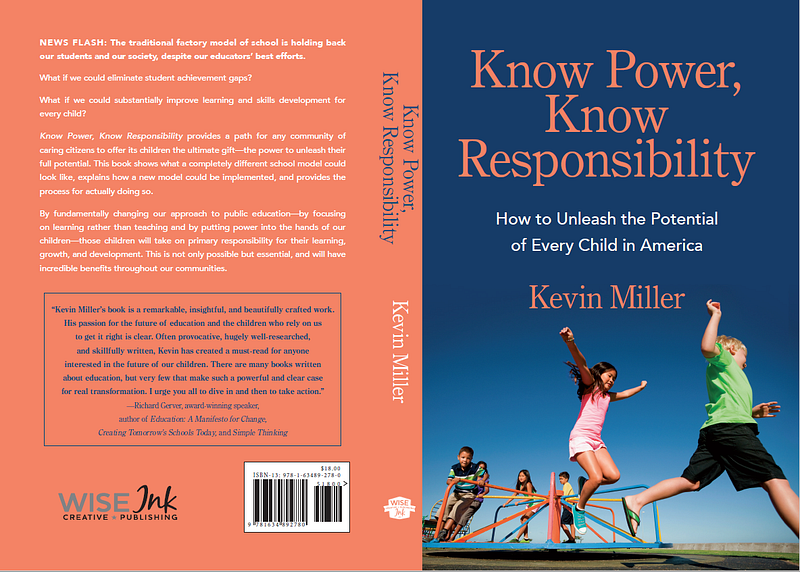
Author’s Note: I will publish additional sections of this book each week. You can find previously posted sections at the following links: Note to Parents of School Age Children and Note to Teachers, School Administrators, and Other School Staff here; Introduction here.
PROLOGUE PART 1 — Critical Thinking
The most important skill readers can bring to this book is critical thinking — being aware of, acknowledging, and accounting for our biases when approaching a thought task. To think critically is to recognize when an initial reaction to an idea, opinion, or information is being influenced by one’s personal biases. This is not easy, especially in an age when critical thinking seems to largely be discouraged.
Critical thinking doesn’t mean eliminating one’s biases — an impossible task, since biases are typically developed and strengthened over time, much like habits, and are based on one’s experiences. Critical thinking also doesn’t mean ignoring or violating one’s values, morals, or belief systems. However, critical thinking does require striving to find the truth behind an idea, opinion, or bit of information, and getting at that truth or facts requires accounting for one’s biases.
This is not an easy skill to develop and use regularly. This is especially true in situations that are emotional, have years or even decades of familiarity, or are related to an important personal value or belief. Yet all rational human beings are capable of doing this, often unconsciously. For example, we may reach out to help or support someone who is in great need despite that person representing something that is distasteful to us. In such cases, the immediate circumstances push our biases behind our instinct to help a fellow human being.
This book will challenge ideas, beliefs, and biases that are based on our own experiences attending schools and our educational institutions being so deeply embedded in our culture and society. Those who work in education may feel significant changes are an attack on their work, a threat to their future employment, or both. And those with school-age children may be concerned about how new and different approaches will impact those children and their education. I had to face all of these as I came to write this book.
These are all legitimate concerns and biases, and the book attempts to acknowledge and address them. However, it is also imperative that the reader acknowledge how his or her biases are affecting consideration of the ideas being expressed. Think critically while reading this book, and don’t feel you should take anything in it at face value. Rather, apply your own knowledge, experience, and research to determine whether this book contains ideas that we should consider for future generations of our country.
PROLOGUE PART 2 — The Committee of Ten and the Factory Model for Schools
As noted in the introduction, at the behest of government and business leaders, the National Education Association convened the Committee of Ten in 1892 to develop a model for delivering instruction to all children in America. The committee considered various approaches to this model for public education, including systems that would focus on critical thinking, rote learning, or sorting students based on their likely future paths as well as race and ethnicity.
In the end, the Committee of Ten and its supporting “conferences”[1] advocated that all children should have an equal opportunity to the same foundational education regardless of who they were, where they lived, or the path they were expected to take after completing their childhood education. The result was a set of expectations for the nature and amount of instruction students should receive in each subject area. The conference reports provided specifics on what should be taught in each subject.
While the Committee of Ten framed their recommendations as the amount of instruction that students should receive, they did not advocate that education should be centered around lectures. In fact, the conferences strongly advocated that lecture be a minority aspect of education. They felt it was critical for students to experience subjects through hands-on methods whenever possible. They also strongly recommended that, within a given subject, students begin to create their own “demonstrations” reflecting their ability to apply the knowledge they were learning to new situations and to express what they knew through these demonstrations. (National Education Association, 2017, p. 25)
For example, the History, Civil Government, and Political Economy Conference reiterated multiple times that history must be taught in such a way as to foster critical thinking by students (though they did not use the term “critical thinking”). They summarized this by noting that the chief object of historical study “is the training of the judgment, in selecting the grounds of an opinion, in accumulating materials for an opinion, in putting things together, in generalizing upon facts, in estimating character, in applying the lessons of history to current events, and in accustoming children to state their conclusions in their own words.” (National Education Association, 2017, p. 170)
Similarly, the Committee of Ten and the conferences did not advocate for various subjects to be taught in isolation by teachers who focused only on one subject in which they were expert. Rather, they expressed that the various subjects must be intertwined for greatest effectiveness and that the teachers of each subject must “feel responsible for the advancement of pupils in all subjects, and should distinctly contribute to this advancement.” (National Education Association, 2017, p. 16) The Committee of Ten even provided examples of places where subjects should be intertwined, such as the study of arithmetic being connected to instruction in elementary physics.
In reading the full Committee of Ten report, it seems clear that the overall committee and the individual conferences understood that school needed to be much more than just delivery of instruction. Unfortunately, the final school design did not include the Committee’s delivery recommendations. Instead, the public-school design only used the recommendations for the amount of instruction students should receive each year and the elements of each subject that should occur in each grade or at each age.
The intent at the time was to provide an education for all children in the US. To achieve that, compromises were needed. So the recommendations would not be implemented as envisioned by the Committee and its conferences. Those building the system of public education had to make it manageable and affordable. Therefore, they applied lessons learned about efficiencies from industry and business. They broke down the overall process into its components so experts could ensure efficient delivery of the same instruction to all students. The result was the factory model of schools.
The Committee of Ten and the individual conferences recommended what students should be taught at roughly each age or grade. They also advocated for teachers with sufficient expertise in the given subjects, at least at the high school level. To make this cost-effective, groups of students would be collectively taught by subject matter experts. Thus, groups of same-age students would move from teacher to teacher being taught the respective subjects. At the elementary grades, generalist teachers could teach multiple subjects, but most subjects were still taught individually rather than being integrated.
Like a factory, students enter kindergarten (or, before the universalization of kindergarten, first grade) with a group of students their same age. They move through the subjects from year to year, with each teacher providing their assigned instruction. When a student struggles to keep pace, the schools make adjustments trying to keep the student on track with their classmates. If things get bad enough, the school may move the student back to another group that’s a bit younger. If a student seems to be outpacing other students his or her age in enough subjects, the student may be moved ahead or given other opportunities that may be more challenging.
Eventually, when a student has gone through all the required subjects satisfactorily, he or she is moved out of the school and is deemed ready for whatever might come next. That, in a nutshell, is the factory model of schools. It takes advantage of economies of scale by teaching large groups of students the same things concurrently by experts in those subjects. It has the added benefit of teaching students compliance, which employers sought in the majority of their employees throughout much of the twentieth century. As with cars, there may be some variations (colors, trim packages, options), but the vast majority of the process is the same for each student.
In practice, the factory model isn’t as cold and impersonal as this makes it sound. To their immense credit, schoolteachers make most schools and classrooms warm, caring, and welcoming places for students. They do a tremendous job teaching students and, by doing so, contribute to advancements in technology, medicine, art, science, and all other aspects of society. However, they have tapped out nearly all room for improvement and growth within the current structure, while our children have potential that remains hidden and untapped.
The recommendations of the Committee of Ten led to our current educational model, but if the committee and conference members were around today, they would certainly demand that we reinvent public education. In fact, I have little doubt that many of them would be appalled at how their recommendations were put into practice and how little has changed in our public education systems over the ensuing century and a quarter.
We owe it to the Committee of Ten and all the conferences to reinvent public education in a way that reflects our current world, continually adapts as the world changes, and leverages existing and emerging technologies.
[1] The Committee of Ten created nine separate “conferences” to provide recommendations for the subjects in each content area. Each conference was made up of ten or so experts on their respective subjects and developed recommendations based on questions provided by the overall Committee of Ten. The conference reports then informed the final overall recommendations. (National Education Association, 2017)
Continue with the next section of Know Power, Know Responsibility (Prologues Part 3 and 4), here:
You may also enjoy reading:
Kevin Miller is a Boomer who joined the Army during the Cold War and continues to serve. He has spent 30-plus years working in K-12 education as a teacher, administrator, and consultant and is now on a mission to reinvent our school model. His book Know Power, Know Responsibility provides the imperatives for a complete redesign of schools and the way to get there. See his website knowresponsibility.com to learn more.