
Kinsey Was Open and Bisexual
The OG of sex study was also the first to put sexuality on a scale
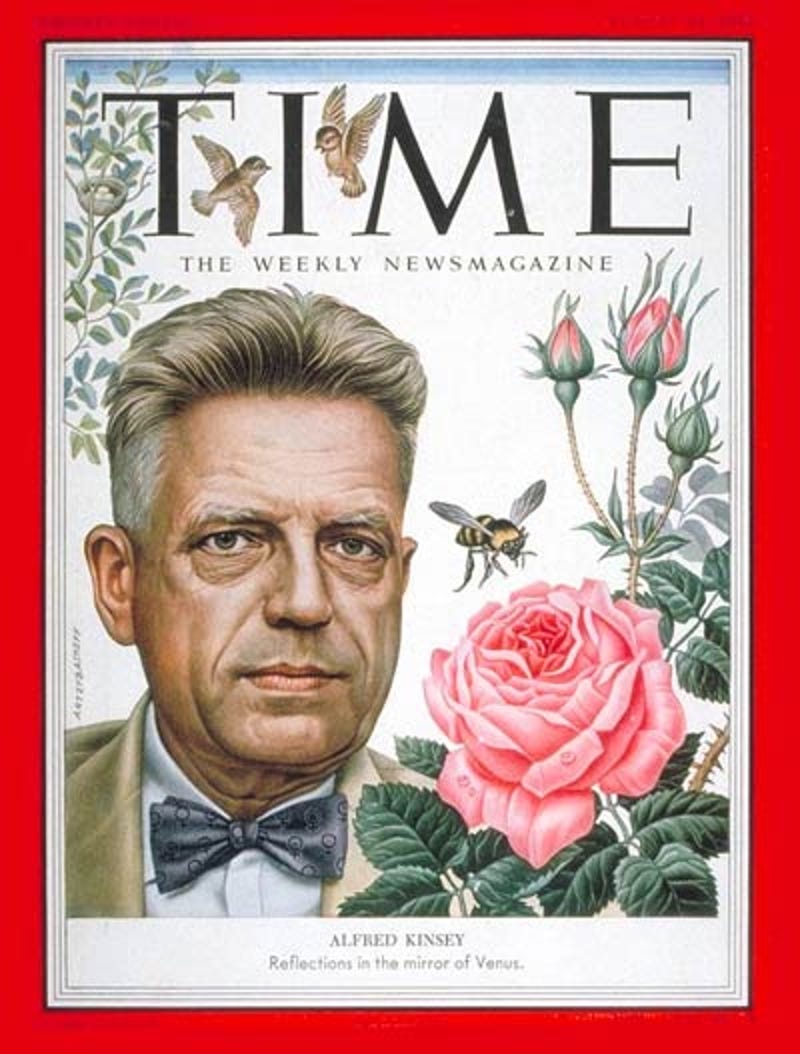
Alfred Kinsey was the first person to make an official, scientific study of human sexuality. Before that, he was an entomologist, studying bugs. He was a world expert on gall wasps and had written important papers on edible plants and a high school biology textbook before he turned his attention to sex. The occasion was being asked to teach a class on Marriage and Family at Indiana University, and realizing there was no scientific data to draw on to answer student questions about sex, just assumptions based on social strictures and faith.
He began his project in the 1930s, when masturbation was said to cause blindness and considered a sin, homosexuality was classed as a criminal perversion, and women were said to like little or no sex at all, with any pleasure coming strictly from penis to vagina intercourse within a marriage. Then he and his team collected more than 12,000 extremely detailed sexual histories from across the United States.
What he found was far different than church and social dictates supposed. The first Kinsey Report, Sexual Behavior in the Human Male, published in 1948, shocked America with its findings that 92 percent of men had masturbated, half of them had extramarital affairs, and 37 percent had had some kind of homosexual experience.
Sexual Behavior in the Human Female, published five years later, was even more shocking with similar revelations and earned him a tsunami of negative press saying he was disparaging womanhood by reporting that 62 percent of women had masturbated, half had premarital sex, and two thirds had sexual dreams, among other things.
The Kinsey Polycule
But America would have been shocked even more if it knew what was going on in Kinsey’s home and at work. He and his wife, freethinker Clara McMillan, both had spouse-approved intercourse with his chief assistant Clyde Martin. He filmed people having sex in the attic of his home, for study. And many in his circle of mostly married assistants shared sex freely with each other.
One theory is that studying sexuality opened up their minds to new ideas. Kinsey and his wife were both virgins when they married, and had difficulty during their first sexual experiences. He’d grown up in a home with a cruelly repressive and patriarchal father, believing like the rest of the country that masturbation and homosexual attraction were both dangerous and wrong, while at the same time doing and having both. Discovering that his feelings and actions weren’t abnormal must have been liberating. Like he said at the time “everyone’s sin is no one’s sin.”
That’s what Janet Hardy and Dossie Easton, the authors of The Ethical Slut, believe:
The cadre of researchers and their partners would be considered, in today’s terminology, a polycule or constellation. When sex is discussed openly, people typically feel much freer to act on their desires — so, unsurprisingly, both Prok [a nickname for Professor Kinsey] and Mac [a nickname for his wife Clara McMillan] were sexually involved with several of the researchers, who in turn had sex with one another’s spouses. Whatever difficulties were encountered in this arrangement — and there were several — seem to have had at least as much to do with the problem of being sexual with coworkers as they did with sexual jealousy. Kinsey’s frequently insensitive personal style was undoubtedly a factor as well. In spite of such small flare-ups, the Kinseyites remained colleagues and occasional lovers until Kinsey’s death in 1956, and members of the original crew continued at the helm of the Kinsey Institute for Research in Sex, Gender, and Reproduction until 1982.
The Kinsey Scale
The Kinsey Reports drew criticism years later, partly based on the people he interviewed, which included prisoners and sex workers, and partly based on revelations about his personal life. Yet they still stand as the most comprehensive study of human sexuality to date.
One of his many major contributions was the sexuality scale he created, which is the basis of today’s understanding that there are more than two sexual orientations: heterosexual and homosexual. Instead, he asked people to place themselves on a continuum represented by a seven-point scale.
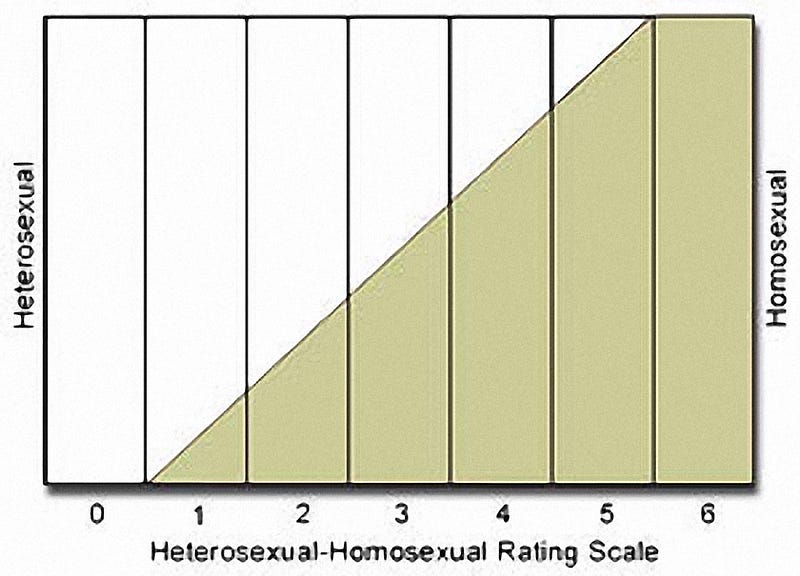
On this image, the white portion represents heterosexual feeling and the olive portion homosexual. According to the Kinsey Report, only 10 percent of people are strictly heterosexual and 10 percent are strictly homosexual. Everyone else falls somewhere in between.
Additionally, “sexual behavior, thoughts, and feelings towards the same or opposite sex were not always consistent across time,” the Kinsey Institute says, which means you might feel one way as a teen and another way as a senior citizen. That tracks with my own experience. Although I felt anxious about and wary of my husband’s hints at homosexual desire in young adulthood, I’m supportive of them in my seniority, to the point that I even asked him to go outside our marriage to try having sex with men. I’ve been writing about what happened next in my Chronicle of an Open Marriage.
Here’s the key that was used with the scale above in the Kinsey interviews:
0 = Exclusively heterosexual 1 = Predominantly heterosexual, only incidentally homosexual 2 = Predominantly heterosexual, but more than incidentally homosexual 3 = Equally heterosexual and homosexual 4 = Predominantly homosexual, but more than incidentally heterosexual 5 = Predominantly homosexual, only incidentally heterosexual 6 = Exclusively homosexual
An additional category of “X” which doesn’t show on the graph was used for people who reported no sexual contacts or response.
People today might find the Kinsey Scale a bit old fashioned, being structured as it is on a binary framework. But Kinsey’s original thinking is what started the sexual revolution that led to our broader understanding of sexuality today.
Other findings that might be surprising included:
- 12% of females and 22% of males reported having an erotic response to a sadomasochistic story
- 55 % of women and 50% of men reported responding erotically to being bitten
- 46 percent of men reported “reacting sexually” to people of both sexes (as differentiated from the 37 percent mentioned earlier who acted on their reaction and had at least one homosexual experience)
The Kinsey Institute at Indiana University is still studying human sexuality, and answers Frequently Asked Questions here.
More Kinsey Love
I first got interested in Kinsey when I started reading The Ethical Slut, considered by many to be the Bible of consensual non-monogamy. First published in 1997, it issued it’s third edition in 2017 and is selling more copies every year.
The authors’ brief bio of Kinsey at the beginning of their book led me to the 2004 movie Kinsey, starring Liam Neeson and Laura Linney. I paid $4 to watch it on Amazon, since it wasn’t available for free on any of my streaming platforms, and I can report it was an interesting and entertaining movie that seemed true to the facts I’d read in articles online.
To me, Kinsey was a great man. His work can be credited with freeing me to explore my sexuality and the parameters of my marriage on my own particular terms. Because as much as I’d like to believe that I’m an independent thinker, there’s no denying that social pressures and strictures have an enormous influence how I feel about myself and my desires. Kinsey deconstructed that, while expanding our notions of what’s normal and acceptable.
It’s like Dean Hamer of the National Institutes of Health said of Kinsey, “His number one contribution was simply recognizing that sexual behavior is diverse and that people do very different things … that there was a marvelous and very substantial diversity of sexual behavior in all segments of the population.”
And that’s everything.
For further reading…
Hubs and I just opened up our long-term marriage. Find stories about how it’s going on this List, or about sexuality in general on this one. Get an email whenever I publish. Or sign up for Medium with my referral link. Let’s do this!


