
Killers of the Flower Moon — Film Review
Diving into the Heartbreaking True Story of the Serial Murders of the Osage Indigenous Nation, this is a Must-See Movie!
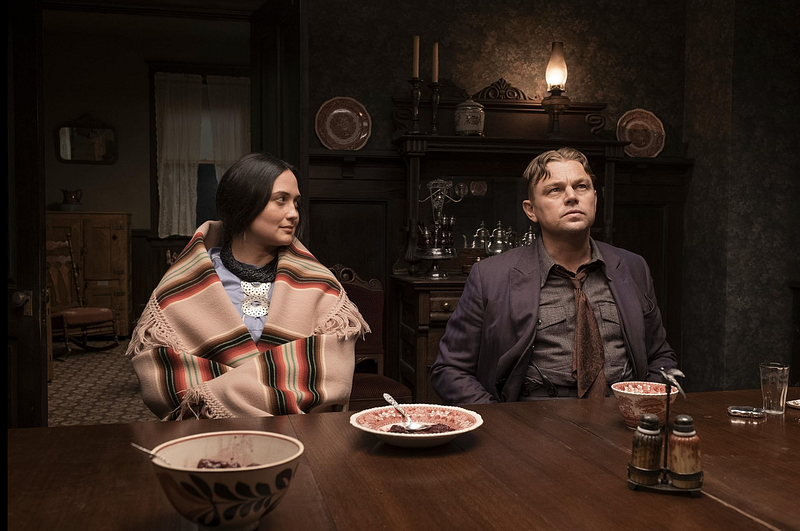
Adapted from journalist David Grann’s 2017 bestselling book, “Killers of the Flower Moon,” the film of the same name portrays the true story of William Hale (Robert De Niro), a white businessman, who orchestrated the brutal murders of numerous Osage tribe members in 1920s Oklahoma.
If you're interested in the meaning of the term "Flower Moon," allow me to provide some context on its origins. This name comes from the Old Farmer’s Almanac, a source that assigns unique names to each monthly full moon based on natural phenomena.
When May rolls around, it’s dubbed the “Flower Moon” because it aligns with the blooming of flowers. It was during this month that the devastating Reign of Terror against the Osage people began. Hence, the perpetrators earned the ominous moniker “Killers of the Flower Moon” due to their actions during this period.

The film narrative centers around Mollie Kyle (Lily Gladstone), a wealthy Osage woman, and her relationship with Ernest Burkhart (Leonardo DiCaprio), her driver-turned-husband. As the story unfolds, Mollie’s household is devastated by one tragedy after another, laying bare the harsh realities of the events. Burkhart, her then-husband, is secretly involved in his uncle’s scheme to murder Mollie’s family for their inheritance.
Receiving 10 Oscar nominations in 2024, the film serves as a poignant reminder of the injustices inflicted upon Native Americans. Witnessing these events depicted in the film deeply saddened me, as it underscored the historical injustices endured by indigenous peoples at the hands of powerful nations driven by greed and a callous disregard for human life.
“What I wanted to capture, ultimately, was the very nature of the virus or the cancer that creates this sense of a kind of easygoing genocide, When there is betrayal that deep, and we know for a fact that it was that way, there’s our story.” — Martin Scorsese
The movie faithfully portrays historical truths. In real life, Mollie struggled with her guardian to access her own funds for medical expenses, because of the implementation of a guardianship system by the U.S. government. Under this system, control over Osage's finances was handed to predominantly white male guardians, often resulting in the mismanagement or outright theft of Osage's wealth.
The depiction of Mollie and Ernest’s marriage is also accurate. The movie depicts Ernest marrying Mollie in 1917 at the urging of Hale. Over time, the couple has three children: Elizabeth, James “Cowboy,” and Anna. Despite doubts about Ernest’s love for Mollie being true, given his role in her family’s murders, Martin Scorsese, the director, was swayed by the couple’s real-life granddaughter to highlight their connection.
“She said we have to remember that Ernest loved Mollie, and Mollie loved Ernest” — Martin Scorsese
The movie also highlights the real violence inflicted upon the Osage, however many Osage died under suspicious circumstances, and their deaths were often left uninvestigated.
Altogether, “Killers of the Flower Moon” is definitely worth watching and deserving of the Oscars nomination. Leonardo DiCaprio delivers one of his finest performances, and Lily Gladstone’s portrayal is equally impressive.
Notably, Lily is the first Native American woman nominated for Best Actress. Though I believe Emma Stone has a slight edge, I’d be thrilled if Lily took home the award.
If you want to read more content about Film and TV, here are some of my articles.
Thanks for your support.
Font: Time Magazine