
Kike
A slur… and a World Series champion!
Today’s New York Times Spelling Bee letters:
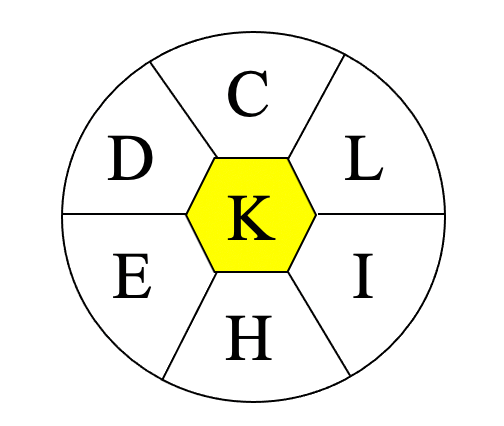
C, D, E, H, I, L, and center K (all words must include K)
Merriam-Webster says…
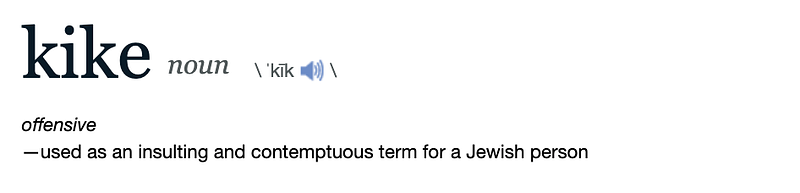
Silly little dictionary! Don’t you know kike can’t possibly be a word if the New York Times says it ain’t?
For further fascinating facts, check out the Spelling Bee Master.
What’s your favorite dord* from today’s puzzle?
My Two Cents
Some languages share words that are spelled identically (or very similarly) but have completely different meanings. One common example that is given as a warning to English speakers learning Spanish is they should not use the expression “I’m embarrassed” (Estoy embarazada) when they are ashamed or disconcerted because what they’re saying in Spanish is “I’m pregnant”. Which is true in most cases. However, the idea that embarrassed and embarazada are false friends is, in reality, a myth. You see, the Spanish term can also be used to indicate that someone feels self-conscious. It’s just that this second definition has all but become archaic.
The warning goes both ways: Spanish speakers should refrain from announcing their pregnancies by saying “I’m embarrassed”… unless they are, of course.
There are much starker examples of words spelled the same with very different meanings depending on the language. In English the word fart means, well… I’m a bit embarazado to type it out loud. In Sweden it means “speed”. It gets even better. Speed bumps in Sweden are called fart-hinders (hyphen added by me for clarity).
My own last name ––Kotzer–– is problematic In Germany and Austria. You see, in German the noun Kotze is slang for “vomit”. And the verb kotzen means “to vomit”. Interestingly, the word Kötzer is a textile term equivalent to the English “cop”. Not the police officer, but “a cylindrical or conical mass of thread, yarn, or roving wound on a quill or tube”.
My favorite memory of a non-equivalent word is from when I was a kid growing up in Venezuela; my family moved there from Israel when I was three years old. Israelis often laughed when they encountered this road sign while driving:
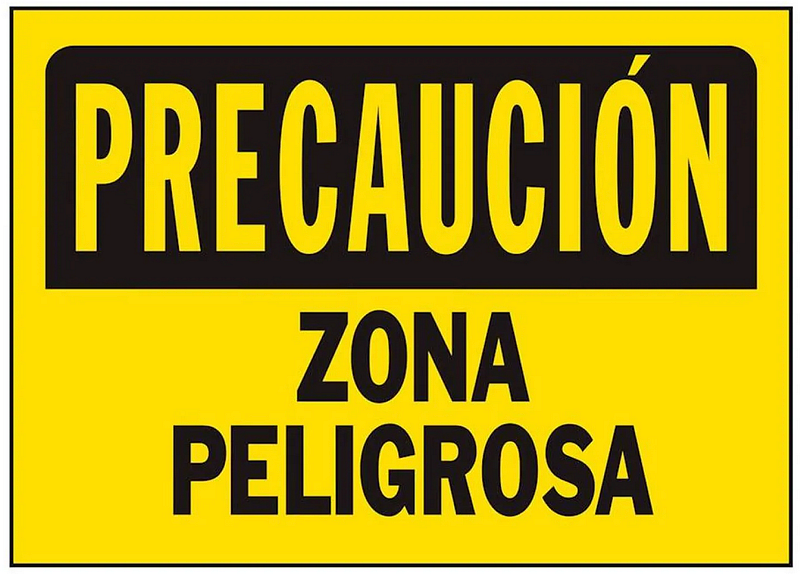
In English, this translates simply as “Warning: Danger Zone”.
But in Hebrew, zona (with the accent on the last syllable) means whore. So yes, warning: dangerous whore.
Kike in English
Our friends at Merriam-Webster offer two explanations for the origin of our word of the day. One of them is not very helpful: “origin unknown”. The other says that the term is “probably alteration of kiki, reduplication of -ki, common ending of names of Jews who lived in Slavic countries”. This second explanation is backed by the Oxford English Dictionary.
Although Merriam-Webster claims the first known use was in 1901, there seems to be strong evidence that it originated a few decades earlier.
Jewish-American humorist Leo Rosten offered a different explanation as to how kike became a slur. In his book The Joys of Yiddish, Rosten explains this:
The word kike was born on Ellis Island when there were Jewish migrants who were also illiterate (or could not use Latin alphabet letters). When asked to sign the entry-forms with the customary “X”, the Jewish immigrants would refuse, because they associated an X with the cross of Christianity. Instead, they drew a circle as the signature on the entry-forms. The Yiddish word for “circle” is kikel (pronounced KY — kel), and for “little circle”, kikeleh. Before long the immigration inspectors were calling anyone who signed with an ‘O’ instead of an ‘X’ a kikel or kikeleh or kikee or, finally and succinctly, kike.
It’s possible that kike began as a neutral or even affectionate term, later began being used by Jews to describe other Jews, and finally developed into the slur as it’s used today. In any case, Rosten’s theory is the one that holds the most water.
Joachim Prinz, a rabbi who was born in the German Empire and later moved to New Jersey, wrote the following in the Jewish-German literary magazine Der Morgen:
“Es ist nicht erhebend zu sehen, wie verworren die Vorstellungen sind, wie wenig die Einwanderer gelernt haben, wie glücklich sie teilweise sind, dem Judenschicksal entsprungen zu sein, und wie überheblich sie oft sind. Es macht traurig, daß sie in manchen Kreisen sehr unbeliebt sind, und man wundert sich über die Dummheit derer, die die Ostjuden (von denen sie ja doch gestützt werden!) verächtlich „Kikes‟ nennen”.
I was completely dumbfounded when I read this. Mainly because I don’t speak German. Then I decided to looked up the translation so you wouldn’t have to:
It is not uplifting to see how confused the perceptions are, how little the immigrants have learnt, how happy some of them are to have escaped the life of a Jew [or: the Jewish fate], and how haughty many of them are. It is saddening that they are very unpopular in many circles, and bewildering is the stupidity of those who contemptuously call the Eastern Jews (who support them after all!) “kikes”.
Here are some examples in which the term was used, courtesy of Kim Pearson’s Rhetoric on Race. (Note that many of them are featured in literary works and should not be taken as an endorsement by the author.)
1905 O. HENRY Works 1449 Judas . . . I always thought that Kike’s squeal on his boss was about the lowest-down play that ever happened.
1912 McClure’s Mag. XXXIX. 230/2 ‘It’s a mascot, be-dad! Jam it, ye kike!’ screeched Tracy.
1927 HEMINGWAY Men Without Women 213 George is a kike just like the rest of them.
1932 J. DOS PASSOS 1919 164 The little kike behind the desk had never been to sea.
1940 R. STOUT Over my Dead Body vi. 84 I don’t care if the background is wop or mick or kike . . . so long as it’s American.
1945 S. LEWIS Can’t Happen Here 204 Why don’t you kikes take a tumble to yourselves and get out, beat it . . . and start a real Zion, say in South America?
1963 V. NABOKOV Gift iii. 179 My better half . . . was for twenty years the wife of a kike and got mixed up with a whole rabble of Jew in-laws.
1963 Spectator 21 June 815 He knocks down Stern’s wife, calls her a kike.
1972 National Observer (U.S.) 27 May 17/3 When kikes are shrewd and dagos or wops are sly and murderous, it is only one step from the epithet to contempt.
1991 B.E. ELLIS American Psycho 152 You retarded cocksucking kike.
1995 New Republic (April 24) 46 Almost everybody he meets that day calls him a yid or a kike.
One of the more recent examples that I remember happened in 1995, when Michael Jackson released his album HIStory: Past, Present and Future, Book I. The original lyrics of the song “They Don’t Care About Us” included these verses: “Jew me, sue me, everybody do me / Kick me, kike me, don’t you black or white me.”
There was a lot of brouhaha about this; I was still living in Venezuela back then and remember thinking that I did not find it offensive because the intent was to highlight these antisemitic expressions in a song about racism and hate.
I guess not everyone agreed with that idea, and after some back and forth about it (a heated discussion which ended up involving Steven Spielberg, who had been quoted in the album’s liner notes), the song’s lyrics were sound engineered to censor the offensive words.
We’ll end this section by quoting Leo Rosten again, in his
Finally, a joke from Leo Rosten’s Hooray for Yiddish (a revised version of The Joys of Yiddish):
“Meyer Levinsky entered a certain tony restaurant in a certain persnickety suburb. As he started for a table, the maitre d’ glared, “Wait! We don’t serve kikes!”
“That’s all right,” said Levinsky, “I don’t eat them.”
Kike en español
As I mentioned at the beginning of today’s column, there are words that mean one thing in one language and something else in a different language. That is the case of kike, which in Spanish is commonly used as a nickname for people named Enrique. In this case, the word is capitalized and pronounced “KEY-Kay”. Stress is on the first syllable. I repeat, stress is on the first syllable.
I’m pretty sure kike developed phonetically from the original nickname quique, and I can see why “que” is used. But I have no idea why the “qui” was added to the beginning, as opposed to, “ri”, for example.
There are many famous or well-known people with that nickname, and most of them are athletes. For example:
- Kike Santander (born 1960), Colombian songwriter and producer
- Kike Burgos (born 1971), Spanish retired football goalkeeper, full name Enrique Burgos Carrasco
- Kiké Maíllo (born 1975), Spanish film director and screenwriter
- Kike Casanova (born 1980), Paraguayan TV presenter, announcer and lawyer
- Kike García (born 1982), Venezuelan football midfielder, full name Enrique García Feijoó
- Kike Oniwinde (born 1992), British entrepreneur and former javelin thrower
- Kike Boula (born 1993), Equato-guinean football forward, full name Enrique Boula Senobua
- Kike Barja (born 1997), Spanish football winger, full name Enrique Barja Afonso
There’s at least a dozen more football player who use that nickname.
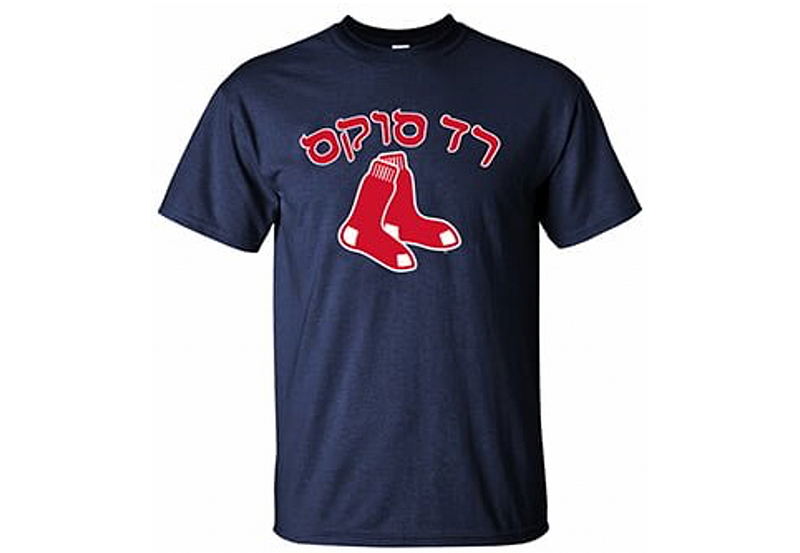
But perhaps the Kike best known to Americans may be Enrique Javier Hernández, a Puerto Rican professional baseball player who is currently on the Boston Red Sox roster. (The photo at the top of today’s column is a shirt that says “Red Sox” in Hebrew.)
Previously, Kike Hernández played for the Houston Astros, Miami Marlins, and Los Angeles Dodgers. It was with the Dodgers that he won the World Series in 2020.
Now, a few paragraphs ago I explained that in Spanish the nickname is pronounced with an accent on the first syllable: KI-ke.
Unfortunately, English-language television broadcasts have been misspelling his nickname as Kiké to prevent it from being confused with the anti-Semitic slur we’ve been discussing. The accent mark on the “e” indicates that stress should be placed on the second syllable: ki-KE.
To paraphrase one of my favorite Seinfeld bits:
“And this offends you as a Jewish person?” “No, it offends me as a linguist.”
Now you know. You should avoid using the ethnic slur kike, of course. But even if what you want to do is cheer for your favorite baseball or soccer player, you’re out of luck. And that’s because the editors of the Spelling Bee decided that kike is a dord*.
You can check out my previous entry on another dord* here:
What the heck is a dord, you ask? Here’s the answer: