avatarJeffrey Erkelens

Free AI web copilot to create summaries, insights and extended knowledge, download it at here

10035

Abstract

ire in the same patterns as the speaker’s brain.</p><p id="5870"><b>2. Storytelling connects listeners to the storyteller through emotion</b> — a process psychologists call “narrative transport.”</p><p id="46bb"><b>3. Stories light up more of the brain than factual reporting</b>. When the brain is presented with factual information, only two of its regions activate. FMRI studies show that storytelling causes many additional areas to light up. The brain responds to the story events as if they were actually happening to the listener.</p><p id="24a2"><b>4.</b> <b>Storytelling enhances memory</b> because the part of the brain involved in memory is the same part involved in imagination.</p><p id="0ced"><b>5.</b> <b>Stories command human attention</b>.</p><p id="108c"><b>6.</b> <b>Stories can change the brain’s chemistry</b>. When captivated by an emotionally engaging story, the brain produces oxytocin, a substance shown to increase generosity, compassion, trustworthiness, and sensitivity to social cues.</p><p id="6e8a"><b>7.</b> <b>Stories affect behavior</b>. Pioneer neuroeconomist Dr. Paul Zak has shown that people are far more likely to donate to a cause after viewing an emotionally impactful story. In a recent social experiment, testers were able to sell 129 worth of trinkets on eBay for over 8000 by crafting personal stories for each object.</p><p id="f77c">So rather than long-winded sermons which are usually met with dramatic eye rolls, parents should expose their children to fairy tales, fables, and myths which are ideal to convey valuable life lessons through the power of story. “If you want your children to be intelligent,” said Albert Einstein, “read them fairy tales. If you want them to be more intelligent, read them more fairy tales.”</p><p id="24c0">In my book, for instance, wanting to teach boys how to turn disadvantages into advantages and then on to spirited action, I could’ve opted for a deep dive into the science of resilience but knew I’d lose their attention. Instead, I found inspiring stories of ordinary human beings <a href="https://writingcooperative.com/when-life-gives-you-lemons-ed9adf674a2c">who turned lemons into lemonade</a>.</p><p id="452b">Is that enough?</p><p id="497e">Not entirely, I believe, without laying some groundwork.</p><p id="4a87">Concurrent with spaced repetition and storytelling, fertile soil needs to be laid so lessons germinate. By fertile soil I mean helping our youth nurture virtues and develop strengths of character before they stop listening and take the wrong turn.</p><p id="8777" type="7">It is easier to build strong children than to repair broken men. — American statesman Frederick Douglass</p><p id="9cb4">I agree with Douglass, and certain that if we instill virtues and strengthen character at an early age, most children will naturally incline toward spirited lives of noble purpose.</p><h1 id="3e8a">Virtues and Strengths of Character</h1><p id="7f65">Virtues are qualities considered desirable in a person. Character strengths are the life forces necessary to lead a good life.</p><blockquote id="9294"><p>As far as the education of children is concerned, I think they should be taught not the little virtues but the great ones. Not thrift, but generosity; not caution, but courage and <a href="https://readmedium.com/danger-4ed52fca4091">a contempt for danger</a>; not shrewdness but frankness and a love of truth; not tact, but love for one’s neighbor; not a desire for success, but a desire to be and to know. — Natalia Ginzburg, The Little Virtues. 1962</p></blockquote><p id="bd29">According to a survey by Public Agenda, adults in the United States cited “not learning values” as the most important problem facing today’s youth.</p><p id="ea7a">As a preface to their comprehensive and <a href="https://www.viacharacter.org/character-strengths-and-virtues">brilliant handbook</a> on character strengths and virtues, Christopher Peterson and Martin Seligman say their project coincides with heightened societal concern about good character.</p><p id="c62b"><i>“After a detour through the hedonism of the 1960s, the narcissism of the 1970s, the materialism of the 1980s, and the apathy of the 1990s, most everyone today [believes] that character is important after all and that the United States is facing <a href="https://readmedium.com/everyone-is-doing-it-82634518f3ea">a character crisis</a> on many fronts, from the playground to the classroom to the sports arena to the Hollywood screen to business corporations to politics.</i></p><p id="b5d7">In the writings of classical antiquity, four cardinal virtues were recognized: Justice, Prudence, Temperance, and Courage.</p><p id="104a">Had I been brought up with a healthy dose of Temperance, for example, my father’s wise counsel would’ve resonated and perhaps prevented me from plunging into the abyss.</p><p id="d885">Had Icarus and Phaethon been steeped in lessons on Prudence, their fathers’ warnings would have not gone in one ear and out the other.</p><p id="24ec">Not sure what happened in the case of Alexander the Great, for it was his tutor, Aristotle, who came up with the notion of ‘The Golden Mean,’ or “nothing in excess.” I suppose Alex just fell through the cracks or was asleep for most of his lessons.</p><p id="5e99">Besides the 4 Cardinal Virtues, I’ve combed through a vast <a href="https://www.facebook.com/notes/the-hero-in-you/research-library-parent-resources/415985575844176/">compendium of knowledge</a> and synthesized for my book a list of other strengths of character necessary to lead a good life:</p><p id="4831">· <a href="https://readmedium.com/the-one-life-force-you-cannot-do-without-a8b8c5df788a">Grit</a></p><p id="304d">· <a href="https://readmedium.com/gods-thumbprint-2f84e5637b27">Curiosity and Imagination</a></p><p id="3b50">· An Open but Critical Mind</p><p id="d55b">· <a href="https://readmedium.com/what-a-clever-horse-teaches-us-about-emotional-intelligence-ceab7a8c53a7">Social Intelligence</a></p><p id="2223">· <a href="https://byrslf.co/when-the-sh-t-hits-the-fan-dc1924c4a2c8">Clear-Eyed Optimism</a>, and</p><p id="5506">· A Healthy Body and Mind</p><p id="442b">These Ten Life Forces, as I call them, certainly cannot make for the lack of virtuous modelling by parents. After all, children are masters at imitation. Telling them they must be compassionate while walking out of a restaurant with a full stomach and past the homeless without a care will not only belie the lesson but add hypocrisy to the toxic mix.</p><p id="445f">But even in households with less than favorable environments, I am convinced that kids who are exposed at a young age to these life forces through spaced repetition and storytelling will not only listen, but have all the tools they need to flourish.</p><p id="1a17">That’s my hope for ‘The Hero in You.’</p><p id="3d09"><a 4="" 10="" href="http://Ignoring his father’s wise counsel, young Icarus plunged to his death for flying to close to the sun which melted the wax of the makeshift wings his father had fashioned to make their escape from the island of Crete. Despite the stern warnings of his father ‘Helios’ (the Sun God), young Phaethon set the earth on fire when he lost control of his father’s chariot. As a young boy, Alexander the Great was tutored by none other than wise philosopher Aristotle yet still managed to piss away his vast empire through hubris and debauchery and died at the early age of 32. While much older than were Icarus, Phaethon and Alexander the Great when they screwed up, the wisest advice I received, and recklessly ignored, came from my father when I was thirty years old and I also paid a heavy price. Experience, warned the ancient Greeks, is a light that only shines upon oneself. What’s the use then, I wonder, of all the accumulated wisdom stored in our cultural memory and in all the books in the world? What’s the point of me writing a book for boys to help them become good men? More importantly, why won’t kids listen? Why do the young insist on making the same mistakes over and over? Isn’t evolution supposed to get rid of organisms which fail to adapt? Worried about my daughters as they entered adulthood, I wrote them an appeal to learn from my experience and mistakes: “I know the world for you right now seems chaotic, ruthless, unjust, and fraught with danger. Imagine you’re dropped into the depth of a jungle. What would you do? How would you feed yourself? How would you know which plants to eat and which to avoid? How would you protect yourself from the elements? Now imagine that the only thing you can take with you are either tools (knife, waterjug, flint) or a survival manual written by a hunter-gatherer who lived in that same jungle years ago. Which would you choose?” Weeks later, driving one of them home from work, berating her for something she had done — or not done, I asked her why kids refused to learn from their parents. If we had already traversed the jungle, been battered and wounded, fought and slain tigers, and crossed victorious over to the other side, why insist on going through the same suffering? Isn’t that the value and beauty of adaptation in the process of natural selection? In her characteristic wisdom, she responded: “Because they wouldn’t be or feel like our own victories. We want our own scars suffered in honorable combat with our own tigers.” I was stumped… She was right. As kids mature, they have a greater need to exert control over their lives. “Children of all ages have a hard-wired need for power,” says parenting expert Karen McCready. Upon careful reflection, I wrote my daughter this response: “There are wounds you do not want, trust me. I am not proposing to be your North Star or compass, but simply your lighthouse, because, as poet Philip Larkin said: ‘An only life can take so long to climb clear of its wrong beginnings and may never.’ My intention is to spare you from the deadliest tigers.” The ancient Greeks blamed Thrasos, the personified spirit of rashness, insol

Options

ence, recklessness and excessive boldness that possesses young people, at least for a while. If you prefer a more contemporary, scientific explanation, here goes: “Risk-taking increases between childhood and adolescence as a result of changes in the brain's socio-emotional system, leading to increased reward-seeking,” says psychology professor Laurence Steinberg, “especially in the presence of peers, fueled mainly by a dramatic remodeling of the brain's dopaminergic system. Risk-taking declines between adolescence and adulthood because of changes in the brain's cognitive control system - changes which improve an individual’s capacity for self-regulation. These changes occur across adolescence and young adulthood and are seen in structural and functional changes within the prefrontal cortex and its connections to other brain regions. The differing timetables of these changes make mid-adolescence a time of heightened vulnerability to risky and reckless behavior.” This suggests that no matter what we tell kids, our advice will go in one ear and out the other so long as they are possessed by ‘Thrasos.’ I refuse to give up that easily. As an elder of the human tribe, I feel obligated to lend my talents to the wellbeing of the coming generations, especially boys. But I want to tread carefully. I don’t want them to ever lose their bold spirit which is all-too-common in most adults who sacrifice their youthful idealism at the altar of comfort and security. By playing it safe, they lose their capacity, or willingness to dare imagine a better world, replacing idealism with cynicism. Our world, I argue, is in desperate need of heroes full of derring-do. So my aim in the book is to engage - and productively channel - young men’s ‘Thrasos’ spirit, while preventing them from plunging to their death or setting the world on fire. As an alternative to aimless, reckless, and self-destructive behavior, I present them with the concept of “Purposeful Audacity.” But will they listen? I believe they will… (that’s the idealist in me). I think it’s just a matter of how we engage them. “Don’t do that” or “Just say no,” won’t cut it. We must use the power of repetition and storytelling, while nurturing virtues and strengths of character in them before they hit puberty. The Need for Repetition French writer Andre Gide said that everything that needs to be said has already been said, but since no one listens, everything must be said again. Ever wonder why the liturgy in Catholicism never changes? Why Buddhists chant the same sutras? Why Muslims are instructed by the Quran to prostrate themselves in prayer five times a day? Repetition is key to making knowledge second nature. “It is frequent repetition,’ said Aristotle, “that produces a natural tendency.” It makes knowledge move from the conscious to the unconscious. Advances in cognitive science have revealed that the key to learning and retention is not only a matter of repetition but how we space it. In a study conducted with medical students, researchers found that without spaced repetition, students had forgotten up to 33% of their basic science knowledge after one year. After two years, the number was up to 50%! If you’re one who likes to study self-help books, I’m sure you’ll identify. Nothing sticks for too long, does it? And old habits die hard. Besides the lack of spaced repetition, I think part of the reason we tend to forget what we’ve learned is because most who have knowledge or wisdom to impart make it too complicated and boring for us to learn. I am of the mind of Franciscan friar William of Ockham who postulated that the simplest explanation is usually the right one. I also believe we learn best through story rather than cold, dry facts. If, for example, you wanted to learn about the price a society will pay for excesses of avarice and greed, and the revolt certain to rise-up due to protracted inequality, you can either spend months at the library, or simply read Dr. Seuss’ Yertle the Turtle. The Power of Storytelling Jesus and Buddha told stories. The prophet Muhammad couldn’t even read or write. Homer didn’t write the Odyssey; he sung it! These sages of antiquity used the power of storytelling couched in parables, metaphor, and symbolic language. They were also brief, and the briefest sermon never ends. Recent research into how the brain processes stories offers compelling clues why storytelling works so well: 1. Stories synchronize the listener’s brain with the teller’s brain. When the brain sees or hears a story, its neurons fire in the same patterns as the speaker’s brain. This is known as neural coupling. 2. Storytelling connects listeners to the storyteller through emotion through a process psychologists call “narrative transport.” 3. Stories “light up” more of the brain than factual reporting. When the brain is presented with factual information, only two of its regions activate. FMRI studies show that storytelling causes many additional areas to light up. The brain responds to the story events as if they were actually happening to the listener. 4. Storytelling enhances memory, because the part of the brain involved in memory is the same part involved in imagination. 5. Stories command human attention. 6. Stories can change the brain’s chemistry. When captivated by an emotionally engaging story, the brain produces oxytocin, a substance shown to increase generosity, compassion, trustworthiness, and sensitivity to social cues. 7. Stories affect behavior. Pioneer neuroeconomist Dr. Paul Zak has shown that people are far more likely to donate to a cause after viewing an emotionally impactful story. In a recent social experiment, testers were able to sell 129 worth of trinkets on eBay for over 8000 by crafting personal stories for each object. Instead of long-winded sermons usually met by dramatic eye rolls, parents should expose their children to fairy tales, fables, and myths which are ideal to convey valuable life lessons through the power of story. In my book, for instance, wanting to teach boys how to turn disadvantages into advantages and spirited action, I could’ve taken a deep dive into the science of resilience but knew I’d lose their attention. Instead, I found inspiring stories of ordinary human beings who turned lemons into lemonade. Is that enough? Not entirely, I think, without laying some groundwork. Concurrent with spaced repetition and storytelling, fertile soil needs to be laid so that lessons germinate. By fertile soil I mean helping our youth nurture virtues and develop strengths of character before they take the wrong turn. “It is easier,” said American statesman Frederick Douglass, “to build strong children than to repair broken men.” I agree with Douglass and am certain that if we instill virtues and strengthen character at an early age, most children will naturally incline toward lives of spirited and noble purpose. Virtues and Strengths of Character Virtues are qualities considered desirable in a person. Character strengths are the life forces necessary to lead a good life. According to a survey by Public Agenda, adults in the United States cited " not="" learning="" values"="" as="" the="" most="" important="" problem="" facing="" today's="" youth.="" a="" preface="" to="" their="" comprehensive="" and="" brilliant="" handbook="" on="" character="" strengths="" virtues,="" christopher="" peterson="" martin="" seligman="" say="" project="" coincides="" with="" heightened="" societal="" concern="" about="" good="" character.="" "after="" detour="" through="" hedonism="" of="" 1960s,="" narcissism="" 1970s,="" materialism="" 1980s,="" apathy="" 1990s,="" everyone="" today="" seems="" believe="" that="" is="" after="" all="" united="" states="" crisis="" many="" fronts,="" from="" playground="" classroom="" sports="" arena="" hollywood="" screen="" business="" corporations="" politics.”="" in="" writings="" classical="" antiquity,="" four="" cardinal="" virtues="" were="" recognized:="" justice,="" prudence,="" temperance,="" courage.="" had="" i="" been="" brought="" up="" healthy="" dose="" my="" father’s="" wise="" counsel="" would’ve="" resonated="" perhaps="" prevented="" me="" plunging="" into="" abyss.="" icarus="" phaethon="" steeped="" lessons="" fathers’="" warnings="" gone="" one="" ear="" out="" other.="" i’m="" sure="" what="" happened="" alexander="" great,="" for="" it="" was="" his="" tutor,="" aristotle,="" who="" came="" notion="" golden="" mean,="" or="" “nothing="" excess.”="" suppose="" alex="" just="" fell="" cracks.="" besides="" i’ve="" combed="" vast="" compendium="" knowledge="" synthesized="" book="" list="" other="" necessary="" lead="" life:="" •="" grit="" curiosity="" imagination="" an="" open="" but="" critical="" mind="" social="" intelligence="" clear-eyed="" optimism="" body="" these="" life="" forces,="" like="" call="" them,="" obviously="" cannot="" make="" lack="" proper="" modelling="" by="" parents.="" children,="" all,="" are="" masters="" at="" imitation.="" even="" households="" less="" than="" favorable="" environments,="" am="" certain="" kids="" exposed="" young="" age="" forces="" spaced="" repetition="" storytelling="" will="" have="" tools="" they="" need="" flourish.="" that’s="" mission="" ‘the="" hero="" you.’"="">Follow </a>the book’s journey to publication.</p><p id="ef8c">Enjoy this companion piece:</p><div id="2944" class="link-block"> <a href="https://readmedium.com/dad-please-find-me-a-wizard-356ffe919635"> <div> <div> <h2>Dad! Please find me a Wizard</h2> <div><h3>The steep price a boy will pay when deprived of true heroes and wise mentors.</h3></div> <div><p>medium.com</p></div> </div> <div> <div style="background-image: url(https://miro.readmedium.com/v2/resize:fit:320/1*w1zQMYRSTZTK-Z0pnPwcBw.jpeg)"></div> </div> </div> </a> </div></article></body>

Kids Don’t Listen!

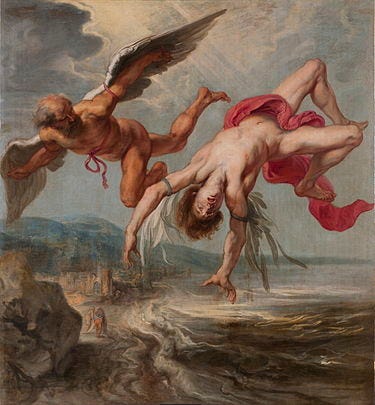
Ignoring his father’s wise counsel, Icarus plunged to his death for flying too close to the sun.

Despite the stern warnings of his father ‘Helios’ (the Sun God), young Phaethon set the earth on fire when he lost control of his father’s chariot.

As a young boy, Alexander the Great was tutored by none other than wise philosopher Aristotle yet still managed to piss away his vast empire through hubris, excess and debauchery and died at the early age of 32.

While much older than were Icarus and Phaethon when they screwed up, the wisest advice I received, and recklessly ignored, came from my father when I was thirty years old and for which I also paid a terrible price.

Experience, said the ancient Greeks, is a light that only shines upon oneself.

What’s the use then, I wonder, of all the accumulated wisdom stored in our cultural memory and for all the books in the world? What’s the point of me writing a book for boys to help them become good men? More to the point, why won’t kids listen? Why do they insist on making the same mistakes over and over again? Here I was, all the while thinking nature was designed to get rid of organisms that failed to adapt and evolve. Were Darwin to climb out of his grave and take a quick look at a great chunk of humanity and the state of the world, I’m pretty sure he’d want to review his theory. What a mess!

When my daughters were nearing adulthood, I became increasingly worried about their future. Wanting to spare them needless pain, I decided to write them an appeal to learn from my experience:

“I suspect that the world, in your eyes, must seem chaotic at present; ruthless, unjust, and fraught with danger and uncertainty. Now imagine you’ll soon be dropped into the middle of a jungle. What will you do? How will you feed yourself? How will you know what plants to eat and which to avoid? How will you protect yourself from the elements? Now consider that the only thing you can take with you are either tools — knife, water jug, flint, hot cheetos 😉 — or a survival manual written by a hunter-gatherer who lived in that same jungle years ago. Which would you choose?”

Weeks later, driving one of them home from work, berating her for something she had done — or not done, I asked her why kids refused to learn from their parents. If we already had slashed our way through the jungle, been battered and wounded, fought and slain tigers, and crossed, scarred and victorious to the other side, why insist on going through the same suffering?

In her characteristic wisdom, she responded:

“Because they wouldn’t be or feel like our own victories. We want our own scars suffered in heroic combat with our own tigers.”

I was stumped…

She was right. As kids mature, they have a greater need to exert control over their lives. “Children have a hard-wired need for power,” says parenting expert Karen McCready.

Upon careful reflection, I wrote my daughter this response:

“While I encourage you to dare greatly and make your unique mark on the world, there are wounds you do not want, trust me. I am not proposing to be your North Star or compass, but simply your lighthouse, for, as poet Philip Larkin warned, ‘An only life can take so long to climb clear of its wrong beginnings and may never.’ My only intention, love, is to spare you from the deadliest tigers.”

The ancient Greeks blamed young people’s seeming deafness on Thrasos, the spirit of rashness, insolence, recklessness and excessive boldness that possesses them, at least for a while.

If you prefer the contemporary, scientific explanation, here goes:

“Risk-taking increases between childhood and adolescence as a result of changes in the brain’s socio-emotional system, leading to increased reward-seeking, especially in the presence of peers, and fueled mainly by a dramatic remodeling of the brain’s dopaminergic system,” says psychology professor Laurence Steinberg. “Risk-taking declines between adolescence and adulthood because of changes in the brain’s cognitive control system — changes which improve an individual’s capacity for self-regulation. These changes occur across adolescence and young adulthood and are seen in structural and functional changes within the prefrontal cortex and its connections to other brain regions. The differing timetables of these changes make mid-adolescence a time of heightened vulnerability to risky and reckless behavior.”

This suggests that no matter what we tell kids, our advice will go in one ear and out the other so long as they are possessed by Thrasos.

I refuse to give up that easily. As an elder of the human tribe, I feel it my duty to lend my talents to the wellbeing of the coming generations, especially boys.

But I want to tread carefully. I don’t want them to ever lose their fierceness and bold spirit which happens to most adults as they gradually sacrifice their youthful idealism at the altar of comfort and security. By playing it safe, they lose their capacity, or willingness to dare imagine and fight for a better world, replacing idealism with cynicism. Our messy world, I argue, is in desperate need of heroes full of derring-do.

So my aim in the book is to engage — and productively channel — young men’s ‘Thrasos’ spirit, while preventing them from plunging to their death or setting the world on fire. As an alternative to aimless, reckless, or self-destructive behavior, I present them with the concept of “Purposeful Audacity.”

But will they listen?

I believe they will… (that’s the idealist in me). I think it’s just a matter of how we engage them. “Don’t do that!” or “Just say no,” won’t cut it. We must use the power of repetition and storytelling, while instilling virtues and strengths of character in them before they hit puberty.

The Need for Repetition

French writer André Gide said that everything that needs to be said has already been said, but since no one listens, everything must be said again.

Selective deafness is not only a childhood quirk.

Ever wonder why the liturgy in Catholicism never changes?

Why Buddhists chant the same sutras?

Why Muslims are instructed by the Qur’an to prostrate themselves in prayer five times a day?

Repetition is key to making knowledge second nature. “It is frequent repetition,’ said Aristotle, “that produces a natural tendency.” It makes knowledge move from the conscious to the unconscious.

Advances in cognitive science reveal that the key to learning and retention is not only a matter of repetition but how we space it. In a study conducted with medical students, researchers found that without spaced repetition, students had forgotten up to 33% of their basic science knowledge after one year. After two years, the number climbed to 50%!

If you’re one who likes to wrestle with self-help books, I’m sure you’ll identify. Nothing sticks for too long, does it? And old habits die hard.

Besides the lack of spaced repetition, I think part of the reason we tend to forget is because most of those who have knowledge or wisdom to impart make it too boring and complicated for us to learn. I am of the mind of Franciscan friar William of Ockham who postulated that the simplest explanation is usually the right one. I also believe we learn best through story rather than dry facts.

If, for example, you wanted to learn about the price a society will eventually pay for the excess of greed and the ensuing mass revolt sparked by protracted inequality, you can either spend months at the library, or simply read Dr. Seuss’ Yertle the Turtle.

The Power of Storytelling

Jesus and Buddha told stories. The prophet Muhammad couldn’t read or write. Homer didn’t write the Odyssey; he sung it!

These sages of antiquity used the power of storytelling couched in parables, metaphor, and symbolic language. They were also brief, and the briefest sermon never ends.

Research into how the brain processes stories offers compelling clues why storytelling works so well:

1. Stories synchronize the listener’s brain with the teller’s brain. In what’s known as neural coupling, when the brain sees or hears a story, its neurons fire in the same patterns as the speaker’s brain.

2. Storytelling connects listeners to the storyteller through emotion — a process psychologists call “narrative transport.”

3. Stories light up more of the brain than factual reporting. When the brain is presented with factual information, only two of its regions activate. FMRI studies show that storytelling causes many additional areas to light up. The brain responds to the story events as if they were actually happening to the listener.

4. Storytelling enhances memory because the part of the brain involved in memory is the same part involved in imagination.

5. Stories command human attention.

6. Stories can change the brain’s chemistry. When captivated by an emotionally engaging story, the brain produces oxytocin, a substance shown to increase generosity, compassion, trustworthiness, and sensitivity to social cues.

7. Stories affect behavior. Pioneer neuroeconomist Dr. Paul Zak has shown that people are far more likely to donate to a cause after viewing an emotionally impactful story. In a recent social experiment, testers were able to sell $129 worth of trinkets on eBay for over $8000 by crafting personal stories for each object.

So rather than long-winded sermons which are usually met with dramatic eye rolls, parents should expose their children to fairy tales, fables, and myths which are ideal to convey valuable life lessons through the power of story. “If you want your children to be intelligent,” said Albert Einstein, “read them fairy tales. If you want them to be more intelligent, read them more fairy tales.”

In my book, for instance, wanting to teach boys how to turn disadvantages into advantages and then on to spirited action, I could’ve opted for a deep dive into the science of resilience but knew I’d lose their attention. Instead, I found inspiring stories of ordinary human beings who turned lemons into lemonade.

Is that enough?

Not entirely, I believe, without laying some groundwork.

Concurrent with spaced repetition and storytelling, fertile soil needs to be laid so lessons germinate. By fertile soil I mean helping our youth nurture virtues and develop strengths of character before they stop listening and take the wrong turn.

It is easier to build strong children than to repair broken men. — American statesman Frederick Douglass

I agree with Douglass, and certain that if we instill virtues and strengthen character at an early age, most children will naturally incline toward spirited lives of noble purpose.

Virtues and Strengths of Character

Virtues are qualities considered desirable in a person. Character strengths are the life forces necessary to lead a good life.

As far as the education of children is concerned, I think they should be taught not the little virtues but the great ones. Not thrift, but generosity; not caution, but courage and a contempt for danger; not shrewdness but frankness and a love of truth; not tact, but love for one’s neighbor; not a desire for success, but a desire to be and to know. — Natalia Ginzburg, The Little Virtues. 1962

According to a survey by Public Agenda, adults in the United States cited “not learning values” as the most important problem facing today’s youth.

As a preface to their comprehensive and brilliant handbook on character strengths and virtues, Christopher Peterson and Martin Seligman say their project coincides with heightened societal concern about good character.

“After a detour through the hedonism of the 1960s, the narcissism of the 1970s, the materialism of the 1980s, and the apathy of the 1990s, most everyone today [believes] that character is important after all and that the United States is facing a character crisis on many fronts, from the playground to the classroom to the sports arena to the Hollywood screen to business corporations to politics.

In the writings of classical antiquity, four cardinal virtues were recognized: Justice, Prudence, Temperance, and Courage.

Had I been brought up with a healthy dose of Temperance, for example, my father’s wise counsel would’ve resonated and perhaps prevented me from plunging into the abyss.

Had Icarus and Phaethon been steeped in lessons on Prudence, their fathers’ warnings would have not gone in one ear and out the other.

Not sure what happened in the case of Alexander the Great, for it was his tutor, Aristotle, who came up with the notion of ‘The Golden Mean,’ or “nothing in excess.” I suppose Alex just fell through the cracks or was asleep for most of his lessons.

Besides the 4 Cardinal Virtues, I’ve combed through a vast compendium of knowledge and synthesized for my book a list of other strengths of character necessary to lead a good life:

· Grit

· Curiosity and Imagination

· An Open but Critical Mind

· Social Intelligence

· Clear-Eyed Optimism, and

· A Healthy Body and Mind

These Ten Life Forces, as I call them, certainly cannot make for the lack of virtuous modelling by parents. After all, children are masters at imitation. Telling them they must be compassionate while walking out of a restaurant with a full stomach and past the homeless without a care will not only belie the lesson but add hypocrisy to the toxic mix.

But even in households with less than favorable environments, I am convinced that kids who are exposed at a young age to these life forces through spaced repetition and storytelling will not only listen, but have all the tools they need to flourish.

That’s my hope for ‘The Hero in You.’

Follow the book’s journey to publication.

Enjoy this companion piece:

Parenting
Children
Childrens Books
Teachers
Education
Recommended from ReadMedium