
Kibbe
This tasty Middle Eastern dish is considered obscure… by the Spelling Bee
Today’s New York Times Spelling Bee letters:
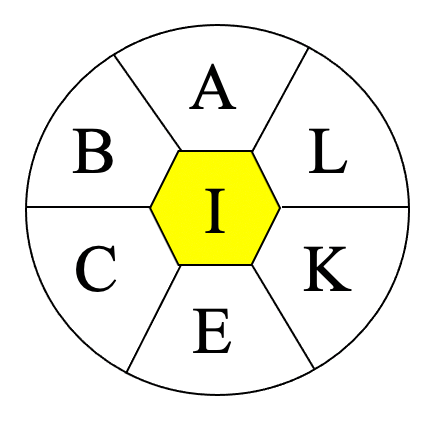
A, B, C, E, K, L, and center I (all words must include I)
Merriam-Webster says…
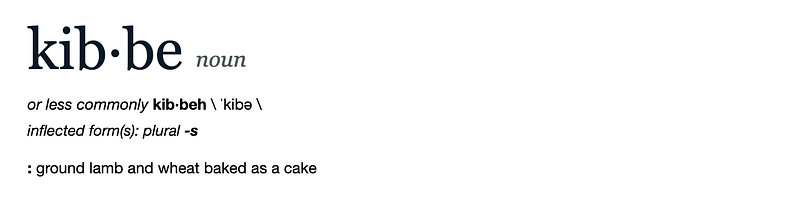
Silly little dictionary! Don’t you know kibbe can’t possibly be a word if the New York Times says it ain’t?
For further fascinating facts, check out the Spelling Bee Master.
What’s your favorite dord* from today’s puzzle?
My Two Cents
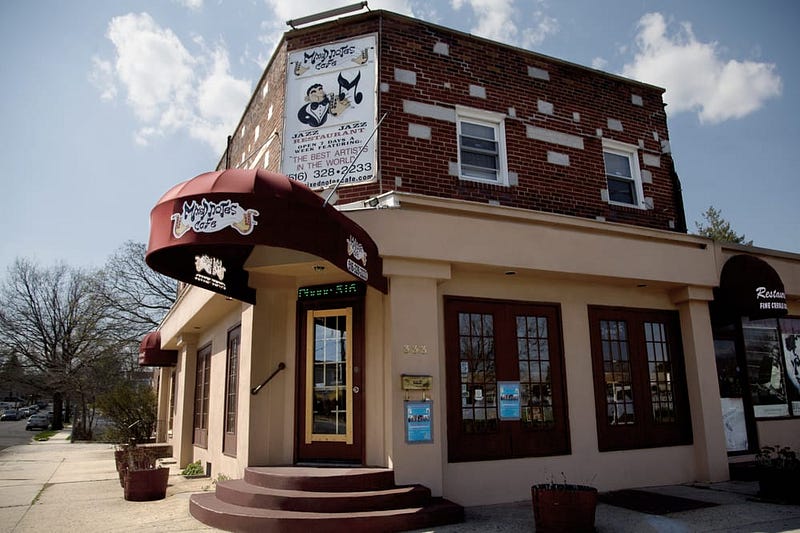
The photo at the top of today’s column is not of a kibbe house. It’s the exterior of Mixed Notes Cafe, located in Elmont, New York, not far from the Belmont racetrack. Yep, the same one where the last leg of the U.S. Triple Crown is run. Boy, would the place get crowded!
No, I’m not an assiduous thoroughbred racing fan… or someone who loves to bet on horses. I used to work at Mixed Notes. It was a brief, mostly wonderful seven-month tenure as a bartender in 2003.
Mixed recipe
The word kibbe comes to English from the Classical Arabic kubbah (kibbeh in North Levantine Arabic), which means “ball”. The basic recipe involves ground meat and grain. Obviously spices and other additions, like onions and pine nuts, are included, depending on the region and tradition. This is considered the national dish of Syria, and the northern city of Aleppo has more than a dozen different styles of it.
The grain involved is typically bulgur wheat, which is made from the cracked parboiled groats of several different wheat species. Groats (not to be confused with grits) are kernels of whole grain that have been stripped of their outer shell. They are also hard to chew, which is why they are parboiled.
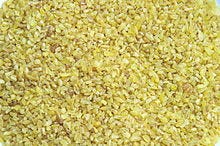
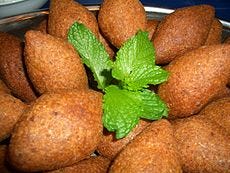
The bulgur is mixed with the spiced meat into a paste and shaped into balls or a prolate spheroid. Then it is grilled or deep fried…
…or left alone and served raw!
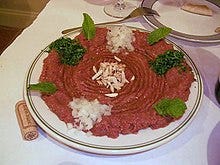
This last version is known as kibbe(h) nayyeh, and uses very finely minced lamb or beef, similar to steak tartare. Because it’s served raw, kibbe(h) nayyeh requires high-quality meat to prepare and is considered a traditional way to honor guests.
Some recipes substitute rice or farina (milled wheat), and some even add semolina. Iraq and other areas of the Middle East have a kibbe soup called kubeh, as explained in this 2017 article from NPR:
Kibbe is well-known in South America because of the large number of immigrants that came from the Middle East at the beginning of the 20th century. Which brings us to…
Mixed music
The owner of Mixed Notes Cafe is Haitian-American, if I remember correctly. (That is, what I don’t remember is whether he was born in Haiti or the U.S., but he identified as Haitian.) He was a gentleman and a scholar, as they say, a man with many interesting facets.
One of them was jazz music. Another was food. A third was White Russians. The drink, that is. And so the bar/restaurant/music venue he opened had all three… and more.
It was definitely a place where I loved working, mostly because of the regulars and the live music.
The year was 2003 and I had just been laid off from my first job in the U.S. as an editor. The quality of my work was fine, the quality of the economy not so much. So the two very nice owners/bosses we had were forced to let everyone go. Or almost everyone. This had been the second time I had worked for the same company in downtown Manhattan on Varick Street. The brief hiatus had occurred in 2000; I had been rehired in early 2001. (I was at the office when the Twin Towers collapsed on 9/11, but that’s a story for another day).
This time there would be no rehiring. But there was bar-tending. I took one of those quickie two-week night courses that I saw advertised and learned the basics of the trade. The same school helped me find my first (and only) job bartending… in Elmont, New York. Which was fine by me, as I lived in Queens. So the commute to work wasn’t too bad, as I would drive against traffic in the early evening.
I started in late February or early March of 2003. I remember because I was tending bar at Mixed Notes the night the Iraq War started on March 19 (March 20 in Iraq).
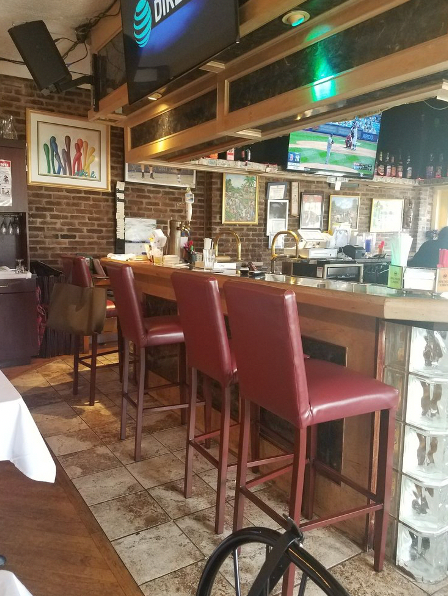
That TV in the above photo had CNN on that evening…
I worked at the place until September, my shifts being mostly Sunday through Wednesdays, with some Thursdays and Saturday nights sprinkled in. Thursdays and Saturdays were a different animal: the bands played Haitian dance music, the locale was crowded, and work was exhausting.
I preferred the more jazzy atmosphere of the earlier part of the week. Tips were not as bountiful at first, but many of the customers were regulars and showed their generosity once they got to know me.
Mixed Notes Cafe had a very eclectic menu that featured a cuisine one could call Haitian fusion, with platters such as conch, staples like burgers, and even appetizers from the Middle East, like… kibbe.
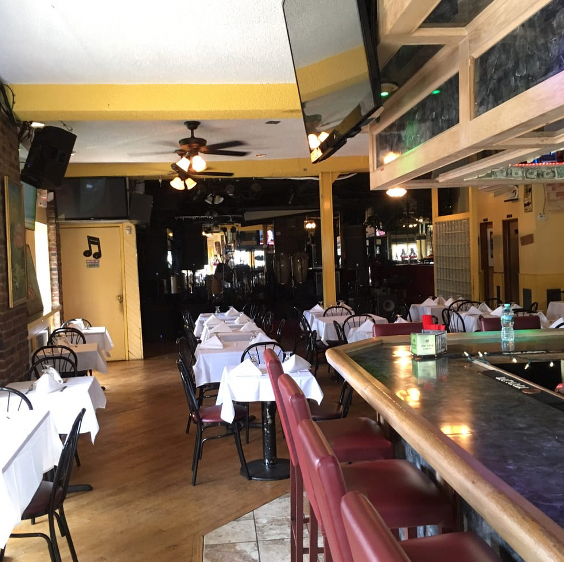
The photo above shows part of the bar and the tables at the restaurant section. The stage where the bands played or jammed is at the very end.
I had started taking saxophone lessons several months earlier, so working at a place where I regularly got to see, hear, and meet sax players — as well as other musicians — was simply a dream come true for me!
A month or so after I started working there, I got a 9 to 5 as an editor through a friend and former coworker. Interestingly, it was at the same building where the company that had laid me off was. I didn’t want to give up bar-tending, so for many months I worked two jobs.
It took its toll, though. I would leave work at 5 or 5:30 pm, get home, change, drive to Mixed Notes to start my shift around 7 pm, then get home around 2 am, sometimes later, sleep for four or five hours… rinse, repeat… I got worn down. So I had to leave in September of that same year.
It’s still one of my favorite life experiences that I remember very fondly.
Now you know. If you ever happen to be in Elmont, New York, and want to listen to some live jazz while enjoying some Haitian fusion cuisine, by all means step into the Mixed Notes Cafe. You may not be able to try their kibbe, because the editors of the Spelling Bee decided that kibbe is a dord*.
You can check out my previous entry on another dord* here:
*What the heck is a dord, you ask? Here’s the answer: