
I shared the stage with an A-list movie star
Kevin Costner Taught me Storytelling
Dreaded words: you will go on after Costner
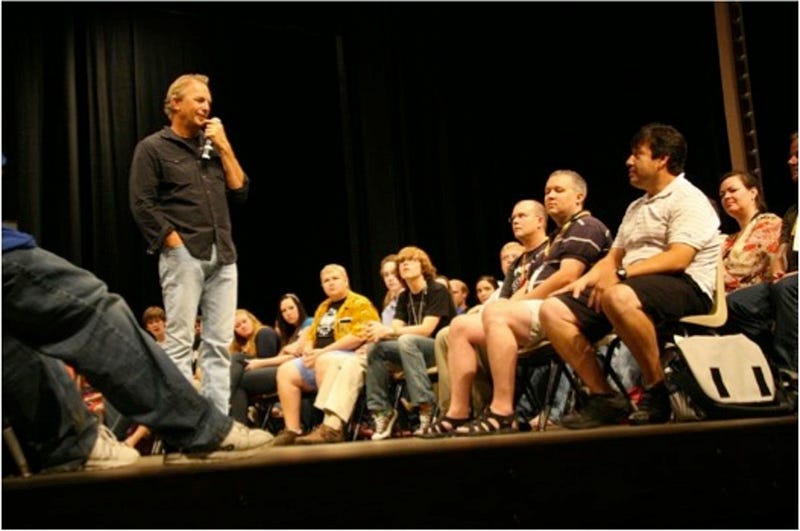
Something strange and magical happened. Costner … validated my beliefs on storytelling. It became one of the inspirations for my book The Craft of Scene Writing.
A few years ago, a daunting challenge turned into a surprising opportunity. The South Dakota Film Festival invited me to Aberdeen, South Dakota as a judge and to give a screenwriting talk. The good news was that I was going to share the stage with Kevin Costner. The bad news was that I was slated to follow him.
It’s not a mystery. Costner would be the climax of the show, so if I follow him, I am necessarily anti-climactic. But the gods of storytelling prevailed, and I was able to go first.
With the pressure off, I relaxed and attended an event the night before where Costner was being interviewed.
To a packed auditorium of over a thousand people, Costner walked out on an empty stage furnished with only two chairs, one for him and one for the interviewer. Two talking heads in a static environment. Really?
Then something strange and magical happened. Costner took that seeming storytelling dead end and brought it to life. A storyteller to the core, his interview and resulting performance validated my beliefs on storytelling. It became one of the inspirations for my book The Craft of Scene Writing.
His understanding of the entire filmmaking process helped him to capture an audience with his story. I will try to recreate his magic and share how you can incorporate it into your writing here on Medium.
Costner had been invited to celebrate the 20th anniversary of Dances with Wolves. Upon expressing his sincere reverence and appreciation for the experience and his time spent in South Dakota while shooting the film, he then bluntly confessed the last thing you would expect to say about his co-stars, the wolves: he hated them. The audience burst into laughter.
Opposites. Reversal.
The event didn’t devolve into an anti-PETA rally, but Costner carried on about how the wolves weren’t behaving as the trainer had promised. In fact, in the long shot in which Costner’s Dunbar character “dances” with the wolf, the trainer himself had to act as the stunt double.
Conflict.
Costner pops out of his chair and runs back and forth along the stage to act out the scene.
Blocking.
And then, in character, he suddenly runs backstage.
Setting. Location.
Where did he go? What the hell is he doing?
Suspense.
Thirty seconds later, Costner walks back on stage as himself.
Pacing. Role-playing.
Costner plays out his conversation with the trainer. Costner asks, “Why’d you run off?” The Trainer replies, “He bit me.”
Surprise.
And that memorable shot where he had to dance with the wolf himself? Well, in order to get the wolf to follow him, he had to fill his pockets with meat. He has already run back-and-forth, so now he adds a twist.
He acts out his important discovery of how to direct the wolf to go away from him: he tosses an imaginary piece of meat over his head to keep the imaginary beast at bay.
As a storyteller, Costner understands the power of a prop. Even an imaginary one.
Props.
He wants the audience to know how it feels to be duped by the trainer. So he takes the idea of the wolf trainer as a door-to-door salesman overhyping his product (in this case, the wolves), and runs with it.
Metaphor.
Suddenly, Costner is a door-to-door vacuum salesman in the middle of his sales pitch. He begins pushing and pulling an imaginary vacuum back and forth on stage. He throws imaginary dirt, dust, jelly, and syrup on the floor and “shows” how the vacuum sucks it up.
Once the imaginary salesman Costner gets the imaginary sale, he steps out of character to set up the next “scene.” His friends are at his house watching a football game and he calls them over to show off his new vacuum. He eagerly throws the same imaginary goop on the floor.
Setup. Payoff.
He moves the vacuum back and forth, but this time to no imaginary avail. He looks perturbed as he speeds up the vacuuming motion. It’s clear that it’s not working for him as it did for the salesman.
And then he does something sublime that sets A-List actors apart: Costner plops down on his hands and knees to investigate what the hell is going on with the imaginary goop. He is completely absorbed and truly invested in this moment.
Importance.
Of course, Costner could have sat in the chair and gabbed away about how he made a work of great cinematic storytelling. Instead, he embraced one of the fundamental tenets of screenwriting and visual storytelling.
Show, don’t tell.
That Costner is an Academy Award-winning director is not a coincidence. He validated my belief that to become fluent in the language of cinematic storytelling, screenwriters must embrace and learn this language from the inside out. They must understand or at least appreciate the other skills required to turn their story into a finished film.
Learn from related arts
I teach my screenwriting students how to think like an actor and a director because it expands their mindset and helps their craft. Costner’s experience as a director helped him tell a better story when he recounted his time on the set of Dance with Wolves.
Although I’ve just started writing on Medium, I have years of storytelling experience in another medium. I see how skills or experience in any form of storytelling improves all of your storytelling. Lend me your mindset while I introduce you to how screenwriting principles can have an immediate impact on your storytelling in Medium.
Reversals
The entire Chapter 2 of my book is about the essence of surprises and reversals. The impact of a turning point is influenced by the setup of expectations. Here, it was Dances with Wolves, commemorating it, celebrating the filmmaker and the Native American people who lived there. Then Costner says, “I hated the wolves.”
In the moment before the surprise reversal, challenge yourself to take your story as far as you can in the opposite direction. So in the instant of the sharp, sudden twist, it will feel monumental.
A perfect example of this craft is in McLintock! with John Wayne. See how powerful and enjoyable it is to precede the wallop with “I’m not going to hit you.”
Opposites
Reversals are a type of opposites. I discuss opposites in storytelling in my first boosted article.
But here’s another form. If your article is full of anger or disdain, find some spots for grace or love. If you’re being super silly, slip in some importance, a surprising slice of heft.
Here’s the hardest one: if your article involves the most serious things possible, find a spot for humor or levity. It doesn’t mean you’re being disrespectful. It means you’re human.
Suspense
When you raise a question, you don’t necessarily have to answer it immediately. Stretch it out, pull us along.
There is a difference between mystery and confusion. Make sure you give the audience enough to clearly understand the question you have implicitly or explicitly asked. You want them to be eager to continue, not to give up.
Metaphor
A metaphor is a truncated simile.
A simile: “My kid’s like a tiger.” Metaphor: “My kid is a tiger.”
Why am I not the one to teach you about metaphor? Because I am l̶i̶k̶e̶ ̶ the person who is really not good at metaphors.
Setups and payoffs
An ending is like the punchline for a joke. It’s a payoff.
Punchlines and endings gain power by being a callback to something set up earlier. When you are looking for the perfect ending, mine the first half of your article for a prop, an idea, or a phrase that you might be able to repeat or reuse.
Alternately, if you love your ending, go back to the beginning and look for places where you can set the stage — hint at — the final payoff.
White space
Before PDFs were a thing, thousands of scripts got mailed and couriered around Los Angeles every day. I would spend hundreds of dollars per month in copies, covers, brads, and postage.
When scripts were a tangible, physical product, it would be common to do what is called the reader backflip. You flip through the 100ish pages in a few seconds — applying a blink test.
Are paragraphs short and succinct? Or are they long and wide and never broken up with dialogue? The latter script would often be put at the bottom of the pile. (A literal pile … I would often take 40 pounds of scripts home for the weekend to read.) Or it would start off with an annoyed reader.
A Medium post is not poetry. But like a screenplay, the flow of the read should move quickly down the page.
Think Haiku.
Here are two drafts of the first page of the script Alien. The left side is Dan O’Bannon’s draft. To the right is Walter Hills' rewrite.
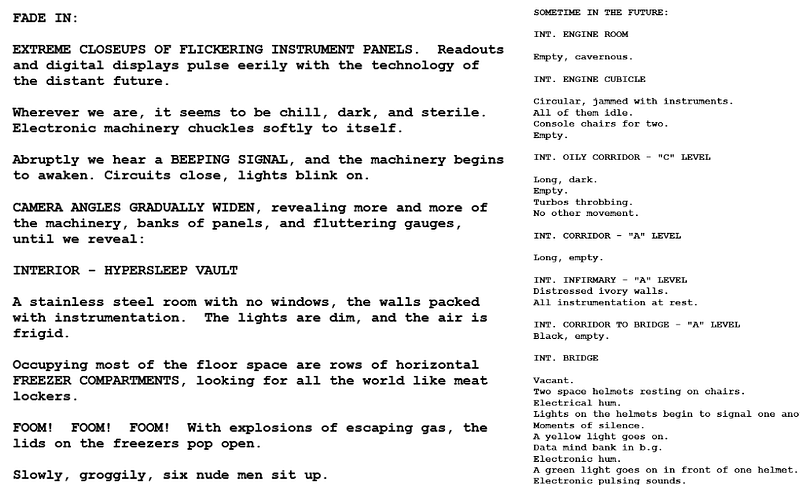
See how the one on the right pulls your eye and attention forward, down the page.
If I glance at a Medium story and the paragraphs are all 4-, 5-, and 6-lines long, I groan and sometimes give up.
Kill your widows
This topic is a combination of brevity and white space — how words lay on the page.
A page of a screenplay represents about a minute of screen time. If you know the adage, a picture paints a thousand words, how the hell do we keep up with that?
We do it by fighting for every line. A piece of that battle is trying to eliminate all of our widows, which are up to a few words that create the need for an additional line. Look at the four widows on the left here.
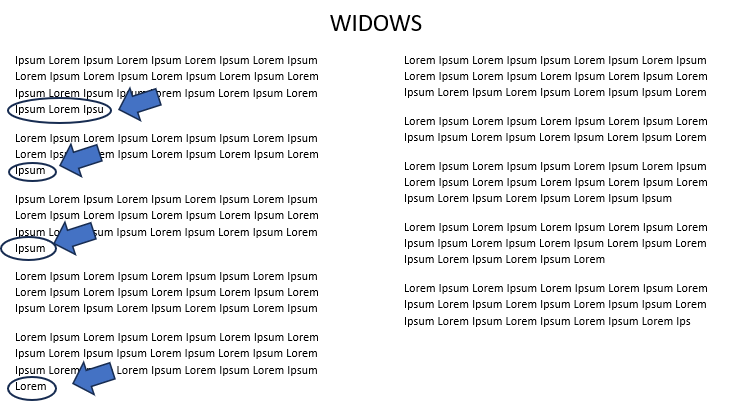
If we tweak those four paragraphs, it’s easy to eliminate the widows and an entire line. See the polished version on the right. It’s quicker and cleaner. If you eliminate four lines per page in a feature, your page count drops by up to eight pages.
Page count in screenwriting slightly parallels read time in Medium. Consider this question, “What will improve my Medium article’s quality, read percentage, and chances to be boosted?”
Almost always, one of the right answers is …
Brevity
William Shakespeare said, “Brevity is the sound of wit.”
I say, Billy, can we change that to, “Brevity”?
Don’t be the writer who believes their work surpasses Michelangelo’s masterpiece, The David. “My project is The David but more. 50 pounds of marble more.”
That’s not how it works. Less is more. Your challenge is to carve away all that is not your story. What’s left is your story’s essence.
In your first draft, trim 10% of the word count. You won’t miss a thing. Try cutting an additional 10%. Wrestle with words, sentences, and paragraphs to refine your story and improve its clarity and quality.
Eliminate everything that detracts from you and your story, and readers can better appreciate it. A concise, clear, and engaging story will attract more eyeballs and create a higher read ratio.
Escalation
If there is one immutable rule in screenwriting, filmmaking, and all stories, it’s “Don’t be boring.” Boring is static, stillness, and a lack of new information.
The opposite is movement, growth, and acceleration. In drama, it’s called rising action. In a song, a bridge will often expand the story and experience. In short humor or satire, it’s called heightening. It’s where the premise takes a surprising jump up in stakes and where the concept of the joke goes to the next level.
One of my favorite satirists on Medium, Kyrie Gray, talks about it here.
If a paragraph in your story doesn’t progress from the previous one, you either cut it or improve it. If it’s a research-based article, you go deeper into the material. If it’s a persuasive story, you might jump to the next step in a rhetorical structure like Monroe’s Motivated Sequence — attention, need, satisfaction, visualization, action.
I recently did a dark satire about a dating service for the terminally ill. Near the end, it takes a surprising, but hopefully organic and on-point, leap to dating after one of the partners has died.
A relationship is like a shark, you know? It has to constantly move forward or it dies. And I think what we got on our hands is a dead shark. -Woody Allen
Consider the above quote from Annie Hall. A story is also like a shark. If it stops moving forward, it dies.
Remember how I told you I am not good at metaphors? Here’s the payoff.
Don’t be a dead shark.
I am giving a free Zoom lecture on Sunday, January 7 at 7:00 PM EST. The topic is Crafting Soulmates: Create the Perfect Love Interests in Your Romances and Rom-Coms. If you want more info or the link, sign up.
