avatarJoshua Davis

Free AI web copilot to create summaries, insights and extended knowledge, download it at here

6800

Abstract

e authoritative whistleblower complaints in a way that was previously impossible or considered to be too costly.</p><p id="453c">This allows communities to create official records of grievances against police brutality. These reports inform local law enforcement of what policies do and don’t work. It also restricts corrupt practices that prevent the proper function of local governments.</p><p id="e892">The TandaPay platform satisfies the prescription of the Kerner commission which outlined the “<i>establishment of effective grievance-response mechanisms</i>.” It does so through the creation of task force groups for local communities. These task force groups then use software to create authoritative whistleblowing reports. Using the software, these reports are then verified by the community.</p><h1 id="fccb">For a community voice</h1><figure id="e3b4"><img src="https://cdn-images-1.readmedium.com/v2/resize:fit:800/1*UCl89jqkAV6GGWH_I5k3Ew.jpeg"><figcaption><a href="https://www.gettyimages.com/detail/news-photo/former-illinois-governor-otto-kerner-holds-a-copy-of-the-news-photo/515047706?irgwc=1&amp;esource=AFF_GI_IR_TinEye_77643&amp;asid=TinEye&amp;cid=GI&amp;utm_medium=affiliate&amp;utm_source=TinEye&amp;utm_content=77643">Otto Kerner Testifying Before Senate</a><a href="https://www.gettyimages.com/search/photographer?family=editorial&amp;photographer=Bettmann">Bettmann</a></figcaption></figure><p id="c2c9">Here are a few paragraphs in the report that describe how TandaPay functions.The source documents of these excerpts are <a href="https://drive.google.com/drive/folders/15N7BlNhO5RiWMG_6HDLS6TzSg45WnUWh?usp=sharing">located here</a>.</p><blockquote id="cd2f"><p>“the demand for a <b>community voice</b> represents a marked and desirable gain over the apathy that existed before. Despite its problems, we believe that <b>meaningful community participation</b> and a substantial measure of involvement in program development is an essential strategy for city government. The <b>democratic values</b> which it advances — providing a stake in the social system, improving the accountability of public officials — as well as the pragmatic benefits which it provides far outweigh these costs.”</p></blockquote><blockquote id="d777"><p>“The essential question which city leadership must face is the ultimate goal of <b>community participation</b>. In this sense, <b>community involvement</b> is directly related to the strategy of <b>decentralization</b>, for with the support of the city, <b>neighborhood groups may become an effective force</b> for carrying on a variety of functions.”</p></blockquote><blockquote id="b0b9"><p>“There remains the issue of leadership. Now, as never before, the American city has a need for the personal qualities of strong democratic leadership. Given the difficulties and delays involved in administrative reorganization or institutional change,<b> the best hope for the city in the short run lies in this powerful instrument</b>. In most cities, the mayor will have the prime responsibility.”</p></blockquote><p id="bca5">The report speaks about these democratic groups as an “<b>instrument</b>” or “<b>mechanism</b>” empowered by a new type of decentralized consensus technology:</p><blockquote id="9101"><p>“The <b>Neighborhood Action Task Forces</b> (<i>i.e. TandaPay groups</i>) should meet on a regular basis at a location accessible to ghetto residents. These meetings will afford an opportunity for ghetto leaders to communicate directly with the municipal administrators for their area to discuss problems and programs which affect the community. In effect, this device furnishes an interagency <b>coordinating mechanism</b> on the one hand and a “community cabinet” on the other.”</p></blockquote><p id="38f9">Neighborhood Action Task Forces are a <i>decentralized</i>, <i>coordinating mechanism</i> serving as a <i>powerful instrument</i> for producing <i>democratic leadership</i> that is embedded into <i>neighborhood communities</i>.</p><figure id="3894"><img src="https://cdn-images-1.readmedium.com/v2/resize:fit:800/1*v7A0PUvY6b3sgWtZbLL4sQ.jpeg"><figcaption><a href="https://time.com/5846727/george-floyd-protests-history/">Hulton Archive/Getty Images; David ‘Dee’ Delgado — Getty Images</a></figcaption></figure><h2 id="dc55">Research and innovation are required</h2><p id="739e">To produce policies with the goal of reducing police harassment, the report highlights the need for research and innovation.</p><blockquote id="f7d1"><p>“Problems stemming from police patrol cannot, perhaps, be so easily resolved. … The first (consideration) relates to law enforcement philosophy behind the use of techniques like aggressive patrol. Many police officials believe strongly that there are law enforcement gains from such techniques. However, these techniques also have law enforcement liabilities. … Gains (from tactics like aggressive patrol) cannot be measured solely in the number of arrests. Losses in police protection cannot be accepted solely because of some vague gain in diminished community tension. The kind of thorough, objective assessment of patrol practices and search for <b>innovation </b>we need will require the best efforts of <b>research </b>and <b>development </b>units within police departments, augmented … by <b>outside research assistance</b>.”</p></blockquote><p id="cfdd"><b>Innovation is required to solve a problem of this magnitude</b>. This requires residents to seek outside assistance. TandaPay was created to provide this assistance. It provides communities the means to seek a more equitable relationship between themselves and local governments. The goal of TandaPay is to coordinate communities. This coordination mechanism gives residents greater ability to participate in the creation of local policies. The goal is to make local governments more accountable to the people. This enables people to effect positive change on the local level.</p><h1 id="f769">The Kerner Report — Why did it happen?</h1><figure id="6fbb"><img src="https://cdn-images-1.readmedium.com/v2/resize:fit:800/1*qnYNKxUsVvWmD3SDatPXCg.jpeg"><figcaption></figcaption></figure><p id="0c7f">From the Kerner Commission Part II. Why did it happen, Chap. 4 The Basic Causes</p><h2 id="b550">Frustrated hopes</h2><p id="59be">The expectations aroused by the great judicial and legislative victories of the civil rights movement have led to frustration, hostility, and cynicism in the face of the persistent gap between promise and fulfillment. The dramatic struggle for equal rights in the South has sensitized northern Negroes to the economic inequalities reflected in the deprivations of ghetto life.</p><h2 id="8838">Legitimation of violence</h2><p id="e022"><b>A climate that tends toward the approval and encouragem

Options

ent of violence as a form of protest has been created by <a href="https://www.hsdl.org/c/us-conference-of-mayors/">white terrorism</a> directed against nonviolent protest</b>, including instances of abuse and even murder of some civil rights workers in the South, by the open defiance of law and Federal authority by state and local officials resisting desegregation, and by some protest groups engaging in civil disobedience who turn their backs on nonviolence, go beyond the constitutionally protected rights of petition and free assembly and resort to violence to attempt to compel alteration of laws and policies with which they disagree. This condition has been reinforced by a general erosion of respect for authority in American society and the reduced effectiveness of social standards and community restraints on violence and crime. This in turn has largely resulted from rapid urbanization and the dramatic reduction in the average age of the total population.</p><p id="114a" type="7">A climate that tends toward the approval and encouragement of violence as a form of protest has been created by white terrorism directed against nonviolent protest</p><h2 id="714b">Powerlessness</h2><p id="90f8">Finally, many Negroes have come to believe that they are being exploited politically and economically by the white “power structure.” Negroes, like people in poverty everywhere, in fact lack the channels of communication, influence, and appeal that traditionally have been available to ethnic minorities within the city and which enabled them — unburdened by color — to scale the walls of the white ghettos in an earlier era. The frustrations of powerlessness have led some to the conviction that there is no effective alternative to violence as a means of expression and redress, as a way of “moving the system.” More generally, the result is alienation and hostility toward the institutions of law and government and the white society which controls them. This is reflected in the reach toward racial consciousness and solidarity reflected in the slogan “Black Power.”</p><p id="a5b0">These facts have combined to inspire a new mood among Negroes, particularly among the young. Self-esteem and enhanced racial pride are replacing apathy and submission to “the system.” Moreover, Negro youth, who make up over half of the ghetto population, share the growing sense of alienation felt by many white youth in our country. Thus, their role in recent civil disorders reflects not only a shared sense of deprivation and victimization by white society but also the rising incidence of disruptive conduct by a segment of American youth throughout the society.</p><h2 id="ce9c">Incitement and encouragement of violence</h2><p id="63ed">These conditions have created a volatile mixture of attitudes and beliefs which needs only a spark to ignite mass violence. Strident appeals to violence, first heard from white racists, were echoed and reinforced last summer in the inflammatory rhetoric of black racists and militants. Throughout the year, extremists crisscrossed the country preaching a doctrine of violence. Their rhetoric was widely reported in the mass media; it was echoed by local “militants” and organizations; it became the ugly background noise of the violent summer.</p><p id="c744">We cannot measure with any precision the influence of these organizations and individuals in the ghetto, but we think it clear that the intolerable and unconscionable encouragement of violence heightened tensions, created a mood of acceptance and an expectation of violence, and thus contributed to the eruption of the disorders last summer.</p><h2 id="9711">The police</h2><p id="9d40">It is the convergence of all these factors that makes the role of the police so difficult and so significant. Almost invariably the incident that ignites disorder arises from police action. Harlem, Watts, Newark, and Detroit — all the major outbursts of recent years — were precipitated by arrests of Negroes by white police for minor offenses.</p><p id="e926">But the police are not merely the spark. In discharge of their obligation to maintain order and ensure public safety in the disruptive conditions of ghetto life, they are inevitably involved in sharper and more frequent conflicts with ghetto residents than with the residents of other areas. Thus, to many Negroes, police have come to symbolize white power, white racism, and white repression. And the fact is that many police do reflect and express these white attitudes.</p><p id="3f84" type="7">The atmosphere of hostility and cynicism is reinforced by a widespread perception among Negroes of the existence of police brutality and corruption and of a “double standard” of justice and protection — one for Negroes and one for whites.</p><h1 id="da0c">One final note</h1><p id="12c2">The assertion that a TandaPay claim has legal precedence in case law to serve as evidence in a court of law hinges on one important assumption. TandaPay groups must function to bridge the gap between local governments and the community in the exact manner described by the Kerner Commission in chapter 10. This requires that a TandaPay group be granted powers by local government to act in the role of a Neighborhood Action Task Force. These powers are described by the commission as being:</p><p id="f5e5">“The power to receive complaints, hold hearings, subpoena witnesses, make public recommendations for remedial action to local authorities and, in cases involving violation of law, bring suit: <b><i>These powers are the minimum necessary for the effective operation of the grievance mechanism</i></b>. As we envision it, the agency’s principal power <b><i>derives from its authority</i></b> to investigate and make public findings and recommendations.”</p><h1 id="80c5">Join the financial revolution</h1><ul><li><a href="https://readmedium.com/join-the-financial-escrow-revolution-accbf9b6b81c">Be an advocate for a better tomorrow empowered by blockchain technology</a></li></ul><p id="ecfb"><b>Video on the legacy of the Kerner commission:</b></p><ul><li><a href="https://www.youtube.com/watch?v=JkPY8pqSkDQ&amp;feature=youtu.be&amp;t=711">History, Origins, and Legacy of Kerner Commission</a></li></ul><p id="25bc"><b>More about <a href="http://www.tandapay.com/">TandaPay</a>:</b></p><ul><li><a href="https://readmedium.com/tandapay-is-a-weak-insurance-protocol-895ef7cd8724">TandaPay is a powerful coordination protocol for galvanizing movements</a></li><li><a href="https://readmedium.com/information-escrows-get-a-power-up-7a5152a26c63">Information Escrows Get a Power-up</a></li><li><a href="https://readmedium.com/what-p2p-insurance-means-to-me-133f358e1289">How P2P insurance can empower social justice in local communities</a></li></ul></article></body>

Kerner Commission’s Prescription for Effective Grievance-Response

Using software to implement the report’s recommendations
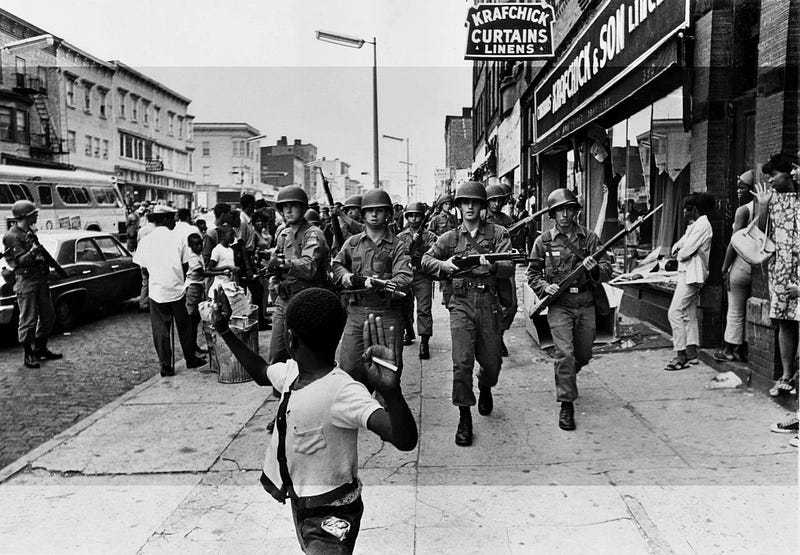
National Guard members clearing Springfield Ave. in Newark on July 14, 1967 — Don Hogan Charles

Formal mechanisms for processing grievances
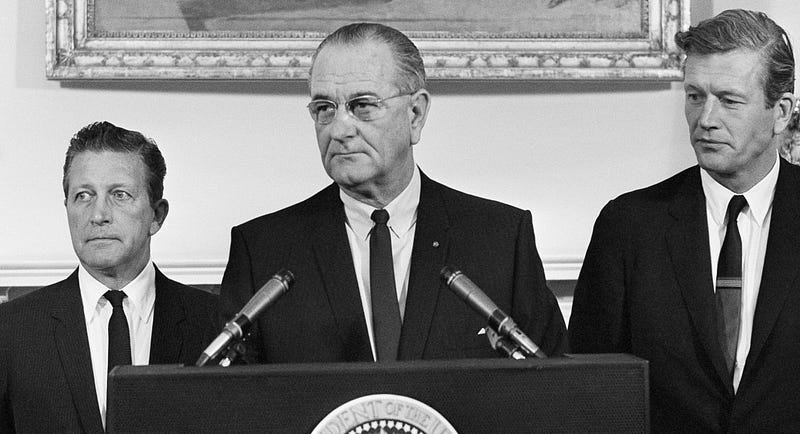
President Lyndon B. Johnson speaks to the National Advisory Commission on Civil Disorders WX, AP

In July 1967 President Lyndon B. Johnson created the Kerner Commission to examine the U.S. race riots of the 1960s. Former U.S. Senator Fred Harris is its last surviving member.

Senator Harris: “We said that the terrible conditions gave rise to these protests and riots. Any spark could set off the violence. The underlying causes were racism and poverty. The most famous words of the commission were these, ‘our country is moving toward two nations one black one white separate and unequal.’” — Separate and Unequal”: The Last Surviving Member of the 1968 Kerner Commission on Race Riots.
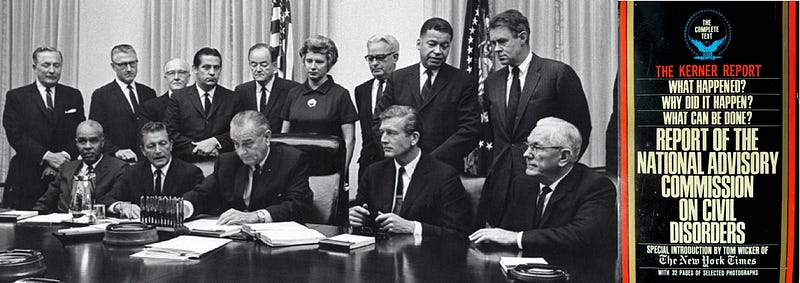
President Lyndon B. Johnson at the signing of the 1968 Kerner Commission published by Bantam Books

In 1968 the Kerner commission wrote the following:

“Effective implementation of the Neighborhood Action Task Forces will depend upon the continuing commitment of the city administration to its success. To ensure continuous attention to many of the sources of tension identified, we recommend that formal mechanisms for the processing of grievances, many of which will relate to the performance of the city government, be established independent of the local administration.” — Pg. 151 the National Advisory Commission on Civil Disorders

This recommendation was never taken seriously and as a result this is the system in place today:
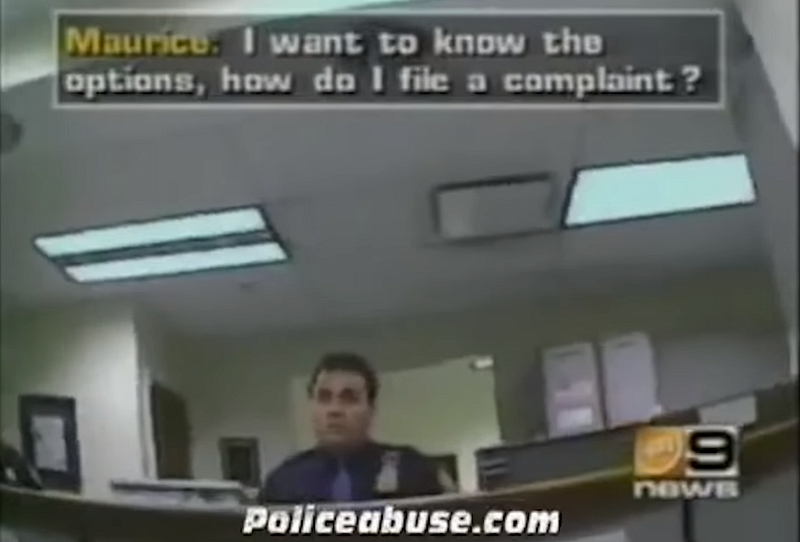
Youtube: What Happens When You Try to File a Complaint Against a Police Officer

Reporter: “San Bernardino Sheriff’s Department Corporal Ray Austin had an intimidating message.”

Officer: “The way it works, they’ll go interview you with the tape, and then they’ll talk to the officer and do an investigation. And, If your allegations are unfounded, the officer has a right to sue you,”

Reporter: “But, that’s not the policy of the San Bernardino Sheriff’s Department. It states that any citizen can take a complaint form home, and they can fill it out anonymously. Jones left feeling as if he was being threatened into not filing a report, and even the captain agreed.”

Captain: “I can see how somebody who was listening to the corporal would feel intimidated.”

Technology solves the intimidation problem
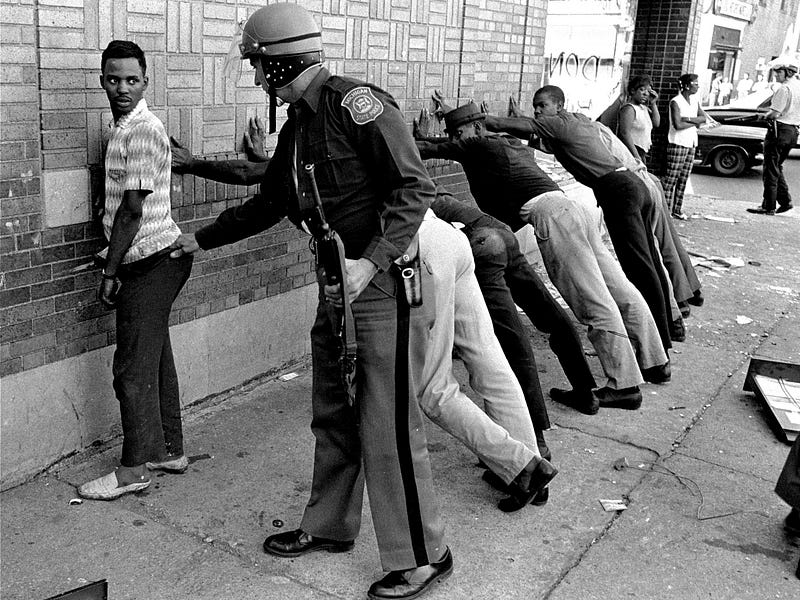
Assume The PositionAmerican Stock Archive

TandaPay was created to solve this exact problem. The concepts embodied in TandaPay as a whistleblowing platform are not new. The commission outlined these ideas more than 50 years ago. In the National Advisory Commission on Civil Disorders report, which was submitted to President Johnson, the commission prescribed a solution for local government accountability. At that time, however, a practical implementation was considered to be too expensive.

This is because the technology required to create the groups described in the report was non-existent. The commission felt that the way to solve many of these problems was through the use of Neighborhood Action Task Forces. The TandaPay protocol empowers communities to produce these types of local groups. These groups can then produce authoritative whistleblower complaints in a way that was previously impossible or considered to be too costly.

This allows communities to create official records of grievances against police brutality. These reports inform local law enforcement of what policies do and don’t work. It also restricts corrupt practices that prevent the proper function of local governments.

The TandaPay platform satisfies the prescription of the Kerner commission which outlined the “establishment of effective grievance-response mechanisms.” It does so through the creation of task force groups for local communities. These task force groups then use software to create authoritative whistleblowing reports. Using the software, these reports are then verified by the community.

For a community voice
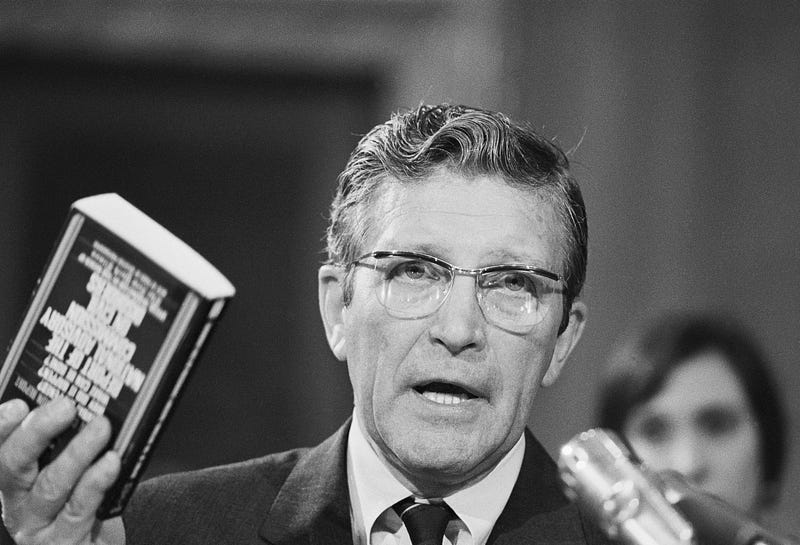
Otto Kerner Testifying Before SenateBettmann

Here are a few paragraphs in the report that describe how TandaPay functions.The source documents of these excerpts are located here.

“the demand for a community voice represents a marked and desirable gain over the apathy that existed before. Despite its problems, we believe that meaningful community participation and a substantial measure of involvement in program development is an essential strategy for city government. The democratic values which it advances — providing a stake in the social system, improving the accountability of public officials — as well as the pragmatic benefits which it provides far outweigh these costs.”

“The essential question which city leadership must face is the ultimate goal of community participation. In this sense, community involvement is directly related to the strategy of decentralization, for with the support of the city, neighborhood groups may become an effective force for carrying on a variety of functions.”

“There remains the issue of leadership. Now, as never before, the American city has a need for the personal qualities of strong democratic leadership. Given the difficulties and delays involved in administrative reorganization or institutional change, the best hope for the city in the short run lies in this powerful instrument. In most cities, the mayor will have the prime responsibility.”

The report speaks about these democratic groups as an “instrument” or “mechanism” empowered by a new type of decentralized consensus technology:

“The Neighborhood Action Task Forces (i.e. TandaPay groups) should meet on a regular basis at a location accessible to ghetto residents. These meetings will afford an opportunity for ghetto leaders to communicate directly with the municipal administrators for their area to discuss problems and programs which affect the community. In effect, this device furnishes an interagency coordinating mechanism on the one hand and a “community cabinet” on the other.”

Neighborhood Action Task Forces are a decentralized, coordinating mechanism serving as a powerful instrument for producing democratic leadership that is embedded into neighborhood communities.
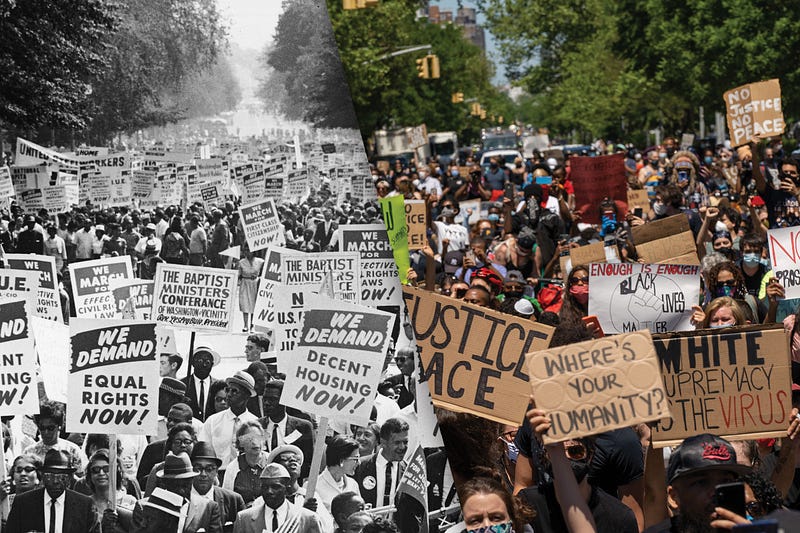
Hulton Archive/Getty Images; David ‘Dee’ Delgado — Getty Images

Research and innovation are required

To produce policies with the goal of reducing police harassment, the report highlights the need for research and innovation.

“Problems stemming from police patrol cannot, perhaps, be so easily resolved. … The first (consideration) relates to law enforcement philosophy behind the use of techniques like aggressive patrol. Many police officials believe strongly that there are law enforcement gains from such techniques. However, these techniques also have law enforcement liabilities. … Gains (from tactics like aggressive patrol) cannot be measured solely in the number of arrests. Losses in police protection cannot be accepted solely because of some vague gain in diminished community tension. The kind of thorough, objective assessment of patrol practices and search for innovation we need will require the best efforts of research and development units within police departments, augmented … by outside research assistance.”

Innovation is required to solve a problem of this magnitude. This requires residents to seek outside assistance. TandaPay was created to provide this assistance. It provides communities the means to seek a more equitable relationship between themselves and local governments. The goal of TandaPay is to coordinate communities. This coordination mechanism gives residents greater ability to participate in the creation of local policies. The goal is to make local governments more accountable to the people. This enables people to effect positive change on the local level.

The Kerner Report — Why did it happen?
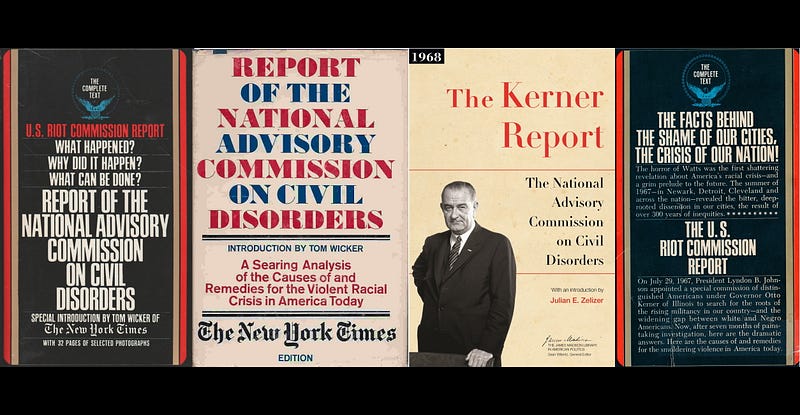
From the Kerner Commission Part II. Why did it happen, Chap. 4 The Basic Causes

Frustrated hopes

The expectations aroused by the great judicial and legislative victories of the civil rights movement have led to frustration, hostility, and cynicism in the face of the persistent gap between promise and fulfillment. The dramatic struggle for equal rights in the South has sensitized northern Negroes to the economic inequalities reflected in the deprivations of ghetto life.

Legitimation of violence

A climate that tends toward the approval and encouragement of violence as a form of protest has been created by white terrorism directed against nonviolent protest, including instances of abuse and even murder of some civil rights workers in the South, by the open defiance of law and Federal authority by state and local officials resisting desegregation, and by some protest groups engaging in civil disobedience who turn their backs on nonviolence, go beyond the constitutionally protected rights of petition and free assembly and resort to violence to attempt to compel alteration of laws and policies with which they disagree. This condition has been reinforced by a general erosion of respect for authority in American society and the reduced effectiveness of social standards and community restraints on violence and crime. This in turn has largely resulted from rapid urbanization and the dramatic reduction in the average age of the total population.

A climate that tends toward the approval and encouragement of violence as a form of protest has been created by white terrorism directed against nonviolent protest

Powerlessness

Finally, many Negroes have come to believe that they are being exploited politically and economically by the white “power structure.” Negroes, like people in poverty everywhere, in fact lack the channels of communication, influence, and appeal that traditionally have been available to ethnic minorities within the city and which enabled them — unburdened by color — to scale the walls of the white ghettos in an earlier era. The frustrations of powerlessness have led some to the conviction that there is no effective alternative to violence as a means of expression and redress, as a way of “moving the system.” More generally, the result is alienation and hostility toward the institutions of law and government and the white society which controls them. This is reflected in the reach toward racial consciousness and solidarity reflected in the slogan “Black Power.”

These facts have combined to inspire a new mood among Negroes, particularly among the young. Self-esteem and enhanced racial pride are replacing apathy and submission to “the system.” Moreover, Negro youth, who make up over half of the ghetto population, share the growing sense of alienation felt by many white youth in our country. Thus, their role in recent civil disorders reflects not only a shared sense of deprivation and victimization by white society but also the rising incidence of disruptive conduct by a segment of American youth throughout the society.

Incitement and encouragement of violence

These conditions have created a volatile mixture of attitudes and beliefs which needs only a spark to ignite mass violence. Strident appeals to violence, first heard from white racists, were echoed and reinforced last summer in the inflammatory rhetoric of black racists and militants. Throughout the year, extremists crisscrossed the country preaching a doctrine of violence. Their rhetoric was widely reported in the mass media; it was echoed by local “militants” and organizations; it became the ugly background noise of the violent summer.

We cannot measure with any precision the influence of these organizations and individuals in the ghetto, but we think it clear that the intolerable and unconscionable encouragement of violence heightened tensions, created a mood of acceptance and an expectation of violence, and thus contributed to the eruption of the disorders last summer.

The police

It is the convergence of all these factors that makes the role of the police so difficult and so significant. Almost invariably the incident that ignites disorder arises from police action. Harlem, Watts, Newark, and Detroit — all the major outbursts of recent years — were precipitated by arrests of Negroes by white police for minor offenses.

But the police are not merely the spark. In discharge of their obligation to maintain order and ensure public safety in the disruptive conditions of ghetto life, they are inevitably involved in sharper and more frequent conflicts with ghetto residents than with the residents of other areas. Thus, to many Negroes, police have come to symbolize white power, white racism, and white repression. And the fact is that many police do reflect and express these white attitudes.

The atmosphere of hostility and cynicism is reinforced by a widespread perception among Negroes of the existence of police brutality and corruption and of a “double standard” of justice and protection — one for Negroes and one for whites.

One final note

The assertion that a TandaPay claim has legal precedence in case law to serve as evidence in a court of law hinges on one important assumption. TandaPay groups must function to bridge the gap between local governments and the community in the exact manner described by the Kerner Commission in chapter 10. This requires that a TandaPay group be granted powers by local government to act in the role of a Neighborhood Action Task Force. These powers are described by the commission as being:

“The power to receive complaints, hold hearings, subpoena witnesses, make public recommendations for remedial action to local authorities and, in cases involving violation of law, bring suit: These powers are the minimum necessary for the effective operation of the grievance mechanism. As we envision it, the agency’s principal power derives from its authority to investigate and make public findings and recommendations.”

Join the financial revolution

Video on the legacy of the Kerner commission:

More about TandaPay:

Geroge Floyd
Racism
Police Brutality
Lyndon Johnson
Protest
Recommended from ReadMedium