
Karma Is Not the Everything
The five universal orders shaping our existence in Buddhism
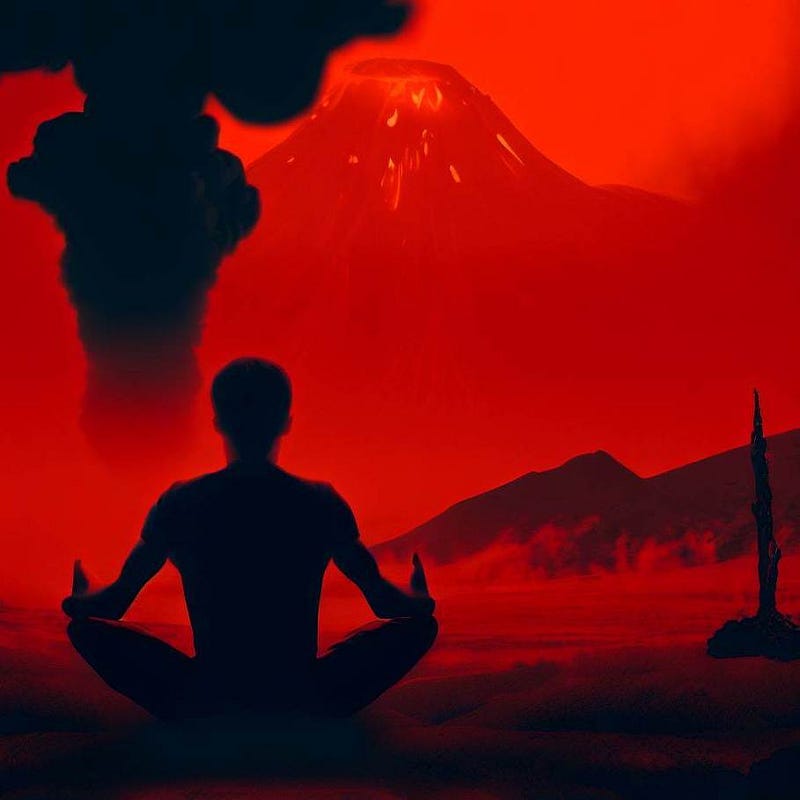
Do you know that five universal laws, or more precisely, orders, define the existence of every single thing and being? Well, at least we Buddhists believe that.
Read this article for free here. Use my referral link to enjoy unlimited access to Medium posts.
I’m not going to impose my beliefs on you; I’m attempting to explain how I have understood this concept of universal orders. These five orders are:
1. Utu Niyama / The Order of Seasons or Change 2. Beeja Niyama / The Order of Germs or Seeds 3. Dhamma Niyama / The Order of Nature 4. Kamma (Karma) Niyama / The Order of Action 5. Citta Niyama / The Order of Mind
Since I am not an expert on this subject, please remember that what I am saying may have shortcomings. Having said that, let’s have a small discussion.
We believe heat is a driving force in this universe that causes change. It affects various aspects of our lives, from simple things like feeling warm on sunny days to cold on rainy days.
Further, it contributes to climate changes, seasonal variations, wind, and storms, leading to natural disasters, global warming, and much more. We can even explore the formation of our world and the atmosphere under this topic.
These actions are associated with change, which originates from heat and is defined by Utu Niyama (The Order of Change).
The next one is Beeja Niyama (The Order of Germs). This is mainly associated with genetics. Simply, when you plant a seed, it will grow into a tree. When you plant a mango seed, you will get a mango tree, not any other type. Similarly, a child may resemble their parents. Everything we discuss related to genealogy falls under this order.
The third one is Dhamma Niyama (The Order of Nature). It describes the natural phenomena of the world. For example, a string may break under tension, and one will feel pain when their finger is punctured by a safety pin.
Further, we can apply scientific concepts such as gravity, inertia, momentum, and more. Even processes like the aging of people are natural phenomena.
Some of these things have been known for a long time, while others have been recently explored, and we will continue to discover more. If something is connected to the world’s natural order, it belongs to Dhamma Niyama.
We can divide every object in this world as animate or inanimate. Inanimate objects are subject to only Utu Niyama (Change) and Dhamma Niyama (Nature). If we consider flora, it falls under Beeja Niyama (Germs) in addition to the previous two orders.
Now, what about animals? In addition to the above three orders, animals are affected by the next order, Kamma Niyama (The Order of Action) also.
The Kamma Niyama or Karma
I assume that most of you are familiar with the concept of Kamma or Karma, up to some extent. If we do a good deed, we will have a good result. Similarly, if we do a bad deed, we will have a bad result. Some even think that the entire Buddhism is entirely about Karma.
No! Karma is not everything. Karma is just one of the five orders.
But it is not far from the truth to say that good deeds result in good outcomes and bad deeds result in bad outcomes.
However, it is not always the case. For now, let’s set aside the Citta Niyama to see how the other three orders can influence Kamma Niyama and vice versa.
In our belief, it is believed that one should have performed good Karma to be born into a good family. Let’s assume a child is born into a wealthy and privileged family. It is considered a result of the Kamma Niyama for that child. The child also inherits the beautiful features from their parents, resulting from Beeja Niyama.
However, suppose one of the parents’ families carries a rare genetic disorder that is passed on to the child. In that case, a combination of Beeja Niyama and Kamma Niyama is at play.
Let’s consider another example. Global warming is a topic we all discuss. It doesn’t matter whether an individual action was good or bad, he has to bear the consequences like everyone else.
To elaborate further, global warming may cause an earthquake, an action caused by Utu Niyama. The seismic waves resulting from the earthquake can cause damage to buildings, an action caused by Dhamma Niyama.
Let’s imagine a scenario where one person remains unaffected by the earthquake. In contrast, thousands of others in the same area are affected. This discrepancy is likely a result of Kamma Niyama for that particular person.
We should understand that most of the real-life cases are very complex, and it is difficult to distinguish each order from the others. Actually, there is no need for us to identify them separately.
It is sufficient for us to acknowledge the existence of these orders. Exploring deeper is not recommended as it does not yield a meaningful outcome.
A developed mind
Instead, we should focus on the final order, Citta Niyama (The Order of Mind). This order is relevant only to living beings with developed minds, and humans fall into that category.
The nature of the mind does not strictly adhere to the principles of the four previous orders. It possesses distinct properties. One’s mind can traverse great distances instantly, making it a highly complex process.
Citta Niyama, or the Order of Mind, is always associated with control. This is because a developed mind can influence the effects of the previous four orders. However, in Buddhism, it is not recommended to deliberately alter the orders of Utu, Beeja, and Dhamma. The primary focus is on altering the order of Kamma.
That is the reason we have heard more details about Karma and Citta related to Buddhism and less about the first three orders, Utu, Beeja, and Dhamma.
Next time, if you hear someone say that Karma is everything, remember that Karma is not everything. It is just one order among the five universal orders. And it can also be influenced by a well-developed mind.
Thank you very much for taking your valuable time to read this post. I hope that I have shared something meaningful with you. If I have created any confusion, please forgive me. I would be happy to discuss it further with you.
Disclaimer If there are any misinterpretations or errors in the information provided, it is solely my responsibility and not a reflection of any shortcomings in Lord Buddha’s teachings. Any knowledge gained from this source should not be attributed to my abilities, but rather to the uniqueness of the Dhamma.


