
Diana C.’s 30-Day Poetry Challenge | Day 28: Heed the message behind the feeling
Justified Rage
Tanka inspired by an incident of hate speech and debate over who has the standing to judge

Anger has value Signals moral core raided My space invaded Blood boiling yet controlled rage Saber of Light rules the page
This poem arises out of a two-day conflict in which I engaged with a group of my co-editors. I flagged a story on the current escalation between Arabs and Israelis for hate speech. It contained outright vitriol but I spotted and identified the allegation that Israel abducts an Arab child every three minutes as the propagation of a 1000’s of year-old anti-Semitic lie and then stepped away so my being Jewish would not prejudice the process, trusting that my judgment would be heeded. It was not. Another editor published a sanitized version of the story but with that line intact. I immediately removed it and reported the story to Medium.
The battle that ensued shocked me and boiled my blood. People said my being offended did not make a comment hateful. Sheer ignorance. I was not offended. I am sympathetic to all people on each side of the conflict that are pawns of their respective governments and other power structures.
The following two quotes are mine:
there is nothing to put to a vote — when the members of a targeted group say that words are hate, it’s not for a member of another group to say they disagree. They do not have the context to get a vote. I specifically noted at the outset that the allegation of kidnappings was hate speech [these hits in this link explain] and it was left in and published with that intact over my voiced objection. Agree to disagree is correct over policies — Not what is and what is not hate.
Words that may seem innocuous to many may be recognized as hateful to others. It is possible that your perspective and life experiences may provide insight that we may miss. If you recognize hate that we have missed, please bring it to our attention and it will be addressed accordingly. People need to agree to disagree about beliefs such as politics, religion, economics, and philosophy, etc., but when a targeted group recognizes hate speech, that is something that is not up for discussion. We should defer to those that have been discriminated against without putting it up for a vote.
These stories by Rebecca Stevens A. are instructive:
The good news is a constructive policy on handling contentious articles is emerging.
I do not recall experiencing such blood-boiling anger as I felt towards the publishing editor and her defensive, patronizing, dismissive and narcissistic posture. She must have triggered some unresolved past-life trauma in me for me to react that way over this. I do not identify myself as Jewish religiously. Ethnically and culturally though, yes.
I questioned whether I needed to calm down and not react out of anger. Upon reflection, I acted properly —I needed to heed and respect my anger, not doubt its authenticity and reasonableness. I think most of the poem explains itself with the context I provided. The fifth line stands for:
The other day I wrote a tanka that addressed cognitive dissonance. Rebecca Romanelli responded:
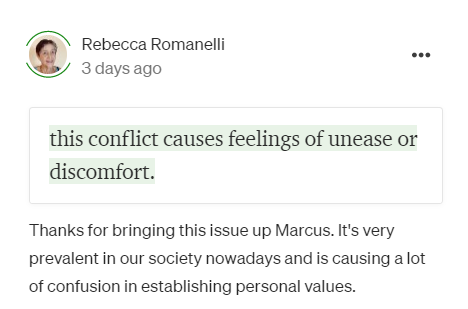
I believe the woman with whom I and one other were fighting, and all those who sat by silently, suffer from this. I thank the two people who spoke up and defended us.
As for the scourge of self-doubt, Holly Kellums wrote another fantastic story today.
We have ropes of trauma and abuse, ropes of societal conditioning, and ropes of the people around us who have whispered doubt into our ears — doubt that became our own inner voice. We have ropes of fear, shame, and guilt — ropes of obligation and weaponized responsibility and humility. So many ropes they could never all be understood, let alone named. But there is one rope that ties together all the ropes that hold us back. It is the rope of doubt.
In Rama I create,


