
Just Half an Hour in a Wheelchair Illuminated My Able-bodied Privilege
Ridesharing apps need to take disabilities seriously
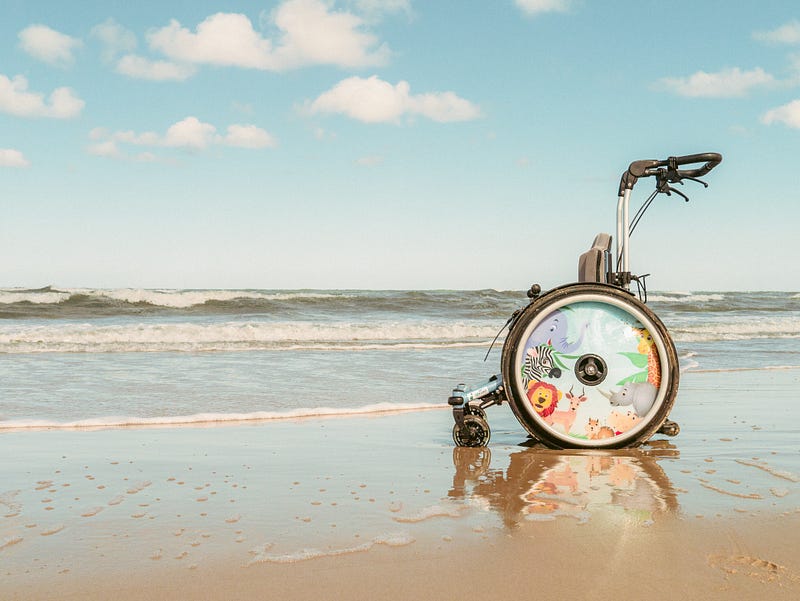
Two days before I graduated college, I had surgery to remove ovarian cysts. It wasn’t medically necessary, but it was crucial for my Peace Corps position that began in a month (and then the Peace Corps dropped me abruptly, but that’s another story).
By the time I could leave alongside my mom, it was late and I just wanted to get home. A nurse waited with us until we had a ride.
I didn’t have a car up at college and the bus wasn’t an option in my condition, so I arranged for an Uber. In a few minutes, the map showed a meeting point on the outskirts of the hospital—a spot relatively far away and definitely inaccessible for someone in a wheelchair.
I didn’t know what to do. I tried calling, but they left. My absence from the spot I couldn’t get to was penalized with a fee.
Okay, round two. I would be more upfront. I immediately called them to explain the situation. “Hi, I’m right in front of the hospital. I can’t get to where Uber wants me to go because I’m in a wheelchair.”
“My car can’t fit a wheelchair.” The driver then cancelled the trip.
Now seething in frustration, I arranged for another ride.
“I need you to drive all the way up to the hospital because I’m in a wheelchair and I can’t get to where Uber wants me to go,” I told the third driver. “But I’ll get out of the wheelchair when I get into the car, so you don’t have to transport it.” That seemed to do the trick.
Finally, this driver pulled up. He glanced at me when I gingerly sat myself down in the passenger seat. “You look fine.”
“Well, I just had an ovarian cyst removal surgery,” I said, an edge to my voice. I assumed mentioning women’s reproductive parts plus surgery would make him uncomfortable enough to take me seriously.
I was correct. He started backpedaling his tone. “Oh. That sounds painful.”
“Yeah.” I had already emerged from a hospital in a wheelchair, but apparently even that wasn’t enough “proof.” It bothered me — but didn’t surprise me — that I had to disclose private medical information to not be dismissed as a fake.
I am privileged enough to not have to go through situations like that regularly, but that’s not others’ realities. I shudder to think how long I would have waited if I couldn’t leave my wheelchair at the hospital, if I needed a ramp.
Disabled activists have been speaking up about this issue for years and lawsuits over the issue have been filed across the United States, but unfortunately I had never read anything about these struggles until I started doing research for this piece, had ignorantly never even considered that this could be a problem until I was in that position myself.
Wheelchairs are not the only barrier in disabled people receiving service. People who need service dogs are routinely turned away from rides.
After continually being denied rides and not getting taken seriously by Uber and Lyft when he reported such incidents, a man with cerebral palsy, who has a service dog, video-taped his encounters with drivers dismissing him.
They usually only took him seriously when he mentioned it was against the law to not let him ride with his service dog, Pico. Drivers through Uber, Lyft, and any other ridesharing company have to sign a contract complying with the Americans with Disabilities Act.
Not that this law makes much practical difference for much of the disabled community trying to find rides. One disabled woman mentioned on Twitter that her friend with Tourette’s had his Uber “account…*suspended* for too many ‘cancellations.’” Cancellations made by drivers who didn’t want the “hassle” of providing service to him.
I realize rideshare drivers are underpaid by greedy companies. In general, it makes sense to want to maximize and simplify their rides. But that’s not an excuse for perpetuating dehumanizing and illegal behavior. Of course, some factors, like a lack of vehicles that can accommodate wheelchairs, are the fault of corporations, not drivers.
In response to lawsuits, Uber has created a system to obtain Wheelchair Accessible Vehicles (WAVs)…in only 11 U.S. cities. Lyft has a similarly lacking system. In New York, the most populated city in the nation, researchers found in 2018 that “not a single wheelchair-accessible vehicle [for Uber or Lyft] could be located at NYC’s two major airports.”
Ridesharing companies may be somewhat dependent on drivers having and wanting to drive WAVs, but their ample resources could provide financial incentives for drivers to acquire WAVs. I can better understand less-populated areas having trouble providing adequate service, but the fact that a program specifically for wheelchair users can’t be relied upon to actually ride in WAVs in a huge metropolitan area indicates just how much Uber and Lyft neglect the needs of disabled people.
Especially when driving is not possible for some disabled people, and when public transportation can be inaccessible for certain disabilities as well as unreliable or nonexistent in many areas, ridesharing transportation can be crucial. But in any case, disabled people deserve to be able to use ridesharing apps and be treated with respect while doing so.
Expecting Uber and Lyft to be ethical on their own accord is laughable, and I don’t expect much change without widespread public pressure and lawsuits. I don’t have all the answers of course, and will look to disabled activists on the issue. Yet a good (albeit obvious) beginning would be for companies to put more pressure on drivers to comply with the ADA and treat everyone with respect, and to take disabled people’s concerns more seriously when issues arise.
More difficult is ensuring reliable rides with WAVs in the cities that they already operate in, as well as expanding this program to other areas, although I’m certain that accessibility is not as impossible as Lyft and Uber like to say it is for their own benefit.
In any case, since my experience, which is absolutely nothing compared to others’ experiences with ridesharing on a regular basis, alongside every other barrier in an ableist society, I have tried to be more mindful of the difficulties disabled people face. Something shouldn’t have had to happen to me personally for me to take these issues more seriously, but I hope to do better in the future.
Thank you for reading!
If you want to read more of my writings, you may check out the following articles.
You can share your outstanding stories and inspire others. Just click the below image and be a writer for The Masterpiece.
