
Jura
…and one of the true 20th-century prophets

Today’s New York Times Spelling Bee letters:
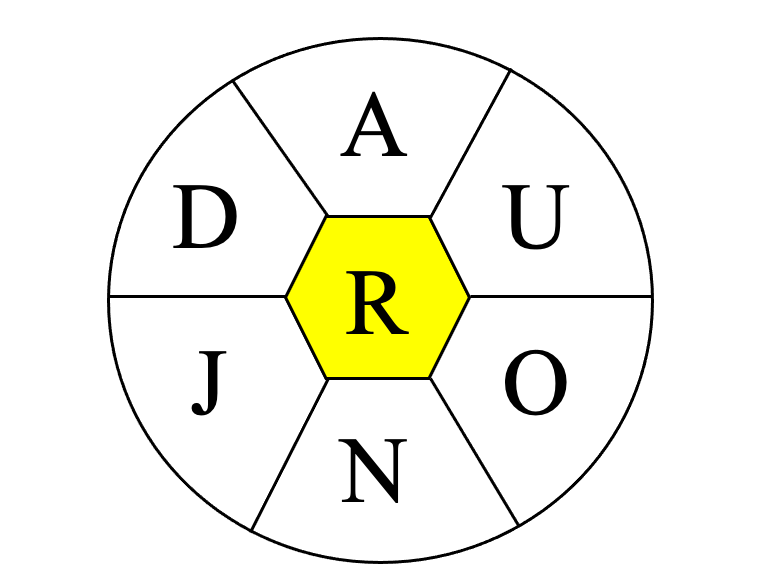
A, D, J, N, O, U, and center R (all words must include R)
Merriam-Webster says…

Silly little dictionary! Don’t you know that jura can’t possibly be a word if The New York Times says it ain’t?
For further fascinating facts, check out the Spelling Bee Master.
What’s your favorite dord* from today’s puzzle?
My Two Cents
For almost two decades, I’ve been telling people how “George Orwell missed by twenty years”. (So, if you ever hear someone else say it, know that I said it first!) Had he named his novel Two thousand four instead of Nineteen eighty-four, perhaps we could have avoided complacently falling into the hands of Big Brother in such a docile and democratic manner. Or maybe not. Maybe we would still have ended up with cameras watching us everywhere we go, eternal wars left and right, and mind-numbing Newspeak permeating our vocabulary.
What does Orwell’s novel have to do with jura… or Jura? Read on to find out!
Laying down the law
Merriam-Webster is not very helpful when it comes to defining jura, especially since our readers cannot click the blue, linked word “RIGHTS” because we here at Silly Little Dictionary! still don’t have the tech to make it active in our screenshots. But that advancement will come soon… as soon as we start earning four figures per month instead of per decade. Anyhoo, when we clicked on RIGHTS we got…
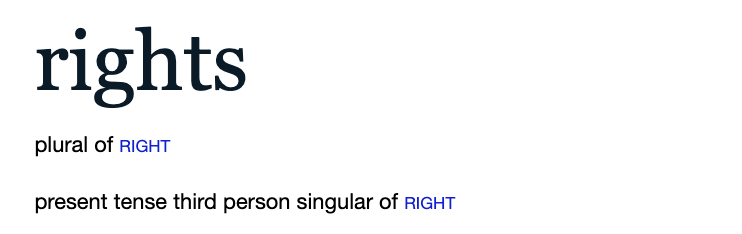
…which also wasn’t very enlightening. So we clicked on RIGHT and got a very long entry with 15 definitions!
Well, let’s stick to the first few meanings, which are the ones that matter for the purposes of this article:
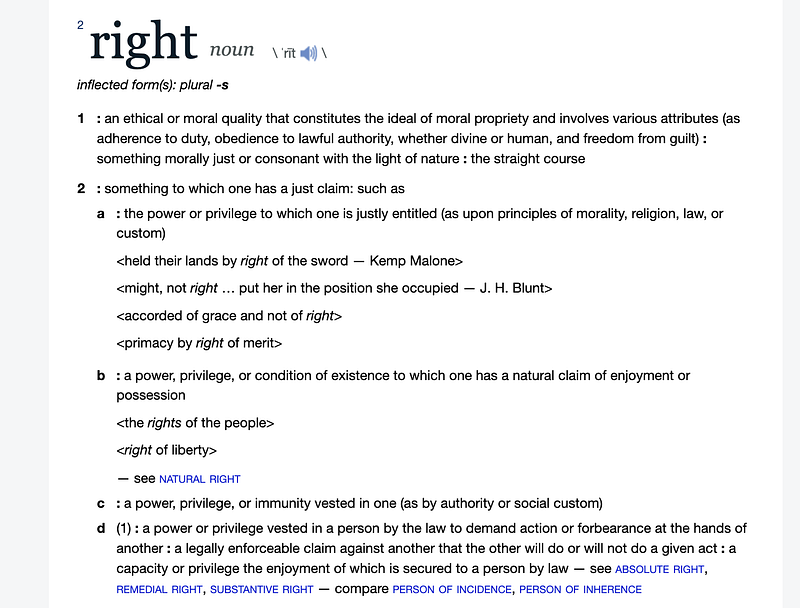
Circling back to jura, the dictionary explains it comes from Latin and is the plural form of jur-, jus, meaning “law” or “right”.
Law in ancient Roman developed over the course of more than two thousand years, from the founding of the city in 753 BC until the fall of the Byzantine Empire in 1453. This legal system influenced law in most of what we now call “Western civilization”, but even had some effect on other societies. (After all, Rome’s influence –-and the Byzantine Empire–- stretched across Europe, Africa, and Asia.) Today, civil law in many European countries is based on the old Roman jura codes.
The Encyclopedia Britannica explains this about the history of Roman jura (please note that jura is the plural of jus):
In the great span of time during which the Roman Republic and Empire existed, there were many phases of legalistic development. During the period of the republic (753–31 BCE), the jus civile (civil law) developed. Based on custom or legislation, it applied exclusively to Roman citizens. By the middle of the 3rd century BCE, however, another type of law, jus gentium (law of nations), was developed by the Romans to be applied both to themselves and to foreigners. Jus gentium was not the result of legislation, but was, instead, a development of the magistrates and governors who were responsible for administering justice in cases in which foreigners were involved. The jus gentium became, to a large extent, part of the massive body of law that was applied by magistrates to citizens, as well as to foreigners, as a flexible alternative to jus civile. Roman law, like other ancient systems, originally adopted the principle of personality — that is, that the law of the state applied only to its citizens. Foreigners had no rights and, unless protected by some treaty between their state and Rome, they could be seized like ownerless pieces of property by any Roman.
The ancient Romans also classified their law into jus scriptum (written law) and jus non scriptum(unwritten law). “Written law” referred not just to legislation and any laws derived from it, but also any laws that could be based on any written source (a tacit acceptance of precedence, in a way). On the other hand, “unwritten laws” were customs that had been ingrained into Roman society over time.
Written laws were split into several categories. One was the lex, an enactment made by the assembly of the whole Roman people, which despite its name was controlled by the wealthier classes, or patricians. Common folk, or plebeians, had their own council in which they could also pass resolutions called plebiscita. (The English word plebiscite ––a vote of the people on some measure submitted to them by a government body–– comes from the Latin plebiscitum.)
But the plebs fought for their rights, and over time were able to pass laws that the patricians could not overturn. These were called the Twelve Tables, vaguely akin to the Bill of Rights in the U.S. Constitution. Unfortunately the text of that code was lost, but from references by different authors, historians know that matters such as family law, tort, and legal procedures were included.
Other types of written law included the edicta (edict), or proclamation issued by a superior magistrate on judicial matters; the senatus consulta (resolutions of the Roman senate), which were suggestions made to magistrates, but that had no legislative force during the republic; the constitutiones principum, or expressions of the legislative power of the emperor (I assume they were similar in spirit to modern presidential decrees); and the responsa prudentium, or answers to legal questions given by lawyers to those who consulted them.
A couple of centuries after Emperor Constantine I converted to Christianity, reorganized the empire and made Constantinople the capital, and emperor named Justinian decided to organized the mess of laws he had inherited. The new law, known as Corpus Juris (body of civil law), remained in effect more or less for around 900 years until the end of the Byzantine Empire in 1453. The Corpus Juris was modified towards the end of the 9th century by Emperor Leo VI –-and called the Basilika–– but its effect was mainly on the Eastern portion of the empire.
Sipping whisky with Big Brother
Jura with a capital “J” is the name of several locations around the globe, but the Scottish island is the one closest to my heart. And for two reasons. First, there is a whisky distillery there, and secondly, it’s where English novelist and journalist George Orwell wrote his prophetic novel Nineteen Eighty-Four.
Jura the island forms part of the an archipelago of the Inner Hebrides, off the west coast of mainland Scotland. Another island in that group, Staffa, has a sea cave that inspired Felix Mendelssohn to compose The Hebrides overture, which many people around my age know as the tune to which a mynah bird hopped in a very un-PC Merrie Melodies cartoon series about an African child called Inki.
Like several other islands in that archipelago, Jura makes whisky in a distillery that was founded more than two centuries ago, but went through a few periods in which it was shut down and even dismantled. There is also a rum distillery that opened on the island in 2021.
Jura whisky has several expressions; currently there are four offered on their website: a 10-year-old, a 12-year-old, an 18-year-old, and one called Jura Seven Wood. But there have been other whiskies made over the years. The Two-One-Two celebrated the 212 inhabitants of the island when it was distilled. Then there is the 30-year-old 1984 whisky, named after the novel George Orwell completed in 1948… on the island of Jura.


The whisky was distilled in 1984 and bottled in 2014. One 1984 bottled were released. I remember when it came out, and although I was a huge whisky collector back then, I didn’t buy a bottle… which today can be found for over $1,000 in some specialty stores.
George Orwell was the pen name of Eric Arthur Blair, who unfortunately died at the young age of 46. But before he did, he wrote two famous novels (Animal Farm and Nineteen Eighty-Four), a bunch of essays on politics, language, and culture, and several nonfiction books about his life, including Homage to Catalonia, which tells of his experiences fighting against General Franco during the 1936–1939 Spanish Civil War.
Although Orwell was already a well-known and respected journalist and critic, Animal Farm, an allegory against Stalinism in short-novel form published just after World War II ended, gave Orwell great success and turned him into a sought-after literary figure. Less than a year after Animal Farm was published, in May of 1946, Orwell went to live in an abandoned house known as Barnhill on the island of Jura. There he wrote what readers of the New York Times Book Review rated in 2021 as the third-best of the “books written in the past 125 years”: Nineteen Eighty-Four.
The name of the book came from inverting the last two digits of 1948, the year in which Orwell finished writing it. Wikipedia has a decent summary of the plot:
The story takes place in an imagined future, the year 1984, when much of the world has fallen victim to perpetual war, omnipresent government surveillance, historical negationism, and propaganda. Great Britain, known as Airstrip One, has become a province of the totalitarian superstate Oceania, ruled by the Party, who employ the Thought Police to persecute individuality and independent thinking. Big Brother, the dictatorial leader of Oceania, enjoys an intense cult of personality, manufactured by the party’s excessive brainwashing techniques. The protagonist, Winston Smith, is a diligent and skillful rank-and-file worker at the Ministry of Truth and Outer Party member who secretly hates the Party and dreams of rebellion. He expresses his dissent by writing in a diary and later enters into a forbidden relationship with his colleague Julia and starts to remember what life was like before the Party came to power.
The novel has brought into the collective unconscious the terms “Orwellian”, “Thought Police”, “doublethink”, “thoughtcrime”, “Newspeak”, and “2 + 2 = 5”.
Orwell prophesied our addiction to TV, our complacency with being monitored 24/7 (sold to us today as something that’s for our own good), and the cult of populist leaders. I’ve always thought he missed on two key elements: (1) the year, obviously, and (2) the fact that it would be overtly fascist governments that would establish the society that he describes in the novel. I’m not saying dictatorships aren’t doing just that –-they are. But many of what we consider free governments and nations are sliding down the slippery slope of totalitarianism and become fascimocracies.
I remember when the year 1984 swung around, and everyone was reading and talking about the book. Back then we didn’t have the surveillance technology we do today, the Soviet Union still existed, and the Cold War seemed like it would go on forever. Who knew that less than a decade later all those things would change. When the 2003 Gulf War began, I remember thinking about how that conflict could end up lasting for decades. It has, in the form of the “war on terror”. So, too, has the “war on drugs” been going on seemingly forever. We have accepted constant surveillance as a fact of life; many people voluntarily place cameras in their own homes without the need for government coercion.
Nineteen Eighty-Four should be required reading not just for high school and college, but for all adults… on a yearly basis, if possible. even though it’s been 73 years since the novel was published and almost 40 since the year it’s named after passed, the book is as relevant today –-and perhaps even more so–– than it was in 1984.
Now you know. Next time someone mentions the novel Nineteen Eighty-Four, you’ll have all the information necessary to engage in a discussion about how George Orwell was a prophet, how he missed by only a couple of decades, and how he wrote about the erosion of our jura while sipping Jura whiskey on the island of Jura. Don’t be surprised if people don’t understand that last part. Not because Orwell’s beverage of preference was beer… but because the editors of the Spelling Bee decided that jura is a dord*.
You can check out my previous entry on another dord* here:
*What the heck is a dord, you ask? Here’s the answer: