
Is It Journalists’ Job to Vet Political Nominees?
Not exactly, no, it isn’t
As we ring in 2024, I want to do a look-back on an incident several years ago during the Trump administration.
Trump Nominated John Ratcliffe as Director of National Intelligence
On July 24, 2019, when special counsel Robert Mueller testified before the House Judiciary Committee, Representative John Ratcliffe pummeled him with questions about whether his investigation was based on politicized anti-Trump sources. Trump saw Ratcliffe on TV and was thrilled with the performance.
Yes, Trump called Zelenskyy the next day
The first important thing Trump did, the very next day, was to call Ukrainian President Volodymyr Zelenskyy and threaten to withhold $400 million of congressionally approved military aid if Zelenskyy did not help Trump discredit his rival Joe Biden. Trump would later be impeached for doing this. We know all this now.
But I digress.
I mean to focus on what happened with Ratcliffe’s nomination, as I did when I wrote the first draft of this essay on another blog a few years ago.
Trump announced on July 28, 2019 that director of national intelligence (DNI) Dan Coats would be fired, and he simultaneously nominated Ratcliffe to replace him. Ratcliffe did sit on the House Judiciary and House Intelligence Committees, which is somewhat relevant experience, I guess, though a normal choice would have been deputy director Susan M. Gordon with her thirty years of experience and relevant positioning. But no. We can’t have normal.
2019 Wasn’t Ratcliffe’s Year
Unfortunately for Ratcliffe, he was found to have embellished his credentials, and he was not to get the job at this time.
Here were some problems, according to Vox:
- He’d overstated his role in the arrest of a large number of undocumented immigrants in a single 2008 incident. Not only hadn’t there been as many people arrested as he claimed, but he hadn’t overseen the operation.
- He said he was responsible for convicting terrorists who funded Hamas, but he did not prosecute that case.
- He claimed that President George W. Bush had appointed him as “chief of anti-terrorism and national security in the Eastern District of Texas,” a position that doesn’t exist.
Furthermore, after a company “forced the shutdown of a critical government cybersecurity office” and retaliated against a whistleblower, Ratcliffe sided with the company. Why? Because that company was his third-largest donor at the time.
Does it matter? Yes. Why? It is a national security concern. Why? Because this is the role of Director of National Intelligence the government is trying to fill here.
Five days after Trump nominated him, Ratcliffe withdrew his name from consideration.
It’s Unfair! Isn’t It?
Trump, interviewed about the matter on the day of Ratcliffe’s withdrawal, waved away the reporting on Ratcliffe as somehow invalid (“fake”) and said he’d recommended to Ratcliffe that he withdraw his name to avoid further unfair scrutiny. Ratcliffe similarly suggested in a tweet that the concerns with his nomination were “purely political and partisan.”
No, actually, he shouldn’t have been nominated in the first place.
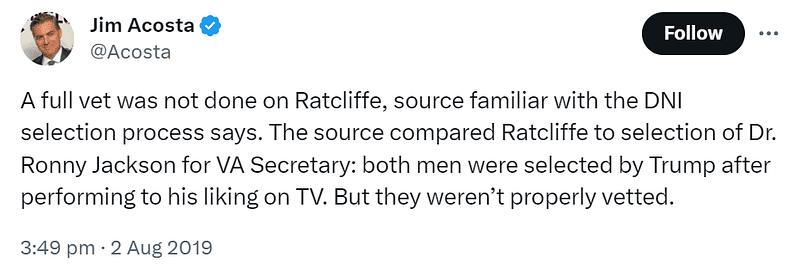
On the day of Ratcliffe’s withdrawal, CNN’s chief White House correspondent Jim Acosta tweeted that Ratcliffe had never been vetted. Trump had just seen the guy on TV.
Trump: You Have to Side With My Guys
Trump, unsurprisingly, contradicted himself in comments to reporters regarding his general expectations for how he wants the world to work.
First, he complained that the press had been somehow unkind in exposing Ratcliffe’s lies. They did it “unfairly,” “harshly,” he said.
“I could see that the press was treating him — I thought — very unfairly. He’s an outstanding man. And I asked him, I said: ‘Do you want to go through this for two or three months, or would you want me to, maybe, do something else?’ And he thought about it. I said, ‘It’s going to be rough.’ I could see exactly where the press is going. (Fake news!) He’s a fine man, he’s a fine man…I think he was just treated very badly, very harshly by the press. And he really had a decision to make. ‘Do you want to go through this for — it could be months.’ And I said, ‘I think I see exactly what they’re trying to do.’ Nobody understands the press. But I think I understand them as well as anybody. And I didn’t think it was fair.” (see video)
Yet in the same interview, he informed the press that it’s indeed their job to “vet” his political picks. In the clip below, he says this seven times.
“You vet for me. I like when you vet. No, no, you vet. I think the White House has a great vetting process. Uh, you vet for me. When I give a name, I give it out to the press, and you vet for me. A lot of times you do a very good job. Not always. I think — if you look at it, if you take a look at it — the vetting process for the White House is very good. But you’re part of the vetting process, you know? I give out a name to the press, and you vet for me. We save a lot of money that way. But in the case of John, I really believe that he was being treated very harshly and very unfairly.” (see video)
Vetting someone implies a number of tasks, including searching for and exposing lies. When someone identifies a concern about the person they’re vetting, you can’t then say they’re being harsh and unfair. That is their intended relationship toward that person. It’s sort of like a prosecutor’s role toward a defendant.
Andrew Simpson writes in the DC Tribune:
“the video shows how Trump doesn’t take any of it seriously in any way whatsoever, telling reporters he gives a name of a nominee to the press ‘and you vet for me’ — meaning he finds out at the same time as everyone in the general public whether the person he’s just nominated is a liar or a criminal or a wife-beater or a tax cheat. Trump doesn’t do homework, he just lets others figure things out and then decides how hard he wants to defend his choices.”
No, It Isn’t Journalists’ Job to Vet Candidates
There are several thousand political appointees in the United States, about 1,200 of whom require Senate confirmation. For all kinds of reasons, an administration should want to vet its own pick for the job — researching them internally, behind the scenes, before the nomination is presented for media scrutiny. Vetting means doing due diligence to avoid error. Researching a nominee after the fact isn’t “vetting”; it’s cleanup.
A journalist can break a story about a stunning pick that is “newsworthy” for good or bad reasons, but they are not empowered to do the elementary vetting, don’t have to, and probably shouldn’t.
Journalists may not have security clearances or insider access to the information they need to vet each person rapidly. For example, a candidate’s résumé from 10 years ago is stuck in an HR database somewhere. Likewise, a candidate’s recorded conversations on government phones live wherever those recordings are kept. Journalists don’t roll out of bed and start their morning by having that kind of information. It belongs to someone else’s job role, and that person ought to be doing their job with it.
Even if a journalist has access to relevant information, they are paid by private media companies whose goal is to sell newspapers and ad space, and their bosses may not want them to write those stories, and the journalist may not have enough “spare time” to write that story, self-directed, without fact-checkers and editors, as an uncompensated hobby.
Even if they are able to research a nominee and are given the green-light by their employer to spend time on it, this work may be seen as helping a political party. The party may not have its act together, but it’s usually the journalist’s mission simply to report that news, not to help the party avoid error or clean up afterward.
And what happens when a journalist does find information on a nominee? How are they supposed to communicate that to the President? By publishing the story (say, on MSNBC) and hoping that a circus will be made so that the President will see it on TV (he watches Fox) and so that someone will eventually be forced to do something about it (who forces Trump to do anything)?
Because journalists are not officially responsible for the job of vetting candidates, there are no standards for how they should complete that task.
Nor can they be held accountable for underperforming according to the standards they don’t have. There’s no oversight. In the case of Ratcliffe, Trump’s complaint about the quality of the reporting was baseless. What criteria was he using for whether the reporting was gentle or fair? Who evaluates the journalists, other than more journalists? Who, indeed, would “watch the watchers”? Is Trump the final arbiter of truth? QAnon certainly believes he is.
Trump’s Persona: Every Error is Someone Else’s
On a more pragmatic note, Trump — politicians generally, but Trump especially — won’t thank journalists for spotting his errors. Trump will blame the press as being “negative” and therefore “fake” when they’re telling him something he doesn’t want to hear or can’t spin in a soundbite to make himself look good and in control.
He will never admit to having made an error. That’s because, in his worldview, he’s incapable of error. That’s what it means when he says it’s not his job to “vet.” Vetting implies avoiding error. When Trump says he’s not responsible for avoiding error, he implies that none of his decisions can be wrong. If his action will have had awful consequences, it will have been someone else’s responsibility to have avoided that.
He confesses the dynamic he’s set up: He expects others to save him from incorrect information but will malign the very people who save his ass every day because that’s his persona. If he stopped yelling at everyone, he’d be no one. QAnon would have to disband.
But Is Vetting Expensive For the Government?
Depends how you judge what “too much” money is.
Some elementary vetting is free of charge. For example: Don’t assume that every sycophant you see on TV is qualified for any job. Instead, start with candidates who have gone through the relevant career trajectory. You’ll have a better applicant pool that way.
When you start the process with that kind of wisdom, the formal vetting down the line is easier, because the people you suggested have been vetted throughout their careers and are unlikely to have grown up to be horror shows. Because the work is half-done to start with, it’s inherently faster and simpler, and it’ll be cheaper. This is true of all work. If you’re careful at the start of the process, you get cost savings across the whole project.
Deciding who’s qualified to work in government is part of the government’s function. So the “hiring process” can be paid for with tax dollars. Dollars should be spent wisely and efficiently, which is not to say a dollar should never be spent at all. Sometimes we look back to where we spent $1 yesterday, or we think about where we can spend $2 today, either or both of is often preferable to spending $10 tomorrow to deal with an avoidable crisis.
Why Can’t Media Companies Pay for This Research?
There can be a role for private sector money in research. But define the research task, please.
If the suggestion is that “The government can ‘save money’ by outsourcing all its work to private companies,” a question is: “Why does a private company want to work for free?”
If the request is to “let private companies tell government whom to hire,” gosh does that sound like it might turbo-fund corruption.
Whatever exactly you believe about the proper role of government, vetting these people is in the public interest so that person’s salary isn’t wasted (or worse).
Trump Does Not Care About the National Budget
During Trump’s four years in office, the national debt increased by 40 percent.
Again, circumventing normal processes for nominating a national intelligence director doesn’t save a penny when you look at potential consequences. You can’t appoint just anyone for this job. What if the person who gets Senate confirmation amplifies wrong information that you use to justify a decade-long, two-trillion-dollar war? Avoiding such catastrophes is why the DNI role was created.
Ratcliffe Did Get the Job Eventually
DNI Dan Coats was out the door on August 15, 2019. He was succeeded by Joe Maguire as acting DNI. Trump got rid of Maguire in February 2020 and made Richard Grenell acting DNI (I wrote a bit about Grenell) while again nominating Ratcliffe.
This time, Ratcliffe got Senate confirmation and was sworn in that May.
I mean, who cares that he lied about his achievements, right? The Senate sure didn’t care.
He stayed until the end of the Trump administration in January 2021.
In Conclusion
I guess what’s up to “the press” is how to respond to this dynamic. (That’s what I concluded in my first iteration of this essay a few years ago.)
The dynamic is challenging because “the press” is not a monolith but is thousands of individual journalists and private companies.
It’s also challenging because it’s not in a typical journalist’s job description to be in a dysfunctional relationship with someone who tells them what their job description is despite not having that authority and also being wrong and also being the president. I mean, the journalist might expect it, or come to expect it, especially from that president. But it isn’t literally written into their job description to allow Trump to order them around on TV and reinvent their job description.
It does fall upon journalists to respond to the situation, as it falls upon all of us to deal with the cauldrons into which we’ve been harshly, unfairly cast. This is the mess we’re in, and this is why we go to work, and this is why we need to be paid for what we do.
Ideally, it would be up to a properly functioning government not to create this problem in the first place.
I’ve taken the time to revise, update, and move this essay because I hope it can serve as yet another implicit reminder that Trump remains a major force in U.S. government and that the election is in November.