
Joshua Harris finally tells the truth about the ‘Purity Culture’
The one-time Evangelical leader spills the beans
Back in 1997 he wrote an era-defining book, telling Evangelical kids that dating is evil. A generation blamed him for ruining their lives.
The saga of Joshua Harris haunts Evangelical culture. In 2018, he ‘unpublished’ his books, including I Kissed Dating Goodbye, and apologized for it. The next year, he got a divorce from his wife—and Christianity.
Now he’s doing a blitz of interviews, and dropping details — like that I Kissed Dating Goodbye was largely contrived.
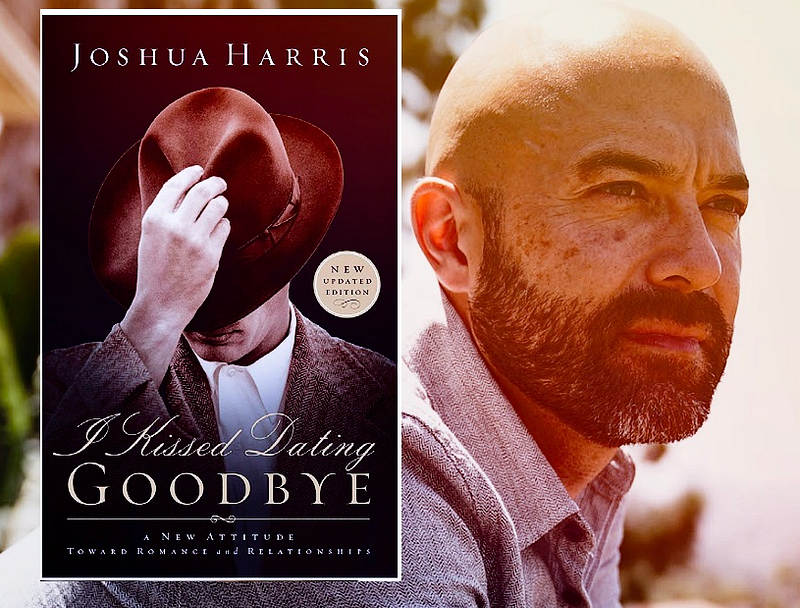
Joahua Harris’ story never exactly made sense.
The book tells the story of what appears to be a regular high school kid who falls prey to the ways of the world. He moves from girl to girl — alarmed at feeling hardened to the rising carnality.
The problem was, he had been homeschooled all his life.
This was a very public fact. With his father, he’d been a homeschool activist.
The big Evangelical movement of the 1980 and 1990s was to homeschool children.
The movement was, as Harris notes, “super radical.” From sex to drugs to rock ’n’ roll, public schooling was public enemy #1 in many churches.
And the way it was always discussed was that public schools oversexualized chidren.
In a new interview on Nadia Bolz-Weber’s podcast, Josh tells a story that is different from the book’s narrative. Though homeschooled, he’d been set up with extracurricular activities. He was on a gymnastics team where the sin really started to flow. He recalls:
“I was making out with these girls behind the school. I stole pornographic magazines and was doing all these things that were very inappropriate for a Christian homeschooled boy to be doing.”
Bolz-Weber interjects: “But developmentally appropriate for a teenage boy…”
That seems to startle him. He adds: “In terms of how I’ve interpreted that time for so long, I viewed it as this incredibly negative time.”
His book had no talk of porn magazines or gymnastics.
Also, it had no talk of homeschooling, or of Josh being a homeschool activist. I Kissed Dating Goodbye began, Harris now discloses, as a speech at a homeschooling workshop.
“I got a massive standing ovation,” he says. “But I look back now and I realize, all these parents, they were standing up and they were applauding for the dream that they had for their kids.”
The “dream” was staying in the religion.
In retrospect, homeschooling was mostly about controlling the process of learning. The religion had deep apprehension of children being educated in a way that would remove them from the religious mentality.
But that wouldn’t be said directly. Or they’d much prefer to talk about ‘oversexualization’ in public schoools.
And Joshua Harris, by deception, provided this proof. He fudged the facts to make it seem as if he had been in public school when his ‘carnality’ was careening out of control.
He was handed a book contract, and at age 21 was writing a book.
His Christian publisher, Multnomah Press, was a hub of homeschooling advocacy. He used some elements from his life. He did have a two-year relationship with a girl in his church’s youth group.
It broke off, he’d written, as he got wary of the “physical side of our relationship” getting out of control.
The actual context for breaking up, he says now, was that he’d gone on a church retreat and decided he wanted to get ‘serious about God’.
The reality was: he got a job as a homeschooling activist.
He launched a magazine of his own, and began travelling the nation giving speeches. Joshua Harris was the demo of the product they were selling — a young man who’d been perfectly trained in Evangelical values through the controlled climate of homeschooling.
All the “purity” narratives must be understood in a different light.
It had been so easy to read I Kissed Dating Goodbye as selling a sexual teaching, but the actual product it was selling was homeschooling.
When Harris was telling stories about inflamed sexual feelings, rising carnality, etc., this pointed in its original context to Evangelical fears about public school and the remedy of religious reclusion.
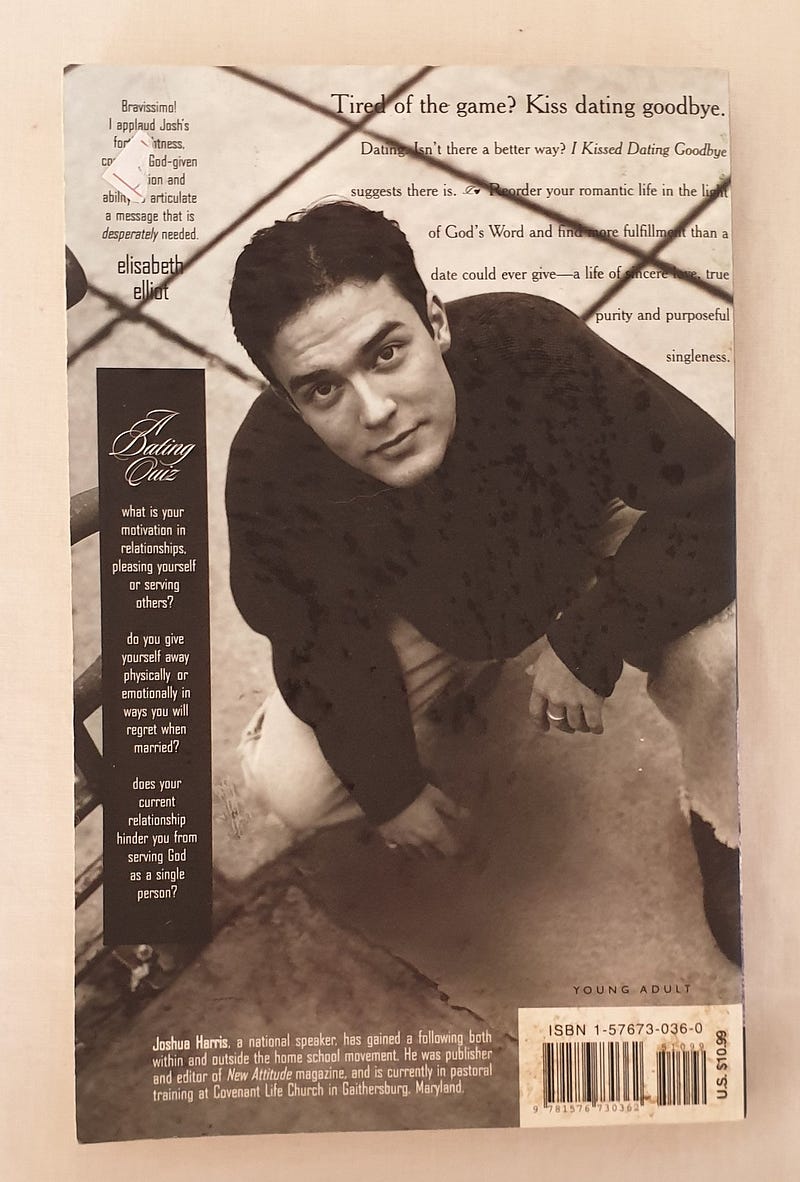
He modeled his book, he’s written, on Elisabeth Elliot’s Passion and Purity, the legendary Evangelical writer’s 1984 broadside against premarital sex. In one of her last gestures as a public figure, Elliot sent him a blurb—commending his “forthrightness, courage, God-given conviction and ability to articulate a message that is desperately needed.”
And Joshua Harris was offered to the Evangelical public as a curiously exotic (half-Japanese) teen heartthrob prophet.
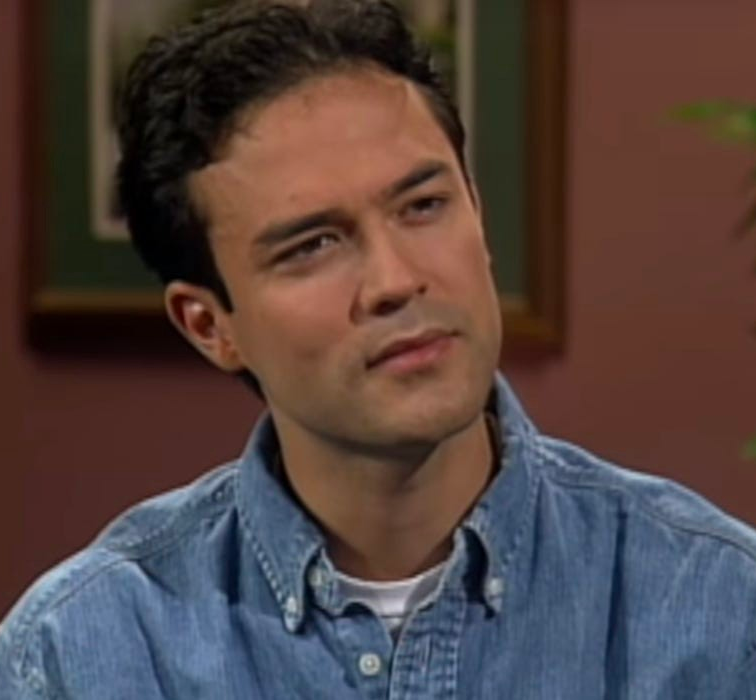
He brushes aside suggestions that he was victimized by adults.
On the Phil Drysdale Show podcast, he says: “I was 21 years old. I was an adult. And I wanted to be a spokesman. I wanted fame. I wanted the notoriety. It was all for Jesus, of course.”
He laughs, and then turns rueful. “I wanted a context that gave me this kind of certainty so I could look down on other people. I was scared of living in a world where, yeah, maybe there’s not one perfect answer. I found my way to a very controlling, legalistic kind of faith. And I made myself at home there.”
He was picked up by a megachurch titan who promised to train him as a pastor.
And so he disappeared into an insular Maryland religious community, which sought to be cut off from the ‘world’.
The separatist mentality at work is a key point in a 2016 exposé in the Washingtonian:
“When it came to the most mundane matters of life, almost any need could seemingly be met in-house: There were members who were lawyers and small-business owners and financial advisers. If you needed your car repaired, there was a mechanic in the next row.”
Harris continued to pump out the books, narrating his ‘pure’ life and latest religious thoughts, and remained an Evangelical star.
It collapsed in 2013 amid a sex scandal at his church.
As part of the reclusive Evangelical community, the clerics wanted their own law enforcement system as well. Taking reports of child abuse, they just buried them.
Though not among those most directly involved, Harris was part of the team of pastors who decided to keep child abuse reports from police. His fame made him a lightning rod in ensuing publicity, and he found himself ejected from the community he had thought was his home.
He still is not expanding on a disclosure he made during that time—that he’d been a sexually abused child.
How many secrets did homeschooling keep?
He’d tried to get trained as a real pastor.
Attending a seminary in Ontario, he became aware that his book was widely perceived as a highly negative influence. He’d turned from famous—to infamous. Unpacking it all now, he calls his big regret “that I didn’t see the flaws and the massive problems in the book sooner.”
He speaks of his delay in facing up to the backlash against his book. He says now:
“I think the wrong motivations there were wanting to please my fan base. The wrong motivations were wanting to cut off the book royalties that allowed me to enjoy a certain lifestyle. It’s almost like I didn’t want to open that door—because who knows what’s on the other side of it?”
Then came his 2018 “confessional” tour, and film. And in 2019, his divorce. Shortly afterward, he announced: “By all the measurements that I have for defining a Christian, I am not a Christian.”
When he marched in a Pride parade—it seemed a done deal.
“I really just wanted to be left alone by Christianity,” he says in an interview with the Sophia Society. He adds: “Affirming LGBTQIA+ people is a great way to get Evangelicals to leave you alone.”
He clarifies it’s not a full retreat from belief.
He says: “That was not this final statement of ‘I’m not going to ever be a Christian, appreciate Christian viewpoints, whatever.’ I view myself—”
He pauses, and adds: “I like the phrase ‘unfolding’. I’m still unfolding.”
He’s no longer an Evangelical leader, and the religion has no desire to get into the details of his story. All his new interviews, I realized, were with non-Evangelical outlets. 🔶


