
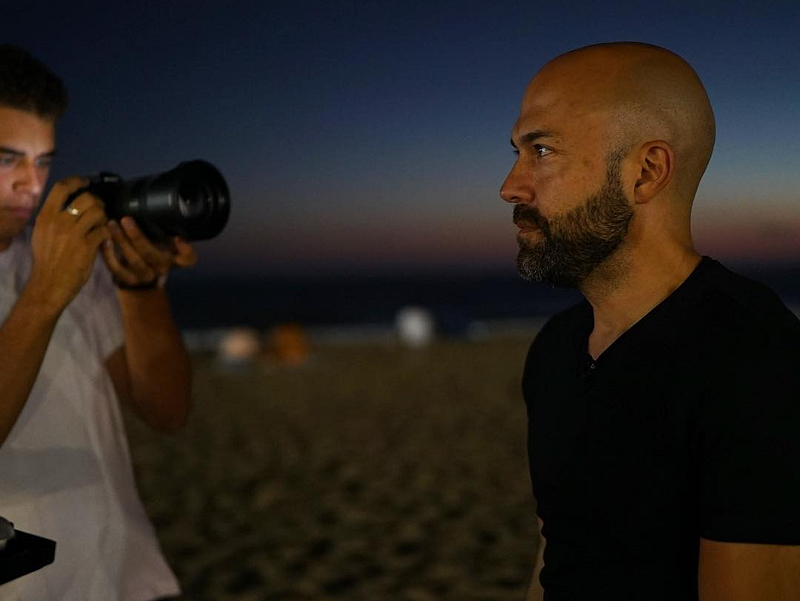
Joshua Harris: the trainwreck reality T.V. show
He played the part of oversexed “Evangelical leader,” out to make people holy by not touching.
For two decades, Evangelical Christianity tuned into the Joshua Harris reality T.V. show. He played the guy who torments himself for sexual thoughts. I flip through his bestselling books, like Sex Is Not the Problem (Lust Is): Sexual Purity in a Lust-Saturated World.
The water was great, the beach was beautiful. But it was also crowded with women in revealing swimsuits.
Back home, his wife gets a lingerie catalog in the mail, and throws that filth away. He longs to pull it out of the trash and look at the ‘pornography’, telling himself: “I’ll only look quickly.”
It was all so adorable. Everybody loved the show.
He recalls in 2008: “I joke now that I was ‘living the Evangelical American dream.’ All I needed was a TV show and I’d have had it all.” But he had one? Carried out in books, blogs, conferences, sermons, podcasts.
It was one of our favorite shows: the man driving himself insane by monitoring every thought for sex, pretending the Creator of the universe was determined that people not touch each other.
He was never a theologian in any formal way. He was homeschooled, and at age 21, decided to write a book about sex. It ended up selling a million copies, and launched “purity” as a movement, but these ideas were never his own. His book was a copy of Passion and Purity, by Elisabeth Elliot, given to him by his mother. It’s how Christians cooled down their hot-blooded sons.
Later, when writing a forward for a re-release of his book, Harris recalls wanting to write a book that Elliot would like. He sends her the manuscript of I Kissed Dating Goodbye.
I re-wrote that letter at least three times. In one discarded version I told Mrs. Elliott that I doubted my book was even worth publishing since hers was so much better. And because I endlessly quoted her I suggested that I ‘just forget my book and work at selling yours.’”
She read his book, and returned an endorsement. He recalls: “She had typed it on a little post card and signed it.” And so his story began.
When his book was making him famous, he was pressured to find a powerful male leader, as he says, “and then to sit at their feet and learn from them.”
And there I was sitting across from CJ Mahaney, a man who at the time had been a senior pastor for 20 years, had done the national conference circuit, who understood the issues I was facing, and he was saying, ‘Go find a Paul.’ I was sitting there thinking, ‘You’re looking pretty good to me!’
Harris moved to Maryland, “so I could live in his basement and have him teach me how to be a pastor,” as he’d write in yet another book, Stop Dating The Church!: Fall In Love With The Family Of God. So he was “mentored” by C.J. Mahaney, a showman megachurch pastor. Mahaney had no formal theological education. He was an ex-hippie, a profile details, who’d re-made himself into a tongues-speaking Charismatic, then after that a Calvinist Evangelical megachurch pastor creating a cult-like community where members, ideally, only interacted with each other.
Mahaney was building a pastor factory to staff his church empire, young men known to imitate Mahaney’s preaching style, “with its clipped cadences and hands waving in the air, and to shave their heads as if to be like the pastor, who had long ago gone bald,” notes Tiffany Stanley’s 2016 Washingtonian exposé. And Joshua Harris was the crown prince.
Had he ever learned much theology? It seems just to have been a macho improv given a biblical veneer. “Men have historically abdicated their responsibility in the home and the church,” as Mahaney says. His idea was to be the Great Father who churned out the cookie-cutter sons, who’d rule their communities in the name of God.
Even more fundamentally, the training was in techniques of the theater of church. Harris recalls: “I remember so many sessions at the conference where he’d be whispering in my ear about how to transition between worship and preaching, how to lead in times of ministry, how to close the meetings.”
The pastor was an entertainer, and had to keep the show running.
While training to be a pastor, running conferences to “purify” America’s youth, Harris starting “courting” and then married a girl in the church, Shannon Hendrickson. Their romance was, of course, the subject of a book: Boy Meets Girl: Say Hello to Courtship.
I caught my first glimpse of her on the Sunday she got up in church and shared the story of how she’d become a Christian. Two and a half years earlier she’d had no interest in God. At the time she’d just returned to Maryland from college in New Hampshire, where she’d lived the typical party life. It was an empty life lived for herself-a life ruled by sin. Back home, she threw all her energy into her dream of becoming a professional singer.
He informs her, of course, that his barely-in-control sex drive must be the foremost concern.
During our courtship, Shannon honored me by always acting and dressing modestly. A few times that meant getting rid of outfits that she didn’t think would cause a problem (Ladies, you’ll never know just how differently we’re wired until you get married!). Once when I told her that a particular pair of shorts were a little too short and were causing me to struggle, she quickly replaced them.
There’s so many weird scenes. Months before they marry, he debates with God over whether he can lay next to her in a hammock. Joshua is for it. God is against it.
“You’re lusting.” Well, she is going to be my wife in four months. “Well, she’s not your wife today.” God does not want me to stifle my sexuality! “Stifle, no. Control for the sake of righteousness, yes.”
I think of her, laying there, watching the man she’ll marry having a debate with God over whether resting beside her is divinely approved.
It was a lonely road, I bet.
A blog from the 2004–2007 period tracks Harris’ life as young pastor, father and husband, but really a showrunner. His wife was doing music, raising their kids, the godly wife in every scene. As he was writing books.
February 02, 2004
Shannon is so awesome. So encouraging. “You can write this book,” she said. “This is an important book. It’s going to be the most important one you’ve written. It will be easy for you.” God, I love this woman! She believes in me when I don’t.
February 20, 2004
At one point I put my head down and just let out a whimper because I was so aware of how unworthy I am to write about God’s plan and purpose in the church. Who am I? I am nothing! And I’m trying to explain why the church matters so much. If God can use this little book it will be a miracle…well, what is new? That’s true of everything I’ve written.
March 22, 2004
It’s so important to be biblically precise. I’m very aware of the potential to offend. I need wisdom and insight from God. I also need physical strength. For some reason the migraines are kicking in this week.
April 24, 2004
[His editor tells him book buyers were shown proofs of the new book.] “They love it, Josh,” he continued. “The response has been amazing. They think this book is so needed and so important.

September 25, 2004
My first editor told me that this is the closest a guy comes to giving birth. I don’t think Shannon would appreciate the comparison, but I think I understand what he means.
August 09, 2006
Shannon is so incredible. I don’t deserve this lady. What she didn’t mention in the interview is that she learned her songs and did the recording in the midst of a very busy season of getting ready for a new year of homeschooling. She’s given up so many music opportunities to support me and to care for our kids. I am so grateful that she values our children more than career success.
When the child abuse scandal hit the church, Harris started to realize he was living in a theater. Until then, he hadn’t known. As Tiffany Stanley narrates:
Parents were reporting that their children had been sexually abused by other church members. And they were sharing stories, saying they were mistreated by churches when they spoke up.
In a series of leaked internal memos, Harris still isn’t getting it.
Part of me is mad at C.J. Part of me is frustrated with how this thing has unfolded. We have a real relationship just like any other real relationship you have with any other person. He is a father in the faith but if you ever wanted to strangle your father. Okay? [laughter] There is a reality behind that and so all of that can be at work.” (Joshua Harris, Member’s Meeting, July 10)
But the insights start to tumble down.
I am seeing overconfidence in leaders. Now don’t get me wrong. I believe we need leaders. God’s word clearly states that leadership and pastors are his idea. But I also believe in light of the doctrine of sin that we need appropriate checks and balances from the congregation.
But Mahaney stonewalls. Amid waves and waves of accusations of sexual abuse happening in the church, possibly with tacit support from pastors, in 2011, he takes a leave of absence. “I believe God is kindly disciplining me through this,” he says. “I believe I have by the grace of God perceived a degree of my sin, and I have been grieved by my sin and its effects on others. I have had the opportunity to confess my sin to some of those affected in various ways by my sin. And I am so very grateful for their forgiveness.”
The abused women sued, but a statute of limitations had expired. The church, for the moment, won? But Harris was the scapegoat, his fame an ongoing lightning rod for media attention. As he was going through some abuse history from his own past.
He makes headlines in 2013 with a comment in a sermon: “Reading this past week about the allegations of sexual abuse was very difficult,” he said. “I know it is for anyone. But it is very personal for me because I was a victim of sexual abuse as a child.”
A blogger comments on the plot twist: “I think that being in his shoes might make me want to kiss dating goodbye, too.”
All over Christendom: church leaders were realizing they were, basically, a lot of abused children. In May 2017, months before #MeToo hit, the Pentecostal superstar Joyce Myers disclosed in a sermon that she had been sexually abused by her father, and discussed the long journey of admitting it even to herself.
“While she was gone, he would rape me. When we went swimming I had to ask him to teach me to swim, so he could take me out in the water and put his hands on me. There is no place where I ever felt safe when I was growing up. I don’t think we even begin to imagine the damage that does to a child. . . . I know that many of you, you’ve had these same experiences.”
When Beth Moore references her childhood abuse, she notes only that he “lived in my house.”
Max Lucado, in December 2018, noted his own sexual abuse fleetingly. “My name is also on the list of those who have been sexually abused,” he said. “As a young man, in my boyhood, not by a church member or a family member but by a community leader.”
Harris didn’t seem to have a path forward. He couldn’t keep the show going. He’ll go to seminary, he thinks? He’ll do the pastor thing the right way.
From fellow students, he gets a rude awakening. As a news story updates:
“A lot of [my classmates] shared stories of the effect my book had, and a lot of them were negative,” Harris remembers. “I couldn’t just write them off as angry trolls, because these were my friends, and so I listened. And then one day, on Twitter of all places, this woman wrote me and said ‘your book was used against me like a weapon.’ I answered and said ‘I’m so sorry.’
He launches a public self-examination of his book, and himself. In a 2017 TEDx talk, he reflects on the motives that might actually have been driving him from the start. “Fear of messing up. Fear of getting your heart broken. Fear of hurting somebody else. Fear of sex.”
All of Evangelical theology is fraying at the seams in his mind, as he starts to think that churches had been the problem all along—the way they were run, the mentality of the pastors. “I do think that a very patriarchal, male-centered, low view of women has connections to sexual abuse in different cases,” he says in an interview for Sojourners.
But he doesn’t know what to think, theologically. “I do not want to engage in a massive, you know, theological expedition to think about all these things. So it just sounds really exhausting to me, honestly.”
He shifts careers—to marketing. It’s what he’s always done?
And also, his wife Shannon is leaving him.
She released an album in 2018, telling her side of the story in the form of speeches to him.
You know, it’s hard for me to ask this so I’ll say it slow Try and understand but could you let me go It’s just that I need something a little more free
Still, she blames herself?
I always thought that things would go so easily That you and I would never fall apart you see I guess I never really was what you wanted me to be

She captions on Instagram: “The shirt sums up the last decade of my life, which happened so fast and so fierce, it is a blur.”
In her photos and videos she’s drifted into a very androgynous style. In her music video for “Invisible,” shot in San Francisco, there’s gay couples in the background. What matters is love?
Or that’s what matters to God.
Which, she realizes, is different than Evangelicalism.
On July 26, his break-up note with Christianity appeared on Instagram: “The popular phrase for this is ‘deconstruction,’ the biblical phrase is ‘falling away.’ By all the measurements that I have for defining a Christian, I am not a Christian.”
His parting photo: his back to us, he looks out at Nature.

The surprise was a special note to women and gays. He said: I’m sorry.
Martin Luther said that the entire life of believers should be repentance. There’s beauty in that sentiment regardless of your view of God. I have lived in repentance for the past several years — repenting of my self-righteousness, my fear-based approach to life, the teaching of my books, my views of women in the church, and my approach to parenting to name a few. But I specifically want to add to this list now: to the LGBTQ+ community, I want to say that I am sorry for the views that I taught in my books and as a pastor regarding sexuality. I regret standing against marriage equality, for not affirming you and your place in the church, and for any ways that my writing and speaking contributed to a culture of exclusion and bigotry. I hope you can forgive me.
Taking it all in, the Christian Post reports: “Harris’ announcement sent shockwaves through the evangelical Christian community and sparked a widespread debate regarding the doctrine of salvation.”
It is all they know how to do—is condemn you.`