
Joseph Campbell was a right-wing racist and anti-Semite
And you think he defines a “hero”?
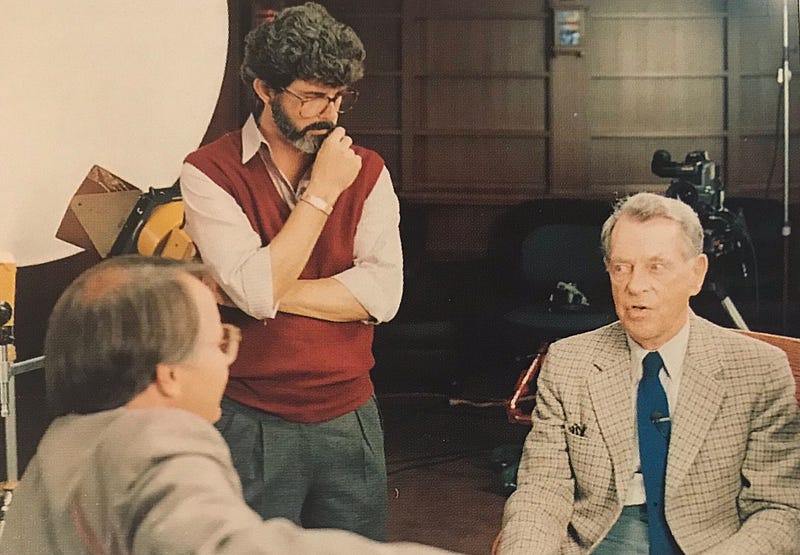
A star was born with a 1988 PBS series, “The Power of Myth.” Bill Moyers interviewed Joseph Campbell, the 83-year-old scholar who’d found the core story of all religions.
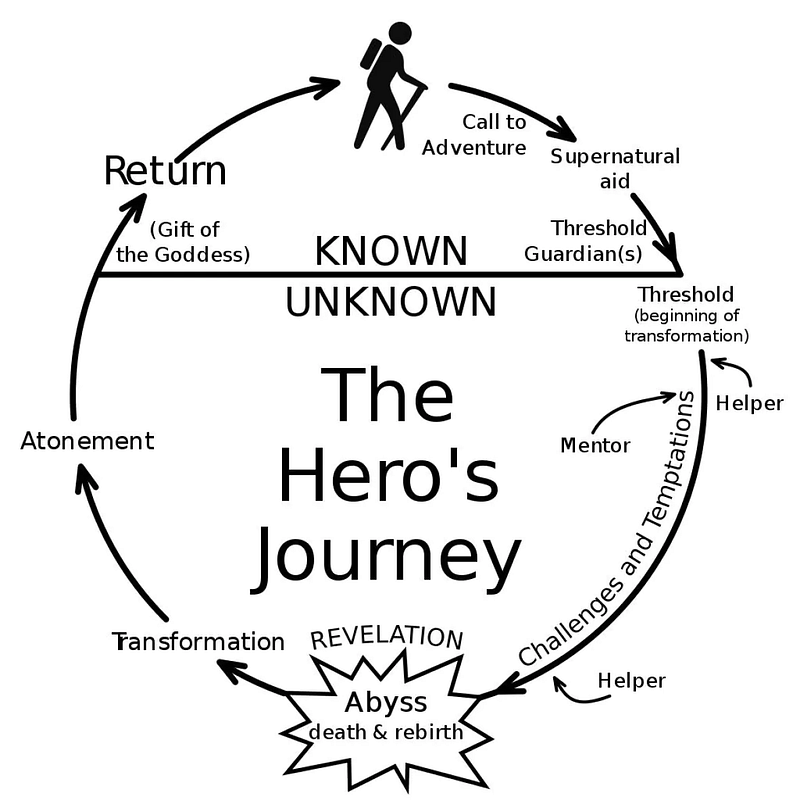
It was called the “hero’s journey,” Campbell explained. He’d actually died by the time the PBS series aired. Posthumously, he became ultra-famous, his ideas cited endlessly—as if they were true.

Campbell’s major statement was back in 1949.
That’s when he published A Hero With a Thousand Faces. Mostly dismissed as scholarship, it found an audience in Hollywood. While at work on 2001: A Space Odyssey, Stanley Kubrick gave it to Arthur C. Clarke to help inspire “mythic grandeur.”
I’ve a hunch that Jim Morrison, the film student turned rock musician, had read Campbell, as his notebooks are full of talk of ‘heroes’ and ‘faces’. Morrison seems to grow skeptical over time, as in this entry:
“Hero = someone who gets away w/it.”
But Campbell had one very public superfan.
The director George Lucas used the book to write his space epic Star Wars. They met in 1983. Having had no idea of his influence, Campbell saw the Star Wars movies, and declared:
“You know, I thought real art had stopped with Picasso, Joyce, and Mann. Now I know it hasn’t.”
Campbell actually didn’t like movies or Pop culture.
That was hardly unusual for an ‘intellectual’ of the time. When George Lucas was introduced to Campbell, the introduction went as follows:
“Joe, there is a man here that just directed the movie that made the most money in the world…”
Lucas set up and funded the interviews that became The Power of Myth, and Campbell became a star as he was dying. A brilliant scholar and a brilliant director—teaching the world the secret of all great stories.
That was their story.
Campbell’s “hero’s journey” has problems.
Is there really a core progression of narrative across all world “myth”? It can seem he’d just picked his favorite scenes from some religious texts to create a meta-narrative about male ego getting even bigger.
An impressive feat, to be sure.
He excludes women from the category of ‘hero’. As he’d explained to Maureen Murdock, later the author of The Heroine’s Journey, women can’t be heroes. They’re just the mothers, goddesses, seductresses, etc., just waiting to be found, apparently, by heroes on journeys.
And did all that ‘hero’ talk seem a bit…white?
Not unexpected from a man who was a notorious racist. In an infamous 1989 article at the New York Review of Books, the well-known media figure Brendan Gill recalled knowing Campbell through their membership at the Century Club in New York City.
As he reported:
“The bigotry that Campbell displayed toward blacks, Hispanics, and other minorities was so irrational that one hesitated to believe he was in dead earnest.”
For decades, Campbell had been a literature professor at Sarah Lawrence College. By several reports, he’d protested the admission of Black students, saying they were “unable to retain information.”
A woman who worked at his publisher recalled: “It was amazing to me that this man of cosmic vision could harbor such meanspirited and seemingly unexamined biases against much of humankind.”
His anti-Semitism was particularly startling.
Campbell was given to spouting off about Jews, saying things like “I can always spot a Jew” or “not all of the Nazis’ ideas had been so bad.”
After Brendan Gill’s report, a Jewish student of Campbell’s recalled him saying “Jews had ruined 20th century culture” and that he’d spent his life trying to avoid Jewish company.
Campbell was recalled giving a lecture once and speaking of humans as predators who ought to behave like it. A woman in the audience asked: “What about the six million who were gassed during World War II?”
Campbell, she said, shrugged and replied: “That’s your problem.”
In 1992, Robert A. Segal published a paper, “Joseph Campbell on Jews and Judaism,” that quoted these moments, and he finds Campbell “never says anything positive about Judaism…”
And what about the Nazi links?
A scholarly critique of 1981 found in Campbell’s work a “revival of the old prejudice of Aryan culture against Jewish…”
Another study in 2016 finds a swarm of Hitler-sympathizing and white supremacist connections around Campbell’s scholarship.
In 2021, a paper protested the use of Campbell’s work on the basis of his repellant views. But he was widely seen as a brilliant scholar of ‘myth’ who’d teach you—and your stories—how to be a ‘hero’.
Lucas continued to speak warmly of Campbell.
“He was an amazing scholar and an amazing person,” he said in 1999, always calling Campbell his “mentor,” or “my Yoda.”
Campbell fans were busy cleaning up the mess. His biographers, Stephen and Robin Larsen, dismissed talk of any bigotry and ignore the Brendan Gill matter. In a letter to the Washington Post they call it “willful misunderstanding, innuendo and hearsay.”
Campbell’s “hero’s journey,” meanwhile, was being replicated in one Hollywood movie after another. It was taught as a “17-step story structure” in a 2007 manual, The Writer’s Journey by Christopher Vogler.
An ironic story? A racist, sexist and Nazi sympathizer was defining the idea of “hero” for the whole world.
But how influential had Joseph Campbell actually been on George Lucas and “Star Wars”?
Lucas biographers and scholars of Star Wars have wondered. Lucas’ story changes oddly over the years. He’s said that he’d read A Hero With a Thousand Faces in college. He’s also said he’d found the book much later, while revising the Star Wars script.
A 2004 biography of Lucas found the writing of Star Wars had Campbell was “one of many” sources. A 2016 biography found Lucas reading Campbell only during revisions of The Empire Strikes Back.
Campbell’s influence on Star Wars was “quite exaggerated over the years,” as Michael Kaminski traces in his 2015 study, The Secret History of Star Wars.
Lucas benefited from the fame of his “mentor.”
As Joseph Campbell became a legend himself, the status of Star Wars raised higher. It was now ‘myth’.
Until learning that Star Wars was about the “hero’s journey,” as the movie’s composer John Williams noted, “we regarded it as a Saturday-morning space movie.”
Is “Star Wars” really a “hero’s journey”?
I’d thought so—until I thought about it. Star Wars is about Luke Skywalker, a young man who is gifted in many ways, but proves to be a strangely stagnant character.
Luke has no experience of sexuality. He never marries, parents, or mentors. His story is that he wanted his father to love him.
His father’s story is that he wasn’t able to love.
It’s that old story—about being a man.

What was Joseph Campbell’s story?
It’s that one about an Irish Catholic altar boy who studied Medieval literature in college. He took to calling all religion ‘myth’—as for him it was all false, but the Jewish religion was pernicious.
As Robert A. Segal writes in a follow-up 1999 paper:
“As hostile as he variously is toward Christianity, toward western religions as a whole, toward eastern religions, toward primitive religions, and most of all toward religion per se, he is especially hostile toward Judaism.”
Campbell set out to find a sacred system he could believe in. The search led to the Germanic myth that produced Nazi Germany.
As the scholar Maggie Macary noted in 2004, Campbell “grew to love German culture” and his initial reaction to Nazism was “enthusiasm.”
After World War II, he took to writing about his ‘hero’, which was just the ‘Superman’ or Übermensch figure of Nietzsche’s, or then Hitler’s dreams.
The man of power — the ultimate figure of Whiteness — became the “hero” of Hollywood.
An army of (male) Hollywood screenwriters went looking for ‘mythic’ stories. Joseph Campbell’s writings were passed around, and his “hero” just seemed super-cinematic.
Many scholarly studies analyze many Hollywood movies in terms of the “hero’s journey”—as if those movies were independent confirmation of the Campbell plot progression.
In fact, they’d learned it from him, as he learned it in Germany.
Does the plot have a final twist?
Campbell’s biographers are a bit prickly about the scene with a Catholic priest. In the hospital in Honolulu, the chaplain asked if Campbell would like to pray together. He did, and the priest visited “many times.”
The biographers cast it as a polite gesture on Campbell’s part, but is that so? The priest is named as Father Kieran Murray, who died of leukemia the following year. A bit of testimony from him appears to survive. The Catholic blogger and scholar Dwight Longenecker says he met a deacon who told him a story:
“…on his deathbed Joseph Campbell asked for a Catholic priest and was reconciled with the church of his childhood.”
Is that a hero’s journey?
It might be that one—old as Oedipus—about the man who tries to go far away, but his story is returning home.
Or is the story about a lot of people who wanted to learn how to be ‘heroes’ — and turned to the nastiest man in the world? 🔶


