
Jordan Peterson: Warrior of the Meek
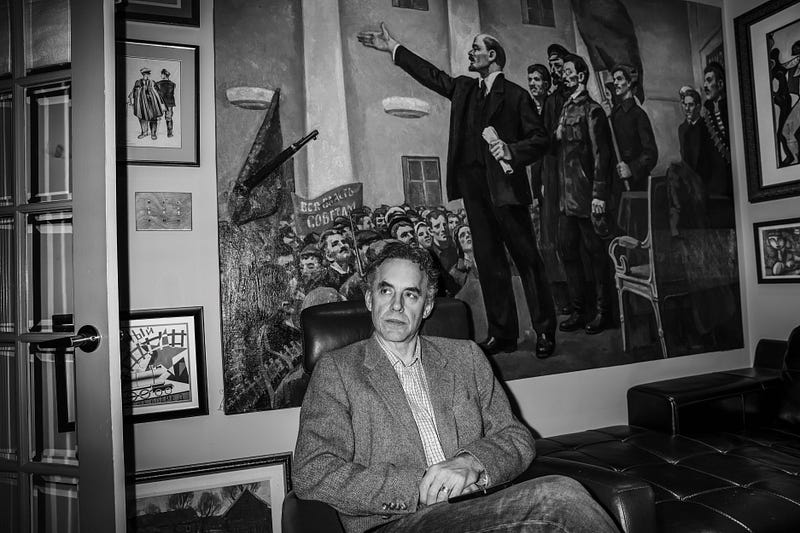
Besides helping countless individuals adrift in a sea of nihilism find meaning in their lives, Jordan Peterson is part of a revolution in education and media, whose institutions are coming apart at the seams. Young men are flocking to Peterson’s YouTube lectures in droves to learn about existentialism, phenomenology, depth psychology, brain anatomy, evolutionary biology, 19th Century Russian literature, Egyptian mythology, totalitarianism and the bible. What the hell is going on?
Peterson supporters represent an inversion of the 1960’s values. They are unlike baby boomers dancing to rock and roll with liberated pelvises, rebelling against suffocating moral up-tightness of their time. Instead, wholesomeness is their badge. Many are are young millennial men, dying to hear a message of virtue and responsibility in an age postmodern relativism. And Peterson seems to have revived the fatherly, gentleman archetype — he is the Jimi Stewart of the age. Furthermore, he is making authenticity, character, and truth cool again—not to mention Christianity. And nothing has been more uncool than Christianity in the past 50 years or so!
Peterson seems like a reactionary to some — leftists shriek in terror at the very mention of his name. They wrongly believe that he is right-wing, which can be easily debunked by a serious study of any of his works. Peterson has become iconic, larger than life. In his recent appearance in London, there was a large banner of him in imposing black and white, which had the iconic quality of a Che Guevara portrait. I doubt that Peterson would appreciate the comparison; nevertheless, the point I’m making is: we are overdue for a meaning revolution and Peterson is the leading figure of this revolution.
The Social Justice Warrior
The ‘social justice warrior’ has become a favourite description of a naïve kind of activism, which Peterson has railed against. And yet Peterson is concerned with social justice and he is obviously in a fight for truth. So what kind of social justice warrior is Peterson then? Let’s call him a ‘Warrior of the Meek’, a term invented by Chogyam Trungpa. The warrior of the meek embodies both the fierce aspect of a real warrior (the ability to make war) and the gentle aspect (the ability to make peace). He or she knows that there can be no justice without mercy or meekness — and that real meekness cannot exist without fierce intelligence and competent judgement.
The Bible says, ‘Blessed are the meek: for they shall inherit the earth’. However, as Peterson has pointed out, biblical meekness doesn’t mean being passive or weak. A warrior of the meek is not without the potential for harm, even if he or she ‘keeps his sword in his sheath’ — which is one translation of biblical meekness. To be meek here means to act with mercy and intelligence, to know how to diffuse the potential for violence and war.
The warrior of the meek, in Peterson’s lexicon, acts from a principal of Logos. Logos here means ‘uttering the sacred truth’ and ‘making habitable order out of chaos’ — not a static order, but a dynamic balance between order and chaos. Logos is embodied articulation, creative consciousness, light and meaning brought forth from the primordial darkness. ‘In the beginning there was the word’ according to Genesis — in other words, life begins with conscious articulation.
According to Peterson, Logos is the remedy for ideological violence. To put it another way: truthful articulation helps us create what Martin Heidegger called a ‘house of being’, or an abode worth living in. Ideological violence, on the other hand, makes the world a desert: killing real intelligence and creativity — or any refuge for being.
The Sovereignty of The Individual
To say ‘The meek shall inherit the earth’ is very different from proclaiming those famous words from the Communist manifesto: “Workers of the world, unite! You have nothing to lose but your chains!” Having ‘nothing to lose’ means that one is ready to cast aside human mercy and engage in violence. It turns out that the workers have everything to lose.
Perhaps Karl Marx’s ‘dictatorship of the proletariat’ is one of the worst ideas ever conceived of: effectively advocating the replacement of one form of tyranny (the individual exploiting the masses) with another (the masses exploiting the individual). If you invert the class structure, it’s still a class structure — the upside-down pyramid is still a pyramid — except it has no foundation and will collapse on itself. Marx and Engel’s dialectical materialism is mono-logical: it sees only material conditions and ignores deep psychology and metaphysics.
Marx thought a people’s dictatorship would be a temporary stage leading to a classless society. There is, however, no psychological realism in this utopian view: in fact, we have every reason to believe that Marx’s theories have their logical climax in mass murder and tyranny. The ouroboros of Revolutions eats its own tale — the new and even more brutal tyrant replaces the old one. Overturning the order of the day usually means a brief spring of giddy freedom followed by a return to a more tyrannical order.
Every hasty revolution has proved: human beings cannot be socially engineered to be rational, peaceful, and cooperative. We are too paradoxical, unpredictable, and uncanny. Furthermore, in a purely sociological conception, the precious and unique being is swept under the rug.
Tyranny needs to be dealt with at the metaphysical root and on the individual level — which doesn’t mean that one should not fight injustice when it arises. The roots of human evil are deeper than any of our social constructions; they are older than recorded history. And the traditional hero myths all tell us: only the sovereign or enlightened individual can kill the dragon and redeem the world.
The mob can never match the person; the group, in itself, can never be virtuous. If the individual is ‘weak, resentful, bitter and hateful’ his revolution will be motivated by hubris instead of meekness; it will be ineffective, if not homicidal. It is the meek individual, on the other hand, who inherits the earth or can restrain violence; he or she is merciful but formidable. We inherit the earth — or live up to our potential — when we are able to sacrifice our egoic childishness and group identification.
In light of the 20th Century, Peterson’s critique of Karl Marx seems warranted. On the other hand, does his hatred of of ‘postmodern neo-marxism’ betray too much intimacy with postmodernism (and Marx, for that matter), as a few critics have suggested? Marx wanted to rescue the working man and women from alienation and social hopelessness—it seems Peterson has the same concern for ordinary people. Does Peterson’s emphasis on embodied action rather than mere philosophy have a Marxist flavour?
Unlike Marx, however, Peterson does not tell us to tear down the palace, but to build the inner palace — to work on what is most intimate and near. The first step towards wisdom is knowing ourselves and our own hidden monsters. We need to ‘grow up and grow teeth’ — to integrate our own shadow — rather than projecting our resentment on others.
And yet, there is an important difference between the warrior of the meek and the Marxist social justice warrior. The former’s goal is not mere justice and punishment but spiritual illumination and wisdom. Such a warrior needs training in ethics, morality, and composure — he or she needs to be educated! Better read Nietzsche, Dostoevsky and Jung in order to arm oneself against ‘ideological possession’ before going to war with society. Better learn ‘the great code of all art’ that William Blake spoke about — and know the myths and archetypes of our civilization.
Each individual may be greater and have more potential than we think. For example, and if Peterson is right, Alexander Solzhenitsyn, by writing the Gulag Archipelago, actually helped bring down the iron curtain. Let us bring down the iron curtain of political correctness and the parroting of ideology, Peterson tells us.
A working class hero is something to be
I’ve been trying to help dispel the myth that Peterson is a reactionary of any kind — which is how he is often perceived in the mainstream media. I’ve even suggested, somewhat capriciously, that he is a working-class hero. Weirdly enough, being reasonable and forthright makes one a revolutionary these days.
The best revolutionaries, just like the best poets, have always come from the provinces — in Peterson’s case northern Alberta. In their solitude and in the desert they have learned to be fierce but meek warriors. They are people of action, not mere theorists. Peterson is one of these. As Karl Marx put it:
“Until now, the philosophers have only interpreted the world in various ways; the point, however, is to change it.” Karl Marx, Theses on Feuerbach.
Follow Me:
Patreon Twitter YouTube Facebook Music
Rebel Wisdom Articles:
Jordan Peterson the 21st Century Battle Rapper vs Akira The DonJordan-Peterson-and-The-Black-tide-of-Mysticism
Jordan Peterson Articles:
Joran Peterson vs Camille Paglia Jordan Peterson vs Ken Wilber Jordan Peterson vs Iain McGilchrist Jordan Peterson vs Russel Brand Jordan Peterson vs Slavov Zizek Jordan Peterson vs Warrior of the Meek In Defence of the Cult of Jordan Peterson
Appendix:
Warrior of the Meek:


