
Roleplaying Games | Movies
Jim Henson Would Totally Dig ‘Labyrinth: The Adventure Game’
Well-crafted, mechanically elegant, and ludicrously inventive
The Good
The Most Lightweight Rules in Any RPG Ever
To call Labyrinth’s rules a “system” is laughable, and that’s a good thing. The player characters have no stats. Just Traits and Flaws, which improve or hinder rolls, and you only start with one of each. Each kin (species) adds a little more variety. Humans start with an extra Trait. Horned Beasts (like Ludo) can control one kind of inanimate object. Etc.
Technically it’s a 1d6 system, but you often roll two dice and take the higher or lower result, depending on your Traits and Flaws. Occasionally the situation itself can also improve or hinder a roll.
A Self-Contained Adventure Engine
Labyrinth plays like a mashup of Risus, Talisman, and Choose Your Own Adventure. To move through the labyrinth, and thus the game, you roll the dice and add that number to the number of the scene you’re in. That takes you to another scene, maybe in the next chapter.
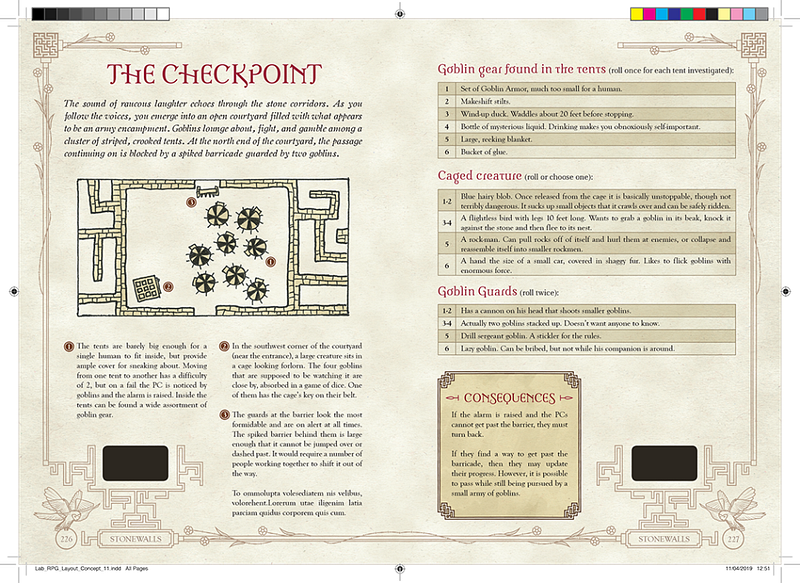
And every scene is a completely different beast. Some feature puzzles or riddles. Some are action scenes. Some are literal mini-games. All of them are two-page spreads with a top-down map, some kind of challenge, NPCs, and usually some random tables to further change things up. Plus, you can download blown-up versions of every map. And if you play Labyrinth over and over, there’s a Tool Kit at the back to help you remix the whole thing.
You Can Lose ‘Labyrinth’
Also like a board game, there’s a lose-state. If you can’t solve the labyrinth in 13 hours, the party fails. This is bizarre because its exceedingly rare for players to fail an RPG adventure. Even total party kills in other games don’t happen often outside of glorious but tragic last stands. In Labyrinth, the characters simply forget what they were doing and wander off.
Every Scene a Painting
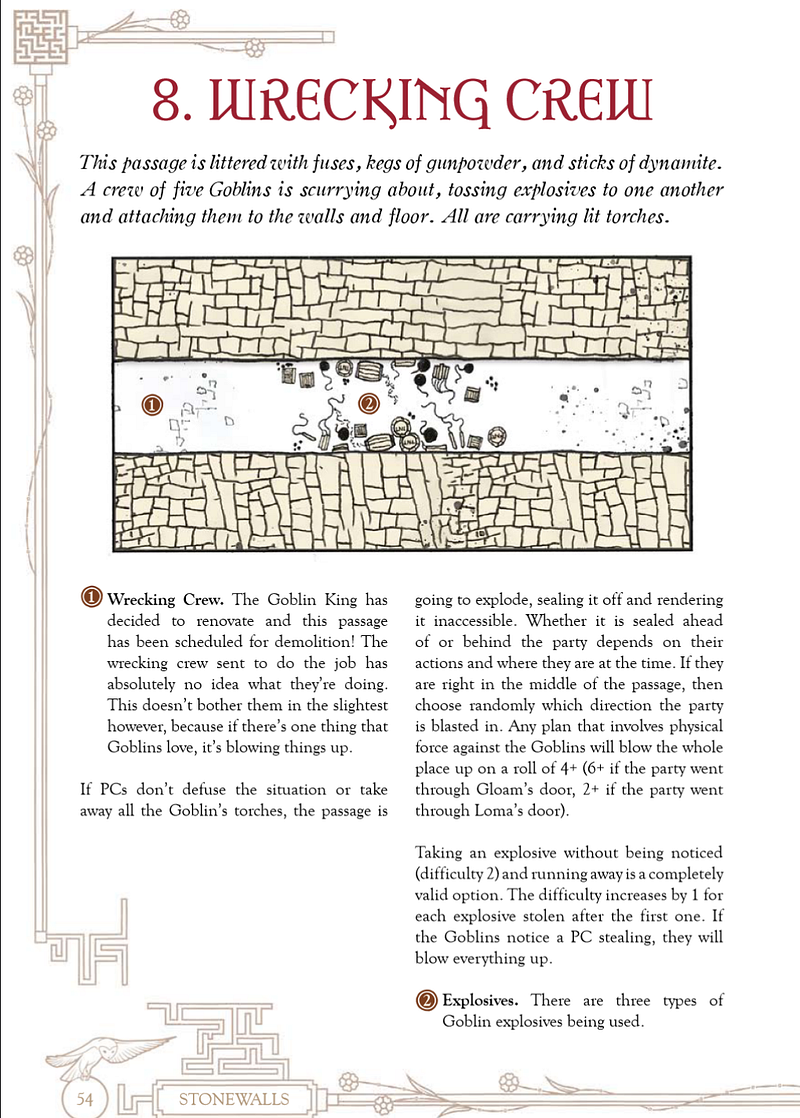
Each scene is a stand-alone set piece, and they never repeat themselves. Chapter 1/Scene 8, aka “Wrecking Crew”, features a team of goblins about to “renovate” a passage with explosives.
There’s no real challenge other than to get past the demolition site before the goblins blow it up. The goblins aren’t trying to stop the party, but they’re so careless with their torches they might blow up the passage prematurely. The scene lets the players play with some bombs and meets some dumb goblins. Fun times.
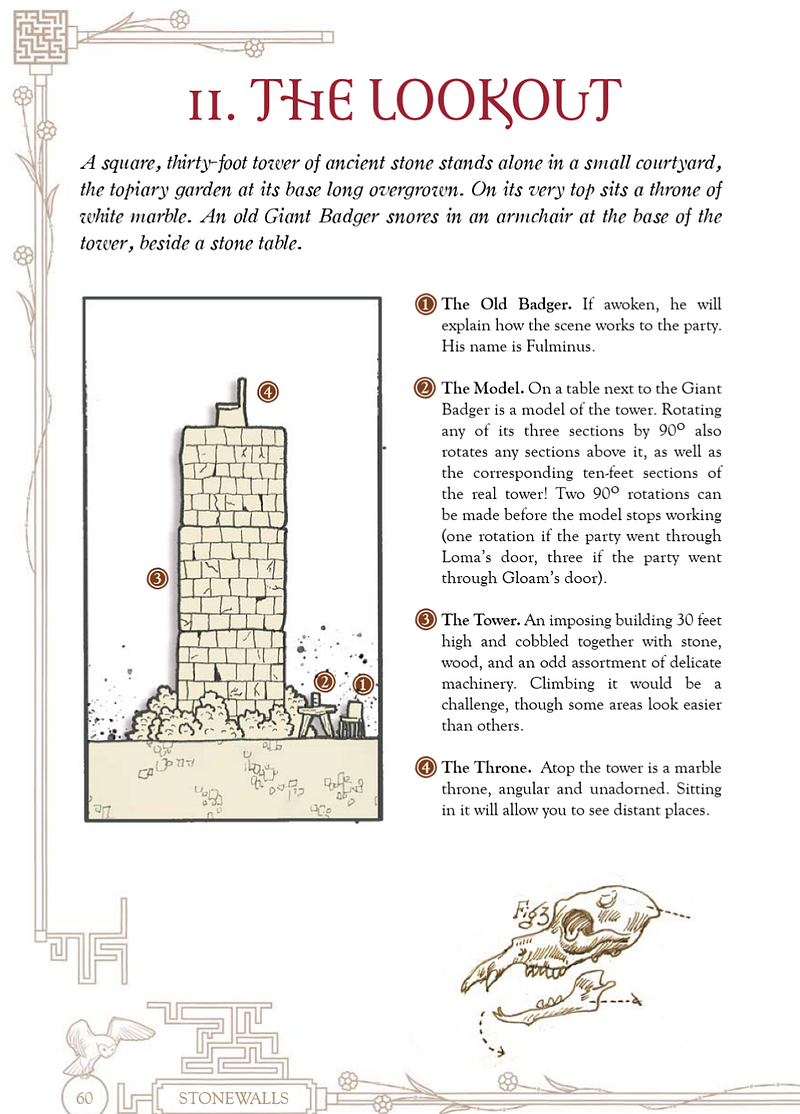
Scene 11, “The Lookout”, is more mechanically relevant but just as odd. There’s a sectional tower the players can climb to get a better look at the labyrinth.
A player on the ground can rotate the sections independently of each other to help the climber find an easier path. If they make it to the top, they can roll a die and see that many scenes ahead, then move directly to any of those scenes.
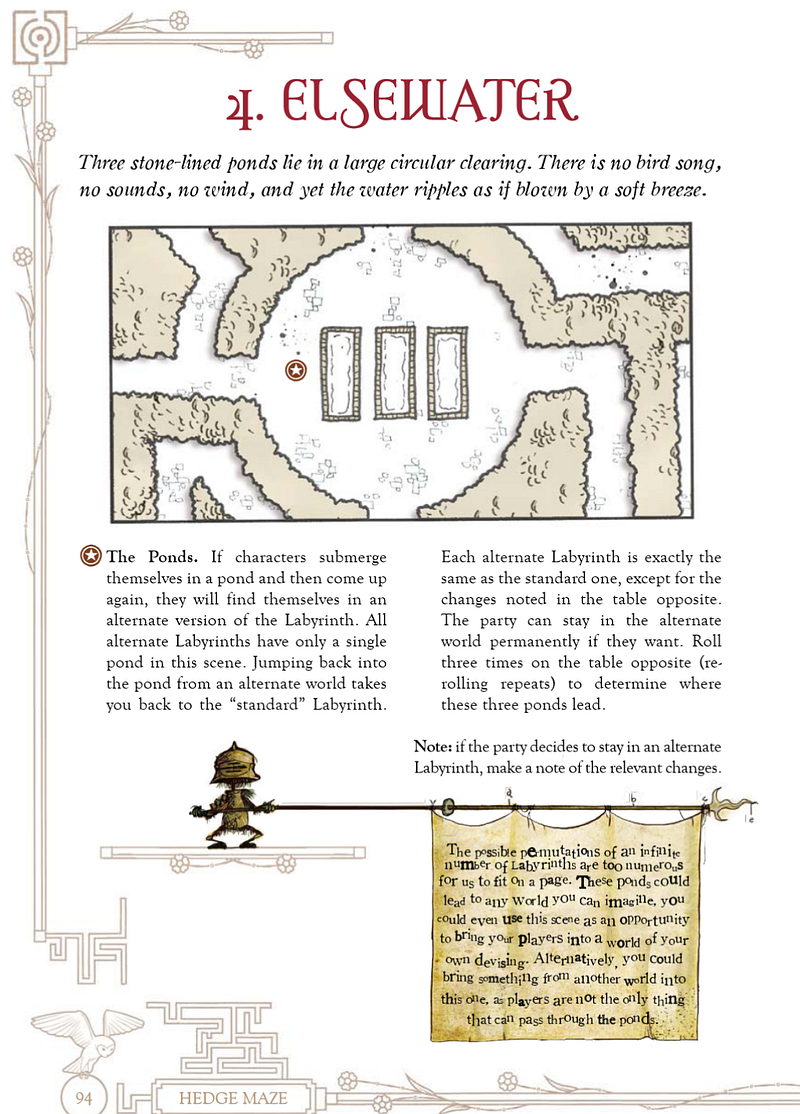
Chapter 2/Scene 4, “Elsewater”, is beyond bizarre. There are three stone-lined ponds. If a player submerges themself in one of the ponds, they will resurface in one of six alternate-universe labyrinths! One is an underground maze. Another is in a world where it’s always nighttime. The other four are just as strange. And if the players want, they can continue through these alternate labyrinths.
The Bad
Questionable Choke Points
When exploring, if you roll high enough to reach a scene in the next chapter, you don’t actually go there. You have to go to the first scene of that chapter. That means you will ALWAYS have to play scene 1 of every chapter. That makes sense in Chapter 1, because you always have to enter the labyrinth. And maybe Chapter 4, because that’s the gate to the Goblin City. Not so much with chapters 2 and 3. But if you let the party plow through these first scenes, they will advance through the labyrinth faster. The Goblin King (what Labyrinth calls its gamemaster) might need to make some challenges harder to slow them down.
If You Lose, You Just Lose
There is no “you loose” scene. Instead, the PCs just “become lost, forgetting why they ever entered”. Not having a scene in which the Goblin King mocks you, punishes you, or casts you out is an inexcusable oversight.
The Dice Are IN the Book
The hard copy of Labyrinth includes two six-sided dice in a rectangular hole that goes through all the pages. Clever, but a pain in the ass. You’re always going to worry about ripping the page, and that worry will double any time you hand the book to someone else. Or you’ll forget the dice are in there and drop and lose them when you open the book. Obviously the PDF doesn’t have this issue.
The Ugly?
There is nothing ugly about Jim Henson’s Labyrinth: The Adventure Game. It’s well-crafted, mechanically elegant, and ludicrously inventive. This is an outstanding first tabletop RPG for almost anyone.
Younger players can be guided and prompted by older players. Growed-ups who are new the hobby will grok the rules way faster than with the dragon game. Seasoned gamers will enjoy the puzzles and mini-games. Because it’s self-contained and remixable, you get a lot of bang for the buck.


