Hacks and Variants
Risus is the Best RPG System for Star Wars
Also, goodbye Chewie
Before we get started, you need to understand something. This isn’t the same as my relationship with past Marvel games. The Marvel RPGs accurately emulated comic book logic. But of the three Star Wars RPGs, only the D6 version grokked space dogfights and shooting bounty hunters first. And even that system could be a little slow. It wasn’t crunchy, but the large dice pools could get way out of hand.
When the prequels came out, WotC got the license and made a D20 version. Not as crunchy as then-contemporary D&D, but still too complex for Star Wars.
I had hopes for Fantasy Flight’s version. The specialized dice and the Specialization and Critical cards abstracted some of the crunch. Still, there were WAY too many rules. The detail kept it from conveying the essence of Star Wars.
Risus’ creator once wrote that “Risus is a comedy RPG. It’s good for serious games only if you insist it is”. I insist, but that’s missing the point. Star Wars is NOT a serious setting. Yes, it has more than a little tragedy and angst. But that’s balanced out by banter between princesses and smugglers, failing to con security, and feeding bounty hunters to sarlaccs. So, as with Marvel, Risus has become my new go-to system for playing Star Wars. Here’s why.
Character Creation Ain’t No Thing
In Risus, characters are made up of cliches. Players allocate ten D6s between (usually) four cliches. If you’re not playing with any advanced rules from the Companion or the fan wiki, that’s the entire process. So Luke may look something like this:
Luke Skywalker (as of Return of the Jedi)
- Young Jedi: 4D
- Pilot: 3D
- Fringer: 2D
- Officer: 1D (he doesn’t really command anyone at this point)
It’s that easy. You might disagree about the cliches and dice, but fixing it takes all of 30 seconds.
Because I’m obsessive about these things, I like using the classes and careers and whatnot from older Star Wars games. Unlike the Marvel games, with their various Distinctions, Callings, etc, all the Templates, Core Classes, Prestige Classes, Droid Degrees, Career Paths and Specializations make legit cliches. And just about all of them are listed online.
D6 Character Templates
- https://starwarsrpg.pettycomp.net/CharacterTemplates.html#cd
- http://d6holocron.com/wiki/index.php?title=Templates
D20 Core Classes
D20 Prestige Classes
- https://1d4chan.org/wiki/Star_Wars_D20#Prestige_Classes
- https://swse.fandom.com/wiki/Prestige_Classes
Fantasy Flight Careers and Specializations
No Grids
The argument between using maps and miniatures vs “theater of the mind” isn’t new. Unfortunately, now that D&D is cool, it’s been renewed. But this was solved a long time ago as far as I’m concerned. Highly tactical RPGs are slow and boring and not Star Wars. This doesn’t mean you can’t use maps or terrain, but only for referring vaguely to distance and direction. Grids and rulers are right out.
Interesting note: WotC’s first Star Wars RPG didn’t use a grid for starship combat. It used a “relative abstraction” mechanic that “measures position and range relative to other vehicles”. Your ship was at the center of a bullseye chart, with blips surrounding it representing other ships at different ranges.
Anti-Crunch
Taking an hour to play out a 2 minute firefight with Stormtroopers is the opposite of Star Wars. Risus combat is super-duper fast. The creator of Risus says it best:
I designed Risus combat for speed. Not because I like to get combat out of the way, but because I like to get combat out of the way to make room for more combat.
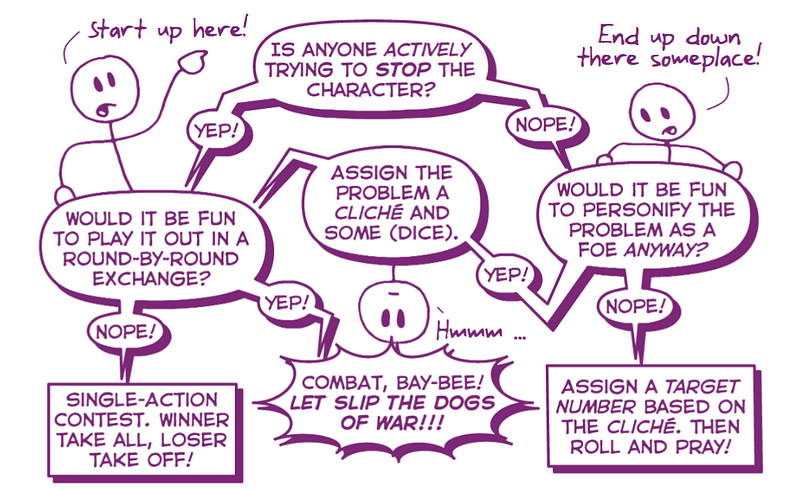
There are three different kinds of dice checks in Risus:
- Target Number Roll — Han trying to fix the hyperdrive.
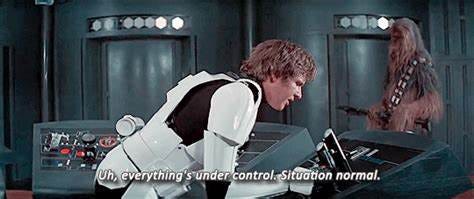
- Single-Action Challenge — Han trying to convince security that everything is fine.
- Combat Scene — Han blasting pursuing TIE Fighters.
And if you really need more of a foundation to work with, at least one other Star Wars/Risus fan has already done it for you.
Grunt-Squads
Most RPG systems treat mooks/goons/canon-fodder like player-characters. I hate that. I think Star Wars D20 had some optional rules for lumping four mooks into one stat-block. Marvel Cortex lumped Hydra agents and such together. Even D&D lumps groups of rats and other pests in swarms.
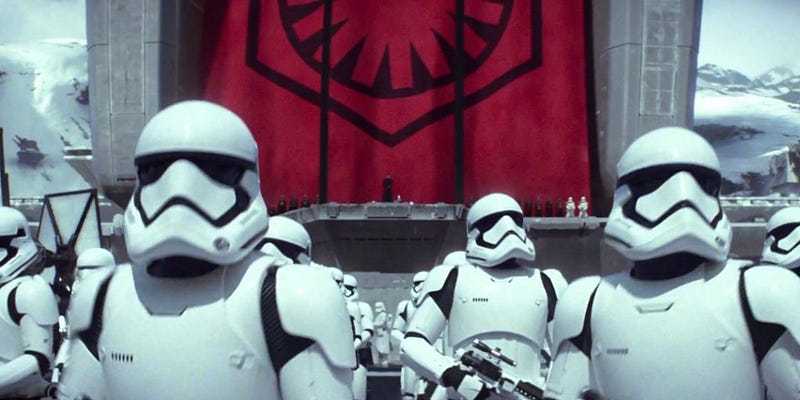
Risus takes this idea even farther. Sure, Captain Phasma gets her own stats, and that one Riot Trooper, but that’s it. All the Stormtroopers get lumped into squads, with one or two cliches. Same with mobs of battle droids, TIE Fighters, and Fyrnocks.
Example:
- Captain Phasma: Officer 4D, Solider 3D, Melee Duelist 2D, Tactician 1D
- First Order Stormtrooper Squad: Solider 3D
- Riot Trooper: Melee Duelist 3D, Solider 2D
There are exceptions, like the Scout Troopers on Endor. If goons are going to split up, they should be tracked separately. Or the AT-ATs on Hoth, because the hero needed to power-harpoon them one at a time.
It’s Cheap
The core Risus rules are free and the companion costs $10. Fantasy Flight’s Beginner Game is $30, and a core rulebook is sixty bucks. Yes, you get a lot of stats and rules for that money, but you don’t need any of it. Star Wars is not a complicated setting. It’s Flash Gordon meets whatever else George grew up watching or studied in film school. The setting is a love letter to classic and sci-fi cinema. Crunchy games NEVER feel cinematic.