avatarJeremy Roberts

Free AI web copilot to create summaries, insights and extended knowledge, download it at here

18080

Abstract

Image Credit: Jerry Lewis Archive <a href="https://www.facebook.com/profile.php?id=100064255226265">on Facebook</a></b></figcaption></figure><figure id="7584"><img src="https://cdn-images-1.readmedium.com/v2/resize:fit:800/1*zdKAfMPUUkRd78X7mSG42A.jpeg"><figcaption><b>“Everybody but the dogs:” Scott, a tall Ronnie, Chris, toddler Joseph, Jerry, Patti, Anthony, and Gary Lewis circa 1964. Image Credit: Archive Photos / caption help courtesy of Shawn Levy’s “<a href="https://www.amazon.com/King-Comedy-Life-Jerry-Lewis/dp/0312168780">King of Comedy</a>”</b></figcaption></figure><p id="cb69"><b>Have you had contact with Jerry’s children [Gary, Ronald, Scott, Chris, Anthony, the late Joseph Lewis, and daughter Danielle], Patti, or widow SanDee Pitnick post-publication?</b></p><p id="6300">Not personally, no. I am aware that at least one of his sons — Chris — echoed Jerry’s distaste for the book, but I have had no contact with any of the family.</p><p id="5d20">When I was doing research, I got an address for Patti and wrote her a letter asking if she would consent to an interview. She sent my request to Jerry, who quashed<b> </b>it and told me that he felt I was being too invasive — one of the several times I reminded him that I was, in fact, <i>literally writing a book about him </i>[Palmer, a little over four years older than Lewis, remarkably endured to the <a href="https://www.findagrave.com/memorial/221398769/patti-lewis">ripe old age of 99</a> in January 2021. The Gary Lewis & the Playboys namesake identified his mother as the source of his musical journey, as she “was always singing songs around the house and playing the piano”].</p><p id="246d"><b>Would you be interested in interviewing Jerry’s family if an opportunity arose?</b></p><p id="edec">No, not really. Chiefly, I’m long done writing about Jerry. I’ve even resisted the edge to finish his story, as it were, by writing about his final 20 years in additional pages in a new edition of the book.</p><p id="1849">More than that, though: Very few of Jerry’s family ever rose from their situation as Jerry’s dependents, which meant that they were obliged to see journalists who displeased Jerry through Jerry’s eyes — which would almost surely make me persona non grata to them. They have their own relationship with the man and with what they believe to be the truth about him, and I wouldn’t dream of presuming to challenge or change that.</p><p id="cd15">Jerry declared bankruptcy at the time that he divorced Patti [in late 1980], which meant she got very little in the way of settlement/alimony, and that his will explicitly disowned all five surviving sons from his first marriage, so God knows there’s a lot of discomfort for anyone connected to the family story. It was uncomfortable enough carrying him around in my head for the three years it took to research and write <i>King of Comedy</i>. I can’t imagine how hard it must have been to be one of his sons. They have my empathy, but they have it from a respectful remove.</p><figure id="8e36"><img src="https://cdn-images-1.readmedium.com/v2/resize:fit:800/1*mWYjmpBNNd3dQsBzUYY4sA.jpeg"><figcaption><b>Jerome Littlefield, “Disorderly Orderly” at your service! From Dec. 16, 1964, is Jerry Lewis’ second picture of the year following “The Patsy.” Image Credit: Paramount Pictures / <a href="https://fineartamerica.com/shop/canvas+prints/jerry+lewis">Fine Art America</a></b></figcaption></figure><figure id="aa65"><img src="https://cdn-images-1.readmedium.com/v2/resize:fit:800/1*uDtvizpMhe6GbURc9bfmWQ.jpeg"><figcaption><b>Jerry Lewis takes direction, but likely has some ideas of his own, from Frank Tashlin in a black and white still from 1964’s “The Disorderly Orderly.” Image Credit: Paramount Pictures / Alamy</b></figcaption></figure><p id="a5c0"><b>Frank Tashlin and Jerry’s lucrative partnership ended with 1964’s <i>The Disorderly Orderly, </i>where Jerry covertly pines for ravishing blonde Susan Oliver, once his high school crush and now committed to a hospital for suicide watch. A slapstick, heart-tugging movie with Jerry still bringing his A-game, how come it’s only mentioned in passing in <i>King of Comedy</i>?</b></p><p id="d932">I can’t remember the decision very clearly. As I somewhat dimly recall, it was hard to find a copy of <i>The</i> <i>Disorderly Orderly </i>in 1993–4, and there wasn’t a lot of material about the making of the Paramount film in Jerry’s papers at USC or in the production files at the Margaret Herrick Library in Beverly Hills.</p><p id="5ab5">Too, I struggled to balance accounts of Jerry’s many films with telling the story of his life in a compelling, readable fashion. <i>The Disorderly Orderly</i> was made at a time when Jerry’s films as writer-director were more interesting to me — and, I hoped, my readers — than the need to give equal weight to everything.</p><p id="b46e">A couple paragraphs more couldn’t hurt, I grant you, but at the time, and perhaps even now, it doesn’t strike me as a substantially important film or, at least, very different from his other for-hire work of the moment or just before.</p> <figure id="b69d"> <div> <div> <img class="ratio" src="http://placehold.it/16x9"> <iframe class="" src="https://cdn.embedly.com/widgets/media.html?src=https%3A%2F%2Fwww.youtube.com%2Fembed%2FCquo5UhCf8k%3Ffeature%3Doembed&amp;display_name=YouTube&amp;url=https%3A%2F%2Fwww.youtube.com%2Fwatch%3Fv%3DCquo5UhCf8k&amp;image=https%3A%2F%2Fi.ytimg.com%2Fvi%2FCquo5UhCf8k%2Fhqdefault.jpg&amp;key=a19fcc184b9711e1b4764040d3dc5c07&amp;type=text%2Fhtml&amp;schema=youtube" allowfullscreen="" frameborder="0" height="480" width="854"> </div> </div> </figure></iframe></div></div></figure> <figure id="c5f1"> <div> <div> <img class="ratio" src="http://placehold.it/16x9"> <iframe class="" src="https://cdn.embedly.com/widgets/media.html?src=https%3A%2F%2Fwww.youtube.com%2Fembed%2FsSNWuzLMgBc%3Ffeature%3Doembed&amp;display_name=YouTube&amp;url=https%3A%2F%2Fwww.youtube.com%2Fwatch%3Fv%3DsSNWuzLMgBc&amp;image=https%3A%2F%2Fi.ytimg.com%2Fvi%2FsSNWuzLMgBc%2Fhqdefault.jpg&amp;key=a19fcc184b9711e1b4764040d3dc5c07&amp;type=text%2Fhtml&amp;schema=youtube" allowfullscreen="" frameborder="0" height="480" width="640"> </div> </div> </figure></iframe></div></div></figure><p id="f8e0"><b>Jerry has an executive producer credit for <i>The Disorderly Orderly</i>. Was that title a token gesture? If not, is it accurate to deem the movie a work-for-hire compared to 20th Century Fox’s abysmal <i>Way…Way Out</i> [1966] where Jerry did just show up and take the money?</b></p><p id="13ec">A few things: By “work-for-hire” during the period of his contract at Paramount [which ceased with the Tony Curtis-assisted <i>Boeing, Boeing</i> in 1965], I mean the films that Jerry made for the studio as part of that deal, which demanded a certain rate of output from him without guaranteeing him any creative input. His executive producer credit on the films he made with Tashlin may have meant that he made more money from them, it may have been a perk of the contract, it may have meant that he served as a buffer between Tashlin and the studio when there were conflicts, etc.</p><p id="32c0">I have no doubt that Jerry had an active hand in those films, but it’s hard to say where, and they do not seem nearly as personal or experimental as the films he wrote and directed. It’s clear, from the sheer volume of paperwork associated with the films he directed as compared with those he mainly performed in, that his focus at the time was on <i>his </i>films, not <i>Paramount’s.</i></p><p id="d105">That said, <i>Way…Way Out </i>can <i>only </i>be described as a paying job — Jerry referred to such work as “my financial pleasure” — and as an abomination. <i>Way…Way Out</i> is a strong candidate for the worst thing he ever had anything to do with in any medium [all the more disappointing as Lewis surrounded himself with the usually reliable Gordon Douglas, a prolific western and crime director who also had a comedy background with the Little Rascals and Laurel and Hardy, previous <i>Rock-a-Bye Baby</i> leading lady Connie Stevens, and a top-notch cast e.g. Dennis Weaver, Brian Keith, Howard Morris, and Robert Morley].</p><figure id="d228"><img src="https://cdn-images-1.readmedium.com/v2/resize:fit:800/1*6B2aeLusvAVc1KI_6XlvXw.jpeg"><figcaption><b>As Helmut Doork, Jerry Lewis and two little girls enjoy a genuine moment together during the Stockholm, Sweden, location filming for “The Day the Clown Cried” between April 5 and June 1972. Lewis suffered extreme anxiety and stress throughout the shoot, but his sense of professionalism never waned. Photography by Roger Tillberg / appears in Shawn Levy’s “<a href="https://www.amazon.com/King-Comedy-Life-Jerry-Lewis/dp/0312168780">King of Comedy</a>”</b></figcaption></figure><figure id="5927"><img src="https://cdn-images-1.readmedium.com/v2/resize:fit:800/1*FP20T7CM3tH-m0MF6mE8Ig.jpeg"><figcaption><b>Jerry Lewis’ favorite pastime, in the director’s chair for “The Day the Clown Cried” during a day when he was not in front of the camera in costume. Photography by Roger Tillberg / Swedish Film Institute</b></figcaption></figure><p id="991f"><b>By the twenty-tens the vitriol directed at Jerry’s lost magnum opus <i>The Day the Clown Cried </i>had changed course. A German documentary, <i>Der Clown, </i>uncovered rough cut footage, which Jerry had shot decades before other Oscar-winning Holocaust films like <i>Schindler’s List</i> and <i>Life Is Beautiful. <a href="https://www.vanityfair.com/hollywood/2017/08/jerry-lewis-day-the-clown-cried-holocaust-movie-review"></a></i><a href="https://www.vanityfair.com/hollywood/2017/08/jerry-lewis-day-the-clown-cried-holocaust-movie-review">Vanity Fair</a>, the <a href="https://www.nytimes.com/2018/12/28/movies/jerry-lewis-day-the-clown-cried.html">New York Times</a>, <a href="https://www.gq.com/story/jerry-lewis-interview-gq-august-2011">GQ</a>, and other prestigious publications contradicted <i>Simpsons </i>voice maestro Harry Shearer’s infamous 1992 Spy magazine anecdote — “If you flew down to Tijuana and suddenly saw a painting on black velvet of Auschwitz, you’d just think, ‘My God, wait a minute!’ It’s not funny, it’s not good, and somebody’s trying too hard in the wrong direction to convey this strongly-held feeling.” Are these recent opinions mostly revisionism? Also, how much footage have you seen from <i>The Day the Clown Cried</i>, and does it deserve to be freed from red tape purgatory?</b></p><p id="0075">At the time I wrote the book, still photos were all I had access to for <i>The Day the Clown Cried</i>.<b> </b>I’ve watched <a href="https://archive.org/details/project-55">perhaps 8–10 minutes</a> of YouTube footage all told from <i>TDTCC</i>, and I’m an agnostic about the quality of a feature film that I’ve seen so little of. We can’t tell much from what’s leaked out of <i>TDTCC</i>. We don’t have context, we don’t, in some cases, have the actual footage but rather EPK footage, we don’t have it sewn together into finished scenes, and, of course, we don’t have a full movie.</p><p id="b6ff">I have to take Harry Shearer at his word that what he saw was what it was like for him, even if I contextualize <i>that </i>experience as being informed with a black-comic quality based on the idea of Jerry Lewis, as he was conceived in the mid-’70s, having made such a film, and, further, the generational glee of a younger comedy creator seeing an older one self-immolate.</p><p id="95e4">I do believe that there is more sympathy toward Jerry and his work today than ever before, but I truly can’t say that means that there will be much more than academic or cultish appreciation of the complete film, if and when it is ever released. As for “deserve,” well, I go with William Munny here: “Deserve’s got nothing to do with it” [Clint Eastwood in <i>Unforgiven</i>, 1992]. We may not ever see <i>TDTCC</i> for legal or technical reasons, but just deserts won’t be a factor [Belgian producer Nathan Wachsberger absconded with the money, Lewis had to pay the crew out of his own pocket, and on top of that Wachsberger didn’t obtain the rights to Joan O’Brien’s screenplay. Lewis donated “13 cans, almost 90 minutes, of unedited camera rushes without sound” from <i>TDTCC </i>to the Library of Congress for public screenings scheduled to commence in 2024].</p><figure id="f85f"><img src="https://cdn-images-1.readmedium.com/v2/resize:fit:800/1*9z71c40KmlW82KNzW_CnHg.jpeg"><figcaption><b>Photography by Roger Tillberg / Swedish Film Institute</b></figcaption></figure><div id="c6a8" class="link-block"> <a href="https://archive.org/details/project-55"> <div> <div> <h2>The Day the Clown Cried : Jerry Lewis : Free Download, Borrow, and Streaming : Internet Archive</h2> <div><h3>Reconstruction of Jerry Lewis’ The day the clown cried based on footage found on the internet.</h3></div> <div><p>archive.org</p></div> </div> <div> <div style="background-image: url(https://miro.readmedium.com/v2/resize:fit:320/0*-oX7MwAteQwanEmn)"></div> </div> </div> </a> </div><p id="04a8"><b>“I do believe that there is more sympathy toward Jerry and his work today than ever before.” How did this phenomenon materialize?</b></p><p id="c089">I think a number of things happened since, say, 1996, when my book appeared. One was that Jerry simply enjoyed longevity, and in the words of Noah Cross, “‘Course I’m respectable, I’m old” [John Huston in <i>Chinatown</i>, 1974].</p><p id="162f">Jerry’s long-overdue Oscar for his philanthropic work is a case in point. He hosted the Academy Awards several times, and they snubbed him for decades. Eventually, sheer decency — and perhaps the passing of anyone whom he’d alienated — won the day in 2009.</p><p id="0766">Also, a generation of comedians who grew up watching him — Steve Martin, Martin Short, David Letterman, Jerry Seinfeld, Eddie Murphy, Richard Belzer, etc. — became elder statesmen themselves and frequently spoke of their affection for him. That softened public sentiment. I would include Martin Scorsese and Steven Spielberg in this list, and Judd Apatow and even Wes Anderson, who told me that he cribbed the set of <i>The Life Aquatic with Steve Zissou </i>from <i>The Ladies Man</i>.</p><p id="c3ae">Too, I think that in an era of digital culture, it has become possible for cult/niche aesthetics to find a home and an audience and, subsequently, to flourish. Prior to 1996, there were a small handful of academic appreciations of Jerry in print. Now there are dozens of articles to access at the stroke of a few keys. He has a following and its members are able to talk with one another.</p><p id="18b3">And lastly, without taking any credit for quality or influence, I believe that my book, which was reviewed in the New York Times and Time magazine, had some impact in drawing attention to Jerry and his work. In practically 30 years, I have heard from well over a hundred film buffs, film journalists, and filmmakers about how they only had a passing or even perverse interest in Jerry before reading my bio. And that was, sincerely, one of my hopes.</p><p id="e27a">Jerry was a huge figure, and he had been ignored. Among my goals in the book, one of the highest was to remind the world that Jerry Lewis had once been among Hollywood’s greatest and most innovative stars.</p><p id="f653"><b>How long did Jerry teach film courses?</b></p><p id="43f0">He never again taught as formally as he did at USC in the late ’60s and early ‘70s [Lewis authored <a href="https://www.amazon.com/Total-FilmMaker-Lewis-Jerry/dp/1615933204/ref=asc_df_1615933204/?tag=hyprod-20&amp;linkCode=df0&amp;hvadid=475790841486&amp;hvpos=&amp;hvnetw=g&amp;hvrand=5816333554810822971&amp;hvpone=&amp;hvptwo=&amp;hvqmt=&amp;hvdev=m&amp;hvdvcmdl=&amp;hvlocint=&amp;hvlocphy=1015331&amp;hvtargid=pla-966849237805&amp;psc=1"><i>The Total Film-Maker</i></a><i>, </i>based on his celluloid lectures attended by future luminaries including Spielberg and George Lucas, in 1971], but he did<i> </i>occasionally host some sort of self-enhancement seminars in “Laughter and Healing” in collaboration with a certified psychologist named Dr. Clifford Kuhn from the University of Louisville. These occurred at American medical schools, hospitals, and universities in 1995 while Jerry was touring <i>Damn Yankees</i> and continued until the play completed its run two years later. How I wish I’d been able to sit in on one!</p><p id="cbc8"><b>What’s your take on Jerry’s last-ever TV guest appearance in “Uncle,” a 2006 episode of <i>Law & Order: Special Victims Unit </i>where he renders the homeless, dementia-battling relative of Det. Munch [Richard Belzer]?</b></p><p id="e900">Never saw it. Belzer was one of the most ardent of Jerry-philes, and I wish I’d been a fly on the wall when they worked and chatted together. Add him to the list of people I wish I’d spoken to.</p><figure id="488f"><img src="https://cdn-images-1.readmedium.com/v2/resize:fit:800/1*mX66SlqLecnfzGzXXoS0xw.jpeg"><figcaption><b>An atypically unshaven Jerry Lewis has Richard Belzer in stitches, mostly likely while the comedy idol was in New York City to film his guest spot on the “Law & Order: SVU” episode “Uncle,” which aired during the never-ending cop procedural’s eighth season on Oct. 10, 2006. Image Credit: The Las Vegas Sun</b></figcaption></figure><figure id="3c80"><img src="https://cdn-images-1.readmedium.com/v2/resize:fit:800/1*Yp7ncDRBKabgP1I8pQIodA.jpeg"><figcaption><b>Claire Bloom, whose second film happened to be “Limelight” with Charlie Chaplin in 1952, slow dances with Jerry Lewis in writer-director Daniel Noah’s “Max Rose,” which ultimately h

Options

ad its world premiere on April 10, 2016, at the Museum of Modern Art in New York City. Photography by Hopper Stone / Lightstream Entertainment / Rush River Entertainment “Max Rose” Movie <a href="https://www.facebook.com/MaxRoseMovie/">on Facebook</a></b></figcaption></figure><p id="c9f8"><b>In a rare dramatic turn, Jerry breathes life into a crotchety jazz pianist grappling with the disclosure that his recently departed wife Claire Bloom cheated on him in <i>Max Rose. </i>Was it a fitting swansong for Jerry’s movie career?</b></p><p id="c998">I didn’t reckon much of <i>Max Rose</i> as a movie, but there are very few roles for actors nearing 90, and this one allowed Jerry to settle into a character whom he could recognize. He doesn’t have a lot of control over his instrument — voice, body — but he conveys more emotion than audiences are used to seeing. It’s not really a graceful or revealing performance, but there are truths in it.</p><p id="ee18">What’s intriguing to me is that Daniel Noah’s indie film debuted to scathing reviews at Cannes in 2013 but didn’t get a theatrical/streaming release for three full years after. I wonder what, if anything, was changed in it.</p><p id="f19a"><i>Max Rose</i> is a sweet-hearted, if soft-headed, film, and a tender final note to a full life and career. But it’s really for completists. I can’t imagine recommending it to anyone who doesn’t already harbor a bottomless thirst for Lewis-iana.</p><figure id="326e"><img src="https://cdn-images-1.readmedium.com/v2/resize:fit:800/1*aWhSqk6welCg_dCR3ytL_Q.jpeg"><figcaption><b>“Do Comics Hate Each Other?” The wheels were coming off Jerry Lewis and Dean Martin’s comedy partnership by the time of this exceptionally hilarious Aug. 14–20, 1954, cover of TV Guide. Image Credit: Fandom, Inc. / Jerry Lewis Archive <a href="https://www.facebook.com/profile.php?id=100064255226265">on Facebook</a></b></figcaption></figure><figure id="1333"><img src="https://cdn-images-1.readmedium.com/v2/resize:fit:800/1*jRQFT--MACKs2nY-RZlXjg.jpeg"><figcaption><b>Photography of Nick Tosches by Alain Roux, 1997</b></figcaption></figure><p id="7565"><b>You’ve chronicled Dean extensively in <i>King of Comedy </i>and<i> Rat Pack Confidential. </i>In contrast to the relatively open page policy of Jerry who granted a plethora of interviews and wrote <i>Instruction Book for…Being a Person or </i>[<i>Just Feeling Better</i>]<i>, The Total Film-Maker, Jerry Lewis in Person, </i>and<i> Dean & Me: A Love Story, </i>do you have a handle on what drove the reticent crooner who hid behind his freewheeling drunk persona and was a mystery to even his wife Jeanne?</b></p><p id="b928">All I know of Dean Martin I know through the lens of Nick Tosches’ <i>Dino: Living High in the Dirty Business of Dreams</i> [1992], which seems to me definitive. I grew up in an Italian-Jewish household in New York, raised by a father and alongside uncles, many of whom were cut from a cloth I recognize in that book. These men had a strong private core and stood at an emotional remove from the world in a way that resembles Tosches’ <i>Dino</i>. So, yeah. I like the breed, but there’s definitely a difficult emotional legacy having been raised by and among them.</p><p id="d410"><a href="https://www.amazon.com/Dino-Living-Dirty-Business-Dreams/dp/038533429X"><b><i>Living High in the Dirty Business of Dreams</i></b></a><b> was published as the seed of documenting Jerry took root, so perhaps you touched base with Tosches. No one comes close to Tosches’ research tracing Dean’s pathway out of Steubenville to stardom, intertwined with the mob underbelly. But his book left me cold. Where’s the empathy? It’s a dissertation of an uncomplicated guy who loved country music, killed time watching westerns, and dined solo at Hamburger Hamlet. Tosches steps into wishy washy territory when he invents dialogue from Dean’s inner psyche. By the late ’60s Tosches loses interest, and his subject packed in 30 subsequent years. There’s a lot to admire about William Schoell’s <a href="https://www.amazon.com/Martini-Man-Life-Dean-Martin-ebook/dp/B00GSSQRUK/ref=sr_1_1?crid=2DEDZD7003M3A&amp;keywords=Martini+Man%3A+The+Life+of+Dean+Martin&amp;qid=1689199820&amp;s=books&amp;sprefix=martini+man+the+life+of+dean+martin%2Cstripbooks%2C184&amp;sr=1-1"><i>Martini Man: The Life of Dean Martin</i></a>, especially Dean’s Hollywood tenure and twilight moments, but Schoell, like Tosches, curiously stays in the shallow end of Dean’s recording oeuvre.</b></p><p id="9250">Tosches is a master, period. There may be strangenesses or oddities in that book, but to my mind they are all value added. I’m not sure that empathy for Dean Martin matter one whit to either Tosches <i>or </i>Dean, and I think that there are ways of understanding Dean Martin that <i>only </i>Tosches, among serious writers of nonfiction, could have comprehended and revealed.</p><p id="064b">I contacted Tosches for research assistance while I was at work on <i>King of Comedy,</i> but after one brief exchange via postal mail we never connected again. I asked Tosches to help me track down a few articles that he had cited. He said he would but never did. We were working on paper so it was a lot to ask in retrospect. Then, as it turned out, I found almost all of them simply by going to the New York Public Library. In effect, Tosches taught me self-reliance. I remain grateful.</p><p id="61cb">I couldn’t write like Tosches and wouldn’t dare try. But his research in <i>Dino</i> is astounding — look at the bibliography and notes. I bow deeply to an author whom I have often referred to as “Il Miglior Fabbro” — the better craftsman. I’ve read a great many of his books and articles, including his 1995 Dino obituary from the <i>Village Voice. </i>An utterly singular writer.</p><figure id="0c72"><img src="https://cdn-images-1.readmedium.com/v2/resize:fit:800/1*xdQgKlREEi6Lt6h2CBwV4A.jpeg"><figcaption></figcaption></figure><figure id="ec42"><img src="https://cdn-images-1.readmedium.com/v2/resize:fit:800/1*krXTQ69QMD8Tcp0Pyhoamg.jpeg"><figcaption><b>Distributed circa June 1, 1992, is the hardcover edition of Nick Tosches’ “Dino: <i>Living High in the Dirty Business of Dreams,” while the paperback version from April 13, 1999, features a more creatively designed, eye-noticing cover etched in neon red letters. </i>Both Image Credits: Doubleday</b></figcaption></figure><p id="e26f"><b>How many copies has <i>King of Comedy</i> sold?</b></p><p id="7b90">Both the hardcover and paperback editions sold out, but we’re not talking huge numbers — perhaps 20,000 copies, maybe fewer. It wasn’t available as an e-book until 2016 — 20 years after publication — so it hasn’t sold nearly as well as several of my other books. But it was thought of as a hit, it was widely reviewed in major publications, and its reputation has lasted and shone. I spent a couple of years working on it for an advance that couldn’t support my family for more than a few months, but it was a crucial first step in what has become my life’s career. I’m eternally grateful for it.</p><p id="5a53"><b>Which of your books has surpassed <i>King of Comedy </i>at the cash register?</b></p><p id="400e">I’ve had some bestsellers, here and abroad. <i>Rat Pack Confidential: Frank, Dean, Sammy, Peter, Joey, and the Last Great Show Biz Party </i>[1998],<i> Paul Newman: A Life </i>[2009], <i>Dolce Vita Confidential: Fellini, Loren, Pucci, Paparazzi, and the Swinging High Life of 1950s Rome </i>[2016], and <i>The Castle on Sunset: Life, Death, Love, Art, and Scandal at Hollywood’s Chateau Marmont </i>[2019] have all outsold <i>King of Comedy, </i>as, I believe, have several other of my books that enjoyed larger first printings in hardback and paperback.</p><p id="ec5c"><b>What are your recent creative ventures?</b></p><p id="a8e0"><a href="https://www.amazon.com/Year-Life-Death-Inspired-Obituary-ebook/dp/B09J1S4QN6?ref_=ast_author_dp"><i>A Year in the Life of Death</i></a> is a book of poems based on obituaries in the New York Times. Everybody seemed to die in 2016, from David Bowie and Prince to Nancy Reagan and John Glenn to Muhammad Ali and Arnold Palmer to Carrie Fisher and Debbie Reynolds [University of Hell Press, 2021]. I also have <a href="https://www.amazon.com/Joke-Original-Queens-Standup-Comedy-ebook/dp/B098PXY7B1"><i>In on the Joke</i></a>, a history of the women pioneers of stand-up comedy, such as Phyllis Diller, Joan Rivers, Elaine May, and Anne Meara [Doubleday, 2022].</p><p id="8e3e"><i>Glitter and Might </i>[Cadence13], my first podcast series, will examine Hollywood and politics. It’s going to be released in August 2023 on all the usual podcast platforms. My biography of Clint Eastwood will be published somewhere between late 2024 and spring 2025.</p><figure id="159f"><img src="https://cdn-images-1.readmedium.com/v2/resize:fit:800/1*_Dnavo0Coph5pLyDta_Yfw.jpeg"><figcaption><b>“Punk rock girl” Minnie Pearl, a legendary Grand Ole Opry comedienne, commands Shawn Levy’s gray T-shirt in this circa March 6, 2022, shot publicizing Levy’s “In on the Joke: The Original Queens of Standup Comedy” tome. Image Credit: The <a href="https://www.facebook.com/ShawnLevyAuthor">Shawn Levy Collection</a></b></figcaption></figure> <figure id="ce51"> <div> <div> <img class="ratio" src="http://placehold.it/16x9"> <iframe class="" src="https://cdn.embedly.com/widgets/media.html?src=https%3A%2F%2Fwww.youtube.com%2Fembed%2FMEm2fAjyY8Y%3Ffeature%3Doembed&amp;display_name=YouTube&amp;url=https%3A%2F%2Fwww.youtube.com%2Fwatch%3Fv%3DMEm2fAjyY8Y&amp;image=https%3A%2F%2Fi.ytimg.com%2Fvi%2FMEm2fAjyY8Y%2Fhqdefault.jpg&amp;key=a19fcc184b9711e1b4764040d3dc5c07&amp;type=text%2Fhtml&amp;schema=youtube" allowfullscreen="" frameborder="0" height="480" width="854"> </div> </div> </figure></iframe></div></div></figure><p id="a717"><b>Where were you when you learned that Jerry had died of end-stage cardiac disease and peripheral vascular disease on Aug. 20, 2017, and what was your reaction?</b></p><p id="d73a">I was here at home in Portland, getting my gear together to go to Burning Man [a countercultural arts event lasting over a week in Nevada’s Black Rock Desert] — somehow fitting! Jerry was 91 and had been having health issues on and off since the ’80s — earlier, even — so my surprise at the news was balanced by my surprise at his longevity. Tough cuss, he was.</p><p id="7bf9">I did interviews with TV, print, radio, and internet journalists from all over the world, and I saw and heard interviews I had done as many as 20 years prior with journalists who were, decades before his death, compiling advance obituaries of him: very bizarre to see oneself on national television looking 15 years younger and having <i>no memory whatsoever</i> of conducting the interview or even where it was you were sitting.</p><p id="b201">There was sadness to the moment. For all my troubled interactions with him, he’d taken occupancy of my mind for a long time and had trailed me for decades. I realized that I would no longer be hearing news of him. And there was some satisfaction, too, in knowing that I had put together what I believe to be a significant and at least partly definitive account of his life and work, and that the world’s knowledge of Jerry Lewis would be informed by the research I had done on his life.</p><figure id="a289"><img src="https://cdn-images-1.readmedium.com/v2/resize:fit:800/1*fWZr_MwdlCxtcpQCxME7lg.jpeg"><figcaption><b>The April 22, 1984, issue of Parade magazine, a supplement for decades in Sunday newspapers in the USA, wisely selected this split personality montage of Jerry Lewis in real life vs. clown makeup for its cover. A decade later Shawn Levy also found it starkly eye-catching, and “King of Comedy” benefitted immensely. Photography by Eddie Adams / The Arena Group</b></figcaption></figure> <figure id="2164"> <div> <div> <img class="ratio" src="http://placehold.it/16x9"> <iframe class="" src="https://cdn.embedly.com/widgets/media.html?src=https%3A%2F%2Fwww.youtube.com%2Fembed%2FeMwC2CxhI40%3Ffeature%3Doembed&amp;display_name=YouTube&amp;url=https%3A%2F%2Fwww.youtube.com%2Fwatch%3Fv%3DeMwC2CxhI40&amp;image=https%3A%2F%2Fi.ytimg.com%2Fvi%2FeMwC2CxhI40%2Fhqdefault.jpg&amp;key=a19fcc184b9711e1b4764040d3dc5c07&amp;type=text%2Fhtml&amp;schema=youtube" allowfullscreen="" frameborder="0" height="480" width="854"> </div> </div> </figure></iframe></div></div></figure> <figure id="a822"> <div> <div> <img class="ratio" src="http://placehold.it/16x9"> <iframe class="" src="https://cdn.embedly.com/widgets/media.html?src=https%3A%2F%2Fwww.youtube.com%2Fembed%2FN6f935vjUpE%3Ffeature%3Doembed&amp;display_name=YouTube&amp;url=https%3A%2F%2Fwww.youtube.com%2Fwatch%3Fv%3DN6f935vjUpE&amp;image=https%3A%2F%2Fi.ytimg.com%2Fvi%2FN6f935vjUpE%2Fhqdefault.jpg&amp;key=a19fcc184b9711e1b4764040d3dc5c07&amp;type=text%2Fhtml&amp;schema=youtube" allowfullscreen="" frameborder="0" height="480" width="854"> </div> </div> </figure></iframe></div></div></figure><div id="2f49" class="link-block"> <a href="https://readmedium.com/deana-martin-cant-help-remembering-the-swingin-king-of-cool-dabe174ab5d5"> <div> <div> <h2>Deana Martin can’t help remembering the swingin’ King of Cool</h2> <div><h3>Dean Martin’s fourth of eight children waxes nostalgic about John Wayne, James Stewart, Sammy Davis, Marilyn Monroe…</h3></div> <div><p>medium.com</p></div> </div> <div> <div style="background-image: url(https://miro.readmedium.com/v2/resize:fit:320/1*BFU74ecrAnosLDm73sat5A.jpeg)"></div> </div> </div> </a> </div><div id="e387" class="link-block"> <a href="https://readmedium.com/everybody-loves-a-clown-she-s-just-my-style-and-15-ear-candies-co-written-by-gary-lewis-37615fe22927"> <div> <div> <h2>‘Everybody Loves a Clown,’ ‘She’s Just My Style,’ and 15 ear candies co-written by Gary Lewis</h2> <div><h3>Gary Lewis & the Playboys fended off the Beatles, amassing a dozen Top 40 pop hits. But did you know the skinny teen…</h3></div> <div><p>medium.com</p></div> </div> <div> <div style="background-image: url(https://miro.readmedium.com/v2/resize:fit:320/1*jX84P-tydjWElmYPcOPcyg.jpeg)"></div> </div> </div> </a> </div><div id="9c3f" class="link-block"> <a href="https://readmedium.com/joey-bishop-deconstructing-the-rat-pack-and-other-cocktails-of-the-moment-1f55fd074ad9"> <div> <div> <h2>Joey Bishop, ‘Deconstructing the Rat Pack,’ and other cocktails of the moment</h2> <div><h3>The deadpan Rat Pack comic’s biographers shed light on Dean Martin, Jerry Lewis, Johnny Carson, the Three Stooges, John…</h3></div> <div><p>medium.com</p></div> </div> <div> <div style="background-image: url(https://miro.readmedium.com/v2/resize:fit:320/1*sLESMhuQM651Vq3hpHo_Sg.jpeg)"></div> </div> </div> </a> </div><div id="3a93" class="link-block"> <a href="https://readmedium.com/totally-true-encounters-with-munchkins-the-worlds-tallest-man-and-the-king-of-cool-8c58b6f6b343"> <div> <div> <h2>Totally true encounters with Munchkins, the World’s Tallest Man, and the King of Cool</h2> <div><h3>Vintage Hollywood journalist Steve Cox shares insight on Dean Martin, the Three Stooges, the Wizard of Oz, and the…</h3></div> <div><p>medium.com</p></div> </div> <div> <div style="background-image: url(https://miro.readmedium.com/v2/resize:fit:320/1*UDqSvMaH0elNU-kfNaLUEA.jpeg)"></div> </div> </div> </a> </div><div id="95c5" class="link-block"> <a href="https://readmedium.com/don-knotts-and-tim-conway-side-splitting-second-bananas-634cd1dbf99f"> <div> <div> <h2>Don Knotts and Tim Conway, side-splitting second bananas</h2> <div><h3>Barney Fife and Carol Burnett’s comedy troupe alum teamed up for six hysterical films e.g. “The Apple Dumpling Gang”…</h3></div> <div><p>medium.com</p></div> </div> <div> <div style="background-image: url(https://miro.readmedium.com/v2/resize:fit:320/1*DnjPb-H6QT1t6HZgs7dADg.jpeg)"></div> </div> </div> </a> </div><div id="d187" class="link-block"> <a href="https://readmedium.com/airport-escapades-with-gomer-pyle-and-frankensteins-monster-ed6bb1f729ec"> <div> <div> <h2>Airport escapades with Gomer Pyle and Frankenstein’s monster</h2> <div><h3>Simple-minded “Andy Griffith Show” mechanic Jim Nabors and irascible “Everybody Loves Raymond” father Peter Boyle were…</h3></div> <div><p>medium.com</p></div> </div> <div> <div style="background-image: url(https://miro.readmedium.com/v2/resize:fit:320/1*an9lEck_zP5fwK31_FGqiA.jpeg)"></div> </div> </div> </a> </div><p id="7987"><i>© Jeremy Roberts, 2023. All rights reserved. The Shawn Levy interview was sequenced cohesively. To touch base, email <a href="mailto:[email protected]">[email protected]</a> and mention which story led you my way. I appreciate it sincerely.</i></p></article></body>

Jerry Lewis threw biographer Shawn Levy off his yacht

‘A remarkably fair portrait of a great American a*****e:’ The ‘King of Comedy: The Life and Art of Jerry Lewis’ scribe exposes the brilliantly mercurial monkey who teamed up with Dean Martin and propelled solo masterpiece ‘The Nutty Professor’ 60 years ago
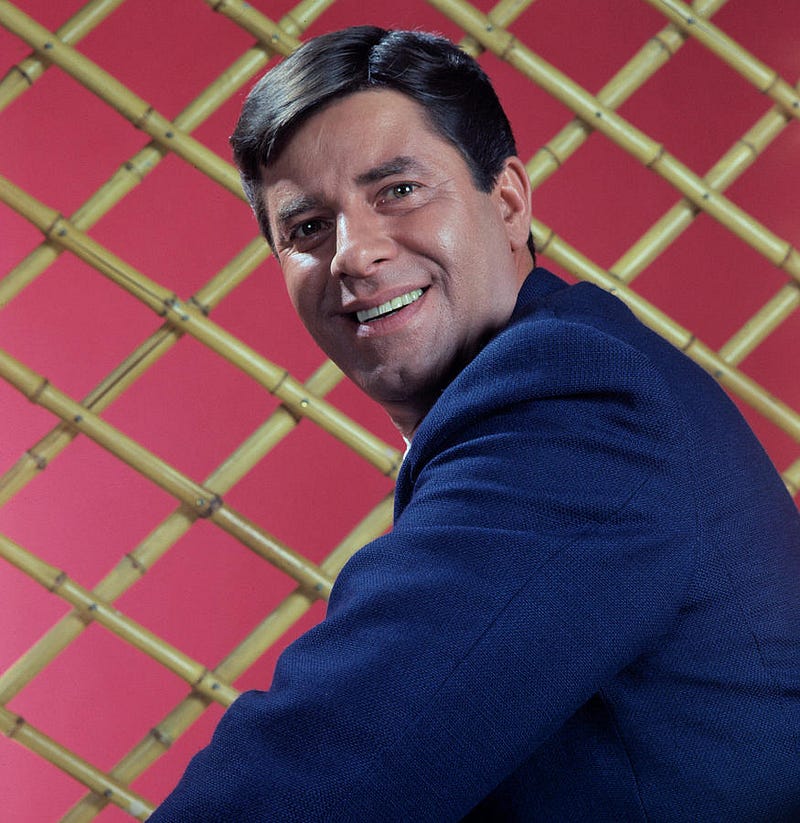
Image Credit: Fine Art America

No contest, Shawn Levy got to the bottom of what made Jerry Lewis tick and has rarely gone on the record so meticulously about The Nutty Professor narcissist that set his career ablaze with 1996's King of Comedy: The Life and Art of Jerry Lewis. Disinheriting all of his sons and creditable accusations of sexual assault towards his leading ladies are contradicted by the monkey’s off-the-wall improv schtick, expertly choreographed vignettes, Chaplinesque sentimentality, and far-reaching philanthropy.

Themes appraised in Levy’s email interview encompass straight man Dean Martin’s emotional reserve, Nick Tosches’ deck-clearing Dino: Living High in the Dirty Business of Dreams, Geisha Boy costar Suzanne Pleshette alerting Lewis that a biographer was nipping at his heels, what he wouldn’t omit if writing King of Comedy today, directorial debut The Bellboy, Frank Tashlin’s underrated Disorderly Orderly, the abominable Way…Way Out, the Law and Order: SVU episode “Uncle,” cinematic swansong Max Rose, Lewis the film instructor, Martin Short’s dead-on impression, why the Muscular Dystrophy Association fired Lewis as its national chairman, and the ultimate white whale — The Day the Clown Cried — i.e. Lewis’ Schindler’s List.

So far in the twenties the Rat Pack Confidential author, no relation to the Night at the Museum trilogy director / Stranger Things producer of the same name, has dropped A Year in the Life of Death, a book of poems based on obituaries in the New York Times, and In on the Joke, a history of the women pioneers of stand-up comedy. Levy is researching an upcoming Clint Eastwood biography and has unveiled Glitter and Might, a Hollywood and politics podcast linking Ronald Reagan, MCA-Universal kingpin Lew Wasserman, and fabled fixer Sidney Korshak.
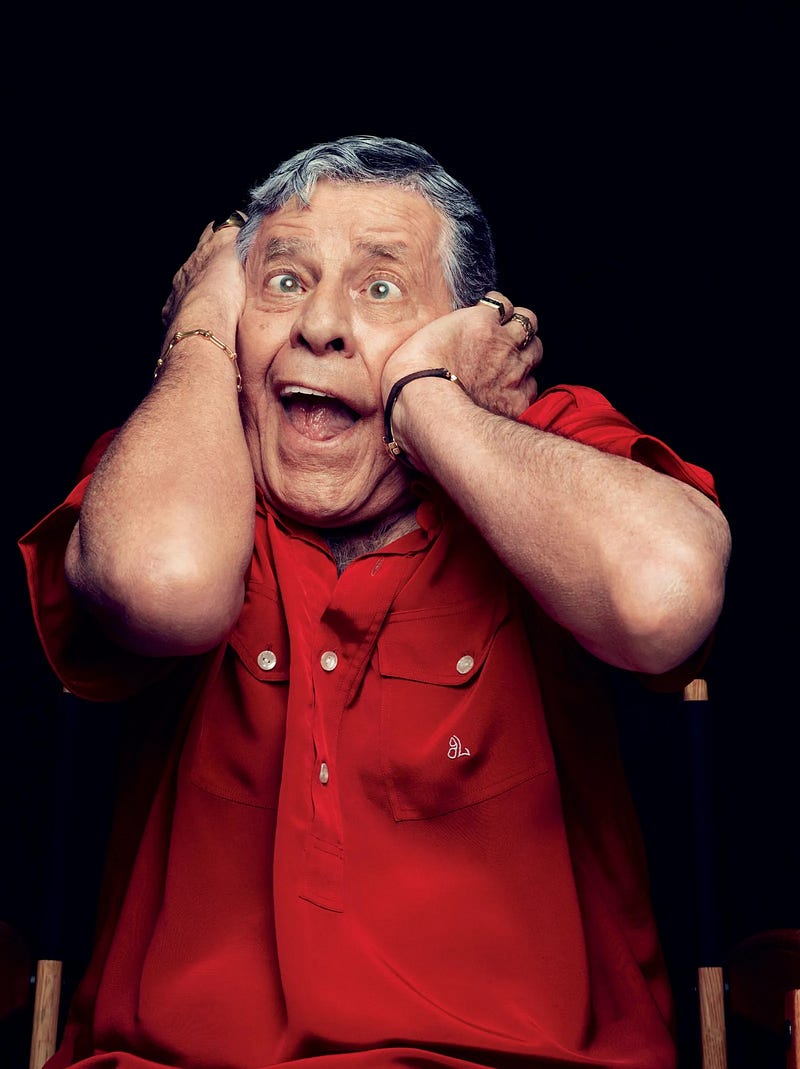
In a monogrammed “JL” short sleeve red shirt, Jerry Lewis’ zany side emerges for a GQ magazine photo spread in May 2011. Photography by Robert Maxwell

The Shawn Levy Interview

Which Jerry Lewis film makes you laugh the hardest? Or is it impossible to separate Jerry’s funny persona from his unpleasant nature which you witnessed and once had recurring nightmares about “him pulling up in front of your house in a rented Lincoln Town Car and trying to punch you in the nose?”

I appreciate Jerry’s art perhaps even more knowing how far the film and stage personality was from the real man. I still enjoy some of his work with Dean Martin, his six solo films with director Frank Tashlin, and many of his self-directed films, at least through 1965's The Family Jewels. I liked him in Martin Scorsese’s The King of Comedy, which still makes me laugh, and Peter Chelsom’s Funny Bones [1995].

If I want to laugh at a Jerry movie, I gravitate toward The Bellboy and The Errand Boy, which seem pure to me in the way of Charlie Chaplin, Buster Keaton, and Jacques Tati. The Nutty Professor, which is surely his masterpiece, has more pathos than humor — the one time Jerry was fully successful in what Dean called his “Chaplin shit.”

Have you met Martin Short? In “Being Rupert Pupkin,” your must-read essay compiled by Murray Pomerance for 2002’s Enfant Terrible!: Jerry Lewis in American Film, Tom Hanks divulged to you that Short does an uncanny impression of Jerry throwing you off Sam’s Place, his 68-foot Grebe motor yacht moored in San Diego, in early July 1993. Everything went breezily well during your various phone chats and first boat rendezvous, mostly because of the softball questions you posed. Jerry went so far as to welcome your mother backstage while he was performing at New York’s Westbury Music Fair. But the second ocean summit started on the wrong foot. Jerry was on guard, agitated about an upcoming exposé by Vanity Fair journalist Leslie Bennetts entitled “Jerry Vs. the Kids.” You knew you had to broach subjects that would undoubtedly raise Jerry’s ire. After a “remarkably frank” exploration through the break-up of Martin & Lewis, you poked at the hornet’s nest with more queries into the duo’s final days until Jerry suddenly interrupted. “What do you wanna do, a Kitty Kelley book?,” you quoted him as saying. Somehow regaining your composure, you shifted topics to The Day the Clown Cried and the lost weekend that followed the collapse of Jerry’s passion project. You wondered, “How did it feel to be left without something significant to work on?” “What do you think?! “What do you think?!” Jerry was on a tirade, labeling you an “insensitive prick” who “seemed to think that hero worship had made it difficult for you to talk with him without being insulting.” He demanded the tape of the conversation so he could delete his outburst, which he did eventually mail back to you. You made a hasty retreat, and the tentative professional relationship never recovered. Jerry declined when you asked if you could attend his long-running Muscular Dystrophy Association telethon. He called St. Martin’s Press and threatened to sue, claiming you were “doing a National Enquirer job” and that you “needed a personality transplant.” A lawsuit never transpired. Getting back to Short, no one tops his scathing, lozenge-sucking parody of Jerry, which can be traced back to SCTV and Saturday Night Live in the early ’80s. I’m nonplussed that Jerry actually invited Short onto his telethon twice, including a classic 2003 sketch where Short, in character as the celeb-obsessed, wildly ignorant Jiminy Glick, conducts a predominantly improv interview with an incredulous Jerry.

Martin Short, whom I’ve never had the pleasure of chatting with, is the only person I know of who can capably imitate both young Jerry — “Hey Dean!” — and old, statesman Jerry — i.e. the one I met.

Jerry loved being recognized by people in the business and was the sort of person who was flattered by attention. He spoke fondly to me of Lenny Bruce, who was savage about Jerry’s involvement with the MDA. Bruce was a legendary stand-up, and Jerry was proud to have known him, even if it wasn’t exactly praise that Bruce heaped on him. So if he was aware of Short’s earlier stuff, he would have likely seen it as a form of adulation, which, really, it kinda was.

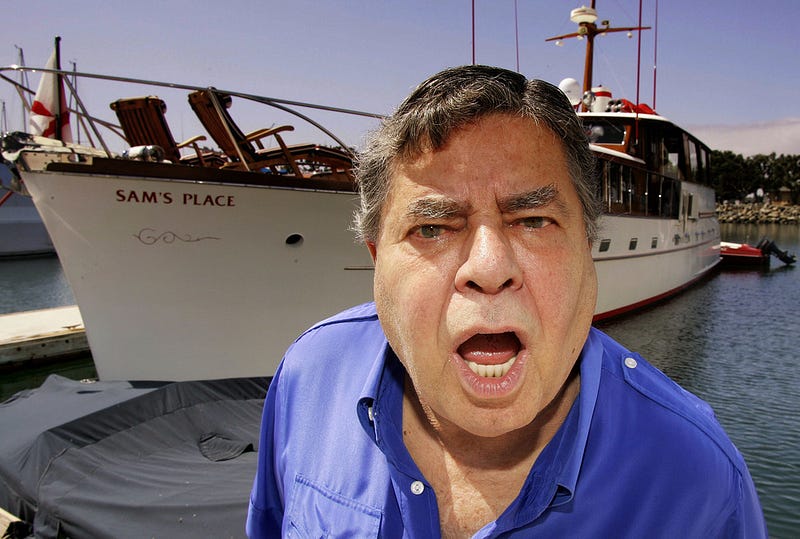
The beach is a safe haven, unlike a certain “Hey Lady!” comic’s yacht, for “Paul Newman: A Life” wordsmith Shawn Levy circa Nov. 15, 2022. Image Credit: The Shawn Levy Collection
Circa Aug. 1, 2004, with his beloved Sam’s Place yacht anchored in the San Diego bay, Jerry Lewis, still showing the effects of the prednisone steroid prescribed to treat pulmonary fibrosis, is apparently reminded of his heated interview with Shawn Levy 11 years earlier. Photography by Sven Doornkaat / Most Wanted Pictures
Shawn Levy caresses “the fearsome Gigi, 3.2 pounds of heavenly joy,” on July 15, 2023. Image Credit: The Shawn Levy Collection

Why was Jerry ejected as MDA’s honorary national chairman in 2011?

I can’t say for sure, but I think Jerry was a victim of changing times and manners. He had one fixed idea of how to appeal to people for money or aid, and it was based in the 1940s and a very patriarchal attitude toward the people he was helping. When the disabled rights movement began in the 1990s, he started to kick back at it as a personal attack, and that couldn’t have been easy for MDA officials to deal with. Too, he was a demanding and controlling collaborator, and I feel certain that he didn’t necessarily appreciate the MDA’s input in the telethon as a show. And, of course, he was getting older, with all that means in terms of stamina, ability to travel, and so on.

That said, he more or less got the bum’s rush from them, which I found deeply shameful. Jerry raised billions of dollars for MDA on his own, and he made the whole world aware of neuromuscular disease and MDA itself. To see him shunted aside without anything remotely resembling his due, which was how it looked from the cheap seats, was deplorable. I’m sure there’s a deeper story, but MDA did itself no honor in the way it handled his exit.
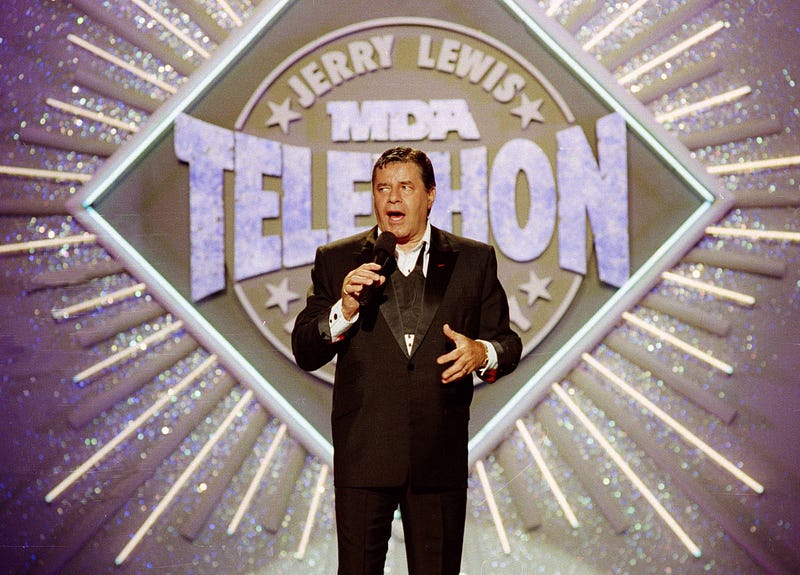
Image Credit: “Dean Martin and Jerry Lewis: The Fun and the Fury” on Facebook

If you were mounting King of Comedy today, what would you do differently since Jerry is deceased, not to mention the fact that you have three further decades of journalism under your belt?

Libel law doesn’t extend to the dead, for starters. There were things I learned about Jerry’s private and business life that I wasn’t able to publish because the standard of proof was appropriately high and Jerry was lying in wait for actionable content in the book. If I wanted to share those stories now — and I don’t — I would be able to. I’m glad some of the women he hurt are finally getting to reveal their truth [multiple Lewis costars spoke to Vanity Fair in a damning sexual harassment investigation in February 2022].

[In a Facebook post from the same time frame, Levy elucidated, “King of Comedy was considered even-handed by almost all reviewers, and it was absolutely unassailable as factual reporting. Nevertheless, Jerry wrote angry letters to me and my publishers calling the book a ‘Kitty Kelly number.’ I begged St. Martin’s Press to use that line in advertising or at least on the paperback along with a blurb from my favorite review from Screw Magazine: ‘A remarkably fair portrait of a great American a*****e.’ Alas, I failed in both efforts”].

I would do more genealogical work and more work on things like censuses. I would do more archive work — I can never do enough. I would write through to his death, his will, and the image[s] America had of him at the end. The story shifted somewhat in the years after I finished writing it. I still think it would be worth fleshing out King of Comedy to bring it up to date, but the publisher wasn’t interested when I proposed doing so. Someday, maybe.
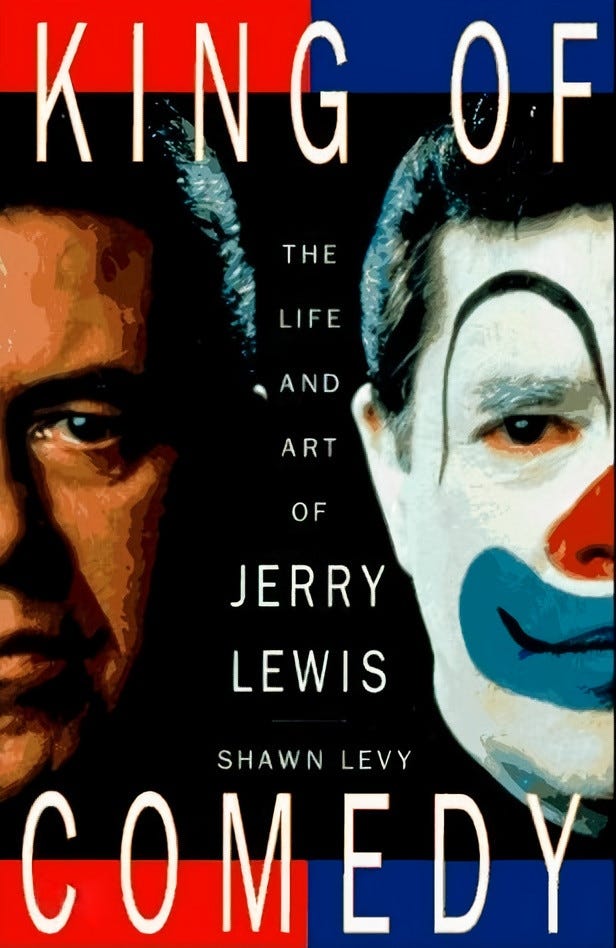
Circulated in April 1996 is the cover of Shawn Levy’s debut book, “King of Comedy: The Life and Art of Jerry Lewis.” Image Credit: St. Martin’s Press
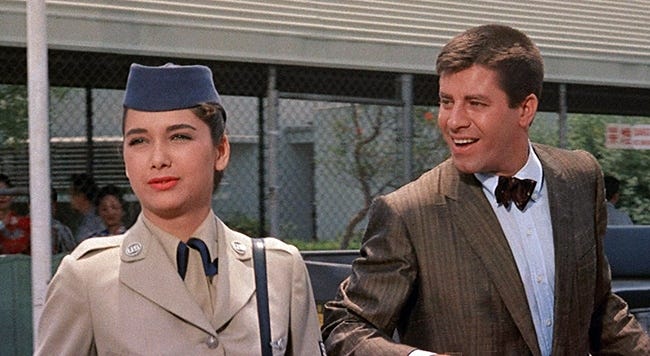
Jerry Lewis’ fourth solo film following the messy split of Martin & Lewis was “The Geisha Boy,” directed by Frank Tashlin [their fourth of eight total collaborations], released on Dec. 3, 1958, and costarring a fresh-faced Suzanne Pleshette. Image Credit: Cinematographer Haskell Boggs / Paramount Pictures / IMDB screengrab

Reaching out to Bob Newhart’s sassy TV wife Suzanne Pleshette, who made her big screen splash in 1958’s The Geisha Boy, got the ball rolling with your King of Comedy interviews. However, she let the cat out of the bag and alerted Jerry that you were planning a bio. Once Jerry gave you the okay to speak with Suzanne, how much was she willing to reveal?

Suzanne Pleshette was raised in the business, knew the game, was gracious and funny, and told stories easily. She saw a lot in her life — her dad managed the Paramount Theatre in Times Square, she worked for Alfred Hitchcock in The Birds, she knew Lew Wasserman and Sidney Korshak very well — and knew exactly how to say very little.

For the record, King of Comedy was never “nearly derailed,” but my opportunity to approach Jerry in the fashion I wished to was pre-empted by her alerting Jerry about my letter to her. If anything, the book was enhanced, though I was too green to see that at the time. St. Martin’s Press was never going to pull the plug.

Who did you really want to participate in King of Comedy?

I never got to speak with Dean or Frank Sinatra, either of which would have been something. Patti Palmer Lewis — Jerry’s first wife [from 1944–1980]. Jerry’s sons. Bill Richmond, his co-author on a number of scripts [The Ladies Man, The Errand Boy, The Nutty Professor, The Patsy, The Family Jewels, The Big Mouth, and Cracking Up].

Scorsese, who told me stories about making The King of Comedy with Jerry after he had read my book. Kind of an infinite list, really. One thing I’ve learned over the years is that once you publish a book, half the world comes out of the woodwork with new information, saying, “You should’ve talked to me!” If only!
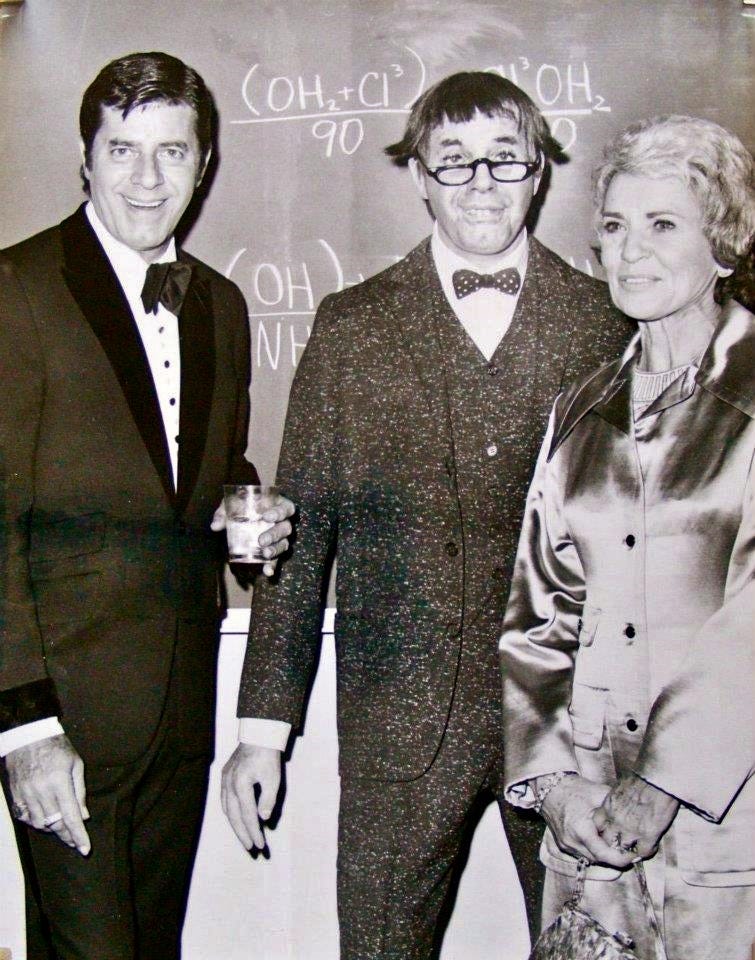
Professor Julius F. Kelp, it’s been awhile: On Nov. 8, 1973, Jerry and Patti Lewis attend the Movieland Wax Museum’s Buena Park Stars Hall of Fame dedication ceremony for his “Nutty Professor” wax dummy, with its vintage wardrobe personally donated by Lewis, in Buena Park, California. Image Credit: Jerry Lewis Archive on Facebook
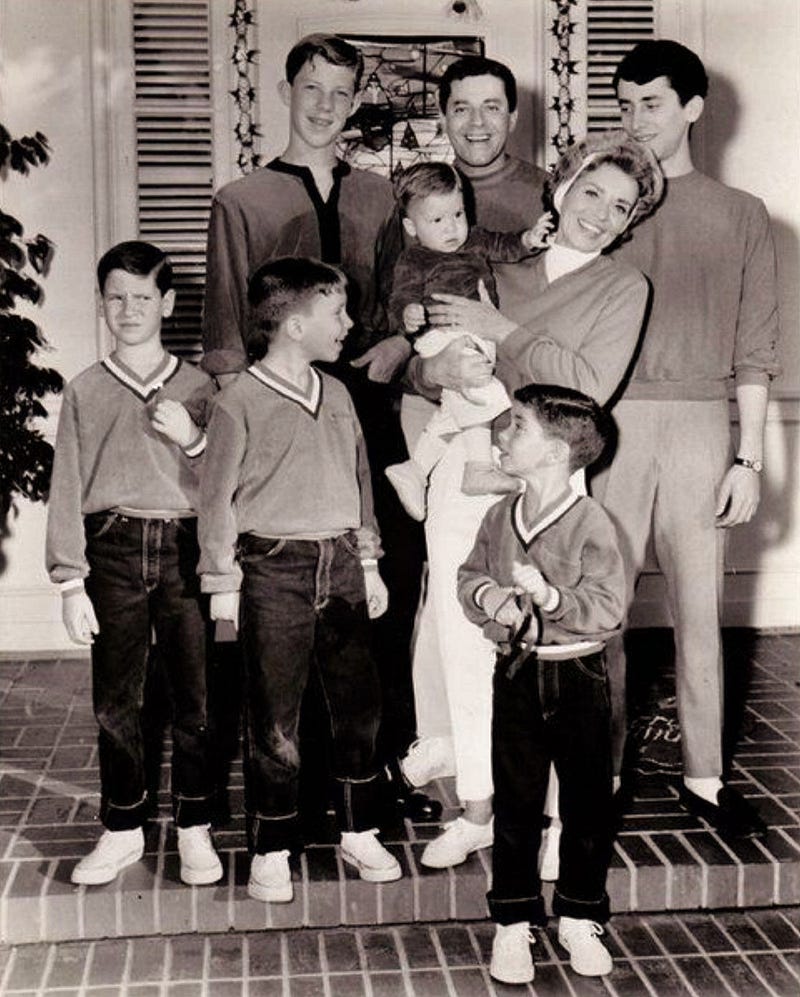
“Everybody but the dogs:” Scott, a tall Ronnie, Chris, toddler Joseph, Jerry, Patti, Anthony, and Gary Lewis circa 1964. Image Credit: Archive Photos / caption help courtesy of Shawn Levy’s “King of Comedy”

Have you had contact with Jerry’s children [Gary, Ronald, Scott, Chris, Anthony, the late Joseph Lewis, and daughter Danielle], Patti, or widow SanDee Pitnick post-publication?

Not personally, no. I am aware that at least one of his sons — Chris — echoed Jerry’s distaste for the book, but I have had no contact with any of the family.

When I was doing research, I got an address for Patti and wrote her a letter asking if she would consent to an interview. She sent my request to Jerry, who quashed it and told me that he felt I was being too invasive — one of the several times I reminded him that I was, in fact, literally writing a book about him [Palmer, a little over four years older than Lewis, remarkably endured to the ripe old age of 99 in January 2021. The Gary Lewis & the Playboys namesake identified his mother as the source of his musical journey, as she “was always singing songs around the house and playing the piano”].

Would you be interested in interviewing Jerry’s family if an opportunity arose?

No, not really. Chiefly, I’m long done writing about Jerry. I’ve even resisted the edge to finish his story, as it were, by writing about his final 20 years in additional pages in a new edition of the book.

More than that, though: Very few of Jerry’s family ever rose from their situation as Jerry’s dependents, which meant that they were obliged to see journalists who displeased Jerry through Jerry’s eyes — which would almost surely make me persona non grata to them. They have their own relationship with the man and with what they believe to be the truth about him, and I wouldn’t dream of presuming to challenge or change that.

Jerry declared bankruptcy at the time that he divorced Patti [in late 1980], which meant she got very little in the way of settlement/alimony, and that his will explicitly disowned all five surviving sons from his first marriage, so God knows there’s a lot of discomfort for anyone connected to the family story. It was uncomfortable enough carrying him around in my head for the three years it took to research and write King of Comedy. I can’t imagine how hard it must have been to be one of his sons. They have my empathy, but they have it from a respectful remove.
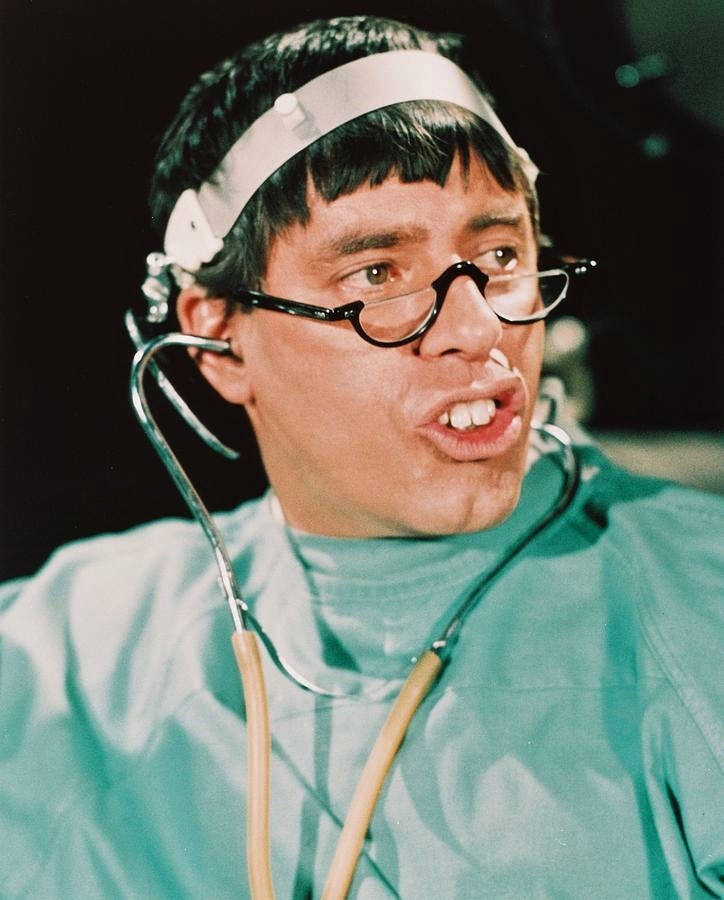
Jerome Littlefield, “Disorderly Orderly” at your service! From Dec. 16, 1964, is Jerry Lewis’ second picture of the year following “The Patsy.” Image Credit: Paramount Pictures / Fine Art America
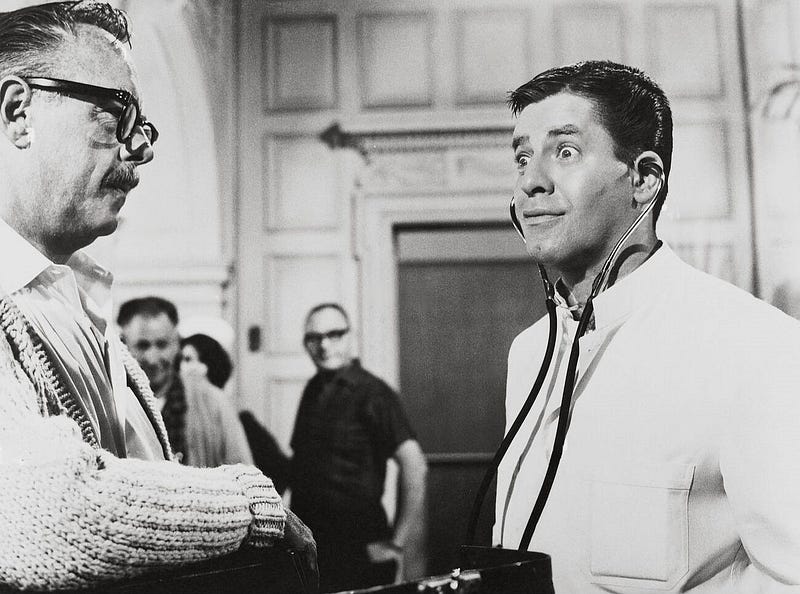
Jerry Lewis takes direction, but likely has some ideas of his own, from Frank Tashlin in a black and white still from 1964’s “The Disorderly Orderly.” Image Credit: Paramount Pictures / Alamy

Frank Tashlin and Jerry’s lucrative partnership ended with 1964’s The Disorderly Orderly, where Jerry covertly pines for ravishing blonde Susan Oliver, once his high school crush and now committed to a hospital for suicide watch. A slapstick, heart-tugging movie with Jerry still bringing his A-game, how come it’s only mentioned in passing in King of Comedy?

I can’t remember the decision very clearly. As I somewhat dimly recall, it was hard to find a copy of The Disorderly Orderly in 1993–4, and there wasn’t a lot of material about the making of the Paramount film in Jerry’s papers at USC or in the production files at the Margaret Herrick Library in Beverly Hills.

Too, I struggled to balance accounts of Jerry’s many films with telling the story of his life in a compelling, readable fashion. The Disorderly Orderly was made at a time when Jerry’s films as writer-director were more interesting to me — and, I hoped, my readers — than the need to give equal weight to everything.

A couple paragraphs more couldn’t hurt, I grant you, but at the time, and perhaps even now, it doesn’t strike me as a substantially important film or, at least, very different from his other for-hire work of the moment or just before.

Jerry has an executive producer credit for The Disorderly Orderly. Was that title a token gesture? If not, is it accurate to deem the movie a work-for-hire compared to 20th Century Fox’s abysmal Way…Way Out [1966] where Jerry did just show up and take the money?

A few things: By “work-for-hire” during the period of his contract at Paramount [which ceased with the Tony Curtis-assisted Boeing, Boeing in 1965], I mean the films that Jerry made for the studio as part of that deal, which demanded a certain rate of output from him without guaranteeing him any creative input. His executive producer credit on the films he made with Tashlin may have meant that he made more money from them, it may have been a perk of the contract, it may have meant that he served as a buffer between Tashlin and the studio when there were conflicts, etc.

I have no doubt that Jerry had an active hand in those films, but it’s hard to say where, and they do not seem nearly as personal or experimental as the films he wrote and directed. It’s clear, from the sheer volume of paperwork associated with the films he directed as compared with those he mainly performed in, that his focus at the time was on his films, not Paramount’s.

That said, Way…Way Out can only be described as a paying job — Jerry referred to such work as “my financial pleasure” — and as an abomination. Way…Way Out is a strong candidate for the worst thing he ever had anything to do with in any medium [all the more disappointing as Lewis surrounded himself with the usually reliable Gordon Douglas, a prolific western and crime director who also had a comedy background with the Little Rascals and Laurel and Hardy, previous Rock-a-Bye Baby leading lady Connie Stevens, and a top-notch cast e.g. Dennis Weaver, Brian Keith, Howard Morris, and Robert Morley].
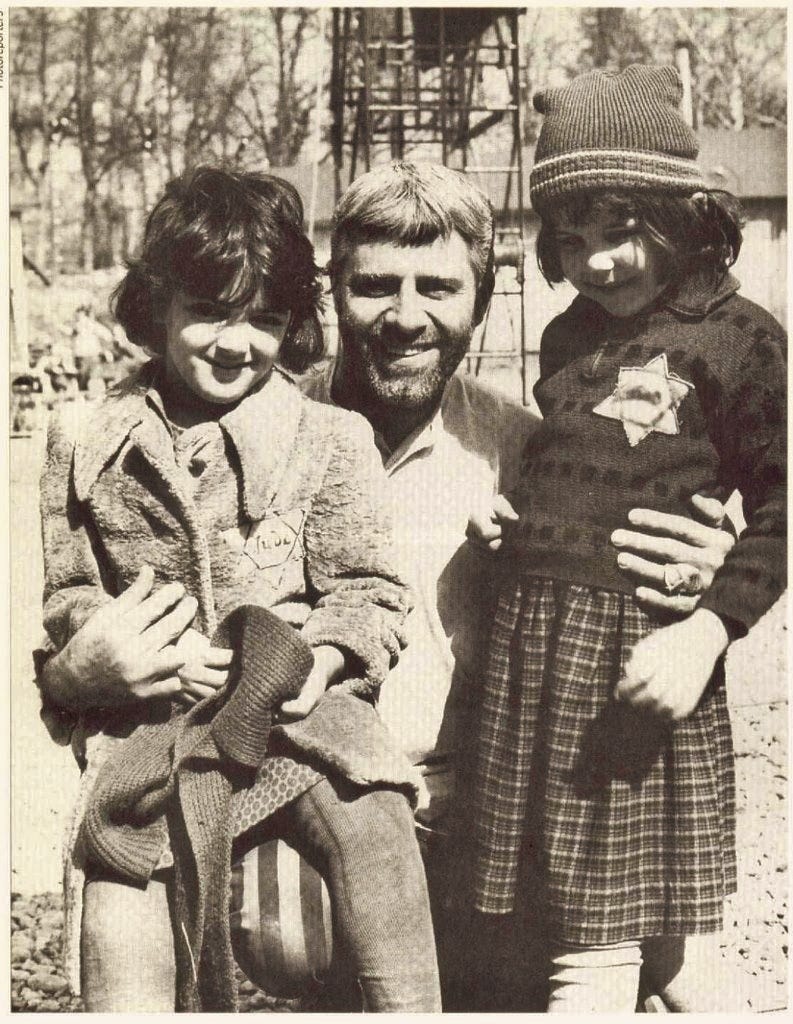
As Helmut Doork, Jerry Lewis and two little girls enjoy a genuine moment together during the Stockholm, Sweden, location filming for “The Day the Clown Cried” between April 5 and June 1972. Lewis suffered extreme anxiety and stress throughout the shoot, but his sense of professionalism never waned. Photography by Roger Tillberg / appears in Shawn Levy’s “King of Comedy”
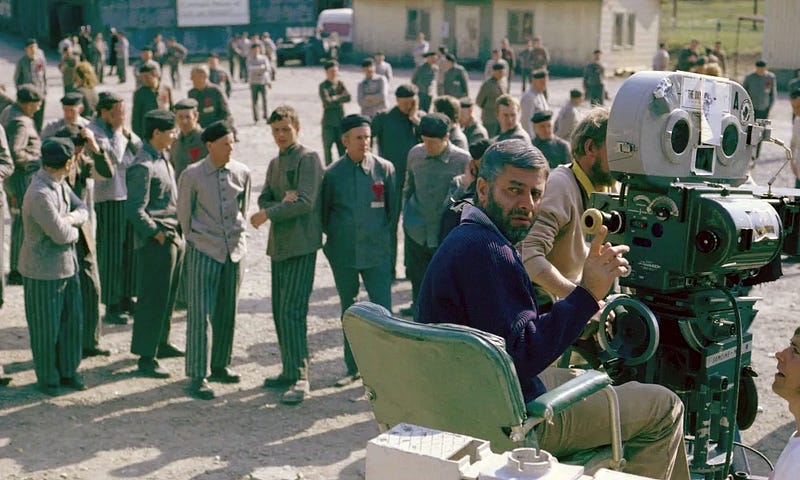
Jerry Lewis’ favorite pastime, in the director’s chair for “The Day the Clown Cried” during a day when he was not in front of the camera in costume. Photography by Roger Tillberg / Swedish Film Institute

By the twenty-tens the vitriol directed at Jerry’s lost magnum opus The Day the Clown Cried had changed course. A German documentary, Der Clown, uncovered rough cut footage, which Jerry had shot decades before other Oscar-winning Holocaust films like Schindler’s List and Life Is Beautiful. Vanity Fair, the New York Times, GQ, and other prestigious publications contradicted Simpsons voice maestro Harry Shearer’s infamous 1992 Spy magazine anecdote — “If you flew down to Tijuana and suddenly saw a painting on black velvet of Auschwitz, you’d just think, ‘My God, wait a minute!’ It’s not funny, it’s not good, and somebody’s trying too hard in the wrong direction to convey this strongly-held feeling.” Are these recent opinions mostly revisionism? Also, how much footage have you seen from The Day the Clown Cried, and does it deserve to be freed from red tape purgatory?

At the time I wrote the book, still photos were all I had access to for The Day the Clown Cried. I’ve watched perhaps 8–10 minutes of YouTube footage all told from TDTCC, and I’m an agnostic about the quality of a feature film that I’ve seen so little of. We can’t tell much from what’s leaked out of TDTCC. We don’t have context, we don’t, in some cases, have the actual footage but rather EPK footage, we don’t have it sewn together into finished scenes, and, of course, we don’t have a full movie.

I have to take Harry Shearer at his word that what he saw was what it was like for him, even if I contextualize that experience as being informed with a black-comic quality based on the idea of Jerry Lewis, as he was conceived in the mid-’70s, having made such a film, and, further, the generational glee of a younger comedy creator seeing an older one self-immolate.

I do believe that there is more sympathy toward Jerry and his work today than ever before, but I truly can’t say that means that there will be much more than academic or cultish appreciation of the complete film, if and when it is ever released. As for “deserve,” well, I go with William Munny here: “Deserve’s got nothing to do with it” [Clint Eastwood in Unforgiven, 1992]. We may not ever see TDTCC for legal or technical reasons, but just deserts won’t be a factor [Belgian producer Nathan Wachsberger absconded with the money, Lewis had to pay the crew out of his own pocket, and on top of that Wachsberger didn’t obtain the rights to Joan O’Brien’s screenplay. Lewis donated “13 cans, almost 90 minutes, of unedited camera rushes without sound” from TDTCC to the Library of Congress for public screenings scheduled to commence in 2024].
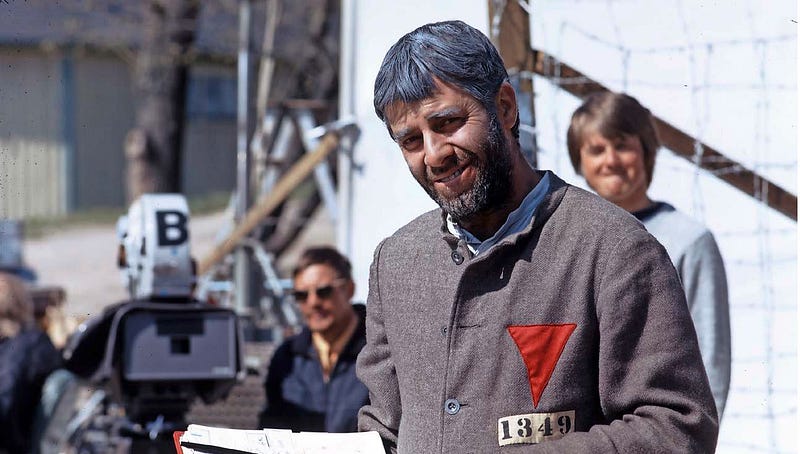
Photography by Roger Tillberg / Swedish Film Institute

“I do believe that there is more sympathy toward Jerry and his work today than ever before.” How did this phenomenon materialize?

I think a number of things happened since, say, 1996, when my book appeared. One was that Jerry simply enjoyed longevity, and in the words of Noah Cross, “‘Course I’m respectable, I’m old” [John Huston in Chinatown, 1974].

Jerry’s long-overdue Oscar for his philanthropic work is a case in point. He hosted the Academy Awards several times, and they snubbed him for decades. Eventually, sheer decency — and perhaps the passing of anyone whom he’d alienated — won the day in 2009.

Also, a generation of comedians who grew up watching him — Steve Martin, Martin Short, David Letterman, Jerry Seinfeld, Eddie Murphy, Richard Belzer, etc. — became elder statesmen themselves and frequently spoke of their affection for him. That softened public sentiment. I would include Martin Scorsese and Steven Spielberg in this list, and Judd Apatow and even Wes Anderson, who told me that he cribbed the set of The Life Aquatic with Steve Zissou from The Ladies Man.

Too, I think that in an era of digital culture, it has become possible for cult/niche aesthetics to find a home and an audience and, subsequently, to flourish. Prior to 1996, there were a small handful of academic appreciations of Jerry in print. Now there are dozens of articles to access at the stroke of a few keys. He has a following and its members are able to talk with one another.

And lastly, without taking any credit for quality or influence, I believe that my book, which was reviewed in the New York Times and Time magazine, had some impact in drawing attention to Jerry and his work. In practically 30 years, I have heard from well over a hundred film buffs, film journalists, and filmmakers about how they only had a passing or even perverse interest in Jerry before reading my bio. And that was, sincerely, one of my hopes.

Jerry was a huge figure, and he had been ignored. Among my goals in the book, one of the highest was to remind the world that Jerry Lewis had once been among Hollywood’s greatest and most innovative stars.

How long did Jerry teach film courses?

He never again taught as formally as he did at USC in the late ’60s and early ‘70s [Lewis authored The Total Film-Maker, based on his celluloid lectures attended by future luminaries including Spielberg and George Lucas, in 1971], but he did occasionally host some sort of self-enhancement seminars in “Laughter and Healing” in collaboration with a certified psychologist named Dr. Clifford Kuhn from the University of Louisville. These occurred at American medical schools, hospitals, and universities in 1995 while Jerry was touring Damn Yankees and continued until the play completed its run two years later. How I wish I’d been able to sit in on one!

What’s your take on Jerry’s last-ever TV guest appearance in “Uncle,” a 2006 episode of Law & Order: Special Victims Unit where he renders the homeless, dementia-battling relative of Det. Munch [Richard Belzer]?

Never saw it. Belzer was one of the most ardent of Jerry-philes, and I wish I’d been a fly on the wall when they worked and chatted together. Add him to the list of people I wish I’d spoken to.
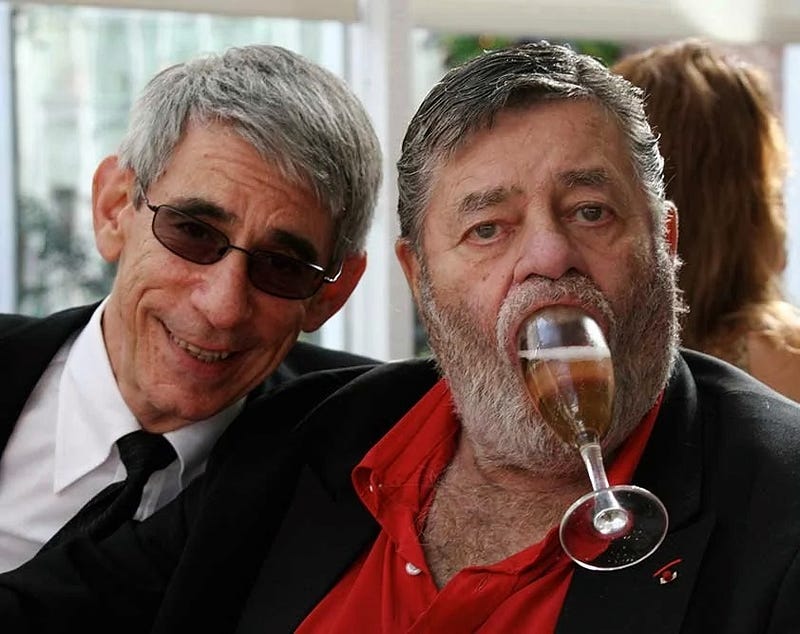
An atypically unshaven Jerry Lewis has Richard Belzer in stitches, mostly likely while the comedy idol was in New York City to film his guest spot on the “Law & Order: SVU” episode “Uncle,” which aired during the never-ending cop procedural’s eighth season on Oct. 10, 2006. Image Credit: The Las Vegas Sun
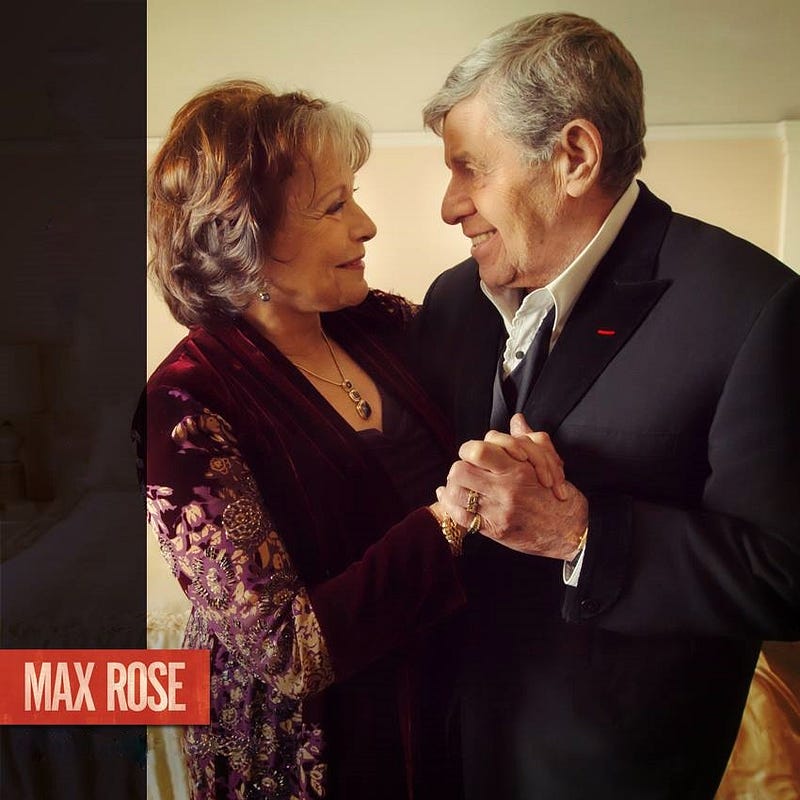
Claire Bloom, whose second film happened to be “Limelight” with Charlie Chaplin in 1952, slow dances with Jerry Lewis in writer-director Daniel Noah’s “Max Rose,” which ultimately had its world premiere on April 10, 2016, at the Museum of Modern Art in New York City. Photography by Hopper Stone / Lightstream Entertainment / Rush River Entertainment “Max Rose” Movie on Facebook

In a rare dramatic turn, Jerry breathes life into a crotchety jazz pianist grappling with the disclosure that his recently departed wife Claire Bloom cheated on him in Max Rose. Was it a fitting swansong for Jerry’s movie career?

I didn’t reckon much of Max Rose as a movie, but there are very few roles for actors nearing 90, and this one allowed Jerry to settle into a character whom he could recognize. He doesn’t have a lot of control over his instrument — voice, body — but he conveys more emotion than audiences are used to seeing. It’s not really a graceful or revealing performance, but there are truths in it.

What’s intriguing to me is that Daniel Noah’s indie film debuted to scathing reviews at Cannes in 2013 but didn’t get a theatrical/streaming release for three full years after. I wonder what, if anything, was changed in it.

Max Rose is a sweet-hearted, if soft-headed, film, and a tender final note to a full life and career. But it’s really for completists. I can’t imagine recommending it to anyone who doesn’t already harbor a bottomless thirst for Lewis-iana.
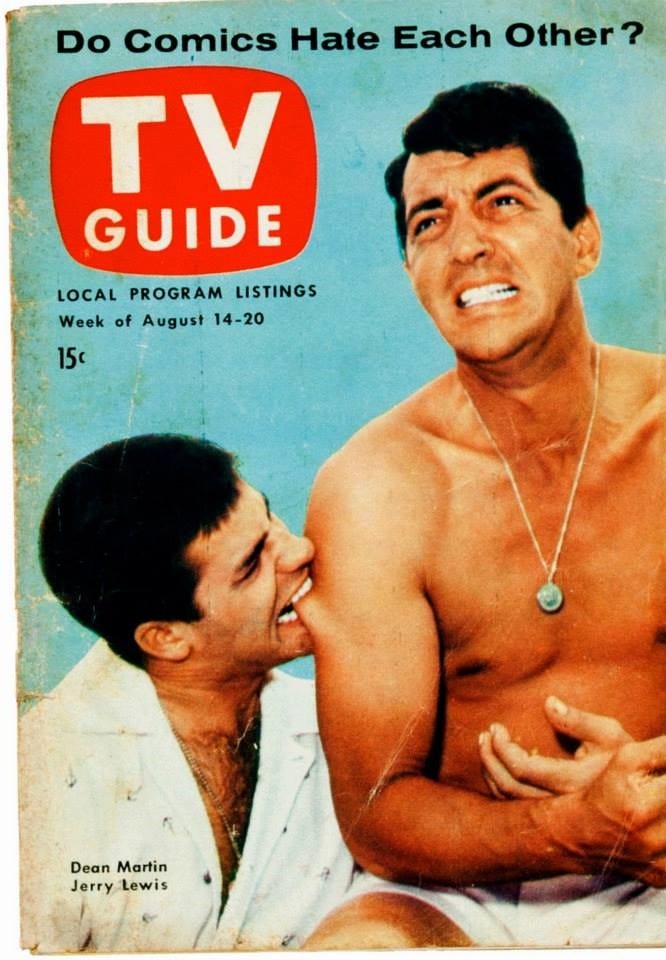
“Do Comics Hate Each Other?” The wheels were coming off Jerry Lewis and Dean Martin’s comedy partnership by the time of this exceptionally hilarious Aug. 14–20, 1954, cover of TV Guide. Image Credit: Fandom, Inc. / Jerry Lewis Archive on Facebook
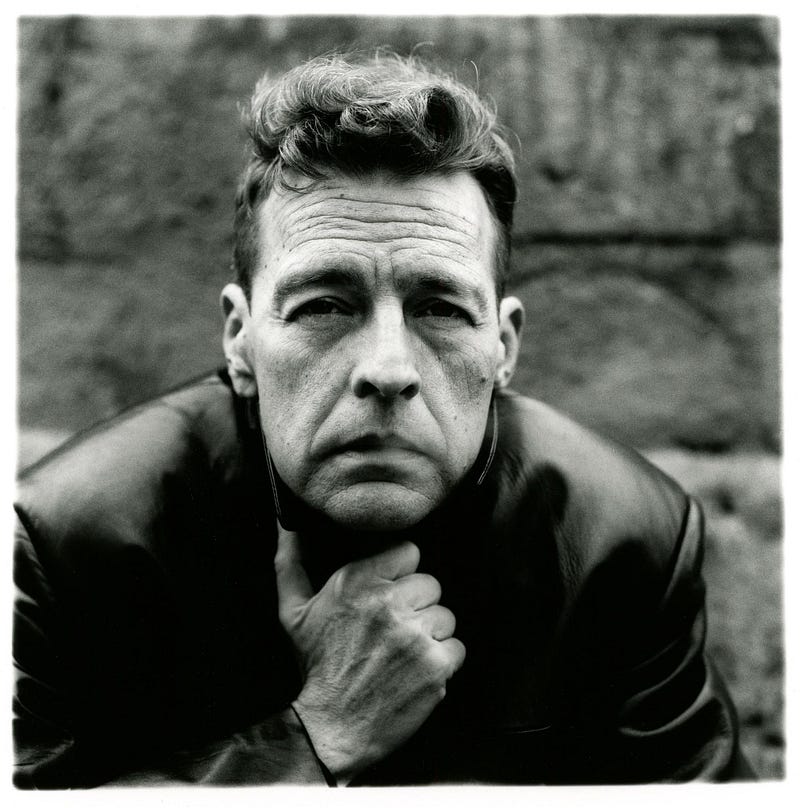
Photography of Nick Tosches by Alain Roux, 1997

You’ve chronicled Dean extensively in King of Comedy and Rat Pack Confidential. In contrast to the relatively open page policy of Jerry who granted a plethora of interviews and wrote Instruction Book for…Being a Person or [Just Feeling Better], The Total Film-Maker, Jerry Lewis in Person, and Dean & Me: A Love Story, do you have a handle on what drove the reticent crooner who hid behind his freewheeling drunk persona and was a mystery to even his wife Jeanne?

All I know of Dean Martin I know through the lens of Nick Tosches’ Dino: Living High in the Dirty Business of Dreams [1992], which seems to me definitive. I grew up in an Italian-Jewish household in New York, raised by a father and alongside uncles, many of whom were cut from a cloth I recognize in that book. These men had a strong private core and stood at an emotional remove from the world in a way that resembles Tosches’ Dino. So, yeah. I like the breed, but there’s definitely a difficult emotional legacy having been raised by and among them.

Living High in the Dirty Business of Dreams was published as the seed of documenting Jerry took root, so perhaps you touched base with Tosches. No one comes close to Tosches’ research tracing Dean’s pathway out of Steubenville to stardom, intertwined with the mob underbelly. But his book left me cold. Where’s the empathy? It’s a dissertation of an uncomplicated guy who loved country music, killed time watching westerns, and dined solo at Hamburger Hamlet. Tosches steps into wishy washy territory when he invents dialogue from Dean’s inner psyche. By the late ’60s Tosches loses interest, and his subject packed in 30 subsequent years. There’s a lot to admire about William Schoell’s Martini Man: The Life of Dean Martin, especially Dean’s Hollywood tenure and twilight moments, but Schoell, like Tosches, curiously stays in the shallow end of Dean’s recording oeuvre.

Tosches is a master, period. There may be strangenesses or oddities in that book, but to my mind they are all value added. I’m not sure that empathy for Dean Martin matter one whit to either Tosches or Dean, and I think that there are ways of understanding Dean Martin that only Tosches, among serious writers of nonfiction, could have comprehended and revealed.

I contacted Tosches for research assistance while I was at work on King of Comedy, but after one brief exchange via postal mail we never connected again. I asked Tosches to help me track down a few articles that he had cited. He said he would but never did. We were working on paper so it was a lot to ask in retrospect. Then, as it turned out, I found almost all of them simply by going to the New York Public Library. In effect, Tosches taught me self-reliance. I remain grateful.

I couldn’t write like Tosches and wouldn’t dare try. But his research in Dino is astounding — look at the bibliography and notes. I bow deeply to an author whom I have often referred to as “Il Miglior Fabbro” — the better craftsman. I’ve read a great many of his books and articles, including his 1995 Dino obituary from the Village Voice. An utterly singular writer.
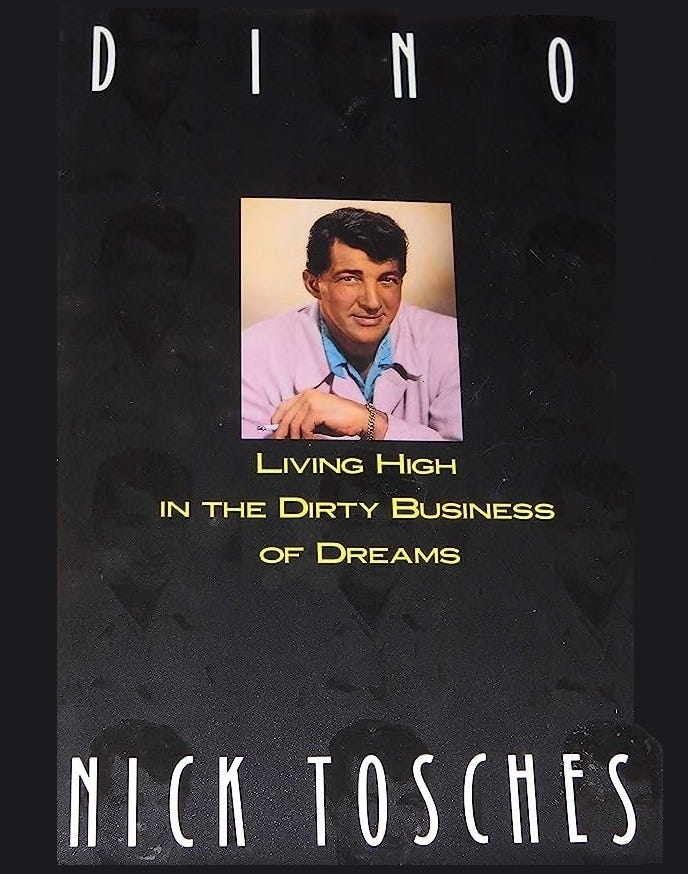
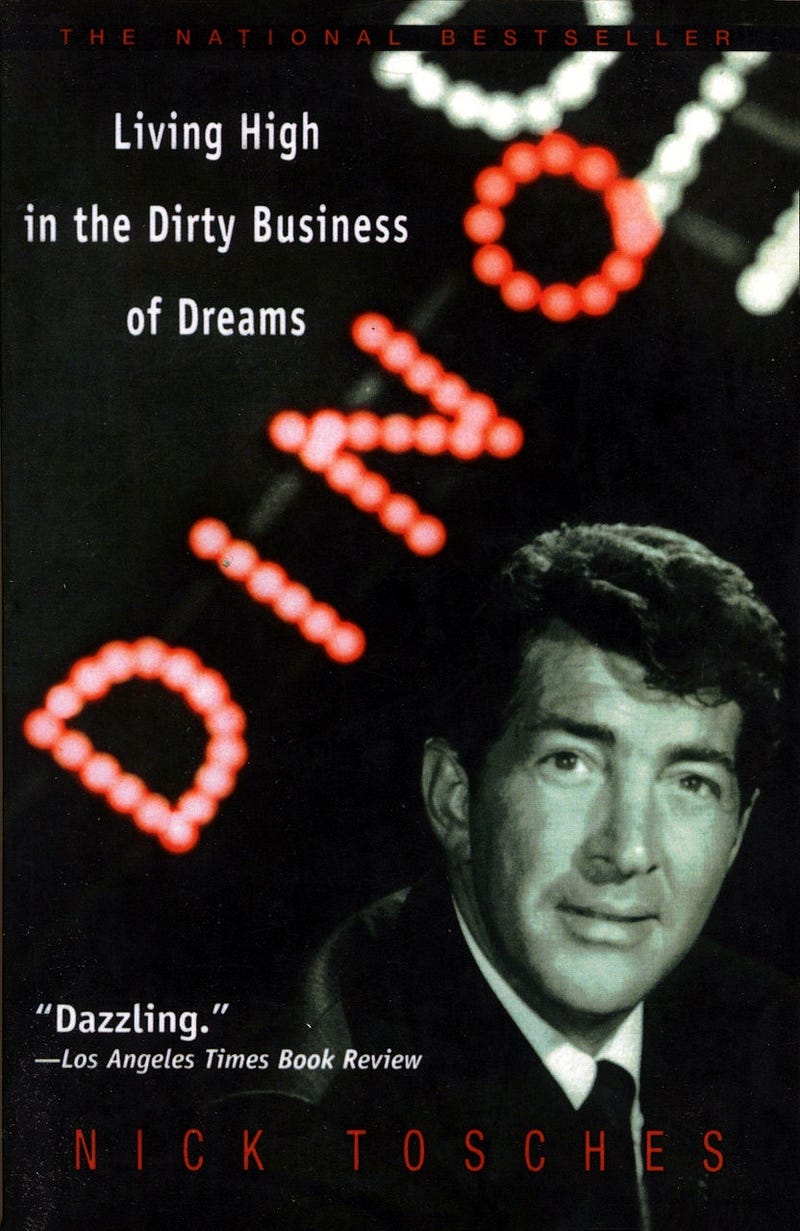
Distributed circa June 1, 1992, is the hardcover edition of Nick Tosches’ “Dino: Living High in the Dirty Business of Dreams,” while the paperback version from April 13, 1999, features a more creatively designed, eye-noticing cover etched in neon red letters. Both Image Credits: Doubleday

How many copies has King of Comedy sold?

Both the hardcover and paperback editions sold out, but we’re not talking huge numbers — perhaps 20,000 copies, maybe fewer. It wasn’t available as an e-book until 2016 — 20 years after publication — so it hasn’t sold nearly as well as several of my other books. But it was thought of as a hit, it was widely reviewed in major publications, and its reputation has lasted and shone. I spent a couple of years working on it for an advance that couldn’t support my family for more than a few months, but it was a crucial first step in what has become my life’s career. I’m eternally grateful for it.

Which of your books has surpassed King of Comedy at the cash register?

I’ve had some bestsellers, here and abroad. Rat Pack Confidential: Frank, Dean, Sammy, Peter, Joey, and the Last Great Show Biz Party [1998], Paul Newman: A Life [2009], Dolce Vita Confidential: Fellini, Loren, Pucci, Paparazzi, and the Swinging High Life of 1950s Rome [2016], and The Castle on Sunset: Life, Death, Love, Art, and Scandal at Hollywood’s Chateau Marmont [2019] have all outsold King of Comedy, as, I believe, have several other of my books that enjoyed larger first printings in hardback and paperback.

What are your recent creative ventures?

A Year in the Life of Death is a book of poems based on obituaries in the New York Times. Everybody seemed to die in 2016, from David Bowie and Prince to Nancy Reagan and John Glenn to Muhammad Ali and Arnold Palmer to Carrie Fisher and Debbie Reynolds [University of Hell Press, 2021]. I also have In on the Joke, a history of the women pioneers of stand-up comedy, such as Phyllis Diller, Joan Rivers, Elaine May, and Anne Meara [Doubleday, 2022].

Glitter and Might [Cadence13], my first podcast series, will examine Hollywood and politics. It’s going to be released in August 2023 on all the usual podcast platforms. My biography of Clint Eastwood will be published somewhere between late 2024 and spring 2025.
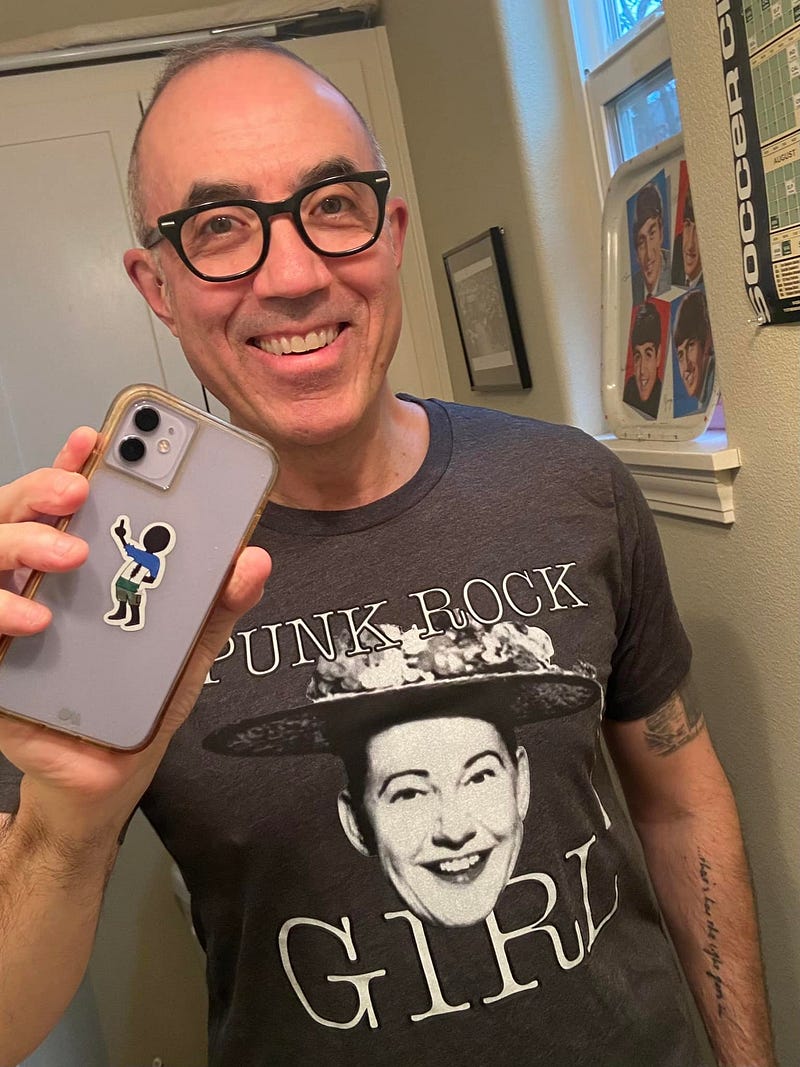
“Punk rock girl” Minnie Pearl, a legendary Grand Ole Opry comedienne, commands Shawn Levy’s gray T-shirt in this circa March 6, 2022, shot publicizing Levy’s “In on the Joke: The Original Queens of Standup Comedy” tome. Image Credit: The Shawn Levy Collection

Where were you when you learned that Jerry had died of end-stage cardiac disease and peripheral vascular disease on Aug. 20, 2017, and what was your reaction?

I was here at home in Portland, getting my gear together to go to Burning Man [a countercultural arts event lasting over a week in Nevada’s Black Rock Desert] — somehow fitting! Jerry was 91 and had been having health issues on and off since the ’80s — earlier, even — so my surprise at the news was balanced by my surprise at his longevity. Tough cuss, he was.

I did interviews with TV, print, radio, and internet journalists from all over the world, and I saw and heard interviews I had done as many as 20 years prior with journalists who were, decades before his death, compiling advance obituaries of him: very bizarre to see oneself on national television looking 15 years younger and having no memory whatsoever of conducting the interview or even where it was you were sitting.

There was sadness to the moment. For all my troubled interactions with him, he’d taken occupancy of my mind for a long time and had trailed me for decades. I realized that I would no longer be hearing news of him. And there was some satisfaction, too, in knowing that I had put together what I believe to be a significant and at least partly definitive account of his life and work, and that the world’s knowledge of Jerry Lewis would be informed by the research I had done on his life.
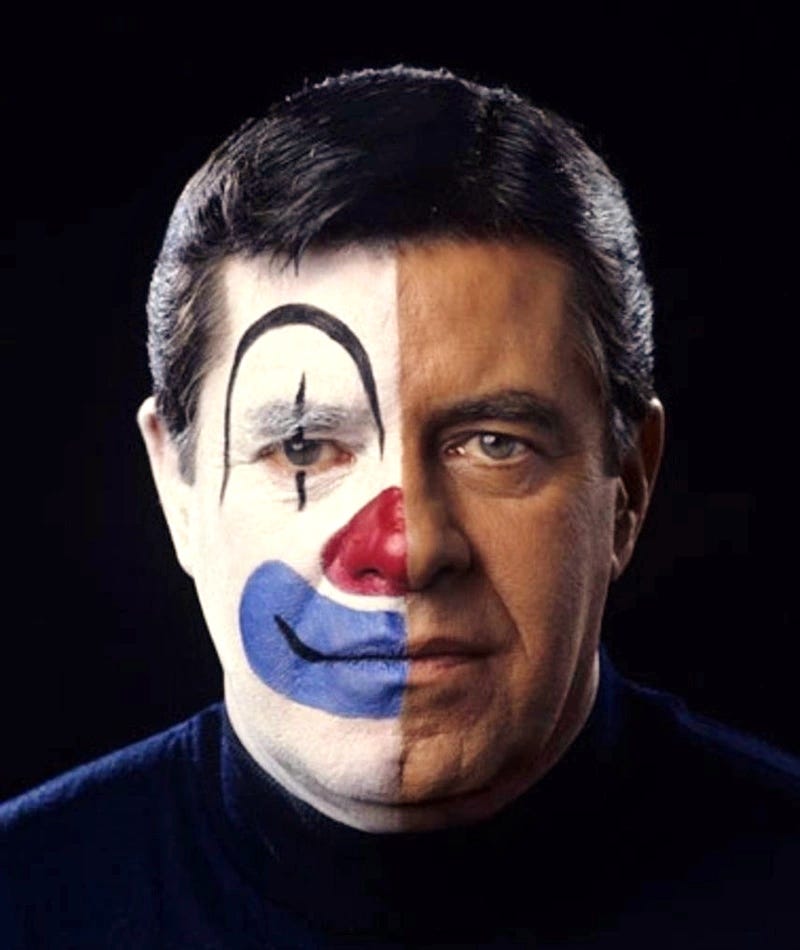
The April 22, 1984, issue of Parade magazine, a supplement for decades in Sunday newspapers in the USA, wisely selected this split personality montage of Jerry Lewis in real life vs. clown makeup for its cover. A decade later Shawn Levy also found it starkly eye-catching, and “King of Comedy” benefitted immensely. Photography by Eddie Adams / The Arena Group

© Jeremy Roberts, 2023. All rights reserved. The Shawn Levy interview was sequenced cohesively. To touch base, email [email protected] and mention which story led you my way. I appreciate it sincerely.

Humor
Comedy
Film
Movies
Books
Recommended from ReadMedium