
Web Development
25 Years of JavaScript
From a simple scripting language to the foundation of every modern web application
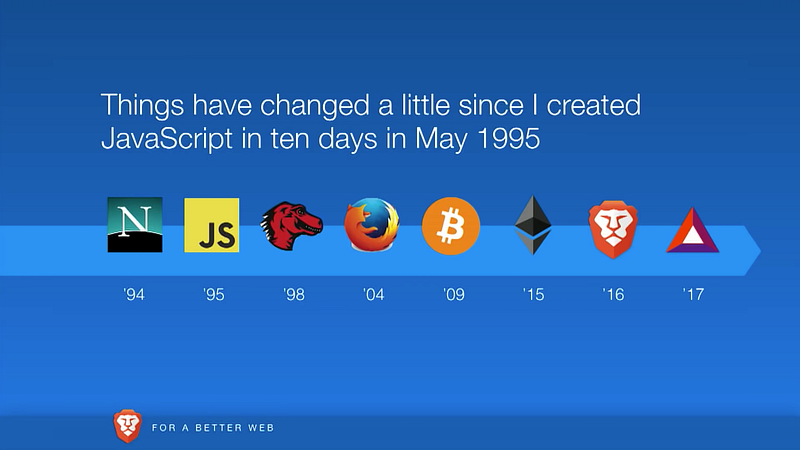
The year 2020 marks the 25th anniversary of JavaScript. On this occasion, let’s review some of the major milestones that have shaped the history of the language and have a look forward to see how it will evolve in the future.
May 1995: The Birth
On December 4, 1995, Netscape, in cooperation with Sun Microsystems, announced a new programming language called JavaScript, which was intended as an open and platform-independent language specifically for use on the internet. One of the main goals from the start was to create a language that was simple but also powerful.
For this purpose, Netscape was looking for someone who could provide the Lisp dialect Scheme with C-like syntax and incorporate it into the in-house web browser Navigator. Brendan Eich, who had only joined Netscape in February 1995, took on the mission. He wrote a prototype for the Netscape browser in May 1995 in only 10 days, and he slept little during that time.
The language was first called Moca, later LiveScript, and finally renamed to JavaScript (to serve as a companion language to Java).
June 1997: ECMAscript 1
Netscape has submitted JavaScript to ECMA for standardization at an early stage. In June 1997, the language specification ECMAScript appeared.
December 1999: ECMAscript 3
In December 1999, the third edition of the language was released with enhancements like:
- regular expressions
- better string handling
- new control statements
- try/catch exception handling
- tighter definition of errors
- formatting for numeric output
The fourth version never appeared because the various manufacturers of the web browsers could not agree on a common denominator. ECMAScript 3 was the current status for a long time.
April 2001: JSON
“Douglas Crockford specified JSON (JavaScript Object Notation), a lightweight data-interchange format based on a subset of JavaScript. JSON data is easier to load and work with in the frontend, and by the end of the decade would supersede XML as a data-interchange format on the Web.” — js25.org
March 2009: JavaScript on the Server
It’s noteworthy that JavaScript was not only intended as a language for the client but also for the server from the start. The Netscape press release already mentioned that JavaScript can be used to access databases on the server-side and to render websites dynamically. While success was quickly achieved on the client, it initially failed to appear on the server.
That only changed with the Node.js project developed by Ryan Dahl and published in 2009, which is a server-side runtime environment for JavaScript and later became one of the most important platforms for developing scalable and complex web and cloud applications.
2009–2015: ECMAscript 5 and 6
In December 2009 and June 2011, we saw a slight improvement in JavaScript with the release of versions 5 and 5.1. The big hit was planned for version 6 under the code name “Harmony,” which was then postponed from year to year. The version finally appeared in the summer of 2015 under the name ECMAScript 2015.
2016–2020: Asynchronous Programming
After planning to follow an annual publication cycle, ECMAScript has appeared in versions 2016, 2017, 2018, 2019, and 2020. The biggest change in this period was the introduction of the two keywords async and await, which have contributed to a significant simplification of asynchronous programming.
While the high speed in the JavaScript world ensures the energetic community that it’s constantly developing constructively and creatively, the long-term reliability suffers. This leads to new challenges, especially in the enterprise context.
May 2020: Deno
“Deno is a runtime for JavaScript and TypeScript that is based on the V8 JavaScript engine and the Rust programming language. It was created by Ryan Dahl, original creator of Node.js. It was announced by him on JSConf EU 2018 in his talk “10 Things I Regret About Node.js”. Deno explicitly takes on the role of both runtime and package manager within a single executable, rather than requiring a separate package-management program.” — js25.org
JavaScript in Enterprise
JavaScript has conquered the corporate world. This is due to the enormous professionalization of the language and the ecosystem in the past 10 years, and it’s also due to TypeScript. The language adds a static type system, which is of enormous help and security, especially in large and complex projects.
One of the noteworthy developments of JavaScript that we’ve recently seen is the JSX extension introduced by Facebook. It supplements the language with an XML data type with which HTML can be natively embedded in JavaScript. TypeScript 4.1 now supports jsx and jsxs factory functions through two new compiler’s options.
A Bright Future
Projects like jQuery and Node.js have played a major role in demonstrating JavaScript’s capabilities both on the client and the server-side. With WebAssembly a promising standard for interoperability with other languages, JavaScript is now more than ever an excellent basis for the development of modern applications. It has proven itself and preserved its original goal to combine simplicity and power in an elegant way. There is no doubt that it will remain so in the future.
Happy 25th birthday, JavaScript, you’ve grown out of your infancy!
What are your experiences with the most popular programming language in the world? When did you first have to use it? Feel free to share your experience with it.
🧠💡 I write about engineering, technology, and leadership for a community of smart, curious people. Join my free email newsletter for exclusive access or sign up for Medium here.
You can check my video course on Udemy: How to Identify, Diagnose, and Fix Memory Leaks in Web Apps.