
POETRY / CLASSIC FILM POETRY CHALLENGE
I’ve Got Bette Davis Eyes
Ever since childhood, my eyes have been inexorably drawn to the great actress and her brilliant performances
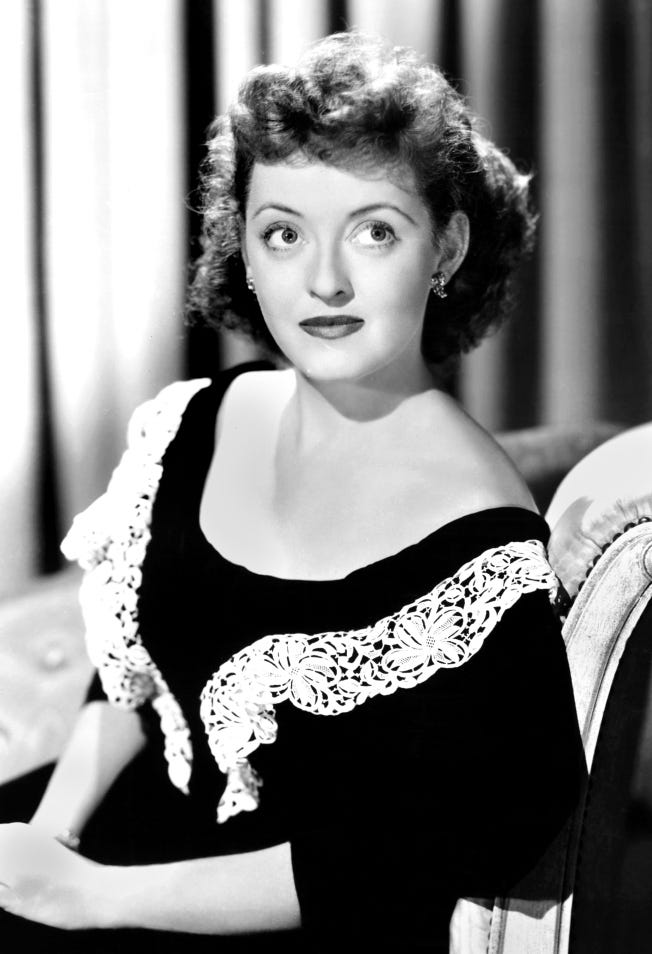
When ‘ere I think of movie classics from Hollywood’s Golden Age, I oft recall an image of my favourite ever actress, born in Massachusetts with the name of Ruth Elizabeth, but she is better known to all as the wonderous Bette Davis.
I’ve been in love with Bette Davis since 1981, when Kim Carnes sang about her eyes, winning Record of the Year. I loved the song and was inspired to learn about the actress, and ever since I’ve loved her films, and followed her career.
She started like so many do by working in the theatre, and at the age of 21 she first appeared on Broadway. Within a year, a screen test saw her sign with Universal, and so it seemed that her career was truly on its way!
But Universal squandered her and all they seemed to give her were a few supporting roles in films that gave no chance to shine. She won acclaim in 1934’s Of Human Bondage, (she was ‘on loan’ to RKO Radio Pictures at the time).
She should have won the Oscar. Studio squabbles intervened, but with her next film, Dangerous, from 1935, she won Best Actress, at long last, and moved to Warner Brothers. It was with them that Bette’s film career would really thrive.
She won Best Actress five years running, ‘38 to ‘42. Jezabel in ’38, Dark Victory ‘39, The Letter, 1940, 41’s The Little Foxes, and then in 1942 with a favourite film of mine.
Now, Voyager, for me, is Bette’s very best performance, and every time I watch it I collapse in floods of tears. She plays the role of Charlotte Vale, a dowager from Boston, who meekly suffers her abusive mom for many years.
Her brother’s wife then intervenes and sends her Dr Jaquith; this psychiatrist suggests escape from Mother Vale, and checks her in for treatment at the doctor’s sanitarium. It does the world of good, and Charlotte’s inner strength prevails.
Before returning to her home and to her nasty mother, Charlotte, now more confident, sets sail upon a cruise. She blossoms like an orchid, meets new friends, the McIntyres, and through them Jerry Durrance, with whom romance soon ensues.
Vale and Durrance leave the ship at Rio de Janeiro just for the afternoon, but then they crash their rented wheels. Thus the pair are stranded there and the cruise ship leaves without them. Stuck five days in Rio, they both fall head over heels.
But Durrance is a married man, with wife and daughter, Tina, and though they are unhappy, he cannot divorce the wife. And so the pair decide they can no longer see each other. Charlotte flies to Buenos Aires and returns to ship-board life.
Returning home to Boston, Charlotte is a much-changed woman. The family all marvel at the way she has transformed. But mother dearest is determined to destroy her daughter, yet the holiday romance with Jerry sees Charlotte now reborn.
As time progresses, Charlotte gets engaged to a wealthy fellow but breaks it off when just by chance she meets again with Jerry. The end of the engagement’s news she has to tell her mother. A vicious argument ensues, then a thing extraordinary.
I do not want to spoil the rest, though it’s nearly eighty years since the classic film, Now, Voyager, first landed on film screens. Suffice to say, I recommend you find yourself a copy so you can watch (and, like me, weep) through all the touching scenes.
Davis’ career continued, blazing like a comet, and she went on to star in Mr Skeffington, Deception. But the timeless classic, All About Eve, released in 1950 saw Bette Davis earn herself the greatest of receptions.
And twelve years later Davis starred in another famous picture, Whatever Happened to Baby Jane, appearing with Joan Crawford. Their bitter off-screen rivalry is cinematic legend, and made the mood on their film set considerably awkward!
Bette died of cancer of the breast in ’89. She had been diagnosed with it in 1983. She’s now entombed in Forest Lawn in LA’s Hollywood Hills, and she remains iconic to film buffs and fans like me!
Thank you to Jeff Ehren for inviting me to participate in the Classic Film Poetry Challenge.
I’m tagging Lucy Dan 蛋小姐 (she/her/她) Denise G Jennifer McDougall Tree Langdon The Academy Lindsay Soberano-Wilson Eva Rotolo Orla Kenny Kyomi O'Connor Kiki Wellington Sherry McGuinn Yael Wolfe TC Hails Skye Mo'ipulelehua Kahoali'i Michael Burg, MD (AKA Medium Michael Burg) Dave Logan Hogan Torah Anthony O'Dugan Elle Beau ❇︎ Laurie Perez Will Hull Terry Trueman Roz Warren Gaby Rogut Denise Larkin Ann Marie Steele Melanie J. Haikuster Sarah Paris Eric Pierce and anyone else who would like to participate.
Jupiter Grant is a self-published author, blogger, narrator, and audiobook producer. Buy me a coffee here: https://ko-fi.com/jupitergrant
More film-inspired poetry by Jupiter;


