
It’s Time for Chief Justice John Roberts to Retire
For the good of the country and the court
I have always liked Supreme Court Chief Justice John Roberts. He was well qualified for the position of chief justice having a solid legal education and career, as well as a stint serving as a clerk to his predecessor, Chief Justice William Rehnquist. He has been, in many ways, a reasoned and thoughtful leader of the court, occasionally stepping in when some of his more zealous colleagues were about to create controversial precedence — such as in the 2012 case when he wrote that Obamacare’s health care mandate was within the taxation power of Congress.
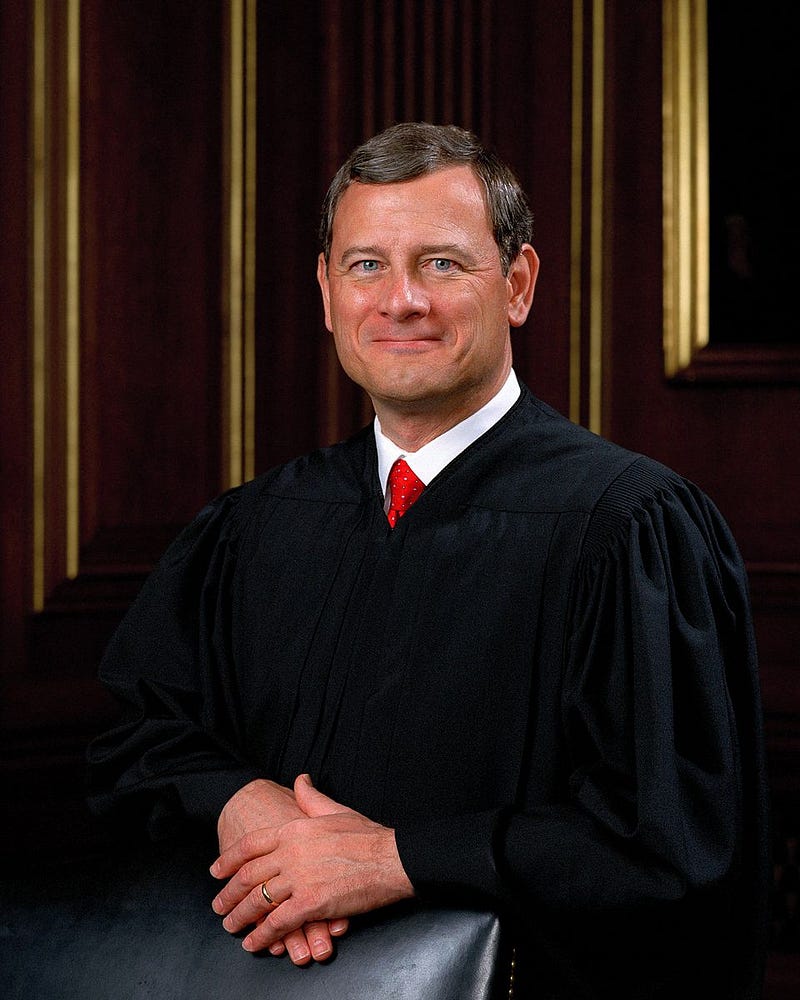

But, as with all things, time passes and things change. And a major change has been with the current complexion of the Supreme Court. The court now has a super-conservative majority of 6–3 thanks to the shameful legislative shenanigans of Senator Mitch McConnell, the Republican leader of the Senate.
When conservative Justice Antonin Scalia died in early 2016, McConnell refused to give President Barack Obama’s nominated replacement, widely respected Judge Merrick Garland (now the Attorney General), so much as a hearing arguing that in an election year, the voters should have a say. McConnell stated this was because of the “Biden rule,” a rule that then-Vice President Joseph Biden was unaware of, and that made little sense as the election was nine months away. But when Donald Trump became president, McConnell’s machinations paid off, and instead of Justice Merrick Garland, we wound up with Justice Neil Gorsuch nominated by Trump.
However, late in Trump’s term, when Justice Ruth Bader Ginsberg died, with a presidential election a mere six weeks away, McConnell fully dismissed his “Biden rule” fabrication and rushed the confirmation of Judge Amy Coney Barrett. Barrett’s confirmation hearings were held even as early presidential voting was underway. The new justice was sworn in on October 27, 2020, exactly a week before Americans went to the polls to have their say.

.jpg)
And what was their say? The election of President Joseph R. Biden who convincingly defeated Donald Trump. Nonetheless, with McConnell’s devious and highly hypocritical assistance, Trump put three justices on the Supreme Court. Among one-term presidents, only Benjamin Harrison, in the 1880s, appointed so many new faces to the court.
This was a modern-era version of “court packing.” And contrary to McConnell’s assertions regarding Merrick Garland, the American people did not get “a say.” Trump did not win the popular vote in 2016 and lost it by an even larger margin in 2020. But what he left behind, ably assisted by McConnell, was a 6–3 Supreme Court that was not reflective of the views of the American people. Had Garland been confirmed, as he should have been, and had Barrett’s confirmation not been rushed leaving her seat to be filled by a Biden nominee, the court would now be 5–4 with a philosophical tilt in the other direction. And it would be a tilt more consistent with the views of the American people. This is, in essence, the core of the current court’s legitimacy crisis.
And nowhere was this controversial conservative tilt been on greater display than in the current court’s 6–3 decision in the Dobbs v. Jackson Women’s Health case that overturned the abortion precedent established in 1973 by Roe v. Wade. And the Dobbs decision, written by Justice Samuel Alito, has been shown with the recent election results to be quite inconsistent with current American perspectives. This widening gap between popular opinion and court decisions has damaged the legitimacy of the court, damage that Roberts — at least in his few public pronouncements — either does not see or does not want to acknowledge.
Accordingly, the reputation of the current court has been in free fall. As recently as mid-2020, when Ginsberg died, 58% of Americans approved of the court according to Gallup polling. Current polling shows that reversed with 58% now disapproving. No doubt that is related to three inter-connected issues. First, as already stated, are the controversial confirmations of Gorsuch and Barrett.
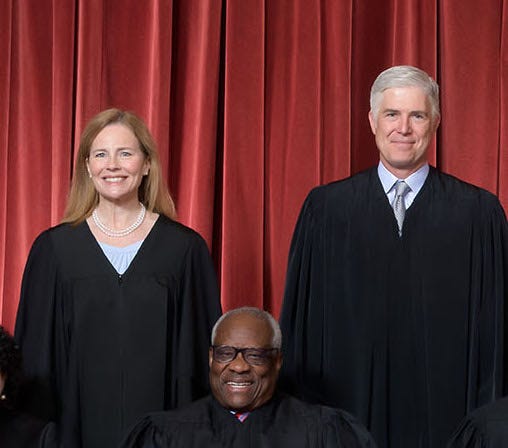

Second, as many senators, most notably Maine’s Susan Collins, have noted, all three new justices nominated by Trump when asked in individual interviews voiced their fealty to the stare decisis doctrine. The question was clearly understood to refer to Roe as settled law, and the impression left was that it was just that — settled law. In brief and blunt terms, senators felt they were lied to by the Trump nominees.
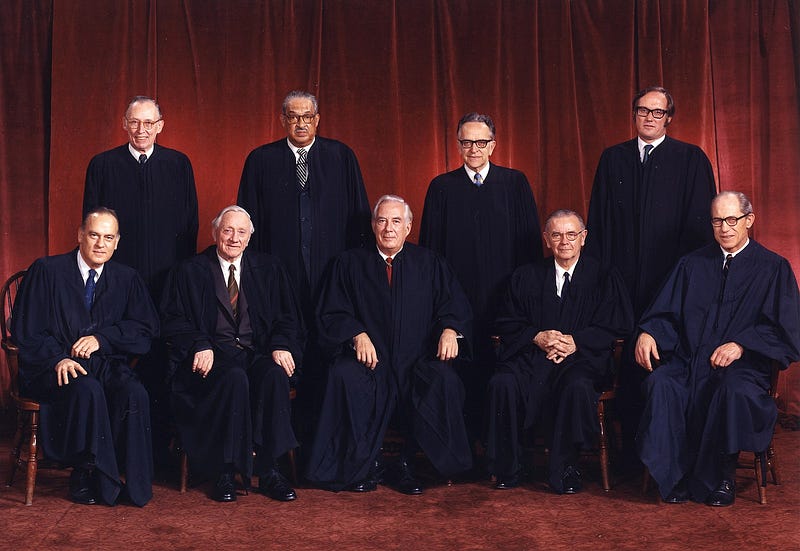
Lastly, the court that has emerged is largely unrepresentative of America. For one thing, it is predominantly Catholic in a country that is predominantly Protestant — and slowly moving to largely non-denominational, the group known as the “nons.” Indeed, before the arrival of newly appointed Justice Ketanji Brown Jackson only one justice, Gorsuch, identified as Protestant although he was raised Catholic. In addition, every justice but one (Barrett) attended either Harvard or Yale law school. It is true that the current court has four women justices, whereas the Burger Court that decided Roe had none, but that distinction seems — ironically enough — rather irrelevant.
Which brings me to Chief Justice Roberts. The chief justice has no legal authority over the other members of the court, and only limited authority within it attached to court rules and traditions. The chief justice is mostly a chief among equals. The primary power of the chief justice is to assign the drafting of opinions when his view is in the majority. But an implicit power is his ability to persuade and, as with Roberts’ vote in the Obamacare case, sometimes add his weight to a decision.
Presumably, the chief justice benefits from some degree of reverential authority bestowed by the others as it is, after all, his name that is attached to the court itself. The famous Brown v. Board of Education was decided by the “Warren Court,” Roe was decided by the “Burger Court,” and Dobbs will be remembered as a major decision (perhaps the major decision) of the “Roberts Court.” Nonetheless, whatever additional authority Chief Justice Roberts once had, he is now seemingly just along for the ride, and it is becoming a most bumpy road, one made no easier by the controversial behavior of Justice Clarence Thomas and his wife.

It is, therefore, time for Roberts to retire. He should step down and give President Biden the opportunity to appoint a new chief justice. That would, at least, move the court ideologically from 6–3 to 5–4, a ratio that is still inconsistent with the expressed mood of the electorate — as seen in the 2020 election and now the 2022 mid-term, as well as the failed efforts to ban abortion in various states including Mitch McConnell’s home state of Kentucky. But at 5–4, the possibilities of reason and balance are improved.
It is also time for Justice Thomas, now the longest-serving member of the court, to step down after disturbing ethical lapses. He seemingly endorsed the senate campaign of Georgia’s Herschel Walker, and has not recused himself from Trump-related cases even though his wife was involved in efforts to overturn the 2020 election. These actions have clouded the reputation of the Roberts Court as an impartial and apolitical arbiter. It would be painful for Thomas to do so, given that his infamously contentious confirmation hearing was before a Senate Judiciary Committee chaired by Senator Joseph Biden, but his continued service will only further diminish the court.
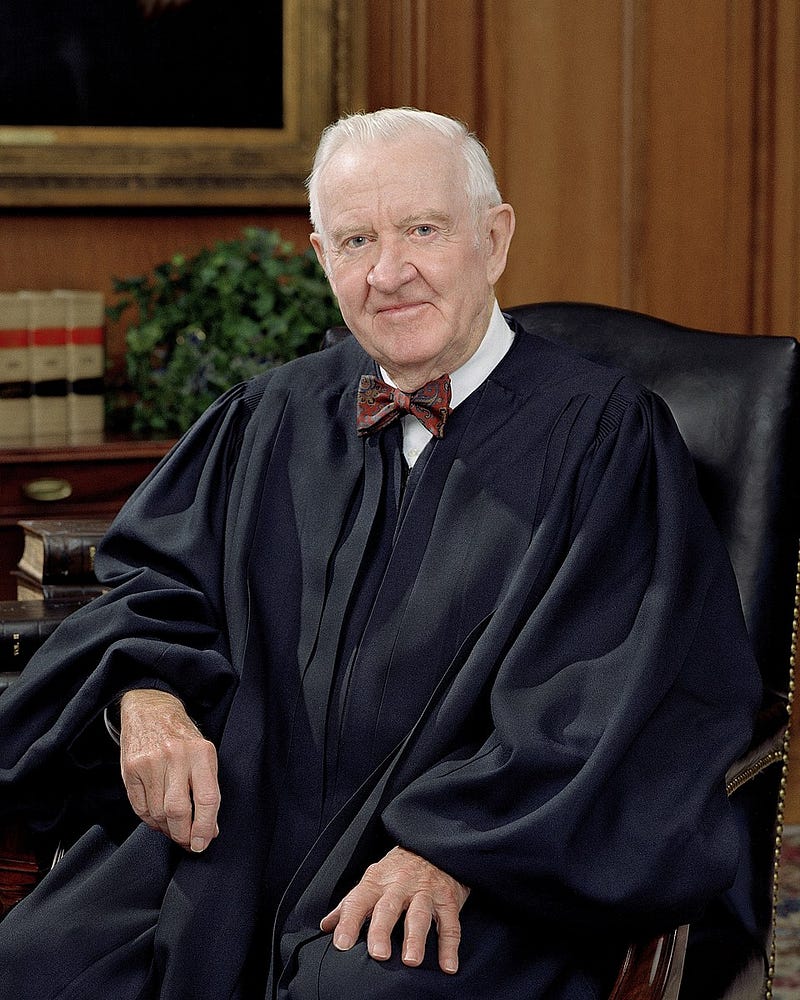
And once Roberts has left the court, he should follow the lead of his former court colleague, Justice John Paul Stevens, and suggest changes to the court that would help restore its public standing. After his retirement, Stevens suggested a wide array of reforms that merit serious consideration. Roberts should consider a similar role. President Biden’s thirty-four-member Supreme Court Commission, which rendered its report in December 2021, contained no former court members. The views of a former chief justice would likely be useful in shaping any proposals that are eventually pursued, especially those regarding the ever-controversial issue of court expansion.

One thing that bears serious consideration is tenure on the court, a topic well covered by the Supreme Court Commission. Appointments to the federal bench are for life. Ours is the only democracy that provides such unrestricted tenure on its highest court. Sometimes that works well, but for those appointed at a young age (Thomas was just 43 when he joined the court and is now its longest-serving justice, while Barrett was 49 when elevated) the isolation and insular life of the court can begin to show. Getting a constitutional change is likely infeasible, but an internal agreement by the court members that eighteen years — three senate terms — is a sufficient tenure might be helpful. Under that standard, Roberts now entering his eighteenth year on the high court could set the example.
In my view, Chief Justice Roberts has served his country well under often trying circumstances, trying because of circumstances largely beyond his control. The chief justice does not get to choose his colleagues and plays no role in the confirmation process. Roberts has administered the presidential oath of office four times and presided over two presidential impeachments. But at the moment, the way he can best serve the court and enhance its eroded legitimacy is to leave it.