
The Differences Between the Roe Supreme Court and the Current Supreme Court
Less than you would think, but still important
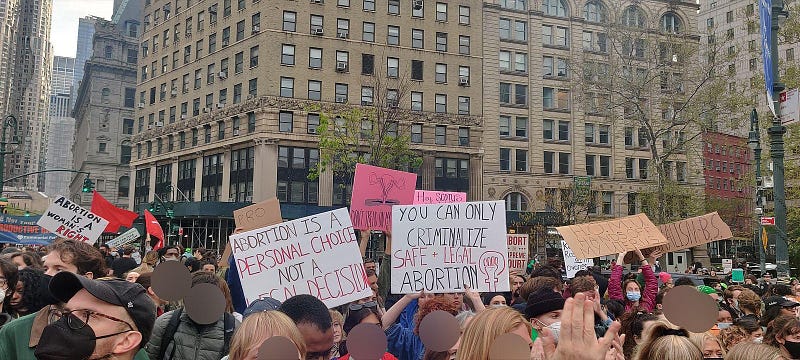
A social and legal maelstrom erupted following the leak in early May of a draft opinion on Roe v. Wade written by United States Supreme Court Justice Samuel Alito. Some of the discussion has revolved around the leak itself and the damage it has done to Supreme Court (SCOTUS) deliberations, but by far the larger furor was about the content and reasoning of the Alito draft. In essence, it advocates overturning Roe v. Wade, a 1973 court ruling that legalized abortion in the United States.
The reversal of rulings by the Supreme Court is relatively rare. About 300 have occurred in the history of the republic — equating to a bit more than one per year. The longest period before overturning an earlier ruling was 136 years, the shortest 11 months. Perhaps the most famous court reversal was the Brown v. Board of Education decision in 1954 declaring that “separate but equal” treatment between the races as established by Plessy v. Ferguson in 1896 was contrary to the “equal protection” provisions of the Fourteenth Amendment. The Brown ruling was controversial, especially down South where signs sprang up calling for the impeachment of Chief Justice Earl Warren. Still, it would be two decades before the provisions of Brown were widely implemented.
But by overturning a previous ruling a sitting Supreme Court is alleging that the ruling of a previous court was wrong — or “wrongly decided” as the legal community would state it. This raises the question as to what the current SCOTUS and its members feel they know, or have discovered, that leads them to the view that their predecessor court in 1973 was in error. I thought it might be useful to look at the two courts, and that investigation was interesting in how it showed the two courts were different, but also what they actually had in common.
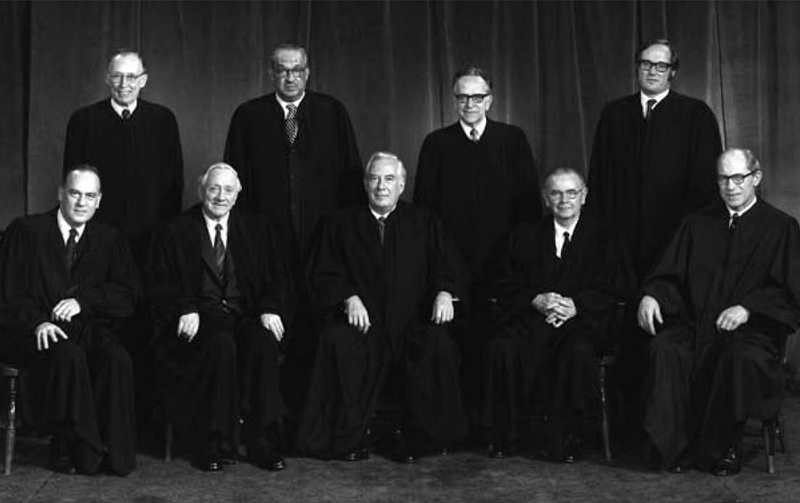

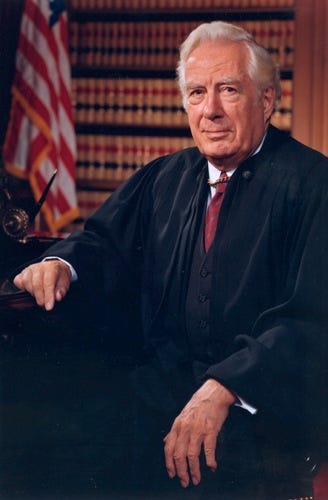
In 1973, the Chief Justice of the Supreme Court was Warren Burger, nominated by President Richard Nixon in 1969 and confirmed overwhelmingly by the Senate 74–3. Burger, a graduate of the St. Paul’s Law school in Minnesota, had been an Assistant Attorney General in the Eisenhower administration and had served 13 years on the D.C. Court of Appeals where he had been critical of numerous decisions of the Warren court. That alone made Burger appealing to Nixon, who was concerned about judicial over-reach.

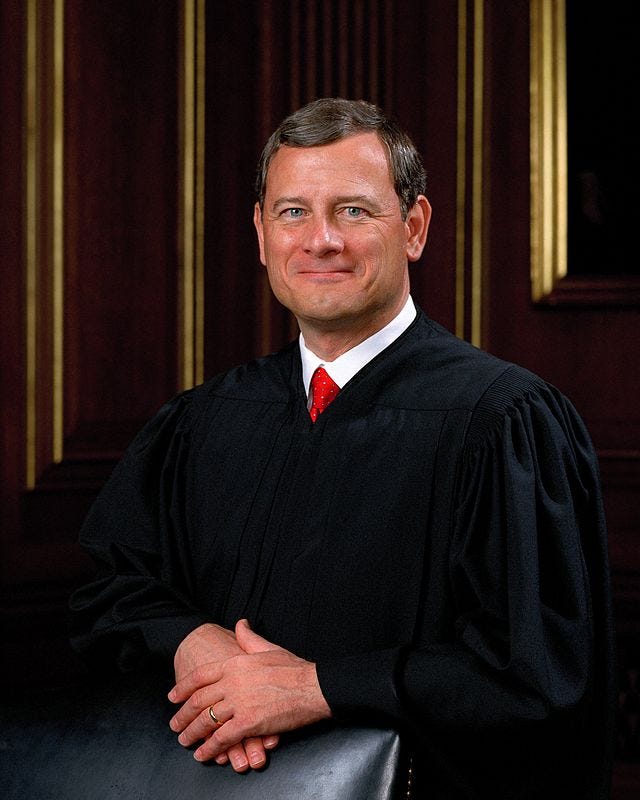
The current chief justice is John Roberts, nominated by President George W. Bush in 2005, and like Burger coming from the D.C. Court of Appeals. Also, like Burger, Roberts stepped directly on to the high court as chief justice, replacing Chief Justice William Rehnquist who had died in office in September 2005. Given this similarity between Burger and Roberts, this might be a good place to review the similarities of the Burger court with the Roberts court.

Interestingly, both courts were viewed as conservative, a natural conclusion as both courts had six members appointed by Republicans and three by Democrats. In fact, of the six members of the Burger court appointed by Republicans, four had been appointed by President Nixon, the sitting president, who in 1973 was into his fifth year in office. Those included Burger and associate justices Lewis F. Powell, William Rehnquist, and Harry Blackmun — more about Blackmun later. And, it was the Burger court during the Watergate scandal that would order Nixon to turn over his incriminating tapes to special counsel Leon Jaworski — by unanimous decision.
The other two Republican appointees were Justices Potter Stewart and William Brennan, appointed by Eisenhower in 1958 and 1959 respectively.
The Burger court’s Democratic appointees were Justice Byron White, appointed by President John F. Kennedy in 1962, and Justice Thurgood Marshall — the first African American justice, appointed by President Lyndon B. Johnson in 1967. The third was the legendary, but controversial William O. Douglas, appointed by President Franklin Roosevelt back in 1939.
The current Roberts court, as is widely known, also contains six Republican appointees. In addition to Roberts there is Samuel Alito — appointed by President George W. Bush in 2006; Justices Neil Gorsuch, Brett Kavanaugh, and Amy Coney Barrett — all appointed by President Donald Trump; and Justice Clarence Thomas — appointed by President George H. W. Bush in 1991.
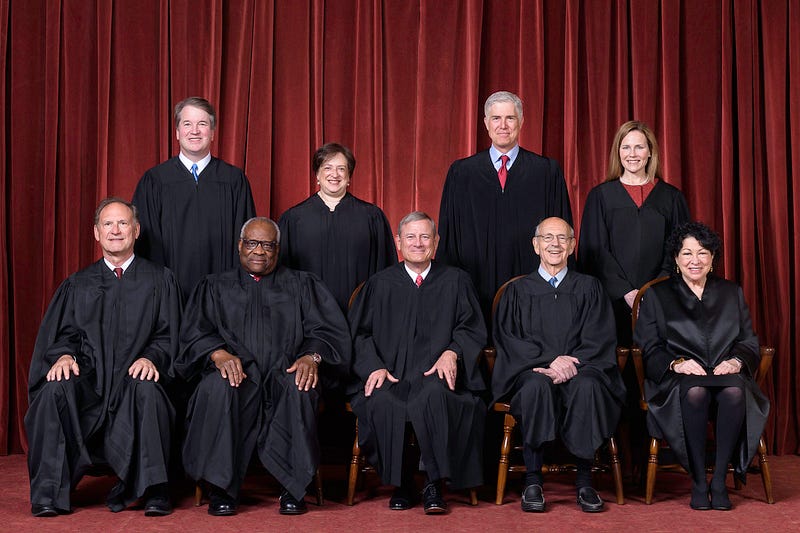

On the Burger court, Douglas was the longest serving having 34 years service by 1973, while Thomas is the longest serving on the Roberts court at 31 years. Douglas was something of a lightning rod and is seen by many as the most liberal justice ever to sit on the Supreme Court. But Thomas has become, if anything, even more controversial.
The Thomas nomination hearing before the Senate Judiciary Committee in 1991 — a committee chaired by Senator Joseph R. Biden — was, to be gracious, a spectacle. Once on the bench, Thomas was known for asking few questions during oral arguments and filing numerous dissents. Recently, the actions of his wife after the 2020 election, supporting efforts to disrupt the electoral vote, have made Thomas even more controversial.
And there are other similarities. In terms of age, whereas the average age of the Burger court members was sixty-three, the Roberts court averages sixty-five. In terms of time served on the high court, the Burger court averaged 10 years to the Roberts court’s 14 years. For the Roberts court, three members had less than five years of service — with Coney Barrett having a little over one, while the Burger court had four members with less than five years of service — led by Rehnquist with only one.
Regrading legal education, the Burger court was clearly more diverse. Although five of its members attended either Harvard or Yale Law Schools, the other four brought in widely different legal training: Burger from St. Paul’s, Douglas from Columbia, Marshall from Howard, and Rehnquist from Stanford. On the Roberts court, all members attended either Harvard or Yale except for Coney Barrett who attended Notre Dame Law School.
Perhaps the most interesting of all these judges would be Justice Byron White. White was a star football player in college in 1938, was drafted by the Pittsburgh Steelers in the fledgling National Football League, and led the league in rushing his rookie season. White then took a year off from football to attend Oxford as a Rhodes Scholar where he met with and became known to U.S. Ambassador Joseph P. Kennedy — and his college-age son John. White then returned to the NFL for two more seasons while also attending Yale Law School.
When it was accepted for review, Chief Justice Burger assigned the Roe case to Justice Harry Blackmun. He no doubt had many practical reasons for doing so, not the least being he realized it was a difficult case and was confident in Blackmun’s ability to navigate a path through it. Burger and Blackmun shared much in common, including their Minnesota backgrounds. Over time, court observers would dub them the “Minnesota Twins.”
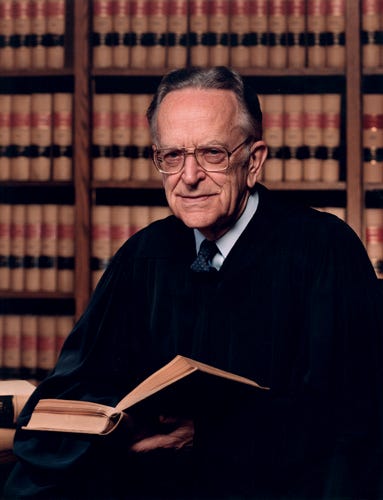

Blackmun had clear moderate credentials. He was, in fact, Nixon’s third nominee for the seat being vacated by Justice Abe Fortas. Nixon’s first two nominees, judges Clement F. Haynesworth and G. Harrold Carswell, both conservative southerners, had been rejected by the senate because of past racial views and activities. By contrast, Blackmun won easy confirmation.
After the Roe decision, Blackmun answered many critics of the decisions with two basic observations. First, that the court was deciding a constitutional issue, not a moral one. And second, that the result was not his decision but that of the entire court, which voted 7–2 in favor of his opinion.
The two dissentions were interesting: Rehnquist — the youngest and most recent member of the Burger court, and White — the Kennedy appointee. In other words, the two dissenters were “bipartisan.” But they also demonstrated that, at the time, there was no litmus test; after all the majority was also bipartisan.
This arguably — and everything about the Roe decision lends itself to argument — points to the four major distinctions between the Burger and Roberts courts. First, political heritage seemingly mattered less to the Burger court. However the current case is decided by the Roberts court, there seems to be only one member of the court whose decision is somewhat uncertain — namely Chief Justice Roberts. The other five Republican appointees can be expected to overturn or tightly restrict abortion, and the three Democratic appointees to advocate the opposite.
Second, the Burger court was actually more diverse and representative than the Roberts court in every way but one. Its members had a more varied legal background, and only one — Justice Brennan — was Catholic. By contrast, the Roberts court is two-thirds Catholic and seemingly quite aware of the opposition to abortion of their church, an opposition recently underscored by the decision of the Archbishop of San Francisco to withhold communion to Catholic House Speaker Nancy Pelosi, who supports abortion rights. The Burger court was solidly Protestant, with Blackmun himself being a Methodist, and was seemingly able to set religion aside more easily, although certainly Roe is viewed differently by Justice Sotomayer compared to her Catholic colleagues.
Third, the one way in which the Burger court was less diverse was that it contained no women. The first woman Justice, Sandra Day O’Connor, did not arrive until 1981 and largely dissented from the Roe decision. The Roberts court has three women with only one (Coney Barrett) seemingly inclined to overturn Roe. When recently confirmed Judge Ketanji Brown Jackson joins the court upon Justice Stephen Breyer’s retirement, she will presumably also favor sustaining Roe.
Lastly, none of the members of the Burger court had been approved by the Federalist Society, an organization that has essentially become the gatekeeper for conservative court nominees. On the current court, justices Alito, Thomas, Gorsuch, Kavanaugh, and Coney Barrett are all reported to have been Federalist Society members. Chief Justice Roberts’ membership is somewhat unclear.
Since the Federalist Society was formed in 1982, it was irrelevant to the Burger court. Nonetheless, The Federalist Society, with its commitment to the legal concept of “originalism,” may be the most significant organizing ingredient of the Roberts court.
The legal concept of stare decisis, Latin for “standing by things decided,” meaning to follow legal precedent, was a major part of the confirmation hearings of nearly all recent Supreme Court nominees. And when the issue has come up, it has most often been explicitly raised regarding Roe v. Wade. Having been addressed numerous times over a half-century, is Roe “settled law”? Should it be sustained as an application of the stare decisis concept?
Clearly, there are those on the Roberts court who believe stare decisis should govern any future Roe decision, and there are others who believe that Roe was “wrongly decided.” Roe’s author, Justice Blackmun, himself had reservations about the decision, but nonetheless felt it settled the legal question if not the moral one.
The Burger court consisted of well-educated, qualified, and thoughtful jurists. In every way but one it was more diverse in background and experience than the Roberts court. And, after a half-century, we have reached a point where the majority of Americans believe that the abortion legalization provided by Roe should remain. This presents the court with a difficult dilemma, one even more difficult than the one faced by the Burger court in 1973. But convincing the contemporary American public that Roe was wrongly decided will be a heavy lift for the Roberts court given that it is seemingly less representative of contemporary America. That condition is also worthy of their consideration.

Two great legal minds who served on the Supreme Court implicitly recognized that legal scholarship is important, but decisions would inevitably have a practical dimension. In the 1930’s, Chief Justice Charles Evans Hughes famously noted, “We are under a constitution, but the constitution is what the judges say it is.” And in the 1950’s, Justice Robert H. Jackson, who in 1946 took a leave of absence from the court to be the chief American prosecutor at the Nuremberg trials, said of the Supreme Court, “We’re not last because we’re right, we’re right because we’re last.” Both observations usefully remind us that applying the law will always have a significant human dimension somewhat distinct from pure legal scholarship.