
Creative Non-Fiction
It’s Not Easy to Identify My First Experience of Queer Love and Sex
As a closeted queer youth, the traditional romantic and sexual narrative was out of my reach.
CW: Sex and sexuality discussed without any graphic details.
Were you or are you an LGBTQ young person? What would you tell the world about love and acceptance? About your life?
At birth, my queerness was tattooed on my body in invisible ink.
I knew I was some kind of queer by age 14. That said, I wouldn’t have access to the fuller message of who I was until age 35. This knowledge would reframe every love story of my life, as clarifying my inherent gender changed the definition of queerness in all of my previous relationships.
I wish I could write about love the way that heterosexual youths experience it. Unfortunately, it can be difficult to find language that bridges the gap between my story and theirs.
In cis heteronormative culture, for example, a lot of emphasis is placed on that fabled first love. My definition of love as a queer trans man on the asexual spectrum is a little more complicated than what that traditional cishet narrative offers.
Experiencing unrequited queer love never felt like a conflict or a disappointment as a youth.
It felt sadly normal. The absence of a formal labeling of relationships didn’t harm the friendships in which I felt a kind of queer romantic love. As a demisexual, I didn’t need sexual touch to feel satisfied in those relationships, so it didn’t feel like anything was lacking.
Queer love also wasn’t something that I felt entitled to because I had no means to maintain it anyway. Marriage certainly wasn’t a legal option. There wasn’t any education teaching me how to experience this love on a sexual level; there was just a single depressing movie that I finally saw when I was 18 years old.
My childhood expression switched daily between a girl all the boys could share secrets with and a boy dressed in flamboyant drag.
This description Ty Bo Yule provides in “I’m a Trans Man, but My Alter Ego is Courtney Love” fit me well:
“The drag queen and the butch dyke, my top-secret identities, used to fight all the time.”
One day, I would be hidden under a sweater twice my size, slouching low enough to wreck my back. The next day, I might have dark blue hair, a black shirt, and a short black skirt above bright blue pantyhose etched in clouds with six inch platform heels and a rigidly straight spine. One of my classmates saw this and suggested I must be “running from the cops” after my umpteenth identity reinvention in high school.
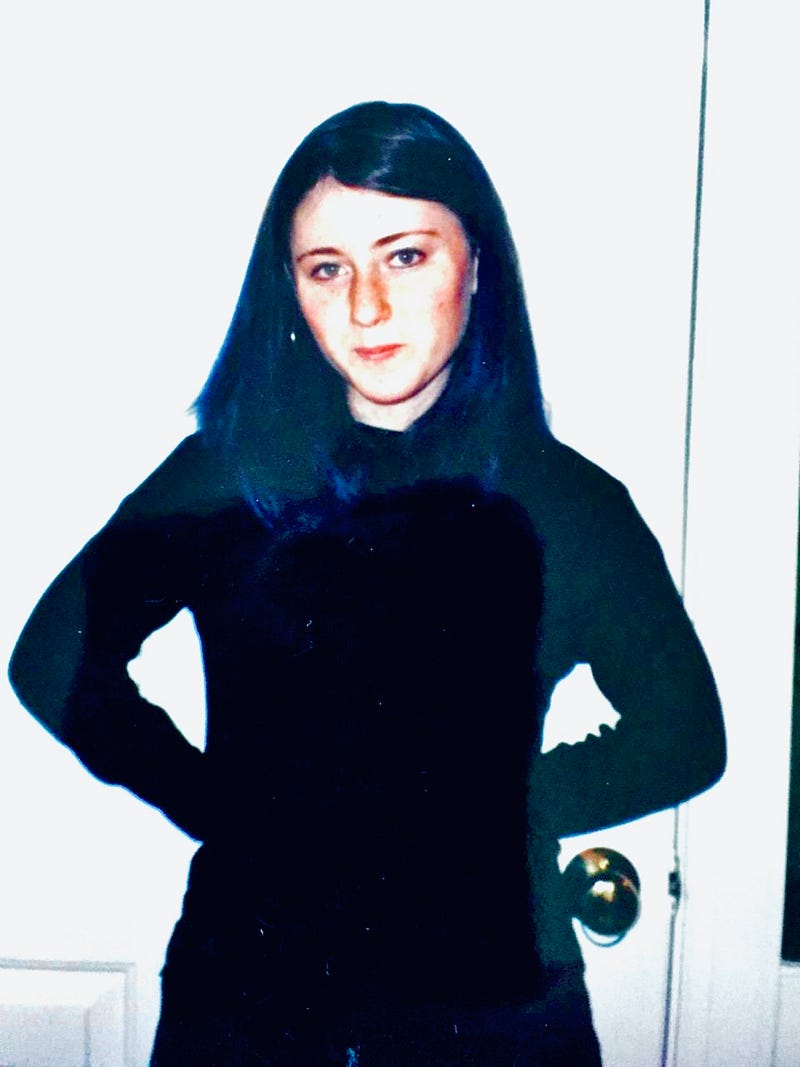
I was perpetually torn between the desire to disappear and the fear of erasure.
I was perpetually torn between the desire to disappear and the fear of erasure. The result was a split between two incongruent alter-egos: I was both a young virgin slut and a prude, innocent and perverted, offensively open in my sexuality, and clearly belonging in my particular slot on the asexual spectrum. Not much has really changed since childhood, except the words to describe me and the chemicals needed to keep me alive one shot at a time.
But what about love? Which was the first? Which was queer?
Each love that I’ve experienced has been so drastically different that it is difficult for me to solidly determine where the line is between love, limerence, romance, and friendship. These four concepts have bled seamlessly into each other since I was very young.
My best friend beginning at roughly age 4 or 5, the first child I can remember loving was a little boy who was afraid of lightening for good reason. He was a fantastic accomplice in the endless stories we spun together. We spent our afternoons acting out our invented fan fiction stories from X-Men, Teenage Mutant Ninja Turtles, Power Rangers, Spiderman, or Batman because we were too young to put pen to paper.
When it came time for our characters to kiss, as happened quite often, we would stand with our lips very close together and just smile.
When it came time for our characters to kiss, as happened quite often, we would stand with our lips very close together and just smile. My friendship with this boy never became romantic, though I certainly had a crush on him every so often between then and high school. Crushes come and go, but if the ego can be kept in check, friendships can survive them. I babysat his baby brother alongside him, rescuing him from a few headlocks while we all watched WWF together.
This was a quiet, asexual kind of love.
I’ve long since lost touch, but hope that he has a good life, even if I’m never in it again. Does that count as a first love? If so, it most certainly would have been queer, at least on my end, as I am very much a man. Anyone perceptive could have seen that I was a little boy when we were running around together finding creative ways for me to injure myself.
He would often gently try to convince me to stop pretending I was Quicksilver from X-Men. I was always running in front of speeding cars as a little child because I believed I was faster. It’s a wonder I made it to adulthood.
If my first queer love had to be romantic to count, I would tell two different stories that occurred simultaneously.
Around age 14, I fell in love with two girls my age at roughly the same time. We were all close friends. Both relationships often involved hints of romance, but never escalated into anything sexual. Neither were ever formalized beyond friendship, as we were all closeted. I don’t think any of us ever even admitted directly that we were queer. The discussions happened in hints.
One loved the Teletubbies and Sailor Moon, remarking on her LGBTQ+ support only in whispers. She had a conspiratorial smile when she said that Sailor Neptune was her favorite. We both knew this character was gay in the untranslated Japanese version of the cartoon, so it was a risk for her to share. She would look deeply miserable the day that she came to me and told me about her first kiss with a boy. This was shortly after we had our only romantic date together. Like any good closeted romance, we never called it a date. We just played our roles quietly without offering any touch beyond a brief grasping of hands that meant everything to me.
Like any good closeted romance, we never called it a date. We just played our roles quietly without offering any touch beyond a brief grasping of hands that meant everything to me.
My other friend and long time romantic interest would talk about “getting drunk” and “making out with girls” frequently in college, blaming her inebriation for these occurrences. I dreaded that sort of thing happening between us, not wanting to ruin something special in the confusion of a hangover. Instead, we exchanged a romantic “I love you” exactly once, and never followed through with anything beyond that.
Now that I know that I was a man all along, it’s difficult to determine whether these relationships even counted as queer. Perhaps the fact that I’m non-binary makes it inaccurate to call them the opposite sex from mine. Perhaps the internalized homophobia affecting us all is what made these unrequited loves still feel queer, even if we acknowledged that the romances would technically have been heterosexual.
If a more formalized, sexual kind of love is required to satisfy the definition of a first queer love, I’d have a different story to share.
Even if I accepted the asexual erasure of this statement above that would be commonplace in cishet narratives of a first love, I don’t think this story would satisfy traditional assumptions about queer love. We were a same-sex couple, though I wouldn’t learn this until I was 35 years old.
He secretly confessed to being bisexual, so it was a perfect situation for me as a closeted trans man. Though I wouldn’t know why until later, it put me at great ease to know that he was attracted to men. We never had the kind of sex that heterosexuals consider “going all the way”, but I now believe him to be the person I gave my virginity to, in a very sweet kind of way. I love that we each communicated clearly exactly what we wanted and stuck to it, despite being inexperienced teenagers who knew next to nothing about queer sex.
Regardless of what you believe counted as my first queer love, there was no shortage of it, even in the closeted life of my youth.
Though I would never wish for the next generations to encounter some of the confusion that I felt early on in queer romance and sex, I do hope that their lives are as rich in love as mine has been. I want them to hear our stories, so that they may never find themselves believing the myth that love isn’t within our reach as queer people.
Would you like to join Medium for $5/month to read more stories like this? If so, you can support me by joining under my name at no additional cost:

This story is a response to the Prism & Pen writing prompt, “Queer as Kids: Or … Can We Please Teach Love?”