
It's Not A Myth That Doctors Used To Masturbate Their Female Patients
One journalist is trying to whitewash this disgusting history

You have probably heard the twisted yarn by now. Medieval physicians once believed hysteria in women was caused by bad "seed" — pent-up sexual arousal. So they masturbated their female patients until they reached "hysterical paroxysm" — orgasm. At first, they manually stimulated women, but once the vibrator was invented in the nineteenth century, doctors were saved from carpal tunnel.
It's the classic "necessity as the mother of invention" tale with a pervy twist.
What's not to love?
Unfortunately, journalist Hallie Lieberman doesn't love this grim chapter in medical history and has been on a crusade to rewrite it. She claims doctors never masturbated their patients and focuses her attack on historian Rachel P. Maines' critically acclaimed book on the history of vibrators, The Technology of Orgasm.
Lieberman doesn't mince words. She writes, "Technology of Orgasm represents a failure in academic quality control."
Ouch. I am obviously going to be on team historian, but let's unpack this catfight.
Lieberman writes, "manual massage of female genitals was never a routine medical treatment for hysteria."¹
Never? I found endless first-hand accounts of physicians masturbating hysterical women to orgasm. And they were “routine” enough to get included in the most well-read medical treatises of their day.
Let's start with antiquity. The word hysteria comes from the Greek word for uterus — hysteros. Hippocrates taught that hysteria — a nervous affliction that only affected women — was caused by a "wandering womb." Apparently, when a women's womb got sad, it packed its bags and headed to a different part of her body. Hippocrates also believed women had a "female seed" that could get trapped inside their bodies if it didn't find an um…release.
Galen ran with this trapped female seed theory and advised midwives to evacuate the seed with either “a finger or a hollowed-out instrument in the shape of a male penis.”² Sort of like scooping the seeds out of a melon.
Persian physician Avicenna also taught that a midwife should relieve a woman of the poisonous seed by sticking a finger inside her vulva and rubbing “diligently.”³
By the sixteenth century, midwives got pushed out of gynecology when the Royal College of Physicians was established in 1518. Bloodletting was in…pharmaceutical herbs were out (and could get you accused of witchcraft in some parts of Europe).
Unfortunately, replacing midwives left doctors with the dirty job of rubbing out all that seed.
At this time, many began to question the ethics of the masturbation cure. In one sixteenth-century treatise, Dr. Abraham Zacuto asked if a "God-fearing physician [could be] allowed to expel from the uterus the poisonous semen by titillation and friction of the genital area of women…"⁴
The question divided the medical community. Most doctors realized masturbating female patients was a bit creepy, but not for the reasons you might think. French physician Francois Ranchin lamented that such rubbing was "abominable and damnable, particularly in virgins, since such pollution may spoil virginity."⁵
So it was ok for doctors to molest women but not virgins.
By the seventeenth century, Juan Ravael Moxius' De method medendi included a chapter entitled "Is The Physician Permitted to Expel Directly the Corrupt Semen That Induces Death?" He concludes that "the seed cannot be expelled without titillation or some sense of pleasure."⁶
So yeah, doctors were aware that rubbing a women’s genitals induced orgasm, but someone had to get the job done.
Still, not every doctor was on board the masturbation cure train. In 1819, French physician, Auguste Tripier, published a treatise on electrotherapy for female diseases. Tripier concluded that the convulsions from hysteria “is sometimes the same as the orgasm,” but he didn’t believe an orgasm would cure hysteria.⁶
Lieberman claims that since Dr. Tripier was not an advocate of uterine massages to treat hysteria, it wasn’t being done. Come again?
How would Dr. Tripier know that masturbating women to orgasm wasn’t curing hysterical women unless he saw the treatment applied to hysterical women? One can assume that Dr. Tripier spoke out against masturbating female patients because he realized the entire procedure was batshit crazy and utterly unethical.
And still, the medical community continued diddling unwed women…
By the Victorian period, doctors still debated the masturbation cure, but now they had a fancier instrument to get the job done — the vibrator. In the early 1880s, Dr. Joseph Mortimer Granville invented the first electric vibrator. It was a huge success. His invention launched a veritable cottage industry in “vibration therapy” to treat hysteria and other female woes.
Lieberman repeatedly argues that doctors were not connecting hysteria with sexual arousal, but the most popular medical advice of the time said differently.
In 1891, Dr. A. F. A King published Hysteria — a book that can only be described as bodice ripper meets The Lancet. King’s descriptions of women reaching hysterical paroxysm (orgasm) are so ridiculously campy that you will need a fainting couch to get through it.
King believed marital sex cured hysterical women, so he waxed poetic about husbands seeing themselves as a “youthful Apollo of the woods” who “handles her as his pleasure” until “the natural purpose of hysterical paroxysm accomplished.”⁷
In other words, he was telling husbands to have non-consensual sex with their wives to cure their hysteria. Nice.
It’s important to note that most of the literature at this time used euphemisms for orgasm and the female genitalia, so you have to speak Victorian to decipher some of the medical advice.
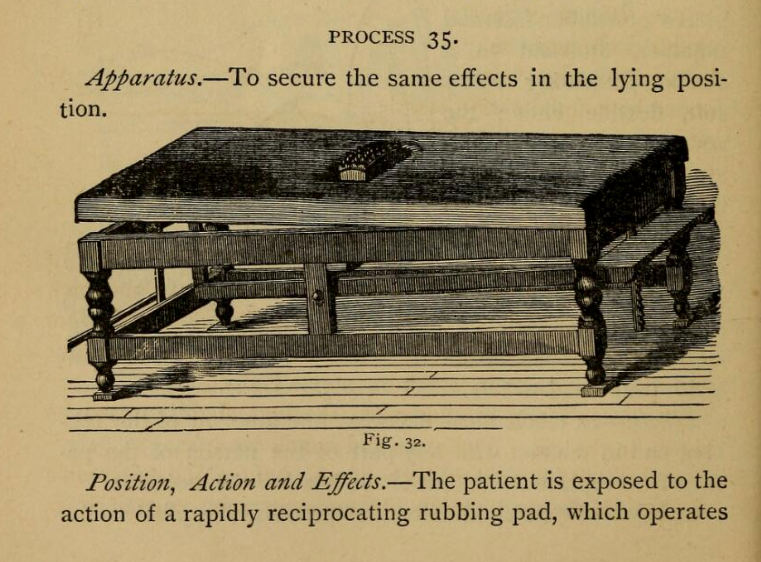
For example, one of the most popular works on "mechanical massage" was Dr. George H. Taylor's 1885 book titled, Pelvic and hernial therapeutics : principles and methods for remedying chronic affections of the lower part of the trunk including processes for self-cure.
These first medicinal vibrators were called an "oscillating massage," and they didn't resemble today's handheld vibrators. The vibrating apparatus for women was a table with a "rapidly reciprocating rubbing pad" in the middle. Hysterical women only had to lie down and think of England.
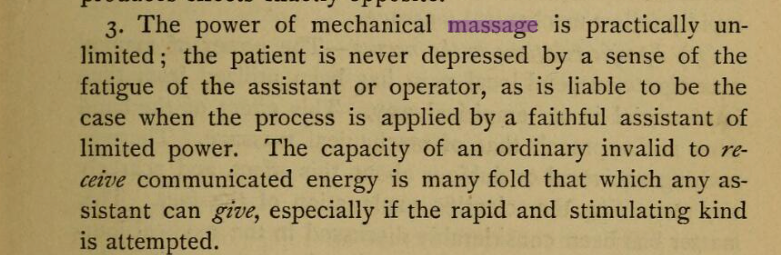
Doctors were pretty jazzed about vibrators and their "rapid and stimulating" results. As Dr. Taylor points out below, vibrators could communicate far more energy than “a faithful assistant of limited power.”
Oh, it gets better…
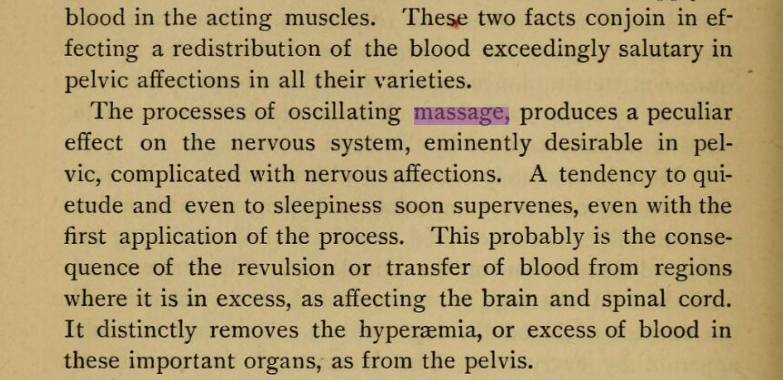
Here, the good doctor opines how an oscillating massage will at least shut a woman up. But don't worry. It's not because he is masturbating her to orgasm. It is merely due to the "transfer of blood from regions where it is in excess."
That sure sounds like masturbation to me.
Still, doctors tried to convince themselves that there wasn’t anything creepy about uterine massages. Would they have protested this much if it was a foot massage? Hold that thought…
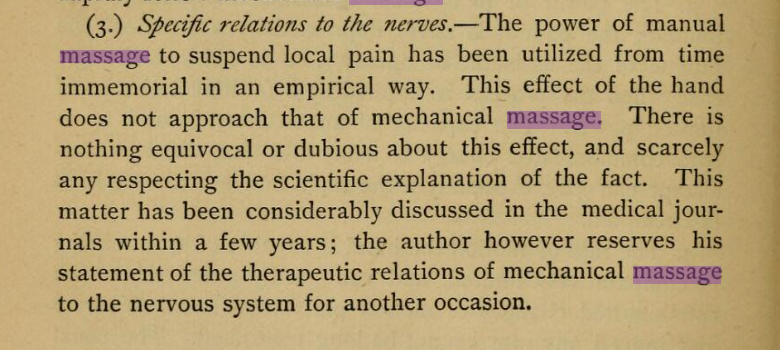
The argument below was a common one — physicians had been massaging female patients since "time immemorial," so there was nothing “dubious about this effect.”
In 1891, Dr. Alphonso David Rockwell wrote On the Medical and Surgical Uses of Electricity — one of the most popular books detailing how physicians could use vibrators to cure female woes.⁸
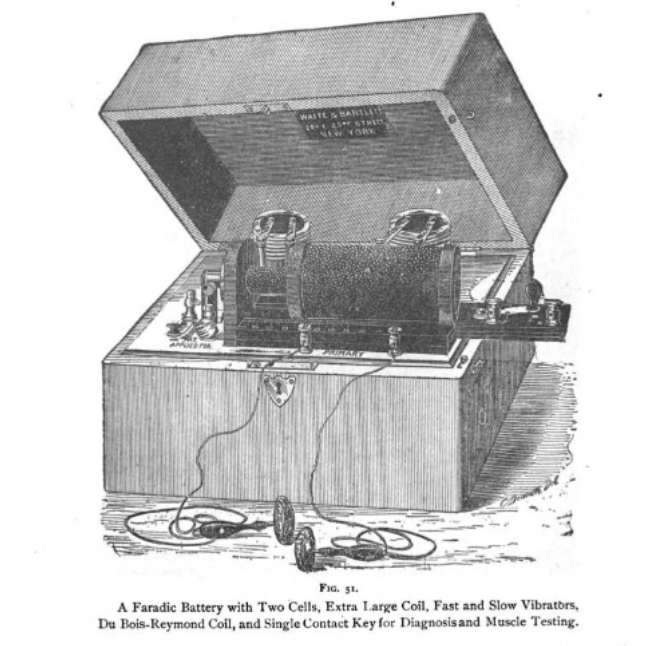
These machines used galvanized current applied to the pelvic region. They were similar to today's TENS machines which use electrical current to stimulate the vulva and clitoris to cure sexual dysfunction.
Except Victorian doctors were not trying to cure sexual dysfunction. They were trying to cure hysteria caused by too much sexual arousal.
Dr. Rockwell recounts one tale of a forty-year-old woman diagnosed with "hysteria" and "violent paroxysms." He writes;
“The patient was submitted to general faradization, and immediately after a galvanic current from eight cells was as nearly as possible localized in the uterus.” ⁹
(Emphasis added.)
According to Rockwell’s detailed case notes, the current pulsating through her uterus cured his patient of her hysteria. This masturbation myth sure has a lot of whacked case studies.
And Rockwell wasn't the only Victorian physician recommending vibrators to cure hysterical women. One of the most respected physicians of the late nineteenth and early twentieth century was Samuel Spencer Wallian, author of Rhythmotherapy : a discussion of the physiologic basis and therapeutic potency of mechano-vital vibration to which is added a dictionary of diseases with suggestions as to the technic of vibratory therapeutics.
Here is what Dr. Wallian recommends to treat hysteria.¹⁰
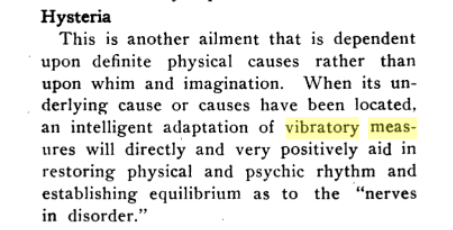
However, Wallian doesn't mention using a vibrator directly on a woman's clitoris. Lieberman claims this is proof that vibrators were not being used on a woman’s lady bits.
Suuuuuuure. Perhaps doctors were supposed to vibrate her big toe once her pelvic "causes have been located."
Ok, here's the deal. This was the Victorian period. The same period when doctors debated banning sewing machines because they feared it excited too many women. Doctors were not writing dissertations on how to bring a woman to orgasm through clitoral stimulation because no one wanted Victorian women to orgasm.
Not only did they rarely discuss the clitoris, but they also couldn't find it. Even when performing clitoridectomies— removing the clitoris to cure hysteria — they never got the whole enchilada. That’s right. Doctors were so clueless about the clitoris that they couldn’t even mutilate women correctly.
By 1920, Freud muddied the waters even more. Freud taught that the vagina and not the clitoris was the seat of sexual pleasure. A vagina required penetrative sex, so it had to be superior. Thus, the whole purpose of clitoridectomies was to direct the sexual energy back to the proper female organ — the vagina.
As Maines addresses in The Technology of Orgasm, physicians viewed stimulating the clitoris as more medicinal than sexual because the clitoris was not the primary sexual organ. The vagina was. Therefore, they could justify molesting countless women.
Fortunately, the vibrator’s use in doctors' offices declined once home models were available for women. In 1952, the American Psychiatric Association finally dropped hysteria from its diagnostic terminology.
In a NY Times article, Lieberman condemns academics who keep perpetuating the masturbation myth. She writes;
“But the myth isn’t harmless. It’s a fantasy that contributes to the ways we still misunderstand female sexuality and that perpetuates harmful stereotypes that continue to resonate in our laws and attitudes.”
Huh? What recondite psychobabble is this?
Wouldn't denial of the heinous history of hysteria contribute more to the misunderstanding of female sexuality? Why claim it never happened when there is so much evidence it did?
It did happen. Not only did it happen, but countless women were probably traumatized by the experience. Lieberman wants to erase those women and discredit a respected historian’s work. Don't let her.
Further reading: Maines, Rachel P.. The Technology of Orgasm: “Hysteria,” the Vibrator, and Women’s Sexual Satisfaction. United Kingdom, Johns Hopkins University Press, 2001.
Sources: (1) A Failure of Academic Quality Control: The Technology of Orgasm, 25. (2) Schleiner, Winfried. Medical Ethics in the Renaissance. United States, Georgetown University Press, 1995, 120. (3) Thompson, Lana. The Wandering Womb: A Cultural History of Outrageous Beliefs About Women. United States, Prometheus, 2012. (4) ibid, 69. (4) ibid, 70. (5) Winfried, 123. (6) Maines, p. 39 (7) King, A. F. A. (Albert Freeman Africanus), 1841–1914, 11. (8) Rockwell, Alphonso David, and Beard, George Miller. On the Medical and Surgical Uses of Electricity. Jordan, William Wood, 1891. (9) ibid, 422. (10) Wallian, Samuel Spencer. Rhythmotherapy; a Discussion of the Physiologic Basis and Therapeutic Potency of Mechano-vital Vibration: To which is Added a Dictionary of Diseases with Suggestions as to the Technic of Vibratory Therapeutics. United States, Ouellette, 1906, 180.


