
It’s Been 41 Days Since I Could Smell
A surgeon reflects on her anosmia and home olfactory training
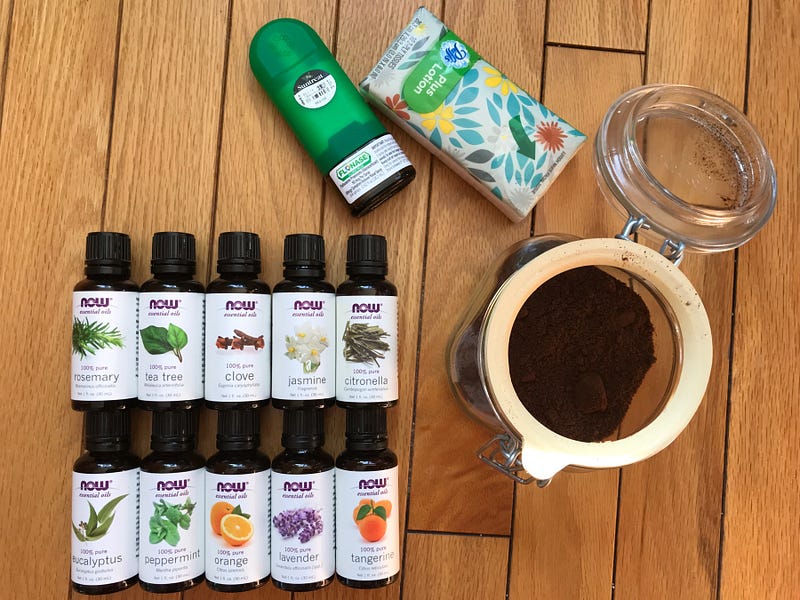
Exactly one week after I got sick with COVID-19, my muscle aches and fever were gone but I was still fatigued and didn’t want to eat anything except for chicken broth. I went to sleep and woke up at 2am with diarrhea. The following morning when my partner presented me with a cup of coffee made from freshly ground dark roast, I sniffed it. And sniffed it again. And I could not smell it.
I panicked a little bit. I had still not been able to get tested and news of anosmia as a COVID-19 symptom had found its way to me from my friends in Canada and Hong Kong. The week previous, my partner had suddenly lost her sense of smell but she had regained it in seven days. Because of this, for the first few weeks, I joked about it a little bit, reassured that it would come back in a week, two at the most, based on reports out of Italy.
It’s been 41 days.
I have been obsessively tracking my symptoms, trying to make sure that my loss of smell wasn’t because of seasonal allergies that usually occur around this time of year. I found that, even as my nasal congestion cleared and my blurry eyes could see again, I still could not smell. I realized that I could taste things that were salty, sweet and spicy, but the finer fragrances were completely lost — its hard to explain a strawberry without its smell, or a peach, or a glass of red wine where you can taste the sweet and acidity but can’t smell the floral notes, the tannins, the grapes. I am such a foodie that it started to really bother me so I started researching this condition. I spoke with a few friends who are ENTs (otolaryngologists). I started using Flonase.
One day my partner came home from work and I had our entire collection of essential oils laid out on the dining room table. We bought them years ago thinking that we would be essential oil diffuser people, but we really aren’t. Used to my antics and frequent ‘experiments’, she raised an eyebrow and asked,
“What is this?”
“I’m re-training my sense of smell,” I replied matter-of-factly.
She went off to the bedroom to change.
I continued with my home-based olfactory training. An article out of Germany in 2009 had mentioned sniffing scents of rose, lemon, eucalyptus, and clove for 15 seconds with each nostril, twice daily. One new pre-print article has mentioned ‘managing expectations’ with olfactory training. It can take at least 12 weeks, maybe longer, cycling the scents every 3 months. Some people may regain their smell, and some may not. It’s too soon to say.
Since I started doing my olfactory training, I have noticed that I can make out the sweet bitterness of orange, and sometimes the bitterness of tea tree oil. I can tell when it’s a minty scent, but cannot differentiate between eucalyptus and citronella. Of lavender, jasmine and clove, I can smell nothing. It’s like wafting an empty bottle in front of my nose. My partner has tested them as a control — she says the scent is so strong, it makes her eyes water. My left nostril is better than my right nostril, and it seems that if I breathe at ‘just the right angle’, I can make the air rush past the cells that work. I know that sounds weird.
Last week, I started waking up from sleep with smells. First it was the spicy pepper of pepperoni, then the clean, crisp scent of fresh laundry. One morning, I woke up smelling cat poop and was worried that my cat had had an accident in the bedroom. I looked everywhere and as I couldn’t find it, my excitement that my smell had returned, faded with the memory. Which, I think, is all it was. A dream containing a memory, just like the way you know an ice cube by touch, or a red scarf by sight, we have memories of smells: warm apple cider at the farmer’s market or a sachet of lavender under your pillow.
Once in a while, I’ll have a fleeting whiff of something, like when I thought I smelled the coconut milk in our coconut rice, or when I thought I smelled our “Blue Capri” shower gel (whatever that smell is). But when I tried again, it was gone. Maybe the scent caught one olfactory cell and then wandered away.
I make jokes about it in the operating room. As a colorectal surgeon, it’s been amazing when the rest of the room is complaining about the smell of poop and pus when to me it’s just like breathing plain air.
Since I started reading about this on April 7, there has been an abundance of new literature on it. A recent search of an online medical library showed 60 articles. The majority of the literature talks about using anomia as a way of detecting COVID-19 since it can be an early symptom. Some papers have talked about how patients with anosmia have milder COVID-19 symptoms. The rate of anosmia in people testing positive for COVID-19 has been quoted as high as 60–80%. Newer research has pointed out that some of what is called anosmia (complete loss of smell) is actually hyposmia (some loss of smell). 30% of people affected have both loss of smell and loss of taste. Researchers have pointed out problems with the anosmia/COVID association, citing patients who tested negative for COVID-19 also have smell loss, or the concurrent allergy season that causes olfactory inflammation anyway. Attempts to quantify this led to one prospective study from Italy that noted return of symptoms at 7.5 days on average. We don’t have enough data to say what it means if you still can’t smell at 41 days.
My partner has mentioned, though, and I agree, that there are certain evolutionary disadvantages to anosmia. There’s a reason we developed our sense of smell. I cannot smell if there’s a natural gas leak or if the toast is burning. I cannot smell a GI bleed or a bacterial foot infection from outside the patient’s room. I cannot smell if the milk or meat has spoiled. All of which can have dire consequences.
I should note that my mom claims to have lost her smell almost 18 years ago, sometime after the SARS epidemic of 2002. Except for exceptionally strong smells, like curry or durian, she doesn’t smell. I’ve been trying to figure out if this is related, either because of the first SARS coronavirus or my particular genetics, but I don’t know yet. I know that people are born with congenital anosmia but that’s not the case here. I didn’t realize until I lost it that I associated so much with my sense of smell — my partner’s perfume, my grandmother’s powder, my strawberries, the green scent of tomato leaves. I was definitely a smeller.
I am saddened by this, of course. I baked a loaf of sourdough like everyone else, and while I could taste the soft bread, the crunchy crust, and could barely make out a tang (or was I imagining it?), I could not smell the bread. That soul-filling, mouth-watering aroma of freshly baked bread. I could not smell it.
It’s rare but I’ve had the thought: if I was tested and treated earlier, would this have been prevented? But I don’t think so.
I am determined to get my smell back so I am probably going to see a doctor. Based on discussions with colleagues, what an ENT can add is at least a scope to rule out nasal polyps, or a proper, quantifiable smell test, or a nasal rinse that I cannot prescribe for myself. Doctors are the worst patients; we think we can fix everything on our own. But that’s why there are specialists. I wouldn’t want anyone else fixing a hemorrhoid on their own. But there you are.
If you or someone you know has experienced anosmia due to COVID-19, go to this COVID-19 Anosmia Reporting Tool to help doctors learn more about this disease.
For more content, visit my Medium profile; or my LinkTree for scholarly work, or Subscribe to my monthly newsletter, Flying Penguins, which is a digest of my best work every month as well as completely new pieces written just for the newsletter, delivered directly to your Inbox!


