
Andy Cohen and a Tiger Got Tested for Coronavirus When Doctors and Nurses Couldn’t
Our testing system failed us
I am a surgeon working in a large health system in New York City. I got sick and I couldn’t get tested.
(For the purposes of this article, ‘test’ means the virus PCR and not the serum antibody test)
Getting Sick
On the eve of a national emergency, I went to check on my patient in the hospital, something surgeons do daily for post-operative patients. This was March 12. He had been in the ICU the day before with two suspected COVID-19 patients (who have since passed away). At the time, only six weeks ago, we had heard faint rumors about a mysterious viral illness spreading from Wuhan to Seattle. I had been with my family in Toronto over Christmas when the first cases of suspected Coronavirus were isolated at Sunnybrook Hospital. I worried that the borders would suddenly shut down, and I wouldn’t be able to come home to my life in New York. Fast forward two and a half months and not only had we not shut down, but New York City also seemed woefully unaware that this disease was quickly approaching.
My patient sat in his chair, short of breath. When I leaned over to examine him, he coughed in my face. The hairs on the back of my neck rose. I turned to my team and said, “We should suspect Coronavirus.”
But we didn’t have the tests.
The next day, the city was shut down. Everything was canceled. In my journal, I wrote: “Cancel culture has reached its peak”. On Monday, St. Patrick’s Day, restaurants and bars became pick-up only. Still, we didn’t have masks or tests.
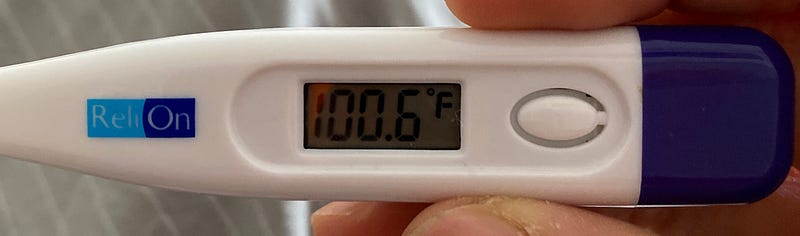
Exactly two weeks from the day I saw my patient, I was sitting at home around 8 pm. Suddenly had the worse muscle aches of my life, in my neck, my back, and my hips. Worse than any muscle soreness from exercising, worse than the worst flu I’d once had in medical school. I also had a headache splitting my head in half, right between the eyes. I did not have a cough or a sore throat, but I went and took my temperature — 99.6. An hour later, it was 100.6; my nose got stuffy, and I couldn’t get comfortable. In my journal, I wrote: “that came out of nowhere.”
I also immediately wrote a last will and testament so that my partner would be taken care of if I died.
The next morning, I was still febrile and couldn’t get out of bed. Overnight my throat had felt ripped-apart raw and my chest heaved with every breath. At 2 am, I woke up with little dry coughs from not being able to breathe deep enough. My partner, who is an infectious disease physician, developed a productive cough and anosmia (which resolved in one week). She worried about me all night.
To this day, we don’t know whether she gave it to me, or I gave it to her.
Getting Tested
The next day, I sent out an email to my employee health department about getting tested. This was on March 26.
According to the CDC guidelines at the time, I now fell into Category I: symptomatic healthcare workers. (Coronavirus.gov) Prior to that, we were only testing symptomatic patients due to the lack of test availability. But when reports came out from Wuhan that 30–40% of people infected in Wuhan were healthcare workers, the CDC guidelines adjusted. The problem was, state and institutional guidelines had not followed suit.
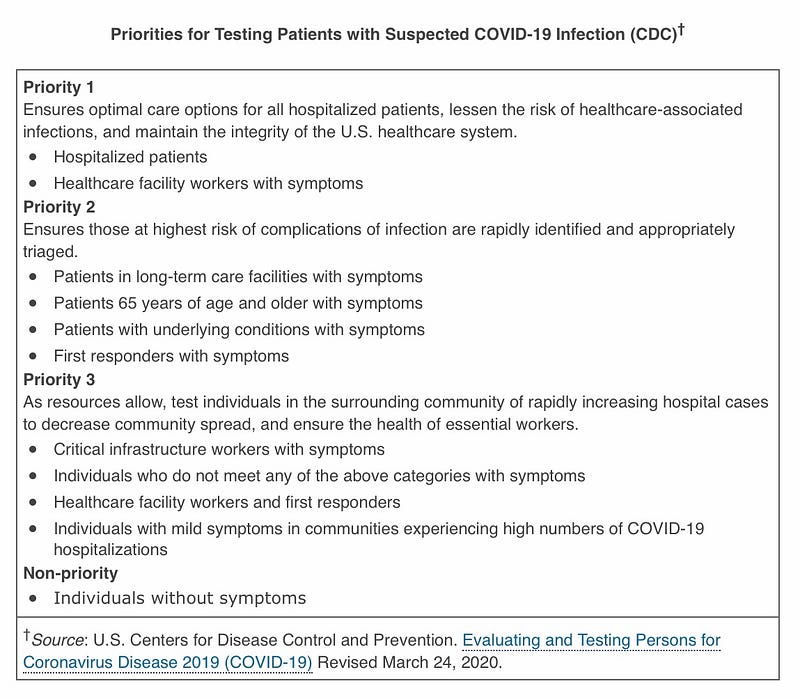
The response from Employee Health was an email from a physician’s assistant saying that they can’t test me because there is ‘rampant community transmission’ and there are concerns over the sensitivity of the swab. The published FDA data is that the swab is 95% sensitive. It is also specific to COVID-19, with the only cross-reactivity coming from SARS. (FDA.gov — later data showed a 25% false-negative rate) They also told me to re-read our email memo.
The gist of it was, if you’re symptomatic, don’t come in. Self-isolate for at least 7 days and after 72 hrs of being afebrile, you can return to work. WITHOUT BEING TESTED. That was current NYS DOH guideline and if you told me, ‘Sure, there’s still not enough tests to test everyone who is asymptomatic’, I would answer- we should have enough tests for everyone, symptomatic or asymptomatic.
Incredulous, I called a senior administrator of our hospital, who told me I might be able to get tested in the ER if I ‘play up my symptoms’. It should be standard to test all symptomatic providers and especially before they return to work. One of my colleagues told me to call someone I knew really high up in the ladder, but I was trying not to abuse the system and pull any strings. I wanted to see what I had to do, as a layperson, to get tested.
I was furious when I found out that on March 20 Andy Cohen, multiple members of the NBA, and Kris Jenner got tested. In the news, there were reports of drive-through testing sites set up at Stanford University and a tent set up by CVS in Rhode Island. I went to the NYS website and filled out a survey to get tested at one of our drive-through locations in the Bronx or New Rochelle.
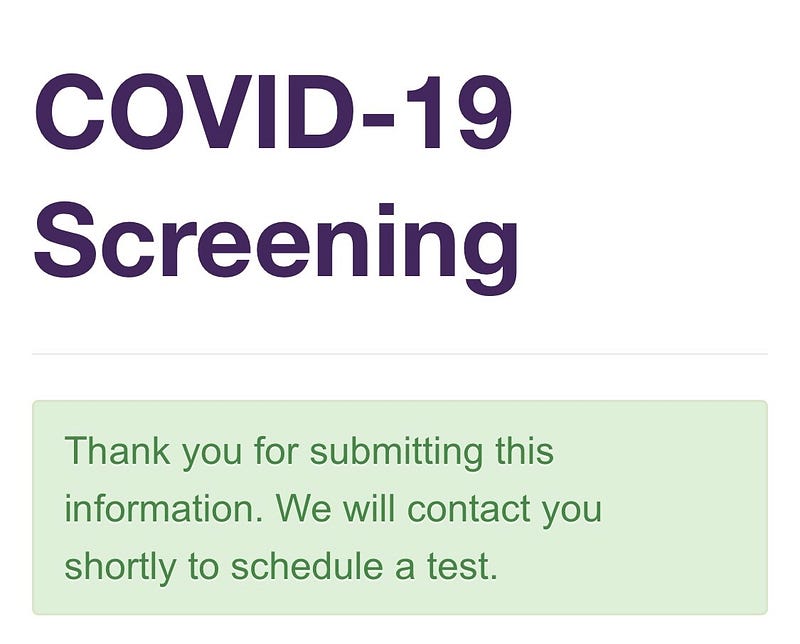
I never heard from the NYS Department of Health. I learned later that the drive-through testing sites got quickly overwhelmed and stopped the online request form. Meanwhile, a handbook from my friends in Hong Kong said that healthcare workers and patients should have two negative tests before returning to work.
I spoke to two other nurses from our operating room who got sick. One of them had to go to a walk-in clinic in Queens to get tested. She had waited a day after filling in the online CDC COVID screening form. It said she would get a phone call to schedule a test, but she never did. The other nurse still hasn’t been tested, even though her daughter, who is also a health care worker, tested positive for COVID.
They were all understandably scared, as others from their ranks have fallen ill and, in one case, died. An earlier version of this story was written on March 26 and submitted to HuffPost. I have since collected more stories. One of my friends is a nurse who is currently undergoing chemotherapy and asymptomatic, but when she went to a lab to get tested, they would not test her. Since I first got sick, colleagues and patients of mine have died. And still, I have not been tested for the virus.
I was completely smashed for two weeks, intermittently fatigued, febrile, or short of breath. I lost my sense of smell.
Two weeks after I got sick, a tiger at the Bronx zoo got tested for coronavirus, and still, I couldn’t get tested.
On April 6, we received an email saying that hospital employees would now get tested for the virus. I called immediately and was told that since I was two weeks out and no longer symptomatic (except for persistent anosmia, which has now lasted almost one month), I would not be eligible for testing.
At this point, frustrated beyond belief that I should have to jump through such hurdles to get tested, I used my connections. I had to use terms such as ‘socially irresponsible’, because we did not know for sure how long I would shed the virus even after I recovered. Studies from overseas show shedding for up to 14 days and possibly beyond 21 days in the stool.
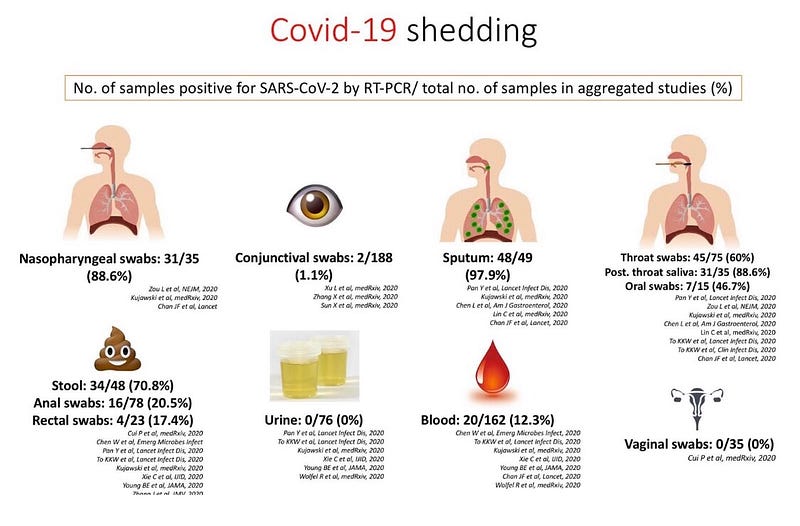
Even that didn’t do anything, though, except to get me on a list for antibody testing. I suspect it’s because they wanted to enroll me in the study to donate plasma, which I would readily do, but also use my data to see how many of us were exposed during deployment. During this time, I had been deployed twice to two different emergency rooms to help with COVID-19 patients. A week of daily emails and texts later, I finally got an appointment to get my blood drawn. A week after that, when I didn’t receive a phone call about my results, I had to call my connections again.
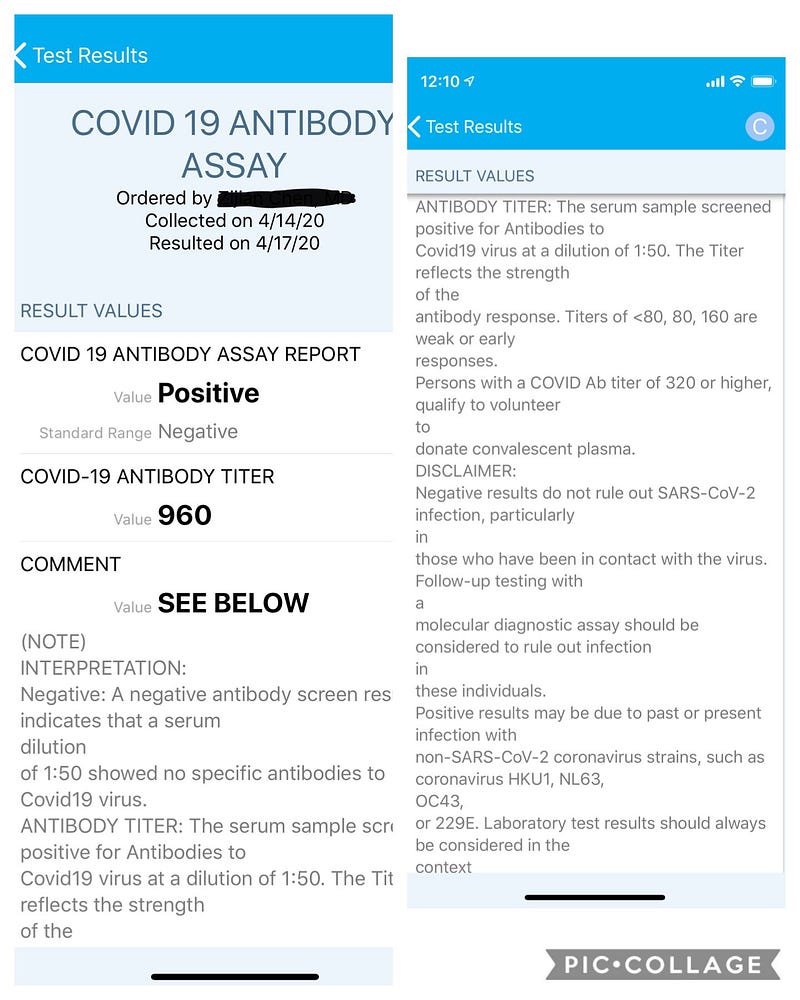
One month after I got sick, I found out I had had COVID-19. And survived.
And as a healthcare worker, I could not get tested. In the meantime, I had been working.
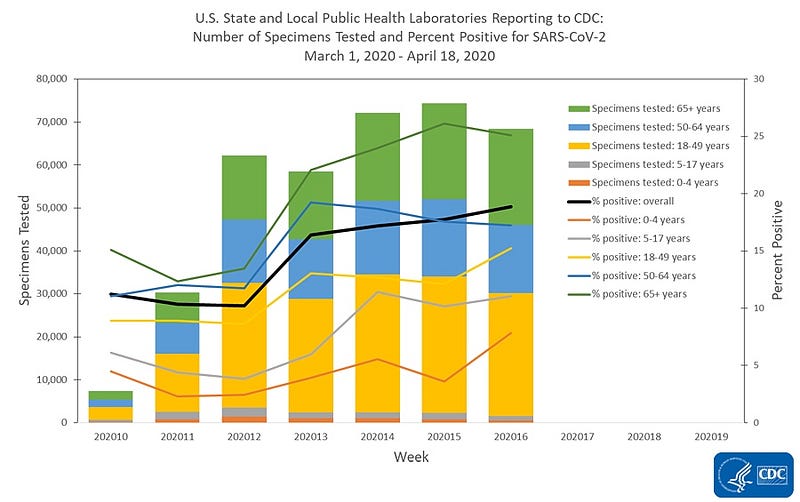
My concern is that we have been spreading this virus all along. Symptomatic healthcare workers are shedding it. Asymptomatic people are shedding it. Studies now show 42% of infected people may not have any symptoms.
We should have been testing and contact tracing since January. We have, thus far, been wrong about everything else about this virus. It’s time to err on the side of caution, right?
Test everyone!
Does it make any sense that testing is still not readily available? Only now our country is talking about random testing?
To date, over 55,000 people have died in the US. I hate to think about how this could have been curbed if we had been adequately prepared.
I made it out with just anosmia, and I know I am one of the lucky ones.
I am not writing to generate pity, but more to add to the growing awareness out there that this virus is horrific. It’s bad for healthcare workers, in more ways than one. These are fundamental state and federal government systems issues that I, even as a ‘powerful, prestigious doctor’, cannot fix alone.
I read an article earlier today about an ER physician who fears that a lot of us will walk away from medicine when this is over. I echo her sentiment.
Our system is irreparably broken, and I cannot fix it.