
It is Impossible to Make 100% Ethical Purchases
The moral and ethical quandaries of buying things in the modern world.
I have an Amazon Prime account. I don’t use it very much these days because, as it turns out, Amazon isn’t that great of a company to work for. I’m honestly considering canceling it, except there are a few things that I can only easily get there.
I have several friends who do not have Amazon Prime accounts and refuse to patronize Amazon for this exact reason. It’s a simple matter of voting with our dollars. Similarly, pretty much nobody I interact with eats at Chick Fil A because of their anti-LGBTQIA+ stances and the huge amount of money they throw at those stances. We all call it “hate chicken” or “bigot bird” or something similar and have taken to flipping it the metaphorical bird as we pass.
That said, I am a happy owner of a Disney+ account, which I use on the regular. My partner and I watch all sorts of movies there, including everything from Disney Channel movies from my partner’s childhood to the recently-released Encanto. One of my friends, however, refuses to give money to Disney because of their conciliatory stance toward China.
I admit, that’s pretty bad in a lot of ways, and it is absolutely blatant capitalism at work. Same with Amazon, and same with Chick Fil A. They all make decisions based on capitalistic principles and have particular corporate values that are at best distasteful and at worst actively harmful to society and the world at large. So, what can you do about it?
Well, you can vote with your dollars like all of the examples on this list, but what good can it do? Amazon has positioned itself to be a low-cost source of stuff you can’t find anywhere that can be delivered to your door in a day or two. Very few other companies can compete with that, and in a country where so many people live paycheck to paycheck, that is a market that they have quite effectively cornered.
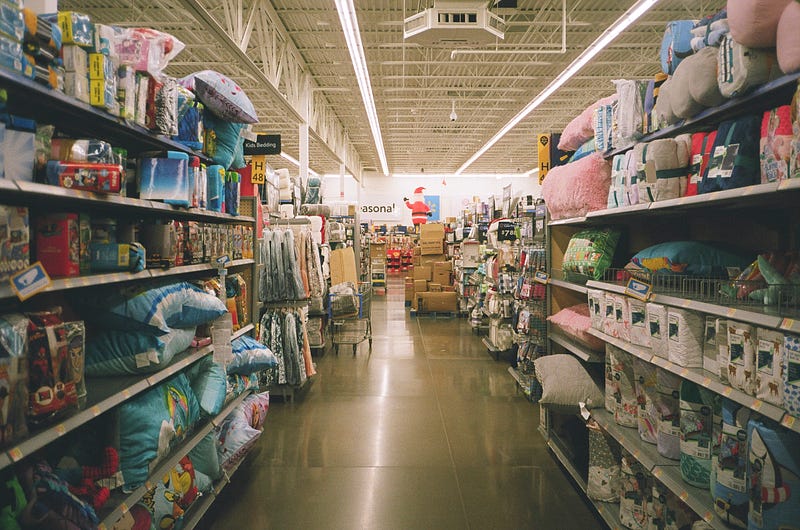
I’ve avoided Walmart for similar reasons since they are a grossly unethical company, but there are things that either they have exclusively or that they make easily accessible compared to any other place. It doesn’t change the fact that their business model is dependent on capitalism forcing their target audience to only shop there.
So I avoid those places as much as possible, and that’s the best I can do personally, but the world we live in has so many bad choices that it is damn-near impossible to make 100% ethical choices. Want to buy an avocado in January? Hope you’re happy with exploited and underpaid laborers picking it and the massive carbon footprint required to get it to you. Is beef what’s for dinner tonight? Well, the beef industry is a major greenhouse gas producer and has a whole host of animal cruelty attached.
Fast fashion? Probably manufactured by children or near-slave labor. Chocolate? Major child trafficking industry. Coffee? All manner of issues there.
Just about anything you can buy these days has some sort of ethical choice or moral quandary attached to it, and there is almost nothing to be done about it. I am typing this on a smartphone using a folding Bluetooth keyboard and a plastic phone stand, and it was all probably built in various factories in China using labor ranging from overworked and underpaid to literal slaves.
My partner and I joined the Kellogg’s boycott last year because of their stance on the union strike and attempt to use non-union scabs. We don’t buy much Kellogg’s stuff anyway since we shop at Aldi, but that raises the question of where the Aldi stuff comes from. I don’t know, I haven’t looked into it, but there is almost definitely something that we buy there — probably a lot of stuff — that has some sort of ethical or moral failing attached to it.
You can try to buy ethical stuff, all organic and non-GMO and fair trade or whatever, but it can be hard to ensure that whatever you buy follows the rules that you expect them to since there are often no official governing bodies for them. Unless you either raise and grow all of your own food, there isn’t really a guarantee of where it came from and how it was grown.
The clothes you wear and the stuff you own are not any better, either. So much of the clothing we wear is manufactured under terrible conditions in countries where workers are often underpaid, abused, or literally slaves. Even clothes made in the U.S. can fall victim to this, as many manufacturers use underpaid immigrant labor to sew their shirts and such. This includes the spinning of raw cotton into fibers and making those fibers into cloth, so even people who sew their own clothes are affected.
Plus, so many electronic devices that we use every day are made in China, which is not the best when it comes to workers’ rights. Even if a device is made in a country with better working conditions, it likely depends on rare earth elements that come mostly from China, so you’re screwed either way.
Unless you can guarantee that every single component of your item was harvested or mined ethically — the cotton in your shirt, the metal in your wrench, every single piece of your phone — you have to make a compromise somewhere.
Heck, simply using something made of plastic could be argued to be negatively affecting the environment and global sociopolitical dynamics due to its primary component: oil. Stop and think about how much plastic is in literally everything we use. Look around and count how many things have plastic in them somewhere. It is in everything from condiment bottles to computer parts to the clothes that we wear. It’s inescapable.
Some of you may be panicking right now, and all I can tell you is to just take a breath and calm down. The modern world is full of these ethical and moral dilemmas, and none of us can escape them. It’s not your fault, though — it’s constructed that way.
We live in a global society where the things that we use every day may have passed through a dozen other countries and farmed, mined, and built by countless people before getting into our hands. The metal that goes into a fork has to be mined, refined, smelted, and poured into an ingot before it even gets to the point where it can become something. That means that it has been through a minimum of three different sets of hands before it has even reached the point where anyone knows what it’s going to be.
Even if that all happens within the same company, there is no guarantee that the company will act ethically at every step. Legal standards in the country where ore is mined may be different than the standards where it is forged, and following the law isn’t the same as acting ethically.
That is not your fault, and there is very little you can do to change or affect it immediately. We as a society have had our hands forced by the capitalist system that has been built by people before us. Even non-capitalist countries are beholden to this system — China has built its communist society on a foundation of capitalistic whims.
All any of us can do is make the best choice available to us right now. If that means that you can afford to buy ethically-sourced chocolate and produce, great! If it means you can only afford to shop places other than Amazon once a month because Prime is a great deal, that’s fine.
Yes, there are better and worse options, but there is no way to be 100% ethical 100% of the time because that’s how the world is built. We are all stuck with this system, and all any of us can do is make the best choices for us at any given point. None of that is your fault, and you should not feel guilty about it.
Unless you’re Jeff Bezos. Then you can get bent.
If you appreciate my work, why not join Medium as a paying member, which allows you access to unlimited stories (not just three free stories per month). Click this link or the image below. I will receive a little portion of your membership fee, but it won’t cost you any extra.
If you liked this, please subscribe to my publication, Thing a Day. I publish something every day on a variety of topics, so you never know what you’re going to see!
Here are some other things I’ve written:


