
Is Trump Worthy of Compassion?
For example, if he developed a terrible disease
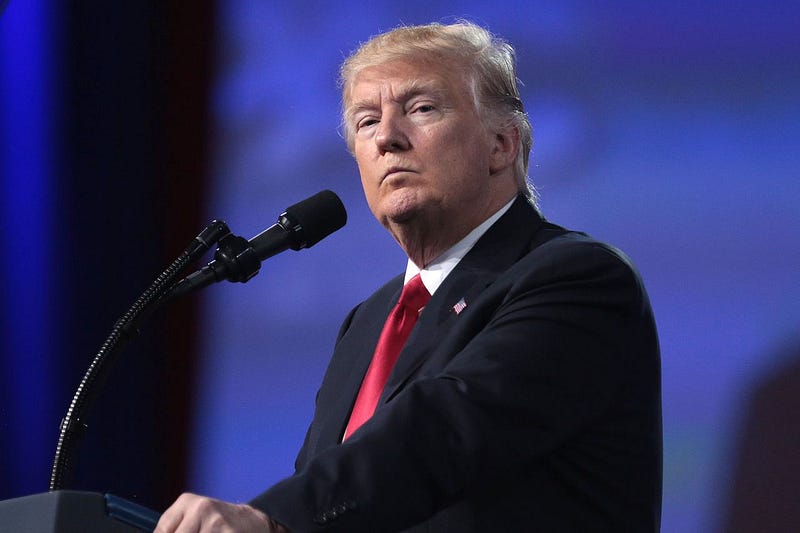
.jpg)
Dr. John Gartner believes Donald J. Trump suffers from dementia.
A psychologist and former professor at Johns Hopkins University Medical School, Gartner shared his opinion in a recent Salon article:
“Not enough people are sounding the alarm, that based on his behavior, and in my opinion, Donald Trump is dangerously demented.”—Dr. John Gartner
Gartner based his assessment, in part, on Trump’s use of “phonemic paraphasias,” which can be a sign of moderate to severe Alzheimer’s.
Gartner explains:
“Phonemic paraphasias” — the substitution of non-words for words that sound similar — are not normally seen until a patient enters the moderate to severe stages of Alzheimer’s.
Some examples of Trump’s non-words: Beneficiaries becomes “benefishes.” Renovations become “renoversh.” Pivotal became “pivobal.” Obama became “obamna.” Missiles became “mishiz.” Christmas became “Crissus.” Bipartisan became “bipars.”
I’d feel compassion for anyone who suddenly discovers they have dementia. But can I feel compassion for Trump?
What a potential downfall for someone who prides himself on his status as a celebrity, tycoon, and one-time world leader. If you’ve seen clips of any of Trump’s recent campaign speeches, the mistakes are painfully obvious.
According to an article in The Guardian, the crowd at a recent Virginia rally went silent when Trump confused Barack Obama for Joe Biden for the third time in six months.
Even Trump’s most ardent supporters have noticed something is amiss.
If you’re a Trump-lover, you may want to skip the next section. Or think of how you see Biden.
I’m not a Trump fan. But I did feel empathy for him after reading Gartner’s article. Believe me, I’m not holier-than-thou. I’ve just been a softie since my childhood years. Even the smallest amount of suffering breaks my heart.
At the same time, I’m far from perfectly pure.
I can easily feel anger when I hear Trump speak and demean others. A jury has decided he’s a sexual abuser and a judge has determined he’s a fraudster, more than enough to make me burn.
Then to think of how Trump targeted election workers Ruby Freeman and her daughter Shaye Moss raises my hackles all the more. Also, I watched the January 6th attack on the U.S. Capitol with my own eyes. People were injured and killed by the crowd he sent to do his bidding.
When I consider all the harm he’s caused, in these ways and others, I wonder if it’s right to feel empathy for him. Is it respectful to the many people he’s harmed?
Despite my inner conflict, I know many great leaders and spiritual teachers have warned us about the danger of hate. Martin Luther King, Jr. told us that hate only begets more hate.
“Darkness cannot drive out darkness: only light can do that. Hate cannot drive out hate: only love can do that.”― Martin Luther King Jr.
In the tradition I follow, Buddhism, everyone is seen as worthy of our love and compassion no matter what offenses they’ve previously committed.
For example, Tibetans consider the 11th-century yogi Milarepa the greatest of saints. But Milarepa practiced black magic as a young adult to revenge relatives who had wronged his mother and himself. The destruction he unleashed resulted in the deaths of many people.
Milarepa later came to regret his actions. He embraced the Buddhist path, spent many years in isolated meditation retreats, and eventually attained enlightenment.
This story illustrates that we all have the potential for good within us.
In one sense, we’re all the same: We all want happiness and none of us want to suffer.
But sadly, not knowing the true causes of happiness, people seek to find it through the acquisition of material possessions, status, and success or in Milarepa’s case even through revenge. Ambition can easily turn into the kind of greed and disregard for others we witness in Trump.
What good will all his status mean if Trump loses the ability to use language due to dementia?
“Hate the sin, love the sinner.”― Mahatma Gandhi
You might argue that Trump will never regret his harmful actions like Milarepa did. I can’t disagree with you there.
But should we reserve our compassion only for those who repent?
Can we instead have faith that justice will somehow be served? In the Buddhist system, the accumulation of negative karma means you’ll suffer in the future.
Still, it’s not easy to feel compassion toward someone we see as an enemy. That’s why I appreciate the Buddhist approach to compassion, which shows us how to start where we are and build it up through repetition.
Compassion is the wish for all beings to be free from suffering and from the causes of suffering — negative emotions, negative actions, and the momentum they create to repeat negativities in the future.
Imagine Trump does indeed have dementia. How would you cultivate compassion for him if you were so inclined?
Before you jump to an enemy, it’s a good idea to start with an individual you love, then move on to one you feel neutral toward, and finally, to one you see as an enemy.
This is a visualization, I adapted from the traditional Buddhist meditation on compassion:
- Imagine someone you know is suffering from dementia. Imagine you’re experiencing this same suffering. Picture in graphic detail how terrible this suffering would be. Consider how powerless and hopeless you would likely feel should your mind be gradually taken over by dementia.
- With all your heart, wish for this person to be free from their suffering and the causes of their suffering.
It might feel impossible to do this meditation with Trump as a focus right now. I understand.
But you can start where you are. Start with the people you love or feel neutral toward. Then work on cultivating a little more empathy each day. Slowly widen the circle of those deserving of your compassion.
“Love and compassion are necessities, not luxuries. Without them, humanity cannot survive.”—The Dalai Lama
Is Trump worthy of our compassion? It’s not an easy question, is it? We might see ourselves as kind, compassionate, and non-judgmental. But some people truly put us to the test.
For more inspiration, sign up for my bi-monthly Wild Arisings e-letter and receive access to free self-discovery resources.
You might also like: