
Is Tom Cotton gay?
Let’s look at a right-wing whisper campaign
He has been a Republican star since 2012, when elected to the House, then the Senate in 2014. All the while, Tom Cotton was frequently insinuated to be gay.
As talk about his sexuality flares up once again, I’m thinking about his life, and those rumors—often from his own political side.
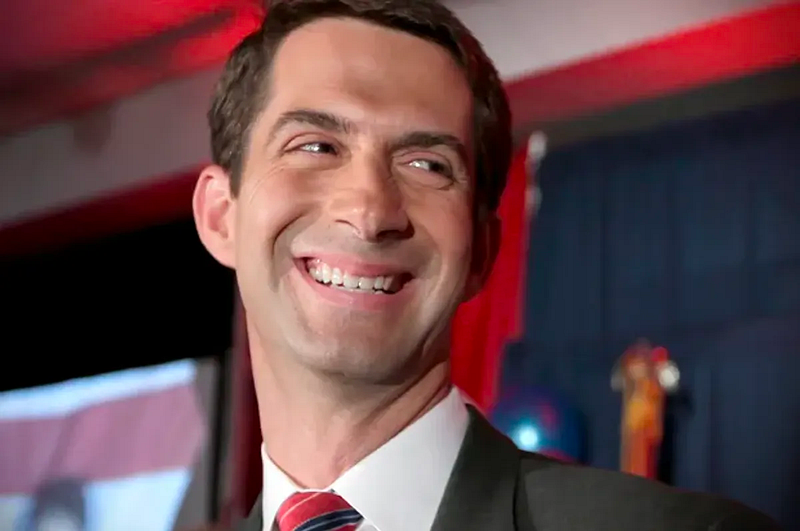
Thomas Bryant Cotton was born in 1977 in the tiny town of Dardanelle, Arkansas.
His parents were civil servants, and the family ran a cattle farm. He was tall, 6'5", and ever unusually focused. He played on the high school basketball team—not gifted but very determined.
He seemed more a fit on the ‘quiz bowl’ team. He was smart, and applied to Harvard University. He was Christian, a Methodist.
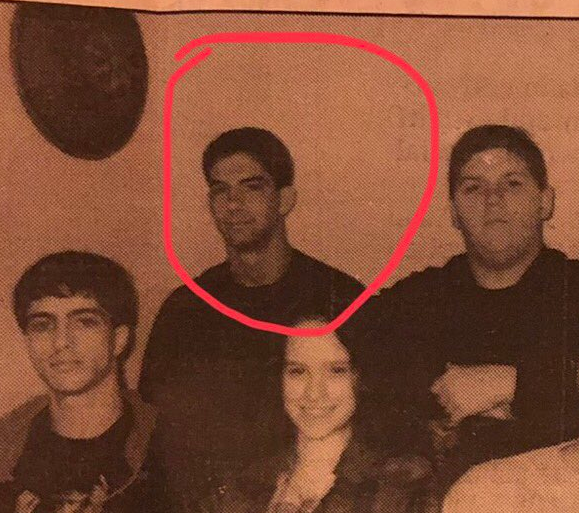
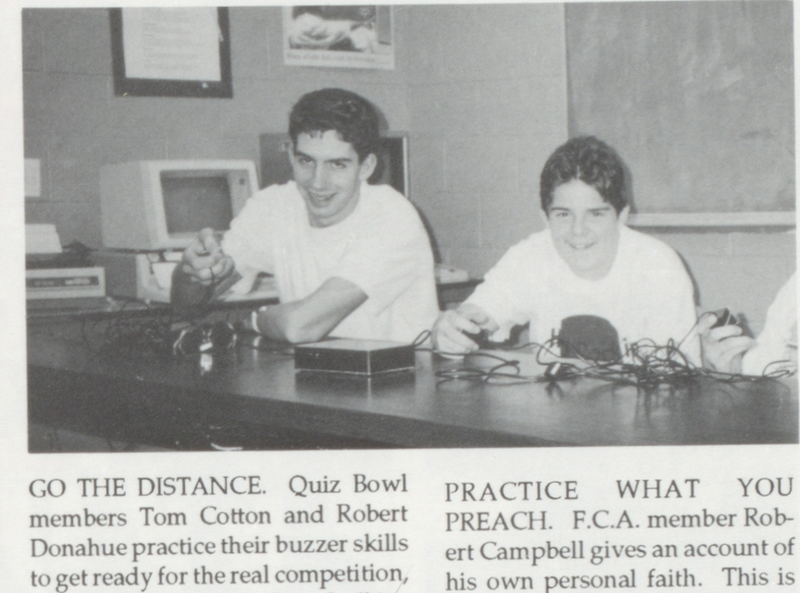
In retrospect it looks like he’d designed his life for a career in Republican politics.
He studied political philosophy and did his senior thesis on the Federalist Papers. Then he went to Harvard Law School.
Along the way he wrote on the student newspaper. He wrote about lighter fare like sports, but he was most interested in conservative public policy.
He recalls in an assessment of the time: “In my years at Harvard, I have been called many things, few of them pleasant.” It didn’t matter to him, he adds, “since I never sought to be loved or to be treated justly.”
He got a law degree, then joined the Army in 2005.
It’s all so perfect as a template for getting into politics that speculation would circulate that he’d been ‘groomed’ for this role.
In 2015, the right-wing fringe journalist Wayne Madsen did a report on Tom Cotton and fellow Republican Lindsey Graham, and put it this way:
“In order to compensate for its lack of veterans, the party grooms people like Cotton and Graham to earn some military gravitas before they are put on the fast track for the U.S. House and then the Senate. The military service record is essential for the Republicans in order to compensate for the ‘gay’ rumors that swirl around some of the party’s political recruits.”
He made a splash in the political world even while enlisted.
In 2012, Cotton wrote an indignant letter to the New York Times demanding journalists be jailed for exposing military intelligence.
It was seen as a bold move against the ‘liberal media’ by the good-hearted American soldier. In retrospect one might note the interest in secrets.
Out of the Army, Cotton worked in the private sector briefly, but was intent on politics. “Tom Cotton is a Republican’s dream,” as National Review put it.
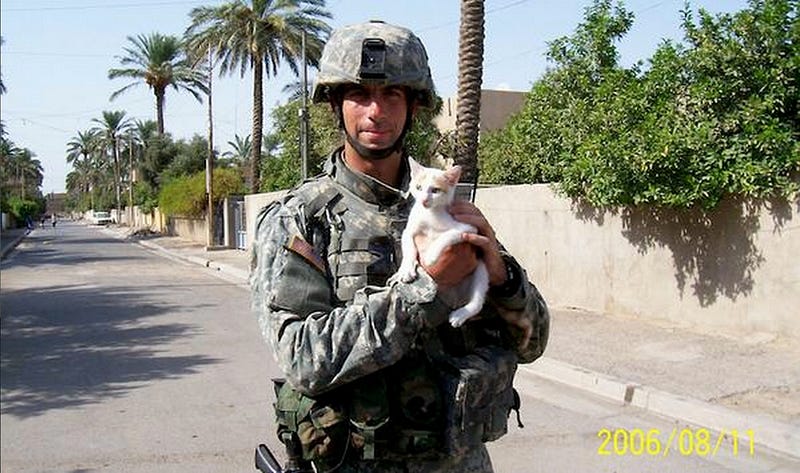
Gay rumors followed him.
In 2015, Gawker reported that gay rumors were “passed around Democratic political circles in Arkansas.” They interviewed a few local Democrat leaders “who would say little about the rumor that Cotton is gay beyond swearing that it existed and was real.”
But could the GOP be looking for people able to be blackmailed? The background of the “Tom Cotton-is-gay” discussion is that the American government typically runs on sexual blackmail — or what the commentator Scott Adams calls a “blackmailocracy.”
Who better than a closeted gay man? He could be ultra-influential — and yet able to be destroyed at any time. It’s an idea that has followed Tom Cotton, Lindsey Graham, Tim Scott, and others.
Cotton won handily, and entered Congress in 2013.
He launched a campaign for a Senate seat a few months later—already seen as a rising star on the fast track to a presidential ticket.
He was also read as gay all along. A Twitter account set up in 2013 purported to be ‘Candy Cotton’, Tom Cotton’s gay alter-ego, with tart political commentary that seemed more Democrat than Republican.
There was vague talk about him being seen in gay bars. But then…he married. The lucky girl? A lawyer for the “intelligence industry.”
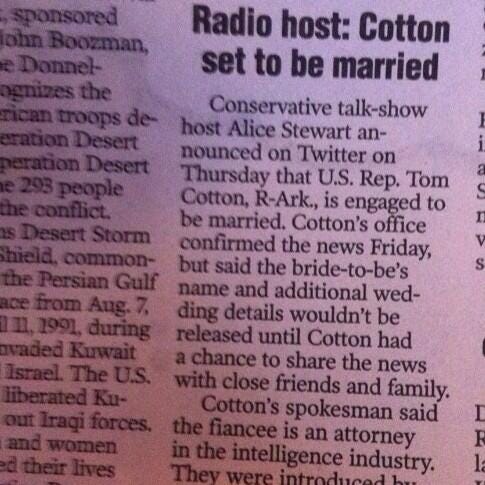

The wedding in 2014 was…curious.
On only one occasion had he been seen in public with Anna Peckham, then they were married. Ge hadn’t disclosed her name until after the marriage.
As Wayne Madsen puts it:
“The rumors that Cotton had to arrange a quick marriage to a ‘beard’ in order to cover up his gay life style immediately began circulating in Arkansas and Washington, DC.”
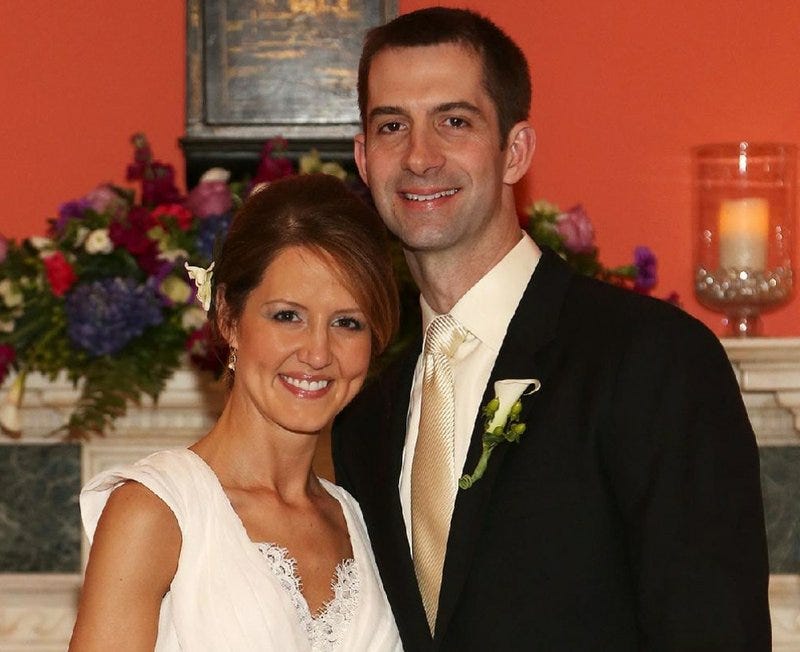

That photo didn’t help…
In 2014, a gay bar in Washington D.C. called J.R.’s was posting crowd shots on their website. In one blurry image, a patron looked rather like Tom Cotton. The man was certainly tall enough.
J.R.’s is a famous hang-out for gay Republicans. In his memoir, Blinded by the Right, David Brock writes of learning this in the 1980s:
“The many closeted gays who served in the senior-most ranks of the Reagan administration called themselves the ‘laissez fairies.’ Gay Republicans were everywhere, even in the city’s bars, long considered a kind of free zone where gay Republicans could let down their guard without much fear of being outed. When I walked into J.R.’s, a popular bar in the heart of D.C.’s gay Dupont Circle strip, it seemed that every other person I met was a Republican.”
The hacker group Anonymous drew attention to the image of the man seen to resemble Tom Cotton. The matter was debated, with some seeing a resemblance and others not.


Rep. Cotton won his Senate race.
The gay ‘reads’ continued. In 2015, Gawker ran a story on his sexuality. A satire site posted a story about Cotton talking up ‘conversion therapy’ as working for him.
Like many links touching on Cotton’s sexuality, it was later deleted.
Cotton seemed adept at dealing with the matter. His decision to grow facial hair was suspected to offset the ‘gayface’ that could creep into photos.
Whether it worked or not was debated. The Datalounge crowd considered the matter. “Bossy bottom,” one commenter said.
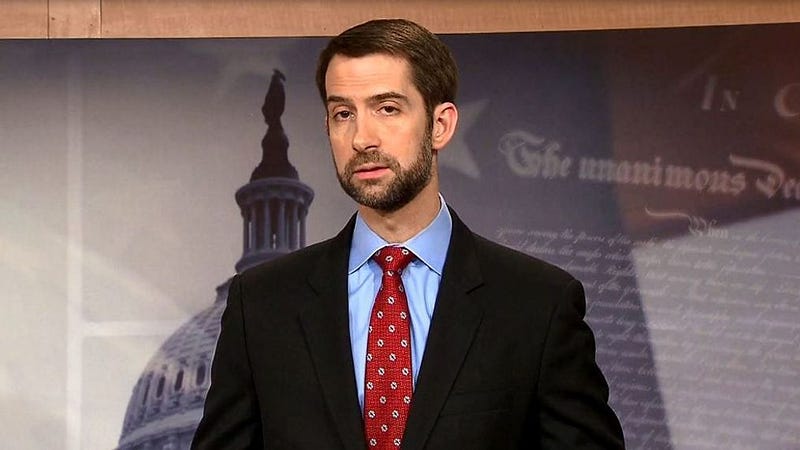
Tom Cotton was a reliably anti-gay Republican.
An observer might wonder: Could the party known for anti-gay politics be nurturing a gay man in the Senate, and even overlook him going to a gay bar? Is that even possible?
The answer is: There are many suggestions of GOP members of Congress allowed to be semi-openly gay so long as they were publicly anti-gay.
In 1981, Steve Gunderson was elected a House member from Wisconsin, and was well-known for frequenting D.C. gay bars. He was out to Republican colleagues. It was known to Newt Gingrich when Gunderson was chosen for chief deputy whip.
But then in 1994, amid a policy dispute over federal funding for gay-friendly curriculum, Gunderson was outed on the floor of the House by the conservative firebrand Bob Dornan. His career was over.
If a GOP politican’s base is happy with his politics, there isn’t much scrutiny of his life.
Even “indiscretions” that blow up publicly can be overlooked, as we see with key activists like Matt Schlapp.
But when the base is unhappy, there’ll be sex talk.
On September 16, 2023, Tom Cotton startled his conservative fans in calling, with Lindsey Graham and two other senators, for an increase in funding for Ukraine. It was seen as a political betrayal. Darren J. Beattie, editor of the fiesty Revolver magazine, let loose with a read:
“It is pretty obvious that at least two of the signatories here are closeted homosexuals. It is natural to infer from this that the war mongering is a product of blackmail. But is it even a big deal these days for a Republican to be gay?”
That pointed to Lindsey Graham and Tom Cotton.
Right-wing influencers puzzled about it. Mike Cernovich offered: “What do they have on Tom Cotton? Must be bad. He went from patriot to traitor overnight. Tom, just leak the material yourself. Don’t live like this.”
He added: “Let’s say I am getting A LOT OF TEXTS about this, and we will leave it at that. For now.”
Commenters piled onto the Cotton outing train: “He’s gay as hell.”
Another offers: “Not a slur at all. Just a fact.”
But it continues to be talk, mostly on social media.
There’s an odd feeling, so often, that the key players, from GOP leaders to the Washington D.C. press, are playing the game. 🔶


