avatarJeffrey Goodman

Free AI web copilot to create summaries, insights and extended knowledge, download it at here

5341

Abstract

s really bad — genuinely awful.</li><li>+10 is a an excellent rating that any company would be proud to receive.</li><li>0 (zero) would be neutral. Neither good nor bad.</li></ul><p id="cec2">As you can see, I gave 5 of the first 6 characteristics a negative rating.</p><p id="dda2">But you might be puzzled why my ratings for Affordability and for Value were actually positive.</p><ul><li><b>Affordability. </b>Regardless of how well-designed or how reliable the Yugo was (or wasn’t), there’s no question that the price of the car was affordable. The average new car in the mid-80s sold for 9,000 to 10,000 . . . and the Yugo’s starting price was $4,000. That’s why I gave it a “10” — because it totally outperformed in terms of affordability.</li><li><b>Value. </b>And while the car didn’t deliver much in terms of design or performance or reliability, etc., the company did charge a very low price for what they did deliver. They delivered a reasonable amount of value for the money a customer paid — hence my rating of +5.</li></ul><h2 id="97d4">But . . . how does all of this relate back to the U.S. healthcare system?</h2><figure id="c6e2"><img src="https://cdn-images-1.readmedium.com/v2/resize:fit:800/0*hrIq1vow0dDuItFi"><figcaption>Photo by <a href="https://unsplash.com/@freestocks?utm_source=medium&amp;utm_medium=referral">freestocks</a> on <a href="https://unsplash.com?utm_source=medium&amp;utm_medium=referral">Unsplash</a></figcaption></figure><h1 id="5eff">What if the Yugo’s designers had created the U.S. healthcare system?</h1><p id="dec6">Well, we could sort of imagine that if the Yugo designers had gone on to recreate the U.S. healthcare system, we would have a poorly performing, bare bones kind of healthcare system . . .</p><p id="2369"><b>. . . but we would pay really cheap prices for this “poorly performing” healthcare system.</b></p><figure id="16fd"><img src="https://cdn-images-1.readmedium.com/v2/resize:fit:800/0*yZjOvyk_NKEspPmT"><figcaption>Photo by <a href="https://unsplash.com/@nci?utm_source=medium&amp;utm_medium=referral">National Cancer Institute</a> on <a href="https://unsplash.com?utm_source=medium&amp;utm_medium=referral">Unsplash</a></figcaption></figure><h2 id="549c">Today’s U.S. healthcare system is a two-class system.</h2><ol><li><b>Excellent care for the people who can afford it.</b> This includes almost all of the Top 1%; a very large percentage of the Top 10%; and probably at least half of the next 10 percentage points (i.e., the “rest of the Top 20%”) of the U.S. population.</li><li><b>Spotty healthcare coverage at best — or an out-and-out lack of healthcare coverage — for various segments of the bottom 70–80% of the population.</b> This is due to lack of medical facilities in many parts of the country outside large coastal cities; uninsured people; underinsured people; technically uninsured people; extortionist-level drug pricing; stock buybacks to transfer windfall industry profits to the Top 10% and the Top 1%; etc.</li></ol><p id="8c24">And if we insist —<i> as I do</i> — that a country’s healthcare system should be designed to serve the middle 80% of the population, then the U.S. healthcare system is a failure.</p><p id="8dcd">This isn’t even a debatable point, although people in the Top 10% will often argue that the system is working ok enough . . . and people in the Top 1% are puzzled when you say that the U.S. healthcare system is broken.</p><p id="6c84">From their narrow perspectives, they aren’t seeing a system that is broken, rapacious, and sociopathic.</p><p id="d5b8">Talk to any average person in the U.S., though, and show them what healthcare systems look like in other parts of the world . . . and then start asking them hard-nosed, direct questions about what they think of our healthcare system. You’ll get some “colorful” answers.</p><figure id="e444"><img src="https://cdn-images-1.readmedium.com/v2/resize:fit:800/1*RLSfAOj093uiWkBhcWz46A.jpeg"><figcaption></figcaption></figure><h1 id="7b8f">So I have to ask these 3 questions:</h1><h2 id="f841">Question #1</h2><p id="59f3"><b>How can it be that (1) we have Yugo-like levels of poor healthcare outcomes</b> (like life expectancy) <b>and crappy levels of healthcare service and product delivery BUT (2) we are charged the most expensive prices in the developed world for our healthcare?</b></p><p id="7beb">Think about this for a moment.</p><p id="8af9">In any other part of your life, you might be willing to buy a product that was poorly built or that under-delivered as long as (1) it met some basic need and (2) the price was cheap enough.</p><p id="cf31">But there are few people —<i> <b>very</b> few people</i> — in the U.S. on the patient side of things who would say that U.S. healthcare is “cheap.”</p><p id="f24e"><b>Why are hospitals, health insurance companies, pharaceutical companies, and PBMs</b> (pharmacy benefit managers) <b>able to charge 2 to 4 TIMES AS MUCH for healthcare here as the far better-performing healthcare systems in our peer countries charge?</b></p><p id="74b9"><b>Note: For peer countries, </b><i>I’m looking at you, <a href="https://youtu.be/6GPnvbfVqBY?feature=shared">Japan</a>, <a href="https://farewellalarms.com/living-in-the-best-healthcare-system-on-earth-e2a12511e4cb">South Korea</a>, Germany (<a href="https://youtu.be/017c4FA2zjM?feat

Options

ure=shared">1</a>) & (<a href="https://youtu.be/X4pmrsiwZMk?feature=shared">2</a>), <a href="https://youtu.be/l_YMrHssFXo?feature=shared">Sweden</a>, <a href="https://youtu.be/MHzUCToycks?feature=shared">France</a>, <a href="https://youtu.be/ei9I4_OKrg8?feature=shared">Finland</a>, <a href="https://youtu.be/-QMicRxsJNw?feature=shared">Taiwan</a>, and <a href="https://youtu.be/sKjHvpiHk3s?feature=shared">Singapore</a>…to name just a few countries.</i></p><h2 id="f928">Question #2</h2><p id="e687"><b>And why are an overwhelming number of Americans willing to put up with this sad state of affairs</b> and continue to pay their family’s financial lifeblood into a healthcare system that seems to exist just to hold your health ransom so that they can grab as much money out of your wallet as they want.</p><p id="5cdc">With the exception of Congresswoman Katie Porter as shown in this article:</p><div id="a853" class="link-block"> <a href="https://bright52.medium.com/the-embarrassing-part-about-big-pharmas-dirty-little-secret-8be729ff84a"> <div> <div> <h2>The Embarrassing Part about Big Pharma’s Dirty Little Secret</h2> <div><h3>A good definition for the word “chutzpah” is “unmitigated gall.” Here’s a real-life example from a Big Pharma CEO.</h3></div> <div><p>bright52.medium.com</p></div> </div> <div> <div style="background-image: url(https://miro.readmedium.com/v2/resize:fit:320/0*5y9YRHIXc-tSVjpV)"></div> </div> </div> </a> </div><p id="c5c4">and Senator Bernie Sanders, how many U.S. politicians are pounding the table to fundamentally reform the U.S. healthcare system?</p><p id="0b96"><i>Exactly.</i> Essentially no one — other than Porter and Sanders — is pounding the table.</p><p id="b045">Is it that none of us voters are demanding change? Are there other things going on? How can U.S. healthcare continue to go on this way?</p><h2 id="525e">Question #3</h2><p id="8897"><b>Folks, can you explain this to me?</b> Why are people in the U.S. not pounding the table and relentlessly, unyieldingly demanding that our system gets fundamentally rebuilt?</p><p id="5583">Healthcare is not a trivial part of our lives and the lives of our families.</p><p id="bd9a">Are you all really content (enough) with <a href="https://bright52.medium.com/has-u-s-healthcare-really-become-a-mob-protection-racket-127cbc97d6c">America’s protection racket healthcare system</a> . . . ?</p><div id="085c" class="link-block"> <a href="https://bright52.medium.com/has-u-s-healthcare-really-become-a-mob-protection-racket-127cbc97d6c"> <div> <div> <h2>Has U.S. Healthcare Really Become a Mob Protection Racket?</h2> <div><h3>“That’s a great looking daughter you have there. Be a shame if something happened to her health. Just sign this here…</h3></div> <div><p>bright52.medium.com</p></div> </div> <div> <div style="background-image: url(https://miro.readmedium.com/v2/resize:fit:320/0*8G_w4cM8aDF1rWc9)"></div> </div> </div> </a> </div><p id="d871">If you’re not complaining and pounding the table, then at the end of the day, doesn’t that mean you are ok with this?</p><p id="ee56"><b>Am I crazy to be puzzled about this state of affairs</b>, especially when every. other. modern. developed. country provides good enough — <i>sometimes “great”</i> — levels of healthcare for a fraction of what our healthcare costs in the U.S.?</p><p id="ce00">Thoughts? Insights?</p><p id="90b7">How do we explain this?</p><h1 id="9e6b">Related and recent articles</h1><p id="e1f0"><a href="https://bright52.medium.com/has-u-s-healthcare-really-become-a-mob-protection-racket-127cbc97d6c"><b>Has U.S. Healthcare Really Become a Mob Protection Racket?</b></a><a href="https://bright52.medium.com/my-health-insurance-company-asked-for-feedback-on-my-specialist-i-blew-my-top-c212af65fb2b"><b>My Health Insurance Company Asked for Feedback</b></a> on My Specialist. I Blew My Top. • <a href="https://bright52.medium.com/the-embarrassing-part-about-big-pharmas-dirty-little-secret-8be729ff84a"><b>The Embarrassing Part about Big Pharma’s</b></a> Dirty Little Secret • <a href="https://bright52.medium.com/3-things-you-need-to-know-about-student-loan-debt-and-debt-cancellation-c51e3360ace2"><b>3 Things You Didn’t Know about Student Loan Debt</b></a> and (Potential) Debt Cancellation • <b>(Part 1 • Barnacles) Six Behavioral Barriers</b> That Prevent You from Changing the Status Quo • <a href="https://readmedium.com/pressing-where-it-hurts-how-to-win-the-fights-that-matter-bf99c63a65d8"><b>Pressing Where It Hurts: How to Win Fights That Matter</b></a></p><p id="7ef0">(<a href="https://bright52.medium.com/subscribe"><b><i>Subscribe</i></b></a><i> to receive email notifications when I post new articles.</i>)</p><p id="d0f5"><i>Again, thank you for reading, <a href="https://bright52.medium.com/subscribe"><b>subscribing</b></a>, clapping, and sharing — I appreciate your time and attention!</i></p><p id="e50d"><a href="https://bright52.medium.com/about"><b>Jeffrey Goodman</b></a></p></article></body>

Is the U.S. Healthcare System Just Like a Yugo…but without the Yugo’s Charm and Value?

If you’re familiar with the Yugo car, you may already be groaning at the reference to the Yugo’s “charm and value.” Just wait — the real groaning is about to begin.

Yugo commercial from 1986

Related and recent articles

Has U.S. Healthcare Really Become a Mob Protection Racket?My Health Insurance Company Asked for Feedback on My Specialist. I Blew My Top. • The Embarrassing Part about Big Pharma’s Dirty Little Secret • 3 Things You Didn’t Know about Student Loan Debt and (Potential) Debt Cancellation • (Part 1 • Barnacles) Six Behavioral Barriers That Prevent You from Changing the Status Quo • Pressing Where It Hurts: How to Win Fights That Matter

(Subscribe to receive email notifications when I post new articles.)

Let’s begin with the question of the day:

“Is the U.S. healthcare system just like a Yugo…but without the Yugo’s charm and value?”

Ouch.

I Bought The WORST CAR Ever Made… (YUGO)” YouTube video

First, some background on the Yugo car from the 1980s

The Yugo, also known as the Zastava Koral, was a small hatchback car produced in the 1980s by the Yugoslavian company Zastava Automobiles. It was imported to the United States by entrepreneur Malcolm Bricklin and pitched as an affordable option for budget-conscious American consumers.

One of the Yugo’s defining characteristics was its extremely low price.

When introduced to the U.S. market in 1985, it was touted as “America’s most affordable car,” with a price tag of just under $4,000.

This pricing strategy was a major part of its initial appeal, attracting buyers who were looking for basic transportation without the frills.

But the low price is not what pop culture today still remembers the Yugo for . . . .

Unfortunately, the Yugo soon gained a reputation for questionable build quality and reliability issues.

While its design was straightforward, critics and owners all pointed out problems ranging from mechanical failures to issues with the car’s fit and finish.

This notoriety was further cemented by a series of humorous and often disparaging mentions in popular culture, making the Yugo a symbol of poor automotive engineering for many.

But was that really a fair assessment of the car?

And what could this possibly have to do with the U.S. healthcare system?

Answers to both questions are coming up.

Defining characteristics of the Yugo

Here are some characteristics of the Yugo that get to the core of what the car was about, along with my own (subjective) rating of how the Yugo did with regard to each characteristic.
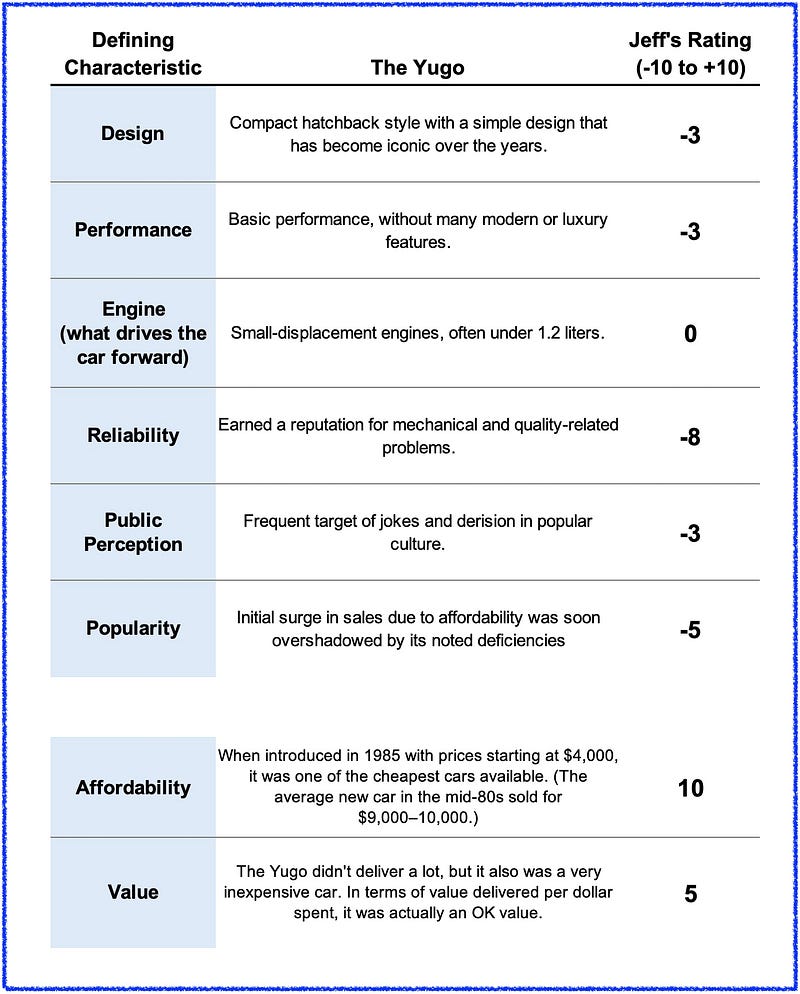
Table and graphic created by author, 10/04/2023.

For each of these 8 characteristics, there’s no real survey data that would give an objective report card, so I went with my own gut feel to suggest a rating on a -10 to +10 scale.

  • -10 is really bad — genuinely awful.
  • +10 is a an excellent rating that any company would be proud to receive.
  • 0 (zero) would be neutral. Neither good nor bad.

As you can see, I gave 5 of the first 6 characteristics a negative rating.

But you might be puzzled why my ratings for Affordability and for Value were actually positive.

  • Affordability. Regardless of how well-designed or how reliable the Yugo was (or wasn’t), there’s no question that the price of the car was affordable. The average new car in the mid-80s sold for $9,000 to $10,000 . . . and the Yugo’s starting price was $4,000. That’s why I gave it a “10” — because it totally outperformed in terms of affordability.
  • Value. And while the car didn’t deliver much in terms of design or performance or reliability, etc., the company did charge a very low price for what they did deliver. They delivered a reasonable amount of value for the money a customer paid — hence my rating of +5.

But . . . how does all of this relate back to the U.S. healthcare system?

Photo by freestocks on Unsplash

What if the Yugo’s designers had created the U.S. healthcare system?

Well, we could sort of imagine that if the Yugo designers had gone on to recreate the U.S. healthcare system, we would have a poorly performing, bare bones kind of healthcare system . . .

. . . but we would pay really cheap prices for this “poorly performing” healthcare system.

Photo by National Cancer Institute on Unsplash

Today’s U.S. healthcare system is a two-class system.

  1. Excellent care for the people who can afford it. This includes almost all of the Top 1%; a very large percentage of the Top 10%; and probably at least half of the next 10 percentage points (i.e., the “rest of the Top 20%”) of the U.S. population.
  2. Spotty healthcare coverage at best — or an out-and-out lack of healthcare coverage — for various segments of the bottom 70–80% of the population. This is due to lack of medical facilities in many parts of the country outside large coastal cities; uninsured people; underinsured people; technically uninsured people; extortionist-level drug pricing; stock buybacks to transfer windfall industry profits to the Top 10% and the Top 1%; etc.

And if we insist — as I do — that a country’s healthcare system should be designed to serve the middle 80% of the population, then the U.S. healthcare system is a failure.

This isn’t even a debatable point, although people in the Top 10% will often argue that the system is working ok enough . . . and people in the Top 1% are puzzled when you say that the U.S. healthcare system is broken.

From their narrow perspectives, they aren’t seeing a system that is broken, rapacious, and sociopathic.

Talk to any average person in the U.S., though, and show them what healthcare systems look like in other parts of the world . . . and then start asking them hard-nosed, direct questions about what they think of our healthcare system. You’ll get some “colorful” answers.

So I have to ask these 3 questions:

Question #1

How can it be that (1) we have Yugo-like levels of poor healthcare outcomes (like life expectancy) and crappy levels of healthcare service and product delivery BUT (2) we are charged the most expensive prices in the developed world for our healthcare?

Think about this for a moment.

In any other part of your life, you might be willing to buy a product that was poorly built or that under-delivered as long as (1) it met some basic need and (2) the price was cheap enough.

But there are few people — very few people — in the U.S. on the patient side of things who would say that U.S. healthcare is “cheap.”

Why are hospitals, health insurance companies, pharaceutical companies, and PBMs (pharmacy benefit managers) able to charge 2 to 4 TIMES AS MUCH for healthcare here as the far better-performing healthcare systems in our peer countries charge?

Note: For peer countries, I’m looking at you, Japan, South Korea, Germany (1) & (2), Sweden, France, Finland, Taiwan, and Singapore…to name just a few countries.

Question #2

And why are an overwhelming number of Americans willing to put up with this sad state of affairs and continue to pay their family’s financial lifeblood into a healthcare system that seems to exist just to hold your health ransom so that they can grab as much money out of your wallet as they want.

With the exception of Congresswoman Katie Porter as shown in this article:

and Senator Bernie Sanders, how many U.S. politicians are pounding the table to fundamentally reform the U.S. healthcare system?

Exactly. Essentially no one — other than Porter and Sanders — is pounding the table.

Is it that none of us voters are demanding change? Are there other things going on? How can U.S. healthcare continue to go on this way?

Question #3

Folks, can you explain this to me? Why are people in the U.S. not pounding the table and relentlessly, unyieldingly demanding that our system gets fundamentally rebuilt?

Healthcare is not a trivial part of our lives and the lives of our families.

Are you all really content (enough) with America’s protection racket healthcare system . . . ?

If you’re not complaining and pounding the table, then at the end of the day, doesn’t that mean you are ok with this?

Am I crazy to be puzzled about this state of affairs, especially when every. other. modern. developed. country provides good enough — sometimes “great” — levels of healthcare for a fraction of what our healthcare costs in the U.S.?

Thoughts? Insights?

How do we explain this?

Related and recent articles

Has U.S. Healthcare Really Become a Mob Protection Racket?My Health Insurance Company Asked for Feedback on My Specialist. I Blew My Top. • The Embarrassing Part about Big Pharma’s Dirty Little Secret • 3 Things You Didn’t Know about Student Loan Debt and (Potential) Debt Cancellation • (Part 1 • Barnacles) Six Behavioral Barriers That Prevent You from Changing the Status Quo • Pressing Where It Hurts: How to Win Fights That Matter

(Subscribe to receive email notifications when I post new articles.)

Again, thank you for reading, subscribing, clapping, and sharing — I appreciate your time and attention!

Jeffrey Goodman

Health
Healthcare
Pharmaceutical
Design
Injustice
Recommended from ReadMedium