

Is Stitch Fix’s Stock Cheap?
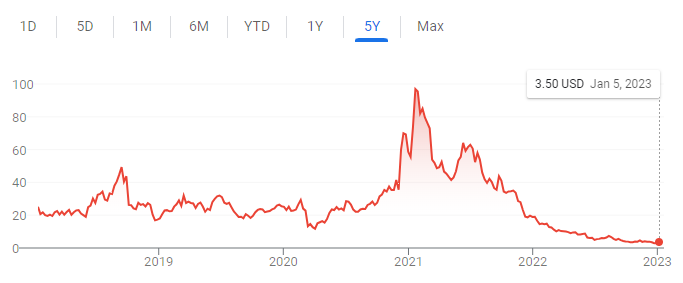
Taking a look at a company whose shares are down 96% from its high
(I do not own any Stitch Fix shares. This article is for educational purposes only, and is not intended to be investment advice.)
Stitch Fix is an interesting company. I first wrote about it more than 2 years ago here. Back then the stock was a pandemic darling thanks to its ability to ride three key trends: shop from home, machine learning, and revenue that approximates a subscription. Let’s recap Stitch Fix’s perceived strengths that I wrote about then:
- The service should grow more valuable to each of its users as it learns more about their tastes and likes.
- On average, Stitch Fix should be able to make each user happier as it employs a one-to-one interaction between its stylists (plus algorithm) and its users. This should be more desirable than the one style fits all approach that traditional fashion retailers take.
- As it learns more about its user base and can service them more efficiently, Stitch Fix should face fewer returns and unsold items, giving it higher gross margins.
- User satisfaction with the service (as it learns users’ tastes and likes) creates brand loyalty and lock-in as well as brand recognition, reducing the need for marketing and retention spend.
Looking at the stock performance over the past two years, it seems like investors have cooled dramatically on Stitch Fix’s value proposition (luckily I never bought any). And while some of this is due to a more stressful macro environment, a lot of it is due to the company’s own lackluster operating performance.
For the past four quarters, Stitch Fix has lost active users (defined as someone that checked out a fix, a.k.a. clothing box, at least once over the trailing 52 weeks), dropping from almost 4.2 million in October of 2021 to 3.7 million now (an 11% decline). This is despite the company increasing marketing spend as a percentage of revenue from 47% to 54% (part of the increase was because top-line revenue declined).
For a company whose valuation is predicated on growth (Stitch Fix managed to grow during the pandemic and increased both active users by 18% and spend per user by 4% in 2021, resulting in an impressive 23% revenue growth), consistently declining active users is a death knell.
From its financials, it’s clear that Stitch Fix has a significant user growth problem despite already spending a lot of money trying to acquire new ones and retain existing ones. This is likely due to several factors:
- A weakening economy and layoffs.
- Lots of competition. If you Google “Stitch Fix competitor” or “online personal stylist,” you will see dozens of similar services.
- Even more competition from traditional retail. Post COVID people want to go out and shop again.
Still the stock is down more than 96% from its peak, its market cap having declined from around $11 billion to a mere $390 million. So is there an opportunity here?
Balance sheet not looking great
As of October 2022, Stitch Fix had $203 million in cash against $178 million in debt (all capitalized leases). So not much in terms of a net cash position. I like to look at net cash because in rare cases, you can find companies trading for close to their net cash position, meaning you get the business for free (though sometimes the business is truly crappy and management is intent in burning through all that cash).
It’s been gradually burning through its cash as well thanks to steadily rising inventory (up almost $100 million versus 2 years ago). Another really bad sign if you’re a retailer, especially one that prides itself on being asset-lite — because the longer your inventory remains unsold, the less it’s worth (nobody wants old clothes). When growing inventories are supporting rising sales, that’s one thing — but now sales and users are both shrinking fast.
Couple this with negative operating cashflow over the past four quarters and there’s a nontrivial probability that Stitch Fix will run out of cash in the coming year, forcing it to either sell stock at fire sale prices or take on debt at very high interest rates. The company seems to have realized the perilous financial position that it’s in and announced today that it’s planning to fire 20% of its staff including its current CEO.
So is it cheap? It’s hard to tell because a return to profitability could be years away at this point. And despite the cost cutting, there’s a real chance of bankruptcy here. That plus the competition’s ability to chip away at Stitch Fix’s customer base (which implies that Stitch Fix’s data advantage is much smaller than it thought) is enough to convince me to stay away.