
Astrophysics
Is our universe super-deterministic? (# 31)
Previous articles in this series have presented theoretical ideas and empirical evidence that our universe could be displayed as a hologram on a boundary in Anti-de Sitter (AdS) space. That boundary displays the contents of the AdS space in one less dimension. The force of gravity that arises out of the curvature of the AdS space incorporates the history of the movement of matter in space. Article 30 — Is hydrogen gas a medium for holding information? — suggests that history/information is instantiated in hydrogen gas. Information has mass that could be the same as dark matter hypothesized by astrophysicists.
This article presents a framework incorporating ideas in the previous articles to discuss some possible implications for the nature of our reality.
Super-determinism
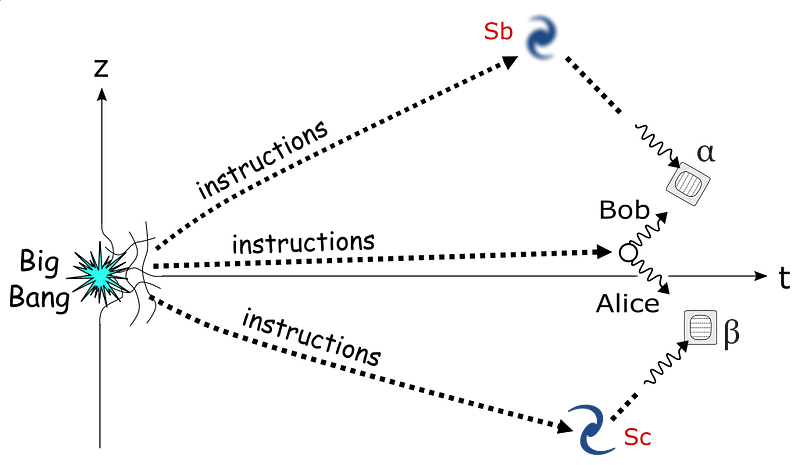
Quantum physics is difficult to understand. How can a photon be both a wave and a particle? Some philosophers suggest that one explanation for quantum phenomena is that everything we see was determined at the start of the universe. The quantum wave function does not collapse when measured. The outcome of the measurement was incorporated into the initial parameters setting out how the universe would evolve. The idea of entanglement between quantum particles is due to a misunderstanding of the nature of reality. This explanation is known as super-determinism. According to this theory, the prepared state of an experiment is never independent of the detector settings.
Super-determinism seems to imply we have no free will. We cannot influence our future. The results of an experiment would have been determined before anyone even thought of the experiment. From many perspectives, super-determinism seems to be an uninteresting philosophy because we are just observers without any meaningful role in how our lives unfold.
However, when super-determinism is considered from the perspective that we are observers in AdS space seeing what unfolds on a boundary in AdS space, we can have a meaningful role. Content presented in a boundary of AdS space could be similar to watching a film where that film has several possible endings depending on how a watcher of the film responds to events in the film. In other words, while events in a film are super-determined, we can learn how to choose between different time paths.
Choosing between different time paths can be an ongoing task, even though all possible endings have been created before the start of a film. Reactions of watchers are monitored and appropriate time paths are inserted in response to these reactions. Although watchers may closely identify with particular characters in the film, no watcher is that character. Watchers may see the same film many times but take on different characters each time. A film can be stored and watched at any ‘time’. Watchers do not experience time in the same way as time appears to unfold in a film.
Information contains the adjacent possible
Previous articles have provided empirical evidence that dark matter is the mass associated with information. The empirical evidence suggests this information may be instantiated in hydrogen gas and contains the history of stars, such as age, distance moved, and temperature changes.
Instantiated information does not need to be limited to age, distance, and temperature. There are also many mediums for instantiating information. Some examples are:
- Auras may be explained by information being instantiated in the water vapor around a living body.
- Homeopathy may be explained by information being instantiated in water even after the water has been diluted many times.
- Dowsing may be explained by our Earth instantiating information about the location of water.
When watchers have certain emotions, the characters with which they identify may develop the ability to access subtle information in the environment i.e. the film can follow different time paths.
We, as watchers, have the potential to change the time path of our film by learning how our emotional responses to events can influence the film. Not all time paths are possible. Our lives provide us with the opportunity to develop and/or experience emotions. Such opportunities have been called the ‘adjacent possible’:
A shadowy inverse of history, exponential in its possibilities the further into the future we go, yet intelligently curtailed at every step by the limitations of the present.
Not everyone may want to learn how to experience their adjacent possible. Nevertheless, this life may provide an opportunity to learn how to access that knowledge. An example of such an opportunity is identifying appropriate actions to address global crises.
Community action
Humanity at present appears to be facing several crises such as global heating that could make Earth uninhabitable. Such a scenario may have been set up as a challenge to see who has the appropriate emotional responses associated with successfully working with others to address a challenge. Perhaps only watchers who cooperate will ‘reincarnate’ in a future life e.g. in a film that has a time path where the Earth does not become uninhabitable.
Learning to change the time path of a film may not only depend on how to respond to personal events but also how to respond to community challenges. In other words, the fact that an individual may not be able to slow global heating is irrelevant. An individual may need to act ‘as if’ everyone else was cooperating even if they are not.
Biologists have discovered a phenomenon called ‘quorum sensing’. Quorum sensing is a mechanism by which bacteria regulate gene expression consistent with different population densities through the use of signal molecules. After reaching a certain concentration threshold, the signal molecules become detectable to bacteria populations. Until the concentration threshold is reached, bacteria may emit signals without having a noticeable effect on the rest of the population
Analogous to bacteria quorum sensing, some of us may need to take action to address a global crisis without any feedback that our action is having the desired impact. For example, there is evidence Earth vibrates at a natural frequency called the Schumann Resonance which is the same frequency as alpha brain waves. We may be able to use this resonance to change the orbit of carbon dioxide gases in Earth’s atmosphere by changing the information contained in the memory foam of the fabric of space. As the carbon dioxide gases move further into outer space, the concentration of greenhouse gases in Earth’s atmosphere diminishes thus reducing the rate of climate change.
Such a strategy to slow down global heating may only happen when some people are willing to take appropriate action in the absence of feedback that their action is having any effect.
The question for this article is:
Can people be convinced to take action in the absence of proof that such action is effective?
To view the headings of all the articles to be published in this series please click on https://michaeledalton.medium.com/orbiting-stars-and-origin-of-our-universe-338906930f51
To obtain a copy of the book ‘Orbiting Stars’ which contains the first drafts of all these articles, please visit https://www.amazon.com


