
Is OpenAI’s Q* the reason behind Sam Altman’s firing and return? And is Q* the Holy Grail of AGI?
Does the tumultuous tale of Sam Altman’s recent reinstatement reveal major milestone in reaching the technological singularity?
Today, I’m blending the news with a pinch of prognostication to explore the mega-drama at OpenAI and the transformative notion of Artificial General Intelligence (AGI). Buckle up regular readers; this is going to be a wild ride!
We’ll weave together the recent coup at OpenAI, including Sam Altman’s ousting, his surprising sudden reinstatement, the intriguing role of Ilya Sutskever (or as I call him, the “Mad Monk of OpenAI)”, and the utopian theories around AGI, along with the potential reasons for Altman’s firing.
A Recap of the Leadership Changes at OpenAI
Imagine if Game of Thrones, Silicon Valley, and Succession all got drunk and had a baby. That’s been the tech news cycle for the last week or so. The OpenAI debacle has had everything: power struggles, corporate betrayals, and a pursuit of something so advanced it borders on the mythical. Recap: the OpenAI board of directors fired CEO Sam Altman — the public face and Golden Boy of AI — in an unprecedented coup. This led to a whirlwind of events that left everyone guessing about the future of the AI tech empire.
Altman, known for forward-thinking leadership and bold vision, was fired for not being “consistently candid in his communications with the board”.
CTO Mira Murati briefly sat in the top chair, only to be ousted in turn days later by Twitch co-founder Emmett Shear. In a rousing show of solidarity that would make Daenerys Targaryen blush, the majority of OpenAI’s 700-plus employees signed an open letter threatening to leave (effectively taking the braintrust) if the board didn’t resign. Top AI engineers wield enormous leverage as the tech industry’s most valued workers right now (some of whom earn $800,000 per year). Microsoft offered to take them at their previous salaries with Altman, and it looked like a complete exodus from OpenAI was in store, with a de facto takeover by collective departure.
Then just as swiftly, Altman was restored as the Once and Future King of AI.
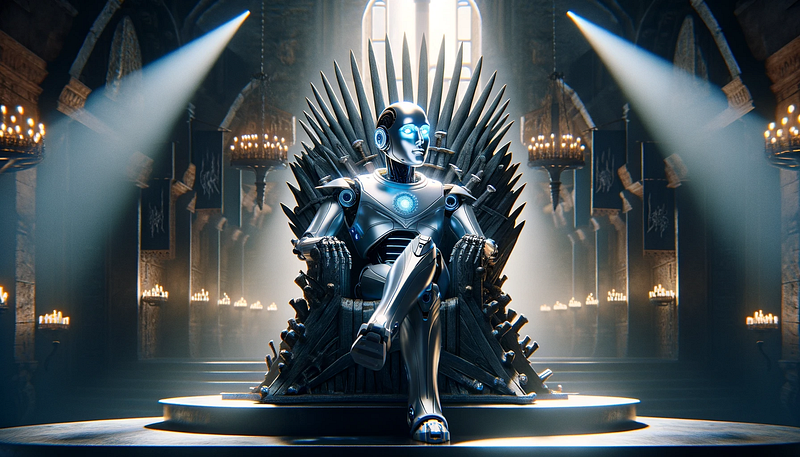
I’ll be honest, the climax was wanting. Binge-watching HBO has led me to expect more satisfying conclusions. Where were the dragons? Who was the Tyrion character in this mess? But seriously, the big question that was left on everyone’s mind was: What triggered this corporate Game of Thrones?
Well, it might’ve been magic. (Bear with me. Remember Arthur C. Clarke: “Any sufficiently advanced technology is indistinguishable from magic”)
Enter Ilya Sutskever, the Unconventional Mystic Scientist
Ilya Sutskever, OpenAI’s chief scientist, emerged as a Svengali-like character in this saga. Although brilliant, Ilya takes an ‘unorthodox’ approach to AI development. We’re talking ritualistic activities, burning effigies, leading chants. Sounds like a scene from a Lovecraftian horror.
Sutskever and Altman have clashed ideologically over the future of AI, with Sutskever appointing himself as an esoteric guru devoted to the attainment of AGI, espousing views of the transcendent potential of AI, and viewing AGI not just as a technological milestone but as a quasi-spiritual entity (Altman similarly seeks AGI, but as result of progress and technological determinism — the inevitable consequence of all this innovation). We’ve seen this ideological battle before, when Google fired ex-Google engineer Blake Lemoine over claims LaMDA had achieved consciousness and had a soul (I’ve even explored this realm of AI myself, somewhat tongue in cheek, by subjecting AI to a battery of Zenner Card tests. The results were spooky).
Sutskever, a quietly charismatic yet treacherous Rasputin, is widely held as the man responsible for pushing Sam Altman out and starting this drama (and make no mistake, ‘this drama’ has global, political and economical repercussions for everyone. The future is being written in the OpenAI boardrooms. There was a congressional hearing over generative AI, and Biden signed an unprecedented executive order regarding it last month).
As strange and cult-leaderish as Sutskever’s behaviour has been, he raises legitimate concerns, with reported friction between him and Altman over AI safety standards (Altman has been vocal about risks too, but even in the congressional hearing he seemed less whistle blower, more proud parent).
But what is AGI? And why might nearing it have triggered Altman’s firing?
The Quest for Artificial General Intelligence (AGI)
AGI, or Artificial General Intelligence, is the ultimate goal in the evolution of artificial intelligence. AGI is the pursuit of a machine intellect that rivals human cognitive abilities across a broad spectrum of tasks. It’s the vision of a machine that can understand, learn, and apply its intelligence as flexibly and creatively as a human brain. Scratch that: AGI makes the human brain seem inefficient. Altman says such a super-intelligence would be godlike.
It’s the ultimate step towards the “Singularity” (a term coined by futurist Ray Kurzweil, referring to a point where technological growth becomes uncontrollable and irreversible, resulting in unforeseeable changes to human civilization). The outcomes of AGI are potentially world-altering.
How Would Attaining AGI Impact OpenAI?
In the midst of this corporate drama, AGI stands out as the Holy Grail of AI. However what superintelligence is, exactly, what it looks like, is nebulous; it’s sort of defined by what the AI can do (and an attitude of “we’ll know it when we see it”). There are moving goal posts, but one thing everyone agrees on is that AGI would be capable of self-improvement, a concept known as ‘Superalignment’ — leaving us humans in the proverbial dust.
I’ve written previously about the difference between generative AI models and AGI, but Altman makes a compelling case that had it existed 10 years ago, GPT-4 or GPT-5 would’ve counted as AGI. It’s a little like the Turing test, which seems quaintly outdated now in today’s current AI landscape.
But the definition matters, because there’s a clause in OpenAI’s charter, stemming from its origins as a non-profit. As soon as AGI is attained, the intellectual property must be shared with humanity. A likely triggering condition is “a better-than-even chance of success in the next two years.”
Why Would the Advent of AGI Trigger a Shakeup at OpenAI?
Could Altman’s temporary dismissal be linked to a conflict over making AGI proprietary, diverging from OpenAI’s ‘open’ ethos? Unlike the board, which is bound by a fiduciary duty, theories have abounded that Altman may have wanted to make AGI licensable. OpenAI’s directors do not have a responsibility to maximize value for shareholders. Their charter states: “Our primary fiduciary duty is to humanity”. It’s worth noting that according to Forbes, OpenAI investors, alongside Microsoft, played a crucial role in Altman’s reinstatement. Microsoft, who own a significant stake in OpenAI, evidently had a vested interest in Altman’s leadership.
A Theory of Motives
Alternatively, Altman’s teaser of major advances came at a delicate time, with OpenAI looking at a massive $86 billion valuation. The timing was precarious. Could his actions have threatened this deal? A day before he was fired, Altman said to the Asia-Pacific Economic Cooperation summit:
“Four times now in the history of OpenAI, the most recent time was just in the last couple weeks, I’ve gotten to be in the room, when we sort of push the veil of ignorance back and the frontier of discovery forward”
Or perhaps it was friction with Sutskever over his mystical approach to the same goal of AGI. The rituals at OpenAI might seem outlandish, such as reportedly burning a wooden effigy of ‘unaligned’ AI, but they could symbolize the urgency to align AGI with humanity’s best interests.
And then there’s why access to OpenAI was, well, open in the first place to free users (yes there is a subscription plans, but you don’t need ChatGPT Plus to reap the benefits of generative AI, and even then, $20/m is a steal).
As the old saying goes, if you’re not paying for the product, you’re the product. Altman’s altruism may have been a way of outsourcing the immense training data needed to advance the development of AGI.
Was It Because of Altman’s Side Hustles, or Safety Concerns?
There were suggestions that Altman’s side projects, including a chip venture named Tigris, might have added to the tension. This venture, aiming to compete with Nvidia, involved fundraising efforts that might have conflicted with OpenAI’s interests. However those rumours were laid to rest by an internal memo from COO Brad Lightcap on 18 November:
The board’s decision was not made in response to malfeasance or anything related to our financial, business, safety, or security/privacy practices. This was a breakdown in communication between Sam and the board.
What didn’t Sam communicate to the board? The impending birth of AGI? That certainly would’ve “hindered its ability to exercise its responsibilities”.
Another layer to this puzzle was the reported friction between Altman and Sutskever over AI safety regulations. Sutskever felt Altman was sidelining safety concerns. However that was similarly laid to rest by Emmett Shear:
Before I took the job, I checked on the reasoning behind the change. The board did *not* remove Sam over any specific disagreement on safety, their reasoning was completely different from that.
The AGI Connection: A Secret Too Big to Keep?
What if OpenAI, under Altman’s leadership, was closer to achieving AGI than we realized? This could explain the board’s drastic action. If OpenAI was on the verge of such a breakthrough, it would not only redefine the company but also the entire landscape of AI. Altman’s ambitions might have been perceived as a risk to OpenAI’s more immediate goals or its commitment to “open” AI development, as per its founding charter.
AGI is not just another technological upgrade; it’s a paradigm shift with profound implications for humanity. Any significant breakthrough or divergence in approach towards achieving AGI could have been a catalyst for a host of dramatic events, including Altman’s firing and reinstatement.
Is it Likely That Open AI has Attained AGI with Q*?
Just four days before Altman’s time in the wilderness, the board received a warning from scientists that they were on the verge of a powerful discovery that presented an existential threat, according to Reuters. CTO Mira Murati acknowledged this discovery was the new model, Q* (pronounced Q-Star).
It’s believed Q* is the breakthrough in the development (AGI). The focus of Q* is not on language, but mathematics; this means there is a purity to the correctness of answers, moving away from the hallucinations that plague generative AI and laying the foundations for reasoning and scientific work. While at the moment Q* functions at a grade school level, it’s an essential step toward AI that is smarter than we are, and not just a stochastic parrot.
The Essence of the Q-function in AI:
The intrigue around Q* is tied to advancements in harnessing the Q-function, a key element in how AI systems like those at OpenAI and DeepMind evolve and learn. The Q-function is core to reinforcement learning. It helps AI agents to estimate the rewards they can expect if they take certain actions in a given state, and to maximize those rewards over time. Effectively, the Q-function enhances how AI entities learn from, and interact with, their environments. This guides AI agents to make their own optimal decisions, shaping their learning far more efficiently than could be achieved through Reinforcement Learning from Human Feedback (RLHF).
Central to understanding the role of the Q-function in AI development is the Bellman equation. This recursive formula is pivotal in updating the Q-value, striking a balance between immediate and long-term rewards. It acts as the backbone of numerous RL algorithms, offering a mathematical framework that empowers superintelligent AI agents to learn and adapt progressively.
From Computational Intelligence to True Intentionality:
While advancements in optimizing the Q-function and the application of the Bellman equation represent significant strides in AI development, they also highlight the ongoing challenge in AI research to bridge the gap between computational intelligence and true intentionality. Superintelligent AI of the kind that Altman and Co. aspire to create would not just perform tasks, but understand and decide autonomously, with the emergence of intentional, self-directed behaviors. This would not only mimic human cognition, but conceivably surpass it. This phenomenological puzzle concerns the extent to which an AI can exhibit genuine understanding transcend beyond mere algorithmic responses. Recent developments in Q* and similar AI models edge us closer to this frontier, where the boundary between programmed responses and intentional actions becomes increasingly indistinguishable.
OpenAI’s Q* and Its Implications:
Such improvements would lead to more efficient and effective algorithms, marking a substantial leap in how AI agents learn and operate. It would be a watershed moment, that — no exaggeration — would radically redefine our existence. We’d lose our spot as the most cognitively advanced entities on the planet. We’re still getting details, but the news surrounding Q* suggests that OpenAI has made progress in optimizing the Q-function. OpenAI has been consistently upfront in their intention to create “autonomous systems that outperform humans”. Did they make a breakthrough in realizing this goal?
The real-world implications would be far-reaching. It represents not just a technological triumph but a shift in how we perceive and interact with AI. With Q* focused on mathematical reasoning and moving beyond limitations of language-based models, it opens up new horizons in scientific research, problem-solving, and perhaps even our understanding of consciousness.
However, AGI is fraught with ethical, safety, and governance dilemmas. The prospect of an AI that can ultimately outthink us raises questions about control, intentionality, and the alignment of AI with human values. These are not just technical challenges, but philosophical and societal ones as well.
As for Sam Altman’s role in this, his leadership has steered OpenAI towards this moment. Whether the clandestine development of Q* precipitated the panicked firing of Altman by the OpenAI board or not, it’s a reminder of what’s at stake in these corporate machinations. The pursuit of AGI isn’t just a technological race; it’s a journey filled with human drama, ethical dilemmas, and — if Sutskever is to be believed — a little bit of magic.
What do you think?
What are your thoughts on the recent developments at OpenAI and the pursuit of AGI? Do they signal a shift in AI’s future? Drop a comment.
Let’s chat about the future that’s unfolding right before our eyes! 🚀✨
Who is Jim the AI Whisperer?
Jim the AI Whisperer offers private coaching on how to write original and compelling content, as well as how to use AI generators to create stunning visuals. If you’re interested in discovering more, feel free to contact me.
I’m also available for podcasts, interviews, fine-tuning AI prompts, and creating prompt libraries and professional AI artistry for companies.