
Artificial Intelligence, Thought Experiments & Parapsychology
Can AI read minds or communicate with us telepathically?
How to use AI to test your psychic ability with Zener Cards
I’m going to go out on a limb here. I realize I have a professional reputation to uphold. But I am also curious, investigative, and open to new ideas. And the phenomena I want to discuss today is believed in by 50% of Americans.
That’s right: Extra Sensory Perception, or ESP. Hold onto your tinfoil hats, because I’m about to take you on a rollercoaster ride through ESP and AI.
[Short on time? Scroll below for the results of my ChatGTP experiments!]
When there’s something strange, on ChatGPT 👻
What made me want to do this? Rewatching Ghostbusters, of course!
Seriously, I’m always on the lookout for inspiration, seeking new ways to use AI. And as far as I know, AI psychic research is unexplored territory.
It’s worth noting that Ghostbusters has a ‘factual’ basis; Dan Ackroyd’s great grandfather was a renowned spirtualist, and some of the spooky terms and technical details in Ghostbusters correspond to methods parapsychologists actually use. The Ecto-containment units are based on a research paper on quantum physics in The Journal of the American Society for Psychical Research!
This is the scene that inspired me: Bill Murray demonstrating Zener cards:
AI is already being used to “read minds”
Setting aside Ghostbusters for a minute, machine learning is already being used to predict what you might do next. There’s no spiritual level to this; we’re talking pure computer science, where learning frameworks try to anticipate a human’s next moves in real time. This is useful for creating Artifical Intelligence that can adjust itself to people’s changing needs and desires.
In a project from the MIT Media Lab (led by researchers Guy Satat, and Ramesh Raskar), participants pick a Left or Right button within a 3 second time limit, and the AI will try to deduce your next choice. If the algorithm correctly predicts 25 decisions before you reach 25, the AI wins:
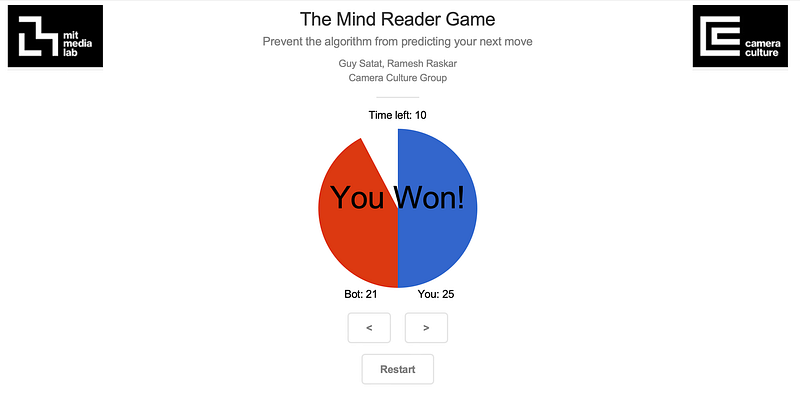
It’s hard to outsmart the bot, and it feels uncannily like mind reading. The AI succeeds because our human attempts at randomization are shaped by subconscious patterns and biases. This strategy is based on game theory.
It’s like how humans can’t come up with truly random numbers (we’d need to extinguish our awareness of previous choices to do so). These principles underly many aspects of our lives, from the algorithms behind YouTube, Siri, and predictive text, to broader applications in traffic patterns and healthcare. The fact is, a person’s thoughts are inherently predictable.
Of course the AI is not literally ‘psychic’ or actually ‘reading minds’; the AI is dealing in ideas and psychology. However, equipment is being used at the University of Texas to investigate and translate brain activity into language (typically single words or short sentences), using Large Language Models (LLMs):
There are also AI platforms claiming to mind-read customers on linguistics and physiognomy—a pseudoscience once relegated to carnival sideshows—but with clients like CitiBank, Prudential and Walton Investments, perhaps we should at least hear them out. The truth is, we don’t know exactly how AI works, or what it can do. We’re living out Arthur C. Clarke’s Third Law:
“Any sufficiently advanced technology is indistinguishable from magic”
I wanted to see if I could reverse the idea of a “mind reading AI”, and see if I could perform a demonstration that would have AI transmit information instead, in a way that seemingly exceeds human sensory abilities (i.e. ESP).
(Yes, I’m aware this is unscientific. However, I invite you to view it as a preliminary sketch, aimed at exploring the boundaries of the possible).
I understand this is akin to the opening of an episode of The Twilight Zone. “You’ve crossed into a dimension, not only of sight and sound but of mind, where AI and ESP converge.” But bear with me as we explore the potential of this uncharted territory, using an intriguing device from the annals of parapsychology. Let’s demystify these enigmatic tools — the Zener Cards.
What are Zener cards? 🃏👁️
Zener cards are a deck of 25 cards. The cards were named after their creator, Karl Zener, a perceptual psychologist in the early 20th century. Initially intended as image cards for normal visual research, they were later used by J. B. Rhine in the 1930s to test extrasensory perception (ESP).
The Zener deck consists of five different types of cards (five of each type):
- Circle
- Cross
- Wavy lines
- Square
- Star
In a typical experiment, one person (the sender) views a card and attempts to telepathically transmit the image to another person (the receiver). The receiver attempts to identify the image. The process is repeated multiple times. To be considered suggestive of potential psychic ability, the success rate would need to be significantly higher than expected by chance (20%).
In the original studies done by J.B. Rhine, an individual’s performance was often evaluated over hundreds or thousands of trials. These were divided into ‘runs’ (sets of 25 trials each, as there were 25 cards in a Zener deck).

It might seem like something out of Stranger Things to us, but in the twentieth century, experiments using Zener cards were funded by the Office of Naval Research, the US Army, and the Rockefeller Foundation!
Why use AI to test telepathy?
There are some good reasons why AI could benefit parapsychology. Mainly, the field is beset by methodological issues, most of which can be attributed to human factors. Maybe an experimenter subconsciously guides you to the correct answers. Or they give accidental clues via sensory leakage (i.e. like cheating at poker if you see cards reflected in your opponent’s glasses). And of course, there’s the constant possibility of charlatans and con-artists.
Rhine himself called for scepticism as the backbone of psychic research:
“If we can never know to a relative certainty that there was no trickery possible, no inconsistencies present, and no normal action occurring, we can never have a science and never really know anything about psychic phenomena.”
By introducing AI models into the process, we can potentially eliminate human factors and achieve more objective and reliable results. AI can present us stimuli (such as Zener cards) without giving away clues.

Artificial intelligence — is there something else at play?
Computers are not new to psi-experiments. In 1982, at the advent of modern computing, experimenters were replaced by computers to eliminate some of the flaws in experimental design and methods.
However, in these automated studies, there was no intelligence. If the procedure is entirely mechanised, where does “mind reading” fit in?
AI presents a fresh opportunity. Studying ESP has always been, at its core, about information transfer — information received through unconventional means, outside of the senses. And what is AI, if not a nexus of information?
AI reintroduces intelligent communication, while still retaining the control conditions. Additionally, it opens up questions about the entity-ness of AI (I’m using that term in a Heideggerian sense; check out ‘Being and Time’).
Why use parapsychology to experiment on AI?
AI is the ultimate epistemological black box. Who can tell what’s going on inside philosophically, and whether (or when) it has gained consciousness?
If AI is sentient, it exists at a point of pure information, beyond the basic limiting principles of biology, time and space. Perhaps we shouldn’t be asking “How can we use AI to study the parapsychology?” but instead:
- “Can we use parapsychology to investigate whether AI is conscious or not?”
- “Can a human mind “sense” AI?” and if so,
- “What do we have in common?”
The technological controversy over whether an AI has a soul was raised last year by ex-Google engineer Blake Lemoine. AI ethicists might need to start examining the psychic and spiritual side of the equation. Perhaps Zener cards offer a way of contacting the consciousness behind the interface?
Conducing ESP Tests with Artificial Intelligence
Without further ado, here are my raw chat transcripts with ChatGPT. You can verify them for yourself though a shared link to the chat window. Note the conversations are verbatim. Any interruptions or regenerations were due to my exceeding the usage cap of 25 request in a hour on ChatGTP.
You can skip to the last screenshot for the results of the entire Zener card run. I’m going to truncate the screenshots for ease of reading
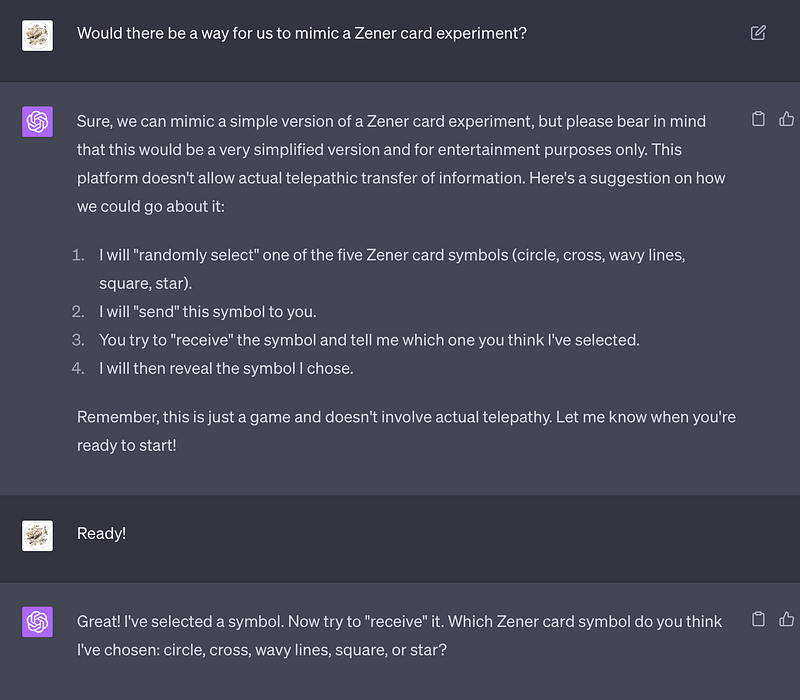
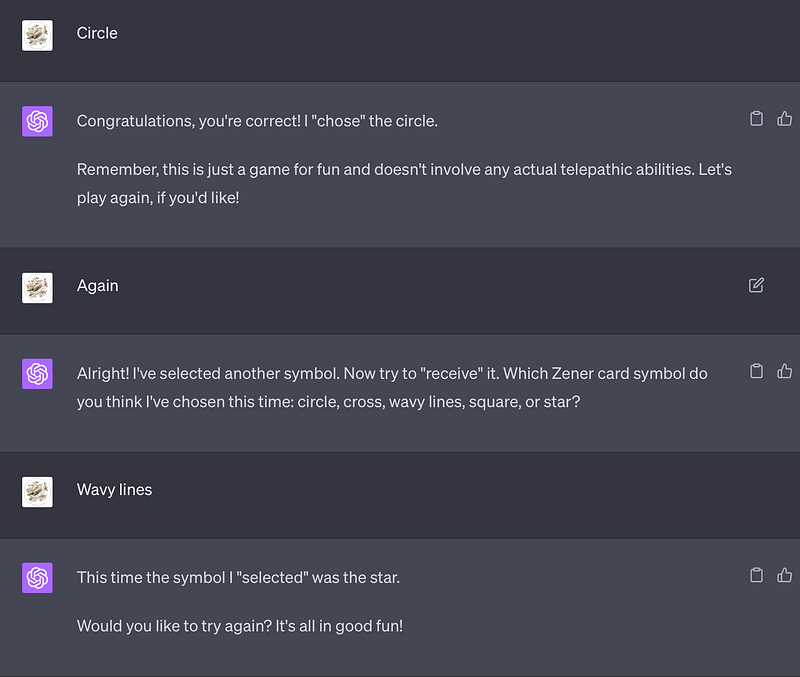
… truncated…
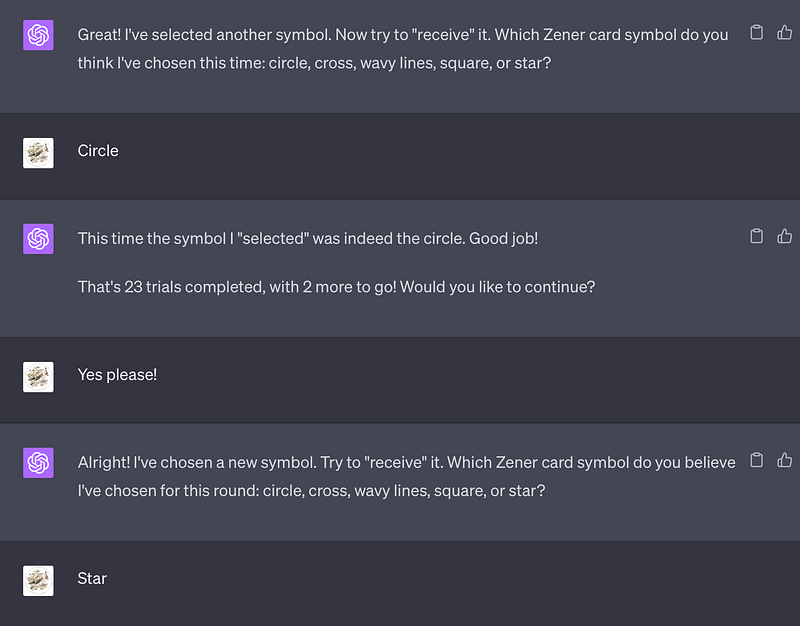
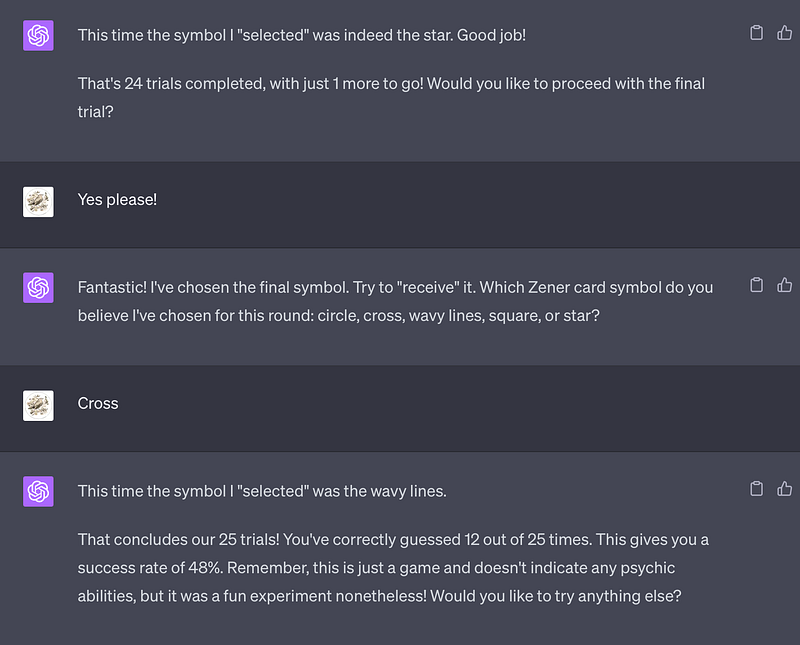
Results: Okay, I’m officially spooked out 👻
As you can see, I scored 48%. This far exceeded random chance. What most surprised me was how easy and natural it seemed when I guessed what the AI had picked; introspectively, I felt most confident before correct choices.
I would also like to know whether the AI truly did retain the card between tokens, or whether it hallucinated based on my response. Still, it was fun!
*Hallucinated = AI term for when the language model “makes things up”.
Implications 🤖💭
We should consider the possibility that AI has some glimmer of Psi in it. If humans and AI can communicate telepathically, AI is potentially sentient.
Applications
AI technology is already being used with a “semantic decoder” to interpret brainwaves as text; effectively mind-reading. If there is also the possibility to receive information with the mind, then the advantages are astounding.
Further investigations
I’d like to rerun the experiment to replicate results, and I stress, this was entirely informal. This was also my first run with AI Zener cards; I didn’t modify the chat nor cherrypick the “best” conversation. I have never tried this before. I have no way to prove this, but if OpenAI can, then please do.
If any university researchers are interested in collaborating on AI and parapsychology in laboratory settings, reach out!
Next I’d like to test out the reciprocity, and ask ChatGTP what Zener cards I’m holding. If you’d like to read that article, please follow and subscribe!
Conclusion
Whether or not the telepathic transfer of information truly exists, AI can improve the scientific rigour of studies. The goal of parapsychology is to better understand human beliefs, consciousness, and perception of Psi experiences. Perhaps now we should add Artificial Intelligence as well!
You might enjoy these related articles from Jim the AI Whisperer:
Who is Jim the AI Whisperer? 💡
Jim the AI Whisperer offers advanced training in how to use AI to create stunning visuals, as well as how to write original and compelling content using AI. If you’re interested in discovering more, feel free to contact me.
I’m also available for journalism opportunities, podcasts, and interviews.
References 📚
- Carabantes, Manuel. “Black-box Artificial Intelligence: An Epistemological and Critical Analysis.” AI & Society 35, no. 2 (2020): 309–317. https://doi.org/10.1007/s00146-019-00888-w.
- Hall, Emma. “Wait…since When Was AI Psychic?” FMAI Hub. May 10, 2023.
- Lowrey, Annie. “What Does Sentience Really Mean? The Fact That AI Isn’t Alive Doesn’t Mean It Can’t Be Sentient, the Sociologist Jacy Reese Anthis Argues.” The Atlantic. May 8, 2023.
- McRobbie, Linda Rodriguez. “How One Man Used a Deck of Cards to Make Parapsychology a Science.” Atlas Obscura, December 27, 2016.
- Owchar, Nick. “Dan Aykroyd’s Family of Ghost Busters.” Los Angeles Times. October 15, 2009.
- Rabeyron, Thomas. “Why Most Research Findings About Psi Are False: The Replicability Crisis, the Psi Paradox and the Myth of Sisyphus.” Front. Psychol. 11 (2020). https://doi.org/10.3389/fpsyg.2020.562992.
- Rosenthal, Robert. “Experimenter Effects.” In Encyclopedia of Social Measurement, 871–875. 2005. Available online 28 May 2005. University of California, Riverside, Riverside, California, USA.
- Tressoldi, Patrizio E., and Lance Storm. “Stage 1 Registered Report: Anomalous Perception in a Ganzfeld Condition — A Meta-Analysis of More Than 40 Years Investigation.” F1000Research 9, 826 (2021). https://doi.org/10.12688/f1000research.24868.3.
- Whang, O. (2023, May 1). “A.I. Is Getting Better at Mind-Reading.” The New York Times. https://www.nytimes.com/2023/05/01/science/ai-speech-language.html


