
Is My Love Toxic?
On motherhood, mental illness, and boundaries vs. walls

I do not deny that my adult son mistreats me sometimes. I’m not confused about that. It’s clear. What’s less clear is how to respond to it. Of course, if he goes too far, I should walk away — if I can. How do you do that when he’s in the passenger seat of your car and won’t get out? But how do I determine when he’s gone too far, exactly? The line is ambiguous. And for how long should I stay away? He’s a grown man with a major mental illness — disabled. He needs assistance. I’m his mother. Shouldn’t I provide it to him?
Currently, we’re in some kind of stand-off
He’s blocked me so I can’t text or call him. Or my texts and calls drop into a void. He’s told his case workers not to talk to me, on pain of lawsuit. As an adult, he has privacy rights. He’s mad at me because I declined to buy him a $250 backpack and to pay for him to move to a hotel. He wants to do that because his landlord asked him to move out of his apartment by the end of April. But when my son, let’s call him Chance, made his requests, it was the middle of March.
To be honest, I considered granting them. I always do. I dislike saying no to Chance, partly because his life seems so f*cked to me from the outside, that I want to do anything I can to make it better. And partly because I don’t like it when he’s mad at me. But this time, I consulted with his father, who thought those were terrible ideas. “Why would you buy him an expensive backpack when he just lost the expensive ipad you bought him?” Mark asked.
I had to admit he had a point.
“And if you pay for him to move to a hotel, he’ll never find a new apartment and he’ll lose his housing subsidy.”
Also sensible.
I don’t know what happens to me when it comes to Chance
I guess I am, like Mark asserts, enabling him. We have a co-dependent relationship that has connections to my childhood — hot pink filaments snaking through history and time — when I grew up with a father who also had a major mental illness. Some of the ways I treat my son have to do with my feelings about my dead dad.
But I do the best I can. I try to make good decisions. I carefully consider each thing that Chance asks for and whether I can and should provide it.
His dad, for all his show of rationality, doesn’t love making Chance mad, either. “You didn’t blame me, did you?” he asked after I told Chance I wouldn’t buy him the backpack or pay for the hotel.
“Yup. Sure did.”
Chance responded like a three-year-old child, by throwing a tantrum: trashing his apartment, eating junk food, and texting that he hates his life and lives in hell. He’s 37. He knows that saying “I hate my life,” will trigger fears of suicide in me. But his dad and I both think Chance wouldn’t do that to himself. We’ve discussed it.
“He’s playing you like a violin. He’s been doing that his whole life.”
An unambiguous line
The last time I saw Chance in person, his behavior was unacceptable. Perhaps he didn’t take his meds. Perhaps he took some other drugs. All I know for certain is he wasn’t acting right. He sat in my car and screamed at me about how his physical pain is real, lifting his shirt up to rub ointment angrily on his back and neck, making sudden movements toward me in the driver’s seat, waving his white plastic bag in the air by my head, and refusing to get out of the car. I sat there and took it. I didn’t know what else to do.
The lineman working across the street looked over at us with his brow furrowed, wondering if he should intervene. He turned away when Chance yelled, “You are a horrible mother!” Mothers are durable, the lineman must have figured. “Get out of the f*cking car!” I shouted back at my son. When he finally exited the vehicle, I sped off down the street.
Being reasonably unreasonable
Chance has called me twice since then, on other people’s phones. Since he blocked me, he must figure that I’ve blocked him, too. Or maybe phones are reciprocal that way. I have no idea. Both times, he spoke in a calm, reasonable way. But what he said wasn’t reasonable.
On the first phone call, he said he was in the office of a “mediator” talking about his daughter. “What are you trying to mediate about your daughter?” I asked. He said he wanted her to go to AA meetings with him. She’s in third grade and lives 100 miles away. I told him she was being well taken care of by her grandparents, and that I wasn’t going to participate in any mediation that would interfere with them.
On the second phone call, he asked me to file a complaint against an employee of his last service provider, and he told me how to go about doing that. There was a particular woman at CVS — a former student of mine — who would help me. He wanted me to ask Janet how to file a complaint against Chris for withholding his meds. I said I would think about it.
In truth, I do have a complaint about Chris, but it’s not because he withheld any meds, and I won’t find out how to file it by calling CVS. His company’s unethical mistreatment of my son destabilized him in a way that he hasn’t recovered from since, costing him money and time in addition to his mental health. But my guess is trying to sue them or otherwise hold them to account would only traumatize him further, so I’m letting it drop.
Despite the content of the calls being unreasonable, I was glad his mood sounded calm and good, at least for those two calls. But once he hung up, I was cut off from him again.
Not being able to talk to Chance or his service providers has opened up a huge lacuna in my life. There are whole days on my calendar where nothing is written in. I want to relax into that, and accept that — consider pursuing some interests of my own — but I can’t help but feel anxious about the lack of contact.

I know Chance is in a bad state
The combination of previous traumas plus the “soft” eviction of his current landlord asking him to leave have combined to throw him into a doom loop that he can’t seem to crawl out of.
He’s been taken to Psych Emergency Services by police THREE TIMES recently, but they just give him a shot and put him back on the street within hours, which isn’t helping. What he needs is a place he can retreat to for a month — or even three — where he’ll get regular meds along with kind treatment; three healthy meals a day; and a good, clean bed.
But that’s a fantasy.
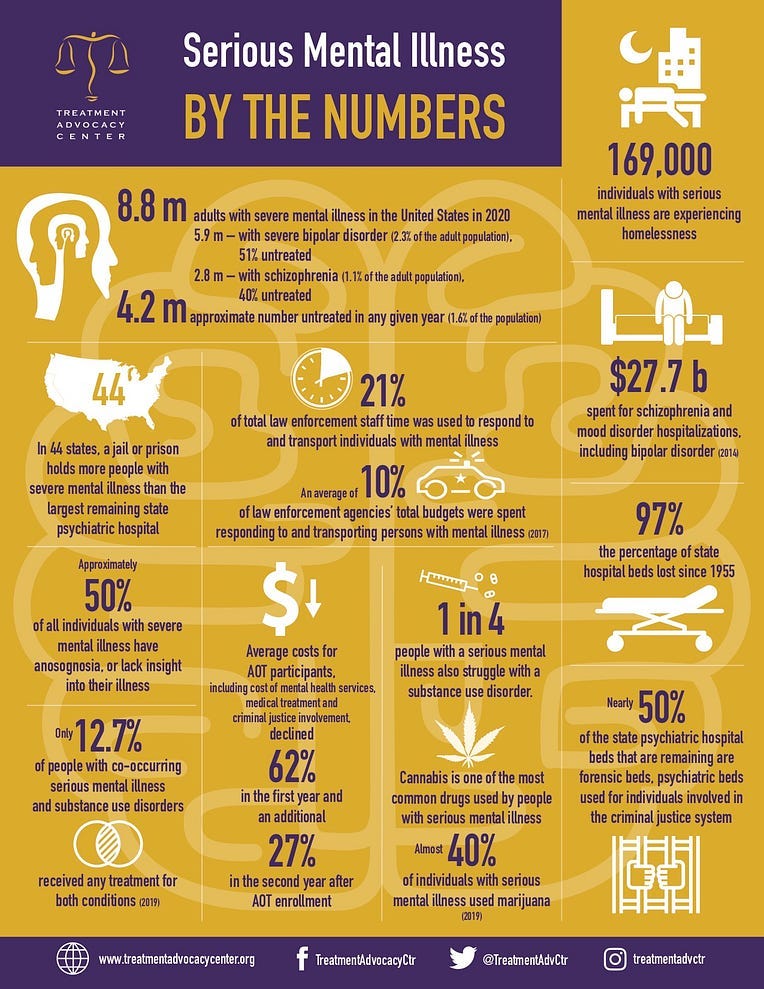
There are only two options for people with a major mental illness in America: locked psychiatric wards — which could fill the bill, but they’re full — or jail.
When help is harm
Mark imagines that most of my efforts to help our son are actually harming him — that my unconditional mother’s love is toxic to him. “We should just let him crash and burn on his own,” Mark says. “Otherwise he’ll never learn.”
But is Chance even capable of “learning?”
The problem is, Mark’s a little bit right, and a little bit wrong. Feels familiar. Every single situation — every request for help — needs to be evaluated on its own merits. There is no one solution that applies to all situations. So I try to do that each time: make a good evaluation. Sometimes I do it right, and actually help our son. Sometimes I do it wrong, and end up “enabling.”
Yet both Mark and Chance can occasionally be heard claiming that the ALL the things I do for him are infantalizing, disabling, and wrong. What’s a (durable) mother to do?
Grow a thicker skin and carry on.
I’m not trying to be a martyr here. I’m not looking for sainthood. And I don’t want to be over involved in my adult son’s life. But I don’t want to abandon him, either. I want to provide just the right amount of love and assistance.
One thing that makes that difficult is “anosognosia,” which means lack of insight — people with a major mental illness don’t know they are ill. And when a number of traumatic events happened to Chance in rapid succession recently, he blamed me for EVERY ONE of them, accusing me of calling the cops on him, and the hospital, and the landlord, too. But the truth is, I didn’t call any of those people or institutions.
So now I’m wondering, if I’m “blocked” from his life, and we are not in contact — if he has no access to my “toxic” mother’s love — will he finally recognize that the things that happen to him are the direct consequence of the choices he’s making? Will he learn something? And will that inspire him to to choose differently next time?
Probably not.
But maybe?
But probably not…
Besides writing stories about movies, books, mental illness, and politics on Medium, I edit the feminist publication Fourth Wave and I’ve published two novels here: Thirsty Work and Count All This. Check them out! Get an email whenever I publish. And if you’re a writer with a passion for social justice, submit to Fourth Wave.


