
Is Life Easy and Pleasant to Engage in Without Picnics?
Nature prompt: Pleasant picnicking
As a small child, whenever I heard the nursery rhyme Teddy Bears Picnic, I’d sing along and imagine being there in the woods with the bears.
I’d conjure up the image of me as Christopher Robin (I was a tomboy) tagging along with Winnie the Pooh, his best friend Piglet, and all the other characters in the stories. Except for Owl, as I thought he’d find it childish.
My dad was a big fan of Bing Crosby, so it’s probable I heard his version in the 50's.
Isn’t it amazing? As children, we never judged or begrudged what wasn’t available to us.
We allowed our imagination to take us where anything was possible. If only we could recapture our childhood vision; innocent, our eyes shining with joy at moments lived only in our imaginations.
As we grow older, our vision blurs and we see only what we don’t have instead of applying our short-sightedness to inspecting the blessings that surround us.
I say this because I never went on a picnic as a little girl — only gave it a whirl as a grown-up. And I never owned a teddy bear until my husband bought me one after my hysterectomy. I now own four bears which sleep on our bed during the day, including Pooh Bear!
Picnics aren’t a big thing in South Africa. Folks prefer to gather at a braai (barbecue) at home or when out camping or fishing.
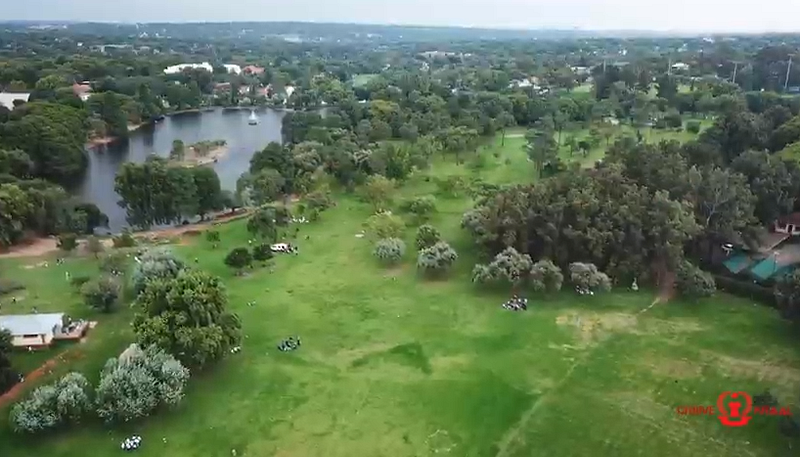
However, there’s a special space in northern Johannesburg called Zoo Lake Park, where I cut my adult teeth on picnics. A unique venue because despite apartheid, all races could visit, play, picnic and row on the man-made lake without fear of being arrested under the Group Areas Act which regulated which races were allowed where.
This venue was the only place in South Africa where all races could mix socially. An extreme contrast to our everyday lives where we only saw other races on the street or at our workplaces in low-paid positions like a tea lady or cleaner.
A brief history
Herman Eckstein, a banker and mining magnate, bought the land for potential mineral exploration. With no success, he laid out the land as a timber plantation — a project which began in 1891.
He named it Sachsenwald after Otto von Bismarck’s estate in Germany. Around 3-million trees were planted. The forest became a popular recreational spot for the wealthy Randlords and their families.
In 1904, ten years after Eckstein’s death, his partners in the mining company donated 200 acres of freehold land to the Johannesburg City Council through a Deed of Gift, to build the Johannesburg Zoo and the Herman Eckstein Park, the formal name for Zoo Lake Park. It was “to be used for the purpose of a public park”.
Another condition was the park be open to all races, creeds and cultures. The apartheid government was later unable to restrict access to the park!
Twenty acres of the land was for use by the Imperial Light Horse Regiment, now the site of the War Museum, which I have visited, and the Rand Regiments Memorial.
The balance of the Sachsenwald land developed into today’s suburbs of Saxonwold to the east and Forest Town to the south.
Most of the park was a wet land and in 1908, the city council added an artificial lake. A forest of blue gum trees was planted to soak up the water that runs close to the surface on the eastern boundary.
The council built the Coronation Fountain, a musical fountain and Johannesburg heritage symbol, to commemorate the coronation of King George VI and Queen Elizabeth.
Yes, all very colonial, but we can’t deny history.
A historic occasion at Zoo Lake
When Johannesburg celebrated its 70th birthday in 1956, a fascinating event took place which will always be remembered by those who were there.
Dame Margot Fonteyn was booked to perform Swan Lake at His Majesty’s theatre in central Johannesburg. Tickets for all five shows were sold out, with a waiting list of thousands. The promoters wrote her a letter begging she come earlier or stay longer. She offered one extra performance.
“An inspirational idea was conceived: build a stage on the Zoo Lake, the perfect setting for Swan lake, and erect a grandstand that could accommodate at least 6 000 people.” — David Gurney.
Tickets sold in a matter of hours. She performed on the evening of 20 October, 1956, the day after Full Moon. The scene was bathed in moonlight, with swans drifting across the lake in the background.
As the audience waited, the heavens opened up in a typical Jo’burg cloudburst which lasted half an hour. Nobody moved.
After workers had dried the stage and the dancers had inspected it, the performance began.
After ten curtain calls by the rapturous crowd when the ballet ended, Margot Fonteyn, aware that many of the audience were school kids, said,
“They’re so wonderful — and so wet. Let’s do it again.”
And they did.
My visits to Zoo Lake
I enjoyed several picnics with my flatmate and our respective boy friends at the time in 1967.
My first husband and I attended a hippie wedding there in 1968. It was glorious fun. So much laughter and flowers made it a happy day for all, including the public.
My current husband and I used to visit, (don’t fret, it’s only my second marriage) just to relax, stroll around the lake, and enjoy the natural surroundings away from the hubbub of the city.
We’d sometimes hire a boat and row on the lake, or treat ourselves to scones at the tea room. And always take bread to feed the ducks!
If we ever return to Jo’burg, I’d love to visit again, but only if my husband has a mobile scooter as he can only walk short distances with his walker. If it never happens, it’s okay; we can use our imaginations to relive those moments.
The Jazz on the Lake concert, now in its 27th year, happens every spring. My husband and I attended one of the concerts, but I cannot recall which year — probably the late 90's — we took a blanket and picnic basket and enjoyed the music, sunshine and company of strangers.
I have fond memories of Zoo Lake. A sea of diverse cultures engaged in having a relaxing day picnicking, napping under the trees, walking their dogs, feeding the ducks or hiring a rowing boat for an hour on the water, figuring how to use the oars.
I’ve gone a little off script for this prompt on pleasant picnicking because I can count the number of picnics I’ve attended on one hand.
Despite that, my story evolved into a long essay infused with history and a dash of picnics to enhance the flavor.
It remains for me to share these relevant quotes with dollops of wisdom:
“If life on Planet Earth was really supposed to be a picnic, we would all have been born clutching gingham tablecloths.” — Jonathan Cainer
“If you’re going to enjoy the picnic that life really is, you’d better learn to like yourself, not despite your flaws and so-called deficits, but because of them.” — Paul Orfalea
“One compensation of old age is that it excuses you from picnics.” — William Feather
Thank you for being here.
I’m off to put my bears to bed early — they snuck off to a picnic while I was writing and are exhausted.
My thanks to Sahil Patel for publishing my late response to this first week prompt of September:
These stories delighted me with their close-up images of birds in their respective gardens.


