
Is it Time to Rethink how we do Democracy?
We may have to ask the unthinkable for the greater good of all.
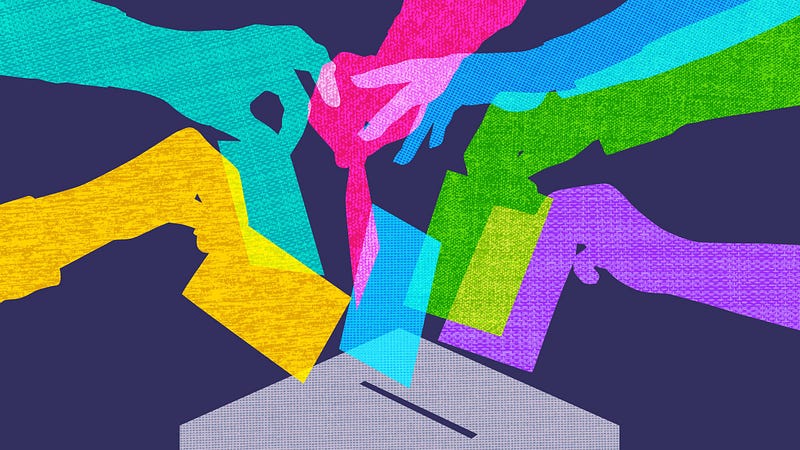
In the current era of political distrust and ideological extremism, perhaps the only element of modern western politics we can largely agree upon is its democratic structure.
Or can we?
While democracy is revered as the only political system which gives value to the opinions and rights of all individuals, in a society plagued by disinformation and manipulation, we are forced to question whether it is really the fairest and most robust system to let everyone over a certain age to vote — no matter their level of knowledge or exposure to potentially misleading political campaigns…
It may be an unfortunate truth, but democracy in the modern age has flaws. Although it may be unclear how to improve the democracies we have, we still need to talk about their limitations and potential dangers — and, if at all possible, improve the way that we do things.
Maybe — though it hurts to admit it — that means tightening up on voting rights.
(Hear me out!)
Democracy’s Flaws
Western democracy has sustained several — what many of us would deem- blows in the last few years. The infamous Brexit referendum of 2016 and Trump’s US election victory that same year have led to a collective reflection on both sides of the Atlantic about how democracy works, and how it can be maintained when corrupt campaigning practices threaten to blur the lines and make us question whether a vote is really democratic at all.
This crude awakening is forcing even the most progressive among us to question the uncontainable fluidity which modern democracy imposes on the political climate. However, reassessing a structure long-deemed the one-and-only perfect system is as open-minded as it is potentially regressive — and is putting society’s hard-earned freedom of speech at risk.
A ‘tectonic shift in Western politics’ ?
British political scientists Milbank and Pabst proposed in 2016 following Brexit and Trump’s election win that the modern surge in populism represents ‘a tectonic shift in Western politics.’ They proposed that democracy — or at least the way in which it is carried out today — is ‘fundamentally flawed.’
Political correspondent for BBC News, Ben Wright, agreed at the time that:
‘With one referendum and a presidential election, liberal democracy as we’ve known it seems finally, dramatically, to have collapsed in on itself.’
A Voting License?
The key question I’d like to ask is should reaching adulthood alone merit the privilege of having your opinion shape decisions that affect the masses?
As elitist as this proposition may seem in this day and age, there may be some weight to the argument that a certain level of education or pre-testing is imposed before granting a citizen the right to vote.
Does this mean an obligatory grade average or formal education level? No. But a test one needs to study for and pass — to, at the very least, ensure a basic understanding of the policies in question — before a license is issued? Possibly.
Not only could this impose myriad benefits by encouraging a baseline political awareness and understanding of the issue at hand (which could have been the Brexit referendum’s saving grace), but it would also deter blind support for populist manipulation and misleading, empty promises, exploiting the public’s insecurities.
But since the right to vote holds such gravitas within modern culture (and rightly so) — any restriction other than age is hugely stigmatized in modern society. Now that gender and racial barriers have been lifted after a long and arduous struggle, it could be viewed as social regression to impose such regulations.
However, as with other rights that affect the wellbeing of others — such as to drive a vehicle or qualify for a certain profession — perhaps being eligible to vote should be regarded with a similar license-based approach in order to ensure public protection. Although limitations to democracy should undoubtedly be considered with caution, it has to be said that this proposition is a far cry from excluding based on race, gender or social class.
But this contentious attitude that the right to vote should be earned rather than freely given upon coming of age is nothing new. American author, Isaac Asimov, proposed back in 1980 that as a society, we’re fooled by the false notion that ‘my ignorance is just as good as your knowledge.’ Indeed, we currently rank at an equal value the vote of the political scientist, and that of the everyman who made a snap decision based on a persuasive political ad on TV.
And of course, the first recorded to voice this issue came thousands of years before from Ancient Greek thinker Socrates — who notoriously defined voting in an election as a skill which needs to be taught, rather than a right to be received.
But should education matter when it comes to the right to vote — or is being an adult member of the society qualification enough? Could this be the slippery slope that pushes the lower classes even further out of the discussion?
Democracy’s Downfall
Every generation is fooled by the myopic mindset that they already have all the answers. However, history has taught us that there is always further progress to be made. In order to evolve, we must look at our current system with a critical eye, never closed to potential improvement. Absolute perfection may be impracticable, but this shouldn’t deter present and future civilizations from at least striving for it.
Although the dominant belief is that the current democratic system is the only viable option, possible alternatives or adaptations should — at the very least — be explored.
Democracy as a political system is unique in that in its nature, it actually welcomes critique — and isn’t subject to any absolute ideology or leader. In fact, all authoritative figures are unquestionably transitory, and their status depends on public approval. Derrida described this self-imposed vulnerability as an ‘auto-immunity,’ suggesting that the very existence of democracy is an attack on itself.
This links to the phenomenon we see increasingly today — in which restrictive, populist ideologies are gaining momentum thanks to the democratic systems in place. This is a prime example of how such movements are paradoxically threatening the very freedoms which gave them a platform…
But could this ultimately lead to democracy’s demise?
Democracy: The Bottom Line
Despite democracy’s imperfections and troubles both throughout history and in recent times, such episodes of volatility are an unavoidable part of the system. The freedom provided by a democratic society means that backlash is inevitable, since, by its malleable nature, democracy is perpetually vulnerable to attack.
That being said, democracy isn’t necessarily doomed to fail, but rather a degree of fluidity and vulnerability constitutes the very essence of the political system. A liberal democracy may not be as strong and self-assured as more rigid regimes that we see in some states around the world, but is this alleged weakness not also democracy’s main strength?
Overall, despite the drawbacks of democracy — only intensified in the digital age — it seems no preferable alternative system has yet been developed. As such, in spite of the inevitable challenges calling for adaptations to the current voting protocol — such as the introduction of a voting license — when it comes to the foundations of the democratic system, as it stands, we’re stuck with what we have.
Roxanna is a British-Iranian content writer specialised in human rights, health, and welfare. With a languages degree from King’s College London, a Masters in European Studies from LSE, and an EU communications background, she strives to increase the visibility and encourage debate around ethical and sociocultural issues around the world. http://roxannaazimy.com @roxannayasmin


