
Physics
Is information matter (#24)

This article provides some background about Constructor Theory to help explain the findings in the next article on ‘Does Dark Matter Exist?’ One of the main researchers in Constructor Theory is David Deutsch of Oxford University. Deutsch is one of the prime theoreticians behind the development of quantum computers. In 2021, an associate of David Deutsch, Chiara Marletto, published a book ‘The Science of Can and Can’t’. This article discusses some of the ideas in this book in the context of the next article on ‘dark matter’.
Counterfactuals
The main thrust of ‘The Science of Can and Can’t’ involves developing the idea of counterfactuals as the basis for understanding the laws of physics. An example of a counterfactual could be a light on the side of a road that shines red when a car has to stop. If the light is not shining, the car can pass. A physics description of the light would describe something that has a light but would not attach any meaning to that light. The counterfactual approach describes a light that can be on or off; a more complete physics description of the light being on would also need to include a description of the possibility of the light being off.
This counterfactual approach to formulating laws of physics requires identifying the properties of information. Without going into the proof of the following propositions, Marletto identified five properties for a medium to be able to instantiate information.
Flip
A medium must be able to be in at least two different states such as On and Off or 0 and 1.
Copying
On a foggy night, from a distance, it may not be possible to see whether a light is on or off. In such a case, another light could be located further up the road. A medium must be able to copy information in a different medium, called interoperability.
Things that can be copied can also be measured and vice-versa.
Impossibility
For quantum information (qubits), there must be at least two information variables that cannot be copied simultaneously to an arbitrarily high level of accuracy.
When qubits are entangled, extracting information globally is possible but impossible locally.
Quantum information increases the range of possible behaviours to be carried by a medium.
Catalyst
A catalyst enables the information to change without changing itself. For example, a law of physics could be a catalyst. The law doesn’t change even when an object that is subject to the law changes.
A catalyst must include an abstract catalyst which could be called knowledge. This knowledge could be information capable of self-preservation e.g. DNA code.
Reversible: Second law of Thermodynamics
It must be possible to reverse all the transformations. A distinction is made between different types of transformations. A transformation that is the equivalent of turning a switch on or off is reversible. A transformation that emits heat is not reversible.
Implications for galaxies
As discussed in these articles, Professor Susskind has identified two equations that describe increasing complexity inside a black hole. The first equation was discussed in Article 21 - Is there a rational explanation for dark energy. The second equation, Kolmogorov Complexity, relates to deriving Newton’s inverse square law and understanding the rotation curves of stars in a galaxy.
One of the conclusions of the next article is that Newton’s Law needs to be modified to take into account information about the history of the movement of a star in a galaxy. This current article describes how that information is instantiated into what happens inside galaxies.
Based on Marletto’s discussion of the properties needed for a medium to instantiate information, stars would not be a suitable medium. The creation of a star involves transformations generating heat. The process is not reversible. Some types of interstellar gas, however, appear to meet the criteria to be a medium for instantiating information.
Most galaxies include hydrogen gas. A hydrogen atom consists of a proton and an electron bound together. The mass of hydrogen gas is included in calculations to determine the velocities of stars in their galaxies. Hydrogen atoms are ionized when the electron is stripped from the proton. Close to the centre of the galaxy, hydrogen gas is hot, up to 10,000 ᵒK, and ionized. Ionized gas is not a suitable medium for instantiating information. A detached proton, however, can capture a free electron and become neutral hydrogen once more. Most of the volume of the interstellar medium has a temperature much less than 10,000 ᵒK and is filled with neutral (nonionized) hydrogen.
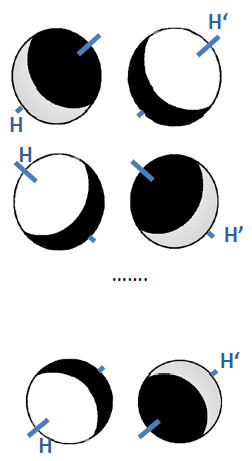

Both a proton and an electron act as if they were spinning like tops, and the spin axes of the two tops can either be pointed in the same direction (aligned) or in opposite directions (anti-aligned). When the proton and electron are spinning in opposite directions, the atom as a whole has very slightly lower energy than when the two spins are aligned. When an atom in the lower-energy state (spins opposed) acquires a small amount of energy, then the spins of the proton and electron are aligned, leaving the atom in a slightly excited state. When the atom loses that same amount of energy, it returns to its ground state.
Neutral hydrogen atoms can acquire small amounts of energy through collisions with other hydrogen atoms or with free electrons. Such collisions are extremely rare in the sparse gases of interstellar space. An individual atom may wait centuries before such an encounter aligns the spins of its proton and electron. If there were no collisions, an excited hydrogen atom would wait an average of about 10 million years before emitting a photon and returning to its state of lowest energy. The amount of energy involved corresponds to a wave with a wavelength of 21 centimetres. Spin is a quantum-mechanical property, akin to the angular momentum of a classical sphere rotating on its axis, except it comes in discrete units of integer or half-integer multiples of ħ which is the modified Planck constant.
Interstellar hydrogen gas meets the criteria for being a medium for carrying information:
- Atoms can flip from gaining or losing an electron;
- Hydrogen atoms can gain or lose electrons and thus be copies of other atoms in the gas;
- An individual spin state cannot be accurately measured but combinations can be measured;
- Individual atoms can transform their state based on laws of physics;
- Transformations of the spin states of individual atoms are reversible and do not change the total energy of the gas.
Spin and Torsion
Jakob Schwichtenberg in Chapter 5 of his book ‘Physics from Finance’ discusses how the spin of a particle can be described in an internal space called isospin space. He also discusses the association between the charge (energy-momentum) of a particle and gravitational interactions. In general, using Noether’s theorem, for each symmetry of a space there is a conserved quantity which is a quantity that does not change in time. The conserved charge following from symmetry in isospin space is called isospin.
In Minkowski space, the conserved charge following from the rotational symmetry of that space is called angular momentum. This conserved charge consists of orbital angular momentum and spin. This spin can be interpreted as some kind of internal angular momentum.
Schwichtenberg shows that particles carrying isospin change the structure of isospin space. He argues that the presence of spin at some location affects the geometry of the arena of physics. One possibility is that spin leads to torsion of spacetime while energy-momentum causes curvature. Einstein’s general relativity assumes the torsion of spacetime is zero. Einstein-Carton gravity includes torsion and spin.
A non-zero torsion of spacetime has never been measured but this could be because the effect of spin on the geometry of spacetime is too small to be measured with present-day technology.
Mass of information
The mass of a hydrogen atom is 1.67 * 10^–24 grams. Dr. Martin Vopson argues the current value for the mass of an individual bit of information is 2.9 * 10^–40 kg. Consequently, the mass of an individual bit of information is around 16 orders of magnitude smaller than the mass of one hydrogen atom. The very large mass of gas in a galaxy provides astrophysicists with the opportunity to measure mass associated with information. The next two articles provide empirical evidence suggesting the mass currently associated with dark matter is in fact mass associated with information.
The question for this article is:
Is the mass associated with dark matter in fact mass of information?
To view the headings of all the articles to be published in this series please click on https://readmedium.com/orbiting-stars-and-origin-of-our-universe-338906930f51
To obtain a copy of the book ‘Orbiting Stars’ which contains the first drafts of all these articles, please visit https://www.amazon.com