avatarChristianlauer

Free AI web copilot to create summaries, insights and extended knowledge, download it at here

1571

Abstract

platform.com/2022/04/06/google-biglake-stretches-bigquery-across-all-data/">THENEXTPLATFORM</a>[1]</figcaption></figure><p id="b7b0">While most Data Warehouses, Data Lakes or the mixture thereof, a Data Lakehouse, usually has the strength within its original cloud environment, such as Amazon Redshift or Azure Synapse Analytics, or in the case of Snowflake, that it can be provided on any large cloud, Google now succeeds with BigLake to provide a platform-independent data analysis environment. Here, you can use the Data Warehouse technology BigQuery and conveniently analyze data via SQL from almost any data source and cloud.</p><div id="8b50" class="link-block"> <a href="https://readmedium.com/google-launches-new-data-lakehouse-engine-big-lake-4648d6be458e"> <div> <div> <h2>Google launches new Data Lakehouse Engine — Big Lake</h2> <div><h3>How it’s great News for all Google Cloud Platform Users</h3></div> <div><p>medium.com</p></div> </div> <div> <div style="background-image: url(https://miro.readmedium.com/v2/resize:fit:320/1*s1M8ondCwffP3uExWjLhzw.jpeg)"></div> </div> </div> </a> </div><p id="ede5">This could be very interesting for companies, because with BigQuery, many machine learning services and Data Studio, Google offers a very powerful range of data analytic tools. While previous hurdles could be barriers between the individual clouds, such as duplicate data storage whe

Options

n I had to laboriously and cost-intensively transfer and store data, for example, from AWS to Google for analysis, I can now evaluate data directly via BigQuery in Azure, AWS & Co. This could now move companies to rethink previous architectures that were decided on the basis of previously non-existent possibilities. For example, Google BigLake could now be considered as a Data Lake or Data Lakehouse, but the data could be conveniently stored where it is now and no major adjustments have to be made to the architectures.</p><figure id="ef3b"><img src="https://cdn-images-1.readmedium.com/v2/resize:fit:800/1*n2LPECODeq5GgcD2SfFh7w.png"><figcaption>Google Trends for Google BigLake — Source: Google Trends[2]</figcaption></figure><p id="e8fb">An indicator for increasing interest in Google BigLake could also be Google Trends, where the search queries have increased on average over the last few months.</p><p id="7682">In summary, it can be said that BigLake is particularly interesting for Google Cloud customers, as data from other platforms and clouds can now also be analyzed here. But BigLake could also be a door opener for Google’s analytics services for companies that previously relied on other services.</p><h2 id="670b">Sources and Further Readings</h2><p id="0d7c">[1] <a href="https://www.nextplatform.com/2022/04/06/google-biglake-stretches-bigquery-across-all-data/">THENEXTPLATFORM</a> (2022)</p><p id="97bc">[2] Google Trends, <a href="https://trends.google.com/trends/explore?q=google%20big%20lake">Google Biglake</a> (2022)</p></article></body>

Is Google BigLake the Killer of Snowflake, Redshift & Co.?

How the new Service enables Platform independent Data Analysis

Photo by Mitchell Luo on Unsplash

This year, Google had introduced BigLake, a tool for platform-independent data analysis via SQL — is it a competitor for other technologies like Snowflake, Amazon Redshift & Co.?

Since most enterprise data sources are stored in disparate data silos like different cloud storage, data platforms and so on, the first requirement for leveraging this data is a Data Lake or Data Lakehouse. With BigLake, Google introduces an engine in which all enterprise data as well as coupled data sources can be brought together. This includes Data Warehouses technologies such as Snowflake, BI tools such as Tableau and maybe most important content from the public cloud storage like AWS and Azure.
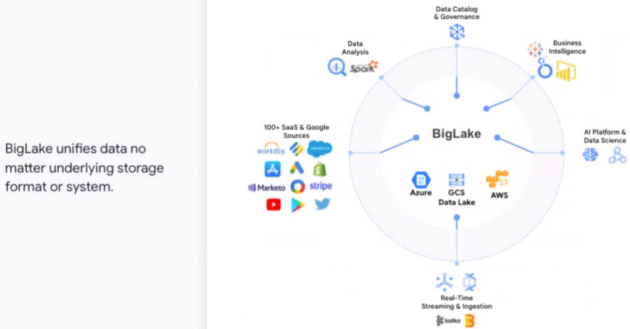
Google BigLake — Source: THENEXTPLATFORM[1]

While most Data Warehouses, Data Lakes or the mixture thereof, a Data Lakehouse, usually has the strength within its original cloud environment, such as Amazon Redshift or Azure Synapse Analytics, or in the case of Snowflake, that it can be provided on any large cloud, Google now succeeds with BigLake to provide a platform-independent data analysis environment. Here, you can use the Data Warehouse technology BigQuery and conveniently analyze data via SQL from almost any data source and cloud.

This could be very interesting for companies, because with BigQuery, many machine learning services and Data Studio, Google offers a very powerful range of data analytic tools. While previous hurdles could be barriers between the individual clouds, such as duplicate data storage when I had to laboriously and cost-intensively transfer and store data, for example, from AWS to Google for analysis, I can now evaluate data directly via BigQuery in Azure, AWS & Co. This could now move companies to rethink previous architectures that were decided on the basis of previously non-existent possibilities. For example, Google BigLake could now be considered as a Data Lake or Data Lakehouse, but the data could be conveniently stored where it is now and no major adjustments have to be made to the architectures.
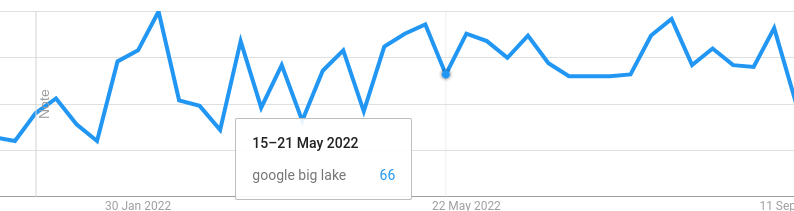
Google Trends for Google BigLake — Source: Google Trends[2]

An indicator for increasing interest in Google BigLake could also be Google Trends, where the search queries have increased on average over the last few months.

In summary, it can be said that BigLake is particularly interesting for Google Cloud customers, as data from other platforms and clouds can now also be analyzed here. But BigLake could also be a door opener for Google’s analytics services for companies that previously relied on other services.

Sources and Further Readings

[1] THENEXTPLATFORM (2022)

[2] Google Trends, Google Biglake (2022)

Data Science
Technology
Business
Google
News
Recommended from ReadMedium