
Is Free Speech a Good Thing, and Is It Really Free?
Some ugly truths about free speech in democratic countries

What is the best thing about free speech? Take a while to think about that.
What about the worst thing about free speech?
A few days ago, I published an article on medium about Elon Musk’s purchase of Twitter. In my article, I tried to analyze what we should expect from the new Twitter- Elon’s Twitter- based on his public statements and his tweets. As fate would have it, a follower commented on my post thanking me for my post — you know how Medium works. This is my article;
He ended his vote of thanks by directing me to take a look at his article about Twitter where he argued that Elon Musk will not liberate free speech on Twitter. This is his article;
His comment developed into a series of exchanges between us about the merits of free speech. I came out of that conversation with some serious questions that need addressing.
If you are reading this, chances are that you live in a relatively democratic country and for whatever reason, you know a shitload of stuff about free speech. Ironically, people in democratic countries have been inundated so much with the idea of free speech that the real meaning seems to have been lost on them. Democratic societies are built on the premise of free speech, a premise which has been enshrined in the multiple constitutions and Bills of Rights worldwide.
Article 19 of the Universal Declaration of Human Rights states that;
“Everyone has the right to freedom of opinion and expression; this right includes freedom to hold opinions without interference and to seek, receive and impart information and ideas through any media and regardless of frontiers”
Despite a seemingly ubiquitous agreement amongst the world’s democracies about the importance of free speech, inasmuch as these countries have enshrined the rights to free speech in their constitutions, they have simultaneously included in their constitutions’ inherent restrictions to free speech.
In other words, while democratic countries scream “free speech” at the top of their lungs to anyone who cares to listen, they have also written into their constitutions powerful clauses to limit the speech of their citizens. Let us consider an illustration.
The Equality and Human Rights Commission (EHRC) is the UK government’s executive body that monitors human rights and protects equality — their words, not mine. Article 10 of the EHRC’s bill protects your right to expression and to hold your opinions. But just under that, it lists several scenarios where your freedom of expression can be taken away from you or limited. Take a look for yourself.
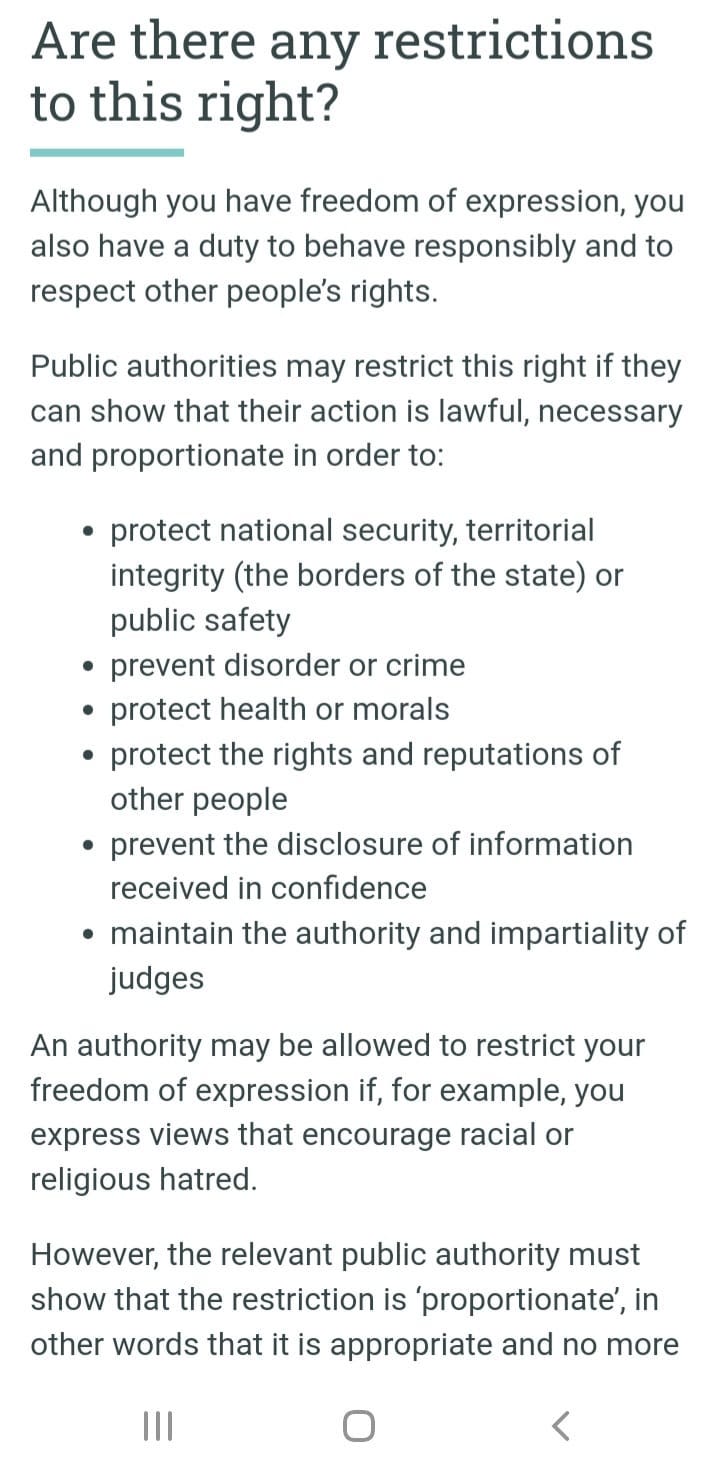
In light of the attempt by top democracies to take curtail free speech, I have to ask the obvious question. If free speech is so good and important, why limit it at all?
Different people might address this question in different ways. One popular argument in favor of restricting speech is that too much of everything is bad. The logic holds that to protect the rights of other individuals and preserve the integrity of society in the face of internal pressures and external threats, speech must be controlled.
By this logic, giving everybody 100% freedom of speech will be detrimental to national security or at least to the rights and dignity of other individuals in society.
Despite the goodwill accompanying this response and the logic of the argument, it opens a semantic can of worms. If free speech is not really free, why call it free speech?
I am reminded of a quote attributed to the Late General Idi Amin of Uganda
“There is freedom of speech, but I cannot freedom after speech”
If you think this statement only applies to dictators in the far-flung countries of Africa and Asia, then go online and utter a provocative statement. I bet that law enforcement or the local authorities will visit you the next day. In the best-case scenario, your social media account will be banned, freezing out of the online world which is the 21st-century equivalent of exile.
So I ask again if free speech is obviously not free, why call it free speech?
In an attempt to answer this question, some facts make themselves clear.
Free speech is a double-edged sword. There is speech that you like and agree with, and free speech that you don’t like and you don’t agree with. Some people might argue that when you give people total leeway to say whatever they like, you give them the freedom to call for violence or to antagonize people they dislike. The response to this is quite simple.
Firstly, that is what free speech is about. If you want and truly believe in free speech, then you must be ready to accept both sides of the coin. You cannot eat your cake and have it.
Secondly, I must categorically make clear that free speech is not a call to violence or to antagonize others. Yes, free speech is not a call to antagonize, but every statement you make — no matter how benign you think it is — is potentially antagonizing or offensive to somebody somewhere. So where do you draw the line?
Yes, free speech is not a call to violence, but we have to remember that some of the defining events of history that we celebrate today were violent. Take for example the French Revolution or the American Revolution. The role these events played in defining the concept of democracy and free speech that we champion today cannot be over-emphasized.
These events were violent, bloody, and chaotic but we commemorate them today and celebrate all the great men who played major roles in this period of history. We argue that the French and American revolutionists fought so that we can have the freedom we enjoy today, but we turn around and say free speech is not a call to violence.
Again, you can’t eat your cake and have it.
So to answer the question of why we call it free speech even though it’s not really free speech, the logical answer is that we talk big about free speech, but we don’t love free speech. What we love is an illusion of free speech, and this is the present reality even in countries supposedly democratic countries.
These countries limit free speech using vaguely defined terms like “national security” and “greater good”. But then again, nobody really loves free speech because free speech has the potential to get ugly quickly.


