
Is ASMR Just a Pretense for Freaky Sexual Fetishes?
Examining a cultural phenomenon that triggers America’s puritanical suspicion of physical pleasure
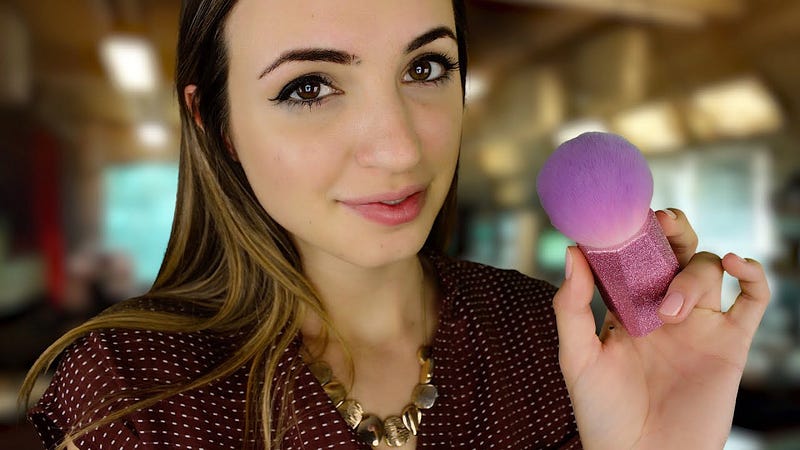
I can’t remember exactly when I got hooked on ASMR — probably three or four years ago. It’s all a blur, and the only detail that matters is that I’m addicted.
Just in case you haven’t heard of this phenomenon, ASMR stands for autonomous sensory meridian response — which, in layman’s terms means “the tingles.” You know that feeling you get when someone tickles your arm or plays with your hair, a tingling sensation that runs down your body or a pleasant shiver that starts in your upper back and radiates outward from there?
That’s ASMR.
I’ve been aware of this experience since I was a child. I always got the shivers listening to people who were whispering or who had French or Spanish accents. I shivered when I watched certain people’s mouths move while they spoke, and especially with those who voices sounded very “wet.” I shivered when I heard drops of water falling from the eaves after a rainstorm or when my mom brushed my hair.
In fact, my siblings and I even traded in shivers. As in, “I’ll let you play with my Smurfette doll for an hour if you tickle my arm while we watch He-Man.” (“Tickling one’s arm” meant we would run our fingernails up and down each other’s arms, very gently.)
Who knew that “the tingles” would one day become a major internet phenomenon, with thousands of YouTube channels dedicated to its art? (And yes, as you’ll see if you get into it, it is an art.)
When I stumbled upon it a few years ago, one night during one of the loneliest, most stressful periods of my life in which sleep had become almost impossible, I was physically and emotionally overwhelmed. I needed help to relax. I desperately needed some pleasure in my life. And suddenly, there I was finding what I needed in a YouTube video that featured someone giving another person a back massage.
Voila.
I could access this intense pleasure whenever I wanted, without needing someone to “tickle my arm.” I could go to bed and not feel quite so lonely. And, best of all, I’d found something that reliably relaxed me so intensely, I could finally sleep.
Is ASMR sexual?
My enjoyment of ASMR (whether through YouTube videos or observing and/or engaging in particular phenomena and/or behaviors) has always been one of the most intense pleasures of my life. The experience of “the shivers” has been called a “brain-gasm” by many, and with good reason. I personally find this sensation just as — or almost as — pleasurable as an actual orgasm.
But is it an orgasm? Is it sexual?
I have never found this to be so, despite the fact that apparently, lots of people do think it’s sexual.
In my own experience, this is just pleasure. Obviously, I know the difference, in my own body, between sexual arousal/pleasure and non-sexual pleasure, and “the tingles” fall into the latter category.
But there’s a lot of suspicion around ASMR — perhaps, unsurprisingly so given America’s distrust of anything involving physical pleasure.
Two years ago, some of my favorite “ASMRtists” had their PayPal accounts suspended due to violating the financial platform’s guidelines concerning sexual content. The term “sexual content,” however, is apparently open to wide interpretation. I have yet to encounter an ASMR video that I considered to be “sexual content.”
I’m sure there are some out there (and there’s nothing wrong with that), but by and large, these videos are not sexual. Sometimes sexy, yes, but not sexual, and it is quite worrisome that ASMR content creators, many of whom rely on their videos as their primary income, are subject to the obscure, ever-shifting definitions of “sexual content.” (So much for a free market — it’s free only if you’re not a sex worker or a woman who might be a sex worker.)
Because I witnessed this as it went down, it did not surprise me in the following years to find people very uncomfortable when I brought up how much I loved ASMR videos.
“Isn’t that fetish stuff?” one friend asked. (Where does one even begin with that question?)
In fact, I recently had a long conversation with someone who insisted that this was the kind of “freaky stuff” people hire sex workers for. I didn’t understand what was “freaky,” so I went through a list of traditional triggers:
Trigger: Eating chips, sucking on lollipops, chewing gum.
Response: “Anything associated with the mouth is fetishizing blow jobs.”
Trigger: Shaking bottles filled with water.
Response: “Anything to do with liquids or the sounds of liquids is about pee fetishes.”
Trigger: Personal attention (a content creator talking to the camera as if they are talking to the viewer), touching the camera lens, “energy pulling,” etc.
Response: “That’s grooming.”
Trigger: Tapping (when content creators tap on various objects with their fingernails, which many people find intensely relaxing).
Response: “That’s for people who want someone to do freaky things to them in bed.”
To be fair, this was a casual, somewhat humorous conversation between two people who know they are very, very different, sexually speaking. I’m not sure how much of these responses were truth and how much were just infusing a little humor into the moment, and I definitely do not want to judge someone who happens to be extremely conservative about sex. There’s room for us all on this spectrum.
But it’s true, I couldn’t understand her perspective at all. None of this sounded like “freaky sex stuff” to me (except for the grooming, which I think was quite farfetched). I’m not into the specific kinks she mentioned, nor do I fetishize blow jobs (which, incidentally, doesn’t seem very kinky to me) but it usually takes a lot for me to consider something “freaky.” And I’m very comfortable with fetishes, to the point where I now actively encourage my own (even if only in fantasy).
Personally, I do not see anything sexual in typical ASMR videos — not in the slightest.
Why we should embrace ASMR without sexualizing it
Focused attention. Physical pleasure. Warmth. Connection.
These are some of the few benefits of ASMR. You can literally get an oxytocin high from watching these videos, with the intense eye contact and feelings of being heard and cared for.
Of course, it’s not better than eye contact and touching between actual people. But you know, when you’re single and stressed out and can’t sleep, ASMR is a wonderful indulgence. And in a pandemic, I think it should be considered daily self-care.
I also feel that it’s so important for us, as a culture, to defy our societal condemnation of physical pleasure. This is the root of so much of our dysfunction.
Sexual pleasure is not wrong, immoral, unholy, or dangerous. And non-sexual physical pleasure definitely does no harm.
As Jamie Lauren Keiles wrote in The New York Times Magazine:
It’s hard to talk about A.S.M.R. without nuanced language for the things that come near sex. In the absence of such terms, the genre seems doomed to appear sexual — a suspect jumble of tingles and pleasure and subservient women you watch alone at your computer. Who, in our time, can look at a video of a young woman doing anything and not wonder who else is watching — and why? Are those who feel the tingles just a bunch of repressed weirdos?
These are all deep and important questions to ask — and to answer. Ultimately, I hope in those answers we find a freedom to seek physical pleasure in whatever way suits us — and without inhibition or shame. I hope in those answers, we find a truly free economy in which women can do whatever they want to do without being subjected to amorphous and ever-evolving definitions of “sex work” and all the financial and legal prohibitions associated with that industry.
And more than anything, I hope we find a way to talk more freely about pleasure, intimacy, and sexuality without fear, judgment, and shame. I suspect much of ASMR’s popularity is something of a cultural barometer, hinting at what’s to come. Clearly, it’s telling us we want more pleasure in our lives, that we believe we deserve more.
And I think, most of all, it is evidence that we are ready to have this much-needed conversation.
A few gems on my ASMR playlist:
ASMR Glow: This video features host Sharon speaking in French (a trigger for me), whispering, and mic scratching. I also find it pleasurable to watch her teeth and lips as she speaks.
Goodnight Moon: No one who has followed me for a while will be surprised by this one. Host Erin is a true artist, creating unbelievably detailed sets (most ASMRtists use green screens), and adorable, well-crafted scripts. She has a whole series called Babblebrook Inn in which she plays several characters (two witches, an innkeeper, a dragon expert, a haberdasher…) and acts out fantastical storylines that all tie together.
Moonlight Cottage ASMR: Again, no surprise why I like this channel. Host Diane is a Frenchwoman (I could die happily just listening to her whisper with that beautiful accent). I love her cozy, realistic sets, her attention to detail, the movement of her hair, and the way her lips move as she speaks. Her apothecary video is my favorite.
Atmosphere: Anastasia, the brains behind this channel is an incredible talent. Though I don’t usually like green screens, hers are off-the-charts amazing. She also plays every part — even when multiple characters are in the same scene. Her accent and halting speech patterns are intensely pleasurable to my ears and her videos exposed me to triggers I didn’t even know I had — check out this video from :58 to 2:02. These visuals are so pleasurable to me, I wish she would create a whole video with more.
Go try some ASMR and enjoy a little more pleasure in your day!
© Yael Wolfe 2020
More on sexuality, censorship, and suspicion:


