avatarFernando Lopes

Free AI web copilot to create summaries, insights and extended knowledge, download it at here

3459

Abstract

8">What Rules to Follow?</h1><p id="eb95">In order to build discipline and consistency, a set of rules is necessary. Here are the rules that I have set for myself and this portfolio.</p><ul><li>Rule#1</li></ul><p id="8073">A very high number of stocks leads to the human inability of actively managing such a high number of positions. So my personal ceiling is around <b>40 to 50 stocks</b>, with a preference towards the lowest number. Another reason to not hold many positions is simply that I do not want to replicate an ETF.</p><ul><li>Rule #2</li></ul><p id="8ea2">While I started with a lump sum, I have set a minimum value of investing per week. While this could potentially be done monthly, I prefer to split it on a weekly basis due to the current volatile environment that we are facing in the markets. At least <b>$50 a week must be added to the portfolio</b>.</p><ul><li>Rule #3</li></ul><p id="c131">To always keep money available on the account in order to quickly take advantage of a market correction or sell-off, around <b>20% of the portfolio will be held in cash</b>. Transferring money to a broker’s account can take up to 3 days so I want to avoid any delays.</p><ul><li>Rule #4</li></ul><p id="0338">To avoid excessive concentration in the portfolio, a <b>single position is limited to 5% of the portfolio</b>. While this may prevent the portfolio to appreciate considerably when concentrated in winner stock, it limits the downside. For this portfolio, the goal is to have a smoother ride and limit the drawdowns as much as possible.</p><ul><li>Rule #5</li></ul><p id="7ca8">Sector concentration also plays a role when addressing drawdowns and I want to avoid being hit by a major loss across a specific sector. The portfolio is limited to a <b>maximum of 20% in a specific sector</b>.</p><ul><li>Rule #6</li></ul><p id="27ec">All <b>dividends collected will be reinvested</b> into the portfolio. To be able to rapidly grow the portfolio and to enhance the compounding effect, none of the dividends will be withdrawn from the account.</p><ul><li>Rule #7</li></ul><p id="c8e6">The major goal of the portfolio is to build an income stream. Therefore, <b>companies that reduce or cut their dividend are removed from the portfolio</b>. A position may be sold during the day or week after the announcement.</p><p id="a39c">The criteria I have used for stock-picking needs an article on its own. So I will be writing about it in the near future. Don’t forget to follow me to be notified.</p><h1 id="183f">How to Track Progress?</h1><p id="806f">In order to track the progress in the portfolio without necessarily relying on the broker’s platform, I will be using <b>Google Sheets</b>. The integration with Google Finance allows users to pull some data as the stock price or the 52-week low. It also allows us to easily track position sizing and performance.</p><p id="e4cb">Here some examples of what can be done. It all depends on the information we consider essential.</p><figure id="6193"><img src="https://cdn-images-1.readmedium.com/v2/resize:fit:800/1*9NU5p92JRfQi9VPoTYrguQ.png"><figcaption></figcaption></figure><figure id="88ea"><img src="https://cdn-images-1.readmedium.com/v2/resize:fit:800/1*J_ESmKkC2NfB0kOLt-kWEg.png"><figcaption></figcaption></figure><p id="5025">Since I have been investing once a week, updating the sheet does not take much time once is already built.</p><h1 id="ef72">How Am I Making Progress?</h1><p id="17b

Options

5">From the initial list of 765 companies to choose from, I selected and currently hold 41 stocks in this portfolio. I started this portfolio with 1000 only back in March and have added an extra 1000 in April.</p><p id="768d">Since I started to build this portfolio, I already removed 4 or 5 positions to comply with Rule #7. I was also forced to trim some positions according to Rule #4. Since I have already picked most of the positions, I will not be changing my portfolio allocation very often from here onwards.</p><p id="0413">In a nutshell, this is the progression of this small Dividend Income Portfolio which currently sits at <b>3878</b>:</p><figure id="c869"><img src="https://cdn-images-1.readmedium.com/v2/resize:fit:800/1*sGGrYVrgcgp49acCRJSdGg.png"><figcaption></figcaption></figure><p id="1596">Here are the dividends received so far on a monthly basis with a total of <b>46.87</b>:</p><figure id="12f4"><img src="https://cdn-images-1.readmedium.com/v2/resize:fit:800/1*hPTZMEh42KbkAiZ5VKQ-dA.png"><figcaption></figcaption></figure><p id="f41e">Thank you for reading and hope I demonstrated that small amounts can compound rapidly and generate income. Every little step is one step closer to the right destination.</p><div id="5aee" class="link-block"> <a href="https://readmedium.com/how-i-built-a-90k-portfolio-in-1-year-following-a-simple-strategy-6aaf849f57db"> <div> <div> <h2>How I Built a $90K Portfolio in 1 Year Following a Simple Strategy</h2> <div><h3>The simple steps I took to build wealth</h3></div> <div><p>medium.com</p></div> </div> <div> <div style="background-image: url(https://miro.readmedium.com/v2/resize:fit:320/0*OXes8ZX7iYm2j7DW)"></div> </div> </div> </a> </div><div id="a6a1" class="link-block"> <a href="https://readmedium.com/3-sacrifices-we-must-embrace-to-achieve-financial-freedom-a60ab334cfb"> <div> <div> <h2>3 Sacrifices We Must Embrace to Achieve Financial Freedom</h2> <div><h3>We must sacrifice something to get something else.</h3></div> <div><p>medium.com</p></div> </div> <div> <div style="background-image: url(https://miro.readmedium.com/v2/resize:fit:320/0*fxKeALh6E4pTo7eN)"></div> </div> </div> </a> </div><div id="8b2f" class="link-block"> <a href="https://readmedium.com/the-1-trick-that-is-changing-my-financial-life-8d6db8b820bd"> <div> <div> <h2>The 1% Trick That is Changing My Financial Life</h2> <div><h3>“Many times we override simple changes in our life due to the many deflectors we are exposed to every single day. No…</h3></div> <div><p>medium.com</p></div> </div> <div> <div style="background-image: url(https://miro.readmedium.com/v2/resize:fit:320/0*IIPoZ5npkpkPdu8X)"></div> </div> </div> </a> </div><p id="89aa"><i>This article is for informational purposes only, it should not be considered Financial or Legal Advice. Not all information will be accurate. Consult a financial professional before making any major financial decisions.</i></p></article></body>

Investing $50 a Week Into A Dividend Portfolio

Photo by Joshua Earle on Unsplash

Any professional climber will tell us that climbing a mountain is a hard and painful journey until we just embrace it. Similar principles apply to the art of investing our valuable money.

We all wish the end result of reaching the top of the mountain but we are less likely to enjoy the process of getting there.

Few weeks, after much thought I started a small dividend portfolio. While dividends are not my main focus at the moment (capital growth is), I clearly understand the strength of compounding and the attraction of passive income.

I will be discussing my thought process and how a small contribution of $50 a week can rapidly compound into a considerable egg nest.

Are Dividends the Way to Go?

There are thousands of ways to become a millionaire and dividends can be one of them for sure. It all depends on how much money we are able to amass and for how long do we let it compound.

I have already discussed some of the advantages of dividend in the article below.

Convinced that is worth the shot, I’ve shifted some money into a new account for the purpose of building a portfolio of dividends stocks. While there are more passive ways of doing it via ETFs, what I will describe next is based on stock picking.

Understanding the inherent risks of stock selection is quite important so be aware of clearly defined rules to avoid emotions and lack of diversification. Is also crucial to discuss fees. Fees do play a major role in net returns, so going with a no-fees (or low fees) broker is quite imperative.

How to Start?

The starting point of the research was the Dividend Champions list, maintained by Justin Law and made available here. This is a monthly publication of the S&P500 Dividend Aristocrats and the Nasdaq Dividend Achievers.

It tracks companies which over the years have been paying dividends and more importantly, growing those dividends. The universe is currently composed of 765 companies so some sort of filtering is necessary.

Be aware that the list is constantly updated and dividends payouts are not guaranteed. The COVID-19 crisis prevented some companies from raising their dividend or paying one at all.

What Rules to Follow?

In order to build discipline and consistency, a set of rules is necessary. Here are the rules that I have set for myself and this portfolio.

  • Rule#1

A very high number of stocks leads to the human inability of actively managing such a high number of positions. So my personal ceiling is around 40 to 50 stocks, with a preference towards the lowest number. Another reason to not hold many positions is simply that I do not want to replicate an ETF.

  • Rule #2

While I started with a lump sum, I have set a minimum value of investing per week. While this could potentially be done monthly, I prefer to split it on a weekly basis due to the current volatile environment that we are facing in the markets. At least $50 a week must be added to the portfolio.

  • Rule #3

To always keep money available on the account in order to quickly take advantage of a market correction or sell-off, around 20% of the portfolio will be held in cash. Transferring money to a broker’s account can take up to 3 days so I want to avoid any delays.

  • Rule #4

To avoid excessive concentration in the portfolio, a single position is limited to 5% of the portfolio. While this may prevent the portfolio to appreciate considerably when concentrated in winner stock, it limits the downside. For this portfolio, the goal is to have a smoother ride and limit the drawdowns as much as possible.

  • Rule #5

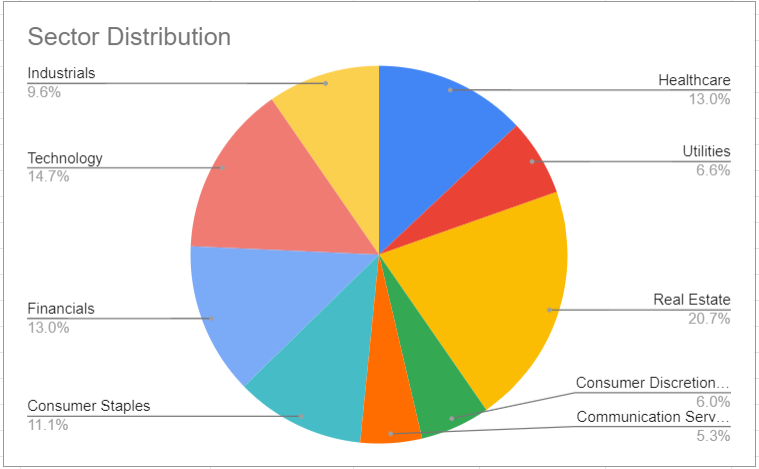
Sector concentration also plays a role when addressing drawdowns and I want to avoid being hit by a major loss across a specific sector. The portfolio is limited to a maximum of 20% in a specific sector.

  • Rule #6

All dividends collected will be reinvested into the portfolio. To be able to rapidly grow the portfolio and to enhance the compounding effect, none of the dividends will be withdrawn from the account.

  • Rule #7

The major goal of the portfolio is to build an income stream. Therefore, companies that reduce or cut their dividend are removed from the portfolio. A position may be sold during the day or week after the announcement.

The criteria I have used for stock-picking needs an article on its own. So I will be writing about it in the near future. Don’t forget to follow me to be notified.

How to Track Progress?

In order to track the progress in the portfolio without necessarily relying on the broker’s platform, I will be using Google Sheets. The integration with Google Finance allows users to pull some data as the stock price or the 52-week low. It also allows us to easily track position sizing and performance.

Here some examples of what can be done. It all depends on the information we consider essential.
Since I have been investing once a week, updating the sheet does not take much time once is already built.

How Am I Making Progress?

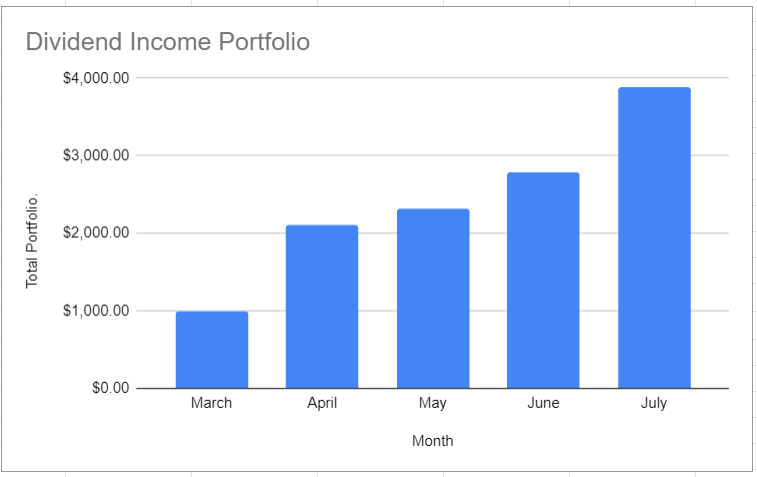
From the initial list of 765 companies to choose from, I selected and currently hold 41 stocks in this portfolio. I started this portfolio with $1000 only back in March and have added an extra $1000 in April.

Since I started to build this portfolio, I already removed 4 or 5 positions to comply with Rule #7. I was also forced to trim some positions according to Rule #4. Since I have already picked most of the positions, I will not be changing my portfolio allocation very often from here onwards.

In a nutshell, this is the progression of this small Dividend Income Portfolio which currently sits at $3878:
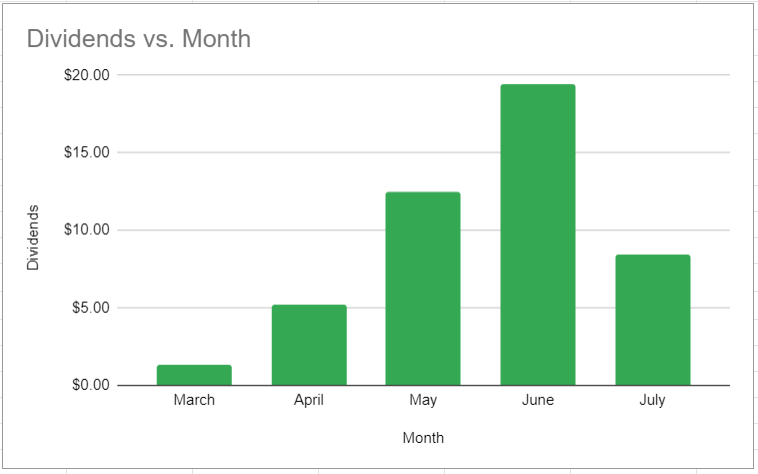
Here are the dividends received so far on a monthly basis with a total of $46.87:
Thank you for reading and hope I demonstrated that small amounts can compound rapidly and generate income. Every little step is one step closer to the right destination.

This article is for informational purposes only, it should not be considered Financial or Legal Advice. Not all information will be accurate. Consult a financial professional before making any major financial decisions.

Dividends
Passive Income
Money Management
Money
Personal Finance
Recommended from ReadMedium
