
How To Pay Expenses With Dividends
Only 10 minutes per week

Everyone likes the idea of building an income stream that is not necessarily linked to a job. Still, we need money to build money and a current job can be our leverage. Saving money and investing in companies that pay dividends can help finance some expenses in the future or live off entirely from that income.
For quite some time, I was not a fan of holding shares of a company just because they pay a dividend. Time told us that dividends are not guaranteed and the company may always cut or suspend this regular payment.
A dividend is always an outflow of money from the company books. Wouldn’t be wiser to re-invest that money into growing the business? This was always a question in the back of my mind.
However, companies can still grow while paying dividends. Can I have some benefit in putting my money into such businesses? Yes, we can. Let’s keep reading…
Why Dividends?
As I hinted in my title, dividends allow investors to build a passive income stream or semi-passive. Semi-passive because it may require some work to build and maintain an investing strategy. Dividends create cash-flow that can be used to pay expenses in the future.
Investing in dividend stocks brings several benefits to investors:
- Regular payments: Most companies pay their dividends on a quarterly basis. This means that every 3 months you will receive a small payment usually announced by the company beforehand.
- Hedge against inflation: With growing inflation, money does not hold the same value over the years. An income that does not increase with time, reduces our buying power. Dividends that grow over the years can be a great tool to increase our income.
- Capital stability: In general a quality company is well managed and their business is mature and stable. A history of growing revenues and dividends provides investors a safer way to preserve capital when compared to growth or speculative businesses.
- Compounding: As with other investment strategies, dividends allow investors to re-invest the money into more shares. More shares mean higher regular payments.
How to Start?
Starting a portfolio always requires some thought and some form of validation. Simpler and most reliable strategies always revolve around Exchange Traded Funds or ETF’s.
Sometimes being stupid means actually being smart. While I speak against myself because I invest in individual stocks, most people are better off with an ETF. A fund greatly reduces the investor bias towards individual companies and shields your investment from the psychological pressure of picking winning companies.
Investors have several options when it comes to ETFs. A few of them are:
- Vanguard High Yield Dividend (VYM): focus on high-yield dividend US companies. Read more here.
- Vanguard Dividend Appreciation (VIG): focus on companies that have a record of growing dividends. Read more here.
- iShares Select Dividend (DVY): tracks a list of 100 companies with steady and rising dividends. Read more here.
For each fund, the investor should read the information and agree with the strategy outlined. Sector exposure, weighting, and diversification are always points of analysis.
Let Time Be Your Friend
People often lose money in the financial markets due to emotions. Investors should enjoy the wild rides of the markets and believe in it for the long term. While no one can predict the future, the safer bet is to believe in what has worked in the past.
Historically, the S&P 500 increases in value even with sharp decreases during brief periods.
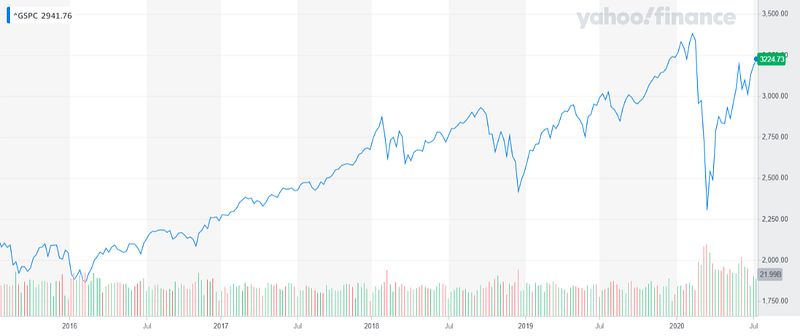
An investor can smooth the ride by setting a buy order every week or every month according to your broker fees. Nowadays with a low cost or free trading broker, an investor can split their buys into chunks to dollar cost average their positions.
I personally take 10 minutes every week, to login to my broker and set a buy order at the market price every single Monday. As I automatically transfer funds into my investment account after my paycheck, the money is already there. This saves time and avoids emotional decisions based on news or other life events.
Thank you for reading and hope I contributed positively to your day!
This article is for informational purposes only, it should not be considered Financial or Legal Advice. Not all information will be accurate. Consult a financial professional before making any major financial decisions.