
Introverts: How to Stop Thinking that Being Quiet is A Bad Thing
Is it a bad thing to be a quiet person? Bust the belief that quietness is a sign of weakness when there is nothing wrong with being an introvert.
It is okay to go quiet every once in a while. However, when quietness is part of our introverted personality, it is often perceived as something bad or a sign of weakness. For not speaking up, our silence is interpreted as being shy and having a lack of confidence.
As kids, we may be taught that there is something fundamentally wrong with having an introverted or quiet personality. We are labelled as “shy” in front of others. I recall feeling rather hurt, which caused me to retreat even more into silence.
I grew up being in my shell and for a long time, I did not know that there is a difference between introversion and shyness. It would appear that I am not alone with the confusion either. Many people automatically assume that introversion means shyness and a lack of confidence. As I have discovered, it’s not a correct assumption to make.
It’s true that introverted people tend to be quiet and reserved. Our energy is more inward and we need plenty of “me” time. Relatively speaking, we don’t talk as much as compared to an extrovert.
To be shy is to be timid or nervous in the company of others. Shyness often reflects a sense of inadequacy or self-consciousness. It is often linked to low self-esteem and confidence.
With greater awareness, I’ve learnt what the difference is.
Just because I am quiet does not necessarily mean that I am shy, have poor confidence or have nothing valuable to contribute to a conversation.
Keanu Reeves has much to say about being a quiet person…
I hate when people ask me: “Why are you so quiet?” Because I am. That’s how I function. I don’t ask others, “Why do you talk so much?” It’s rude.
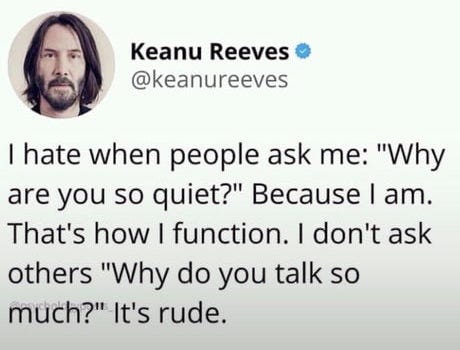
Exactly!
Susan Cain, best-selling author of Quiet: The Power of Introverts in a World that Can’t Stop Talking, sheds more light…
Shyness is the fear of social disapproval or humiliation, while introversion is a preference for environments that are not overstimulating. Shyness is inherently painful; introversion is not. Susan Cain
What’s Happening in The Quiet World of an Introvert
I may prefer not to speak for various reasons.
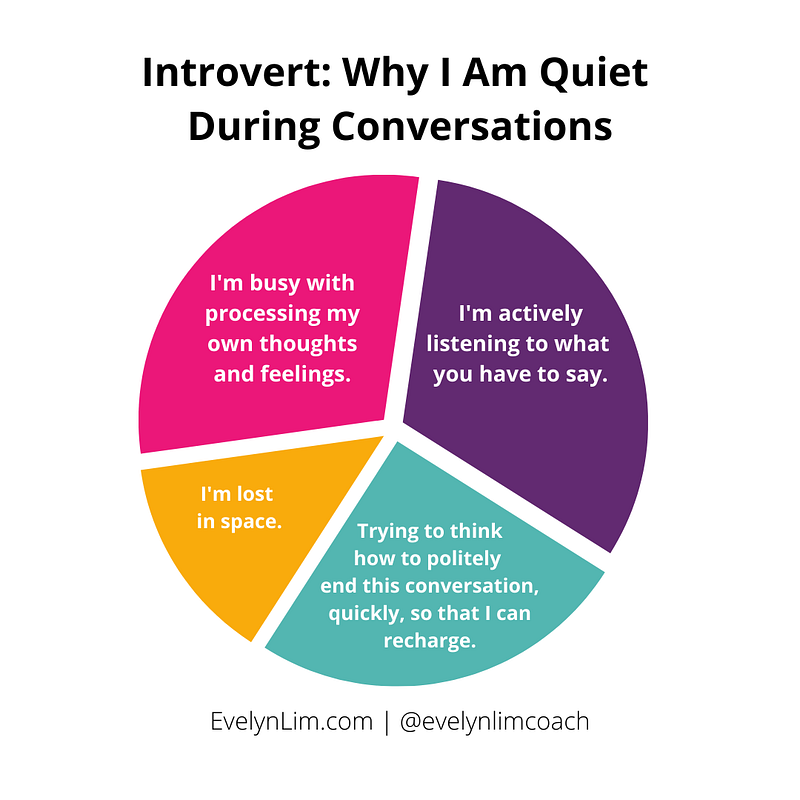
Sometimes, it is because I prefer to listen rather than talk. I am actively listening and taking an interest to what the speaker is saying.
Sometimes, it is because I refuse to take part in a conversation that is gossipy and unhealthy. Talk that has a low energy vibe just doesn’t sit with me. I would be secretly thinking up excuses to leave as soon as possible.
Sometimes, I need more time to process my own thoughts and feelings. It’s why I stay silent in the outside world. However, in case anyone is mistaken, it’s not silent on the inside. My mind is busy reflecting on the finer points of the subject matter. Plus, I’m busy with connecting to how I feel. I’m occupied with exploring the richness of my inner world, in other words.
And of course, there are times when my mind is somewhere in space. It happens when the conversation is boring. Topics like politics just don’t interest me. I’m sorry but I just can’t help zoning out.
The Difference Between Being Quiet as an Introvert and Being Shy with Low Self-Confidence
Let’s represent the difference in a diagram so that it is easier to understand.
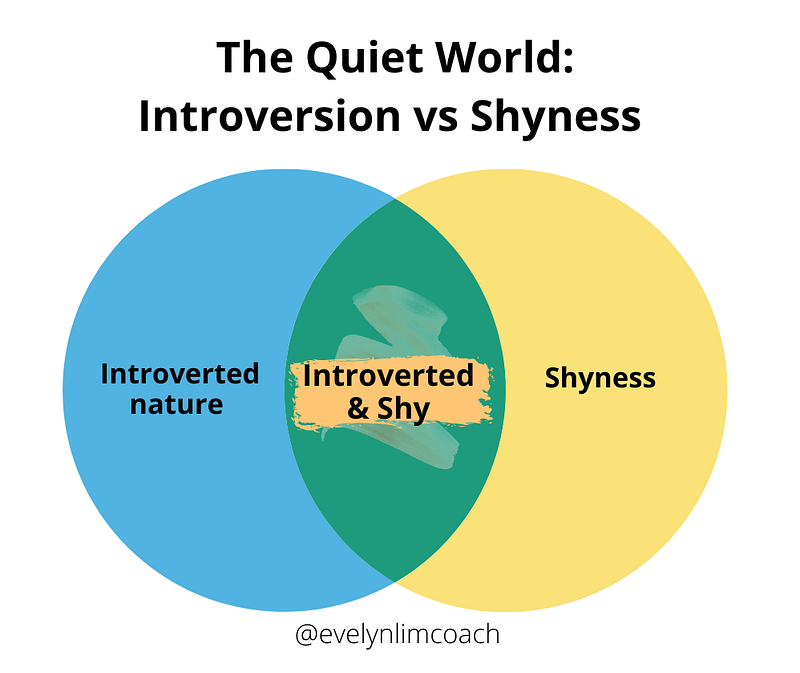
Refer to the diagram as follows…
- There are people (including myself) who are introverted but who will speak up or join in conversations when necessary. We may also enjoy social gatherings or being in the spotlight every now and then. It’s not true that we will stay silent on every topic. When it is a topic that we are passionate about, we won’t stop ourselves from expressing our views.
- There are also people who are shy but who are not introverts. Their problem is a lack of confidence and the fear of judgment, more than anything else.
- Some people are both shy and introverted. They fall in the overlapping section, per the diagram. They prefer to stay out of sight, for fear of being spotted. Mostly, they choose not to be seen or heard.
- There are also others who are not shy and who are not introverts.
If you have a lack of confidence and esteem, regardless of whether you are an introvert or not, it will help to address your issues. For one, shyness can develop due to having authoritarian or overprotective parents. Fortunately, shyness or confidence issues can be overcome. It was certainly what I did.
In short, here’s what I like anyone to understand… Being quiet is not a bad thing. Being an introvert is not a sign of weakness. Shyness is something that can be changed.
It’s great that Tim Denning has pointed out, quiet people can change the world.
If you are an introvert like myself, I’d like to invite you to shift to the left side of the diagram.
By having greater confidence, you’d know that it is okay to be quiet and that you are free to speak your mind in appropriate situations, if you choose to. Even though you tend to be more quiet, you are okay. You are comfortable with who you are. You feel authentically confident in yourself and what you can potentially offer to others.
Recommended Reading on Self-Acceptance
P.S. Follow me on Medium for more of my articles.


