
A Roundup of Methods for Taking and Making Notes
Introduction
I’ve written before on why & how I take notes. I see four purposes for taking notes:
- Documenting what happened
- Making notes to remember things
- Making notes to learn things
- Making notes to clarify my thinking
Today, I want to focus on all the different kinds of notes that you can take. In other words, I intend to begin to dive in depth into the how of note-taking and note-making.
I’m going to introduce a wide array of note types today. Over the coming weeks, I will be highlighting each kind of note, along with sharing research on taking and making notes. Let’s begin by clarifying taking and making notes.
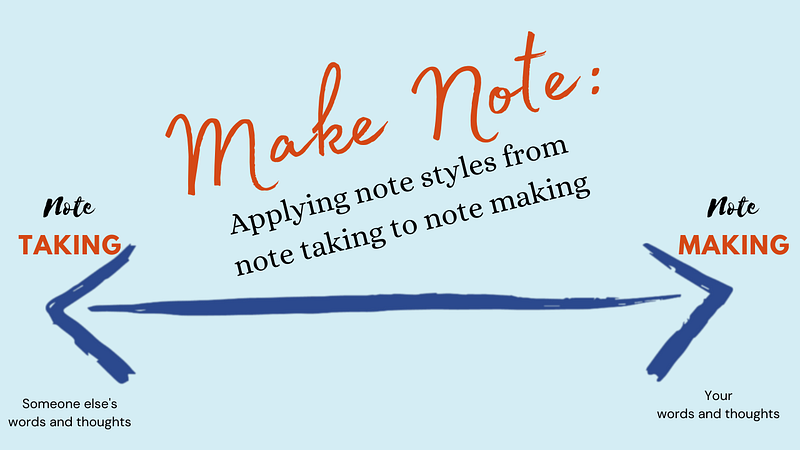
What’s the difference between taking and making notes?
I see taking notes as a mostly passive activity. When you take notes you are capturing information, but you aren’t really processing that information. When you make notes, you are actively processing information and transforming it into your words and thoughts.
Let’s consider a few examples and place them on the spectrum between taking notes and making notes.
Example 1: Class Lecture Notes
Taking notes in class can bridge the spectrum from taking to making notes. In a classroom where you are typing essentially a transcript of what the instructor is saying, you are taking notes. If you are actively summarizing the instructor’s points as you listen in class — putting their words into your words — you are much closer to making notes.
Example 2: Genealogy Research
I take many notes as I examine genealogy records. I transform this into a note-making activity when I place family events on a timeline across multiple data sources. Furthermore, I have even taken a few tries at constructing a story from the various bits of information I find in news clippings, family journals, and public records.
Example 3: Handling Tasks
I take notes in meetings to capture the tasks I need to do to fulfill my commitments to clients. Often, as I put these into my task management system after the meeting, I further clarify the task, adding details, answering questions for myself about how I want to handle the task, and more. This act of clarification is making notes.
All the different types of notes identified below can be used anywhere on the spectrum, from taking to making notes.
An Overview of Note Methods
Cornell Method
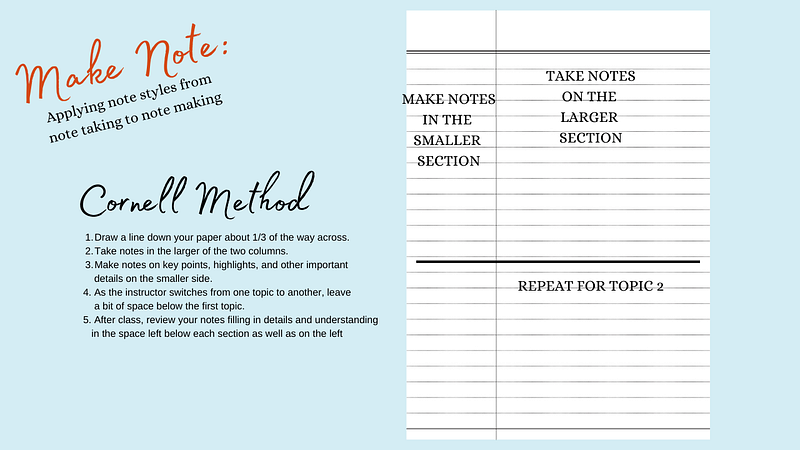
The Cornell Method is the only note-taking method I learned in school in a “formal” way. I picked up topics like Outline and Mapping organically during my time in school. I learned the other methods below through my research and study. But, the Cornell Method was the one method of note-taking I was taught.
To give the Cornell Method a try:
- Draw a line down your paper about 1/3 of the way across.
- Take notes in the larger of the two columns.
- Make notes on key points, highlights, and other important details on the smaller side.
- As the lecturer/instructor switches from one topic to another, leave a bit of space below the first topic.
- After class, review your notes, filling in details and understanding in the space left below each section as well as in the smaller section of the page.
The Cornell Method can give you a set of “flash cards” built into your notes to study from as you cover either side of your notes and practice recalling various details or higher level thoughts not shown on that side.
The Cornell Method also encourages both note-taking (in the bigger section of the page) and note-making (in the smaller section of the page and in the section you leave empty below each topic.
Outline Method
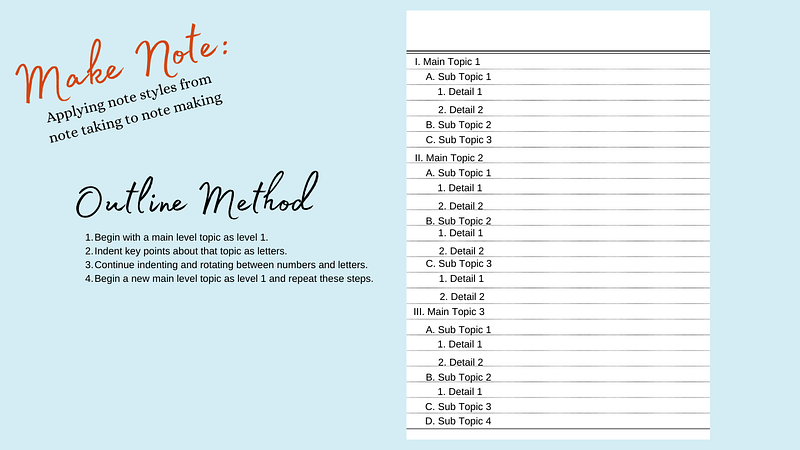
I was taught the outline method in school, but never as a note-taking tool specifically — although now I realize that’s what it was. I was taught outlining as the first step in organizing my thoughts for writing a longer work. Once I clarified for myself that making notes is all about clarifying your thinking, I realized how important outlining was in the process of making notes.
Outlining is also a wondering place to introduce that note-taking and note-making tools do not work in a vacuum. Imagine for a moment if you applied the Cornell Method to a sentence-based outline. We’ll meet the Sentence Method of taking notes a bit later. Occasionally, you add in a map or a chart for good measure. I this kind of approach, note-taking tools work together to help you make more useful and practical notes.
Questions — Evidence — Conclusion (QEC) Method
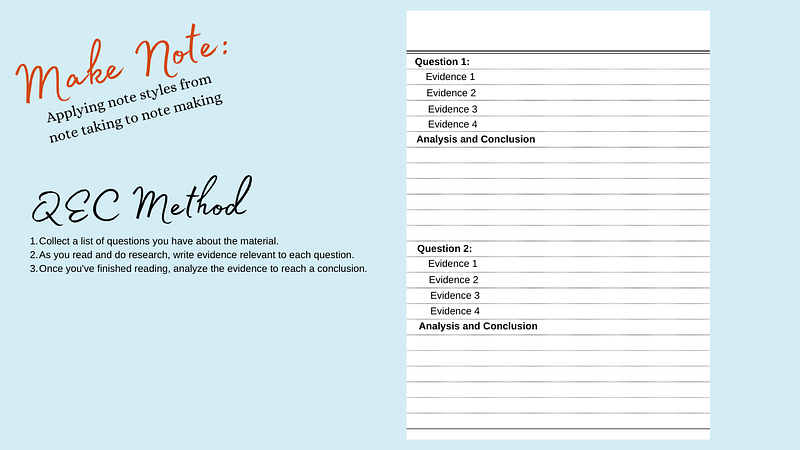
The QEC method, like the Cornell method, builds in the need for you to actively engage in note-making as well as note-taking. The QEC method first requires you to think about and collect the questions you have about the specific topic being studied. I especially like to use the QEC method when I am engaging with a new book.
Before I start reading a new book that I wish to learn from, I’ll do what Mortimer Adler refers to as “Inspectional Reading” (in the book How to Read A Book).
The steps in inspectional reading are:
- Look at the title page and skim/read the preface
- Review the table of contents and index.
- As you review each of these, pick a couple of sections/references that seem interesting and read a brief passage or two about them.
- Is the arrangement of chapters critical to the conclusions the author is trying to draw?
- Lightly skim the book.
- Look at a few sections and read passages.
- Review graphics that feel of interest to you.
- Since we have the Internet and ChatGPT available to us today, I like to find/ask ChatGPT to generate a summary of the book that highlights both positive and negative reviews of the book. The results here using the free version of ChatGPT are haphazard at best, so I typically supplement by reviewing several reviews from my library, Goodreads, Bookshop.org, Amazon and other sites.
From this inspectional reading, I write out a list of questions for myself that I hope to draw conclusions on before finishing the book.
As I read, I’ll fill in evidence that relates to those questions. It’s important to point out here that a well-formed question does not point towards a conclusion. A well-formed question allows you to let the conclusion come forward from the evidence you gather from reading and studying. It does not include a suggested or expected conclusion in its wording.
I’ll draw a conclusion and fill it in below each question and its supporting evidence.
I create a lot of personal learning projects, and this method is a wonderful tool for use in those projects. It keeps me focused on both developing new questions and then gathering evidence. It keeps me engaged in curiosity, which is one of my favorite states to be in.
Mapping Method
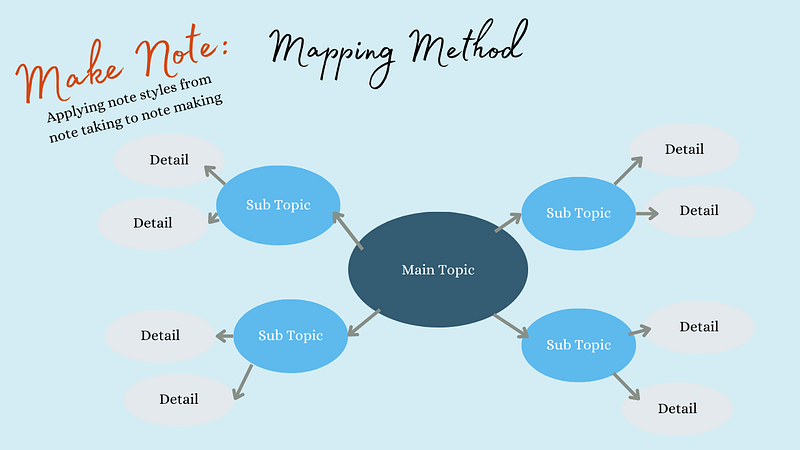
I’m going to lump several ideas together into the broad category of the mapping method for now. In a later article, we’ll look at some differences between these.
For now, we’ll let the mapping method serve as a broad home for things like concept maps, mind maps, process maps, and more.
Mapping is a practical tool for organizing a large amount of information. The general idea behind mapping is to turn ideas into a visual diagram. This typically begins with a main topic in the center of the page, and then each successive layer of topics branching out from that main topic.
Charting Method
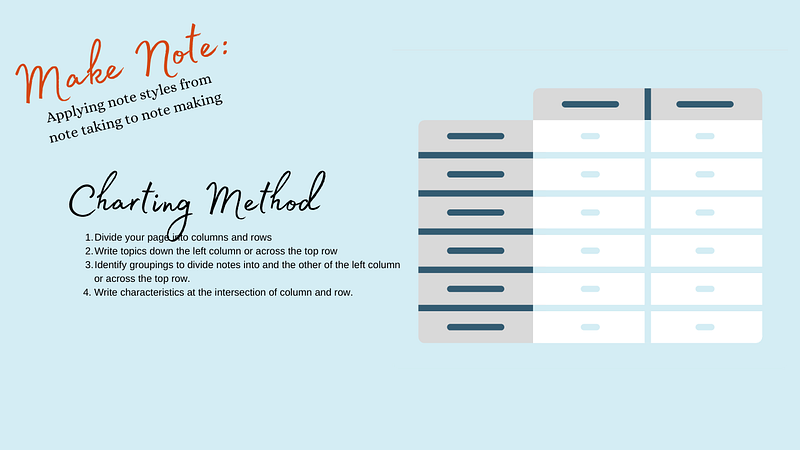
Charting is, like mapping, a visual note-taking method that can help you compare and contrast two or more things. One of my favorite books about visual thinking — Blah, Blah, Blah by Dan Roam — gives us a hint on when to use charts. Roam says, “Hear numbers = Draw a Chart” (p. 171). I agree with Roam completely here, AND I think charts can be extremely helpful in studying and analyzing text-based information where logical groupings exist.
Charting is another note-taking method that has some amount of note-making built into it. In the charting method, you organize information into groups — typically in a table with headings at the top of each column. Your first level of note-making when using the charting method is deciding what the headings are that are appropriate to compare or contrast for each group of information.
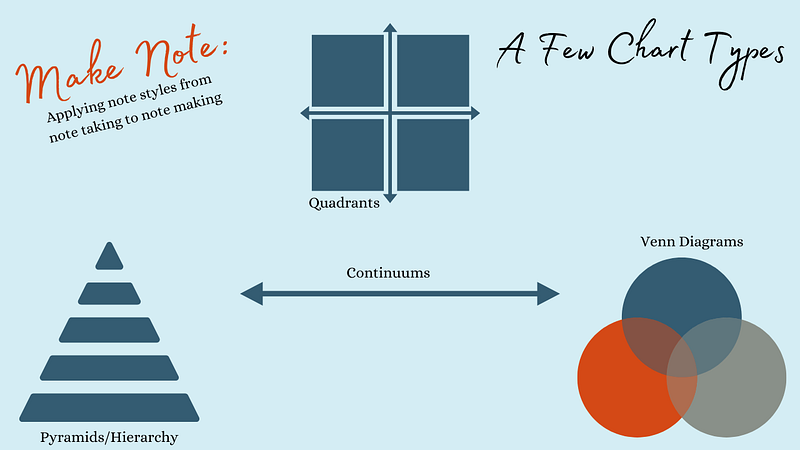
This method of charting is the way it is commonly taught as a note-taking tool, but as a mathematics educator, I acquired many other kinds of “charts” for my toolbox. I’ve also collected different ways of grouping text information in visual ways. A few of my favorites are:
- continuums (double-sided arrows)
- quadrants (add arrows to signify direction when appropriate)
- pyramids and hierarchies
- Venn diagrams
Sentence Method
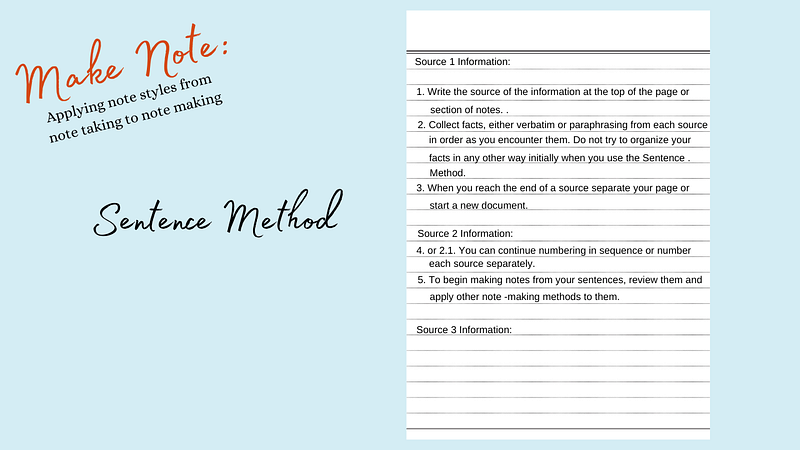
The sentence method is a little hard to see the purpose of when you first learn it. I didn’t discover the value of the sentence method until I began teaching and leading creative problem-solving sessions. In those sessions, we are collecting large amounts of information as quickly as possible. Generally, the sessions may be designed around a specific topic or focus area, but undoubtedly, there will be some divergence from that initial topic.
It’s in this type of environment where the sentence method truly shines. You make no attempt, in the first pass, to order or organize the information. You are purely taking notes, rather than making notes.
In the sentence method, you create a numbered list of facts as whole sentences. Each sentence should be able to stand fully on its own. As you make the list of facts, you don’t attempt to assign order or importance to them — apart from the fact that they reflect the order in which you wrote them down. In this way, the sentence method is mostly a note-taking method.
When you take the time to paraphrase the sentences in your words as you write them, you are moving from note-taking to note-making. In my creative problem-solving sessions, someone will give a two or three minute explanation of something related to the problem at hand. As the person capturing ideas, I’ll do one of two things. I’ll either try to capture a high-level summary of the topic, or I’ll ask the person — and the rest of the participants — to give me the headline of the story that was just relayed. That’s the fact I’ll write down.
Some people will teach the sentence method using bullets instead of a numbered list. This does a terrible disservice to the note- making process. You may encounter topics that link together at various places in your notes. Say you’re doing research on the role of recycling in community health. You’ve collected 82 items from books, articles, interviews, and videos using the sentence method. You were careful to express each idea you wrote in your words, so you’ve done the first layer of note-making. However, you want to continue this effort and synthesize these facts into a position paper. You want to present a conclusion related to the reduction in the need for raw materials in your paper. You look back through your sentences and see that items 3, 18, 24, 25, 26, 52, 73, 74, and 76 all relate to that idea. Try quickly capturing which ideas go together when some relate to multiple topics with bullets — trust me when I tell you it’s much harder!
In this example, we also find the need to add citations and references in the sentence method. I typically draw a line across my page as I move between references, and then add in the reference information at the top of the section. I’ve seen others make one document for each reference/citation source. Do what works best for you, but definitely cite your sources in any of the methods we’ve talked about here today.
Flow Method
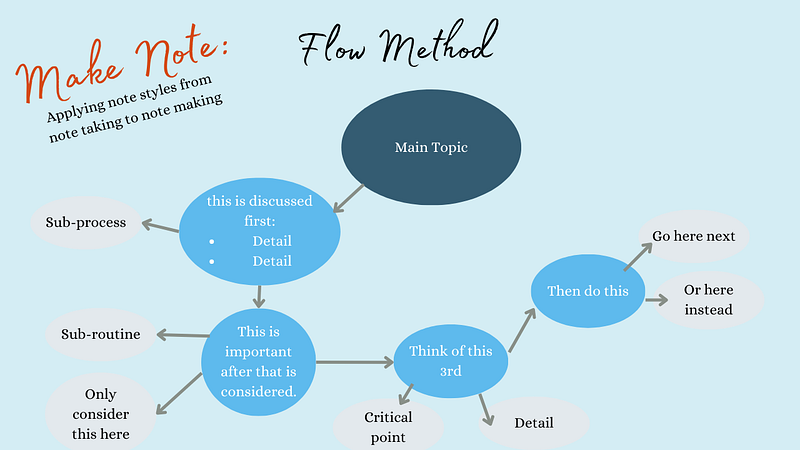
The flow method of note-taking gives your notes a visual appeal while also applying some amount of order and/or direction to them. I consider flow to be the messier cousin to charting and mapping — but it is also a method in its own right.
Many of my notes start in flow and then move forward to charts or maps. Likewise, many outlines or even some maps or charts have a specific order and direction embedded in them, and so a flow-based note might naturally make its way into the note-making process in one of those cases.
Flow methods are great for many cases. You’ll encounter them in many disciplines. Here are a few:
- Process Maps & diagrams
- Flow diagrams and flow charts (in technology and IT)
- Scientific processes
- Many mathematical problems are just demonstrations of flow processes.
In The Sketchnote Handbook, author Mike Rohde describes various layouts for sketch notes. In my opinion, sketchnotes are a specific form of the flow note-taking method. I highly recommend Rohde’s books, videos, and more. As freely available resources go, this is an excellent overview of the various sketch note layouts.
Boxing Method
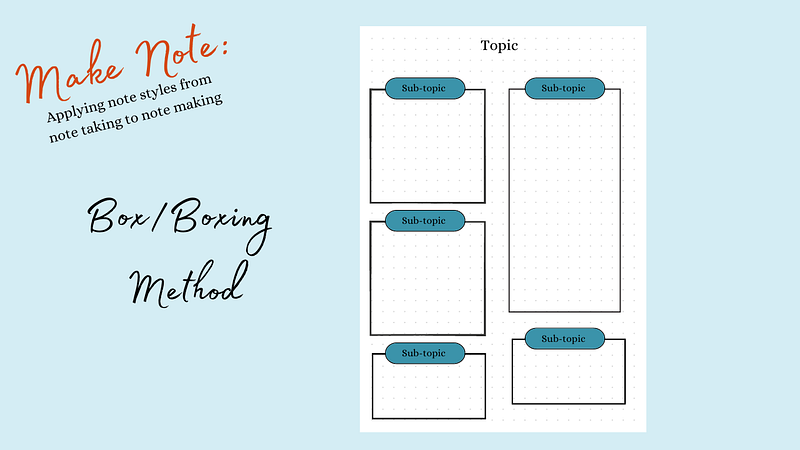
In a future article in this series, I’m going to discuss note-taking and note-making workflows. Introducing the boxing method of note-taking and note-making is a good place to preview this topic. I rarely start a note-taking session with the boxing method. The boxing method is, for me, almost always an act of note-making. I consolidate ideas from a set of notes taking using another method into boxes arranged by topic.
In the summary image shown above, I depict a single page about one topic with five separate subtopics. However, each box could house one topic. Adapt the structure to meet your needs.
REAP Method
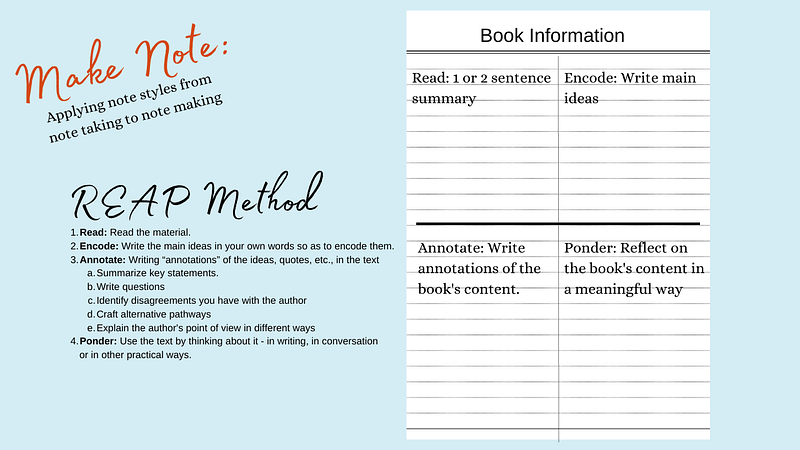
I learned about the REAP method in a course on teaching reading in my secondary education program. It was a required course for all secondary education majors at my university. While I thought it was odd that high school mathematics teachers should have to learn how to teach reading, I loved the course and took much from it — including the REAP method.
I like to combine what I learned in college as the REAP method which is outlined in the above image with the Inspectional Reading method outlined above from Mortimer Adler’s How to Read a Book. I will use inspectional reading to begin the R and E stages, and even occasionally one or more high-level annotations — particularly questions. The REAP method is an excellent tool to use for what Adler calls the next stage or type of reading after inspectional, which is analytical reading. Analytical reading is the very best reading you can do of a particular text. REAP is a tool for doing analytical reading.
I’ve also used REAP as a toolset for Adler’s highest level of reading — syntopical reading. Syntopical reading is reading multiple texts about a similar topic. In this usage example, my notes from each book become the overall text to be analyzed, and I conduct a REAP method review of all of my notes from the various books on a topic.
The REAP method was developed as and is still almost exclusively taught as a method for analyzing a piece of reading material. It is a note-making method by its very design, assuming you go through all four of the steps. While REAP was developed as a tool for analyzing reading, today, I use REAP as a note-making method for any sort of recorded content that I can review multiple times. The annotation step is certainly easier if you have a piece of writing in front of you to track through, but I’ve “annotated” many podcasts, TED Talks, and YouTube videos in my notes. As such, REAP is a method appropriate for use with any recorded content — not just writing.
Adapting note-taking Methods
I chose to leave the Split Page Method of note-taking out of my list of methods. I made this decision because I see it predominantly as a personal adaptation of the Cornell Method.
Likewise, as I described the Cornell Method above, I decided not to describe the page layout as drawing a line down your page one-third of the way from the left-hand side. Why? Because it doesn’t matter where you draw the line — right or left side of the page. It also doesn’t matter whether you draw the link a 1/3 of the way across the page or divide the page in half. It matters what works best for you.
I’ll focus more on adaptations of note-taking methods in the article on workflows, as well as in comparing and contrasting digital and analog methods of note-taking. For now, remember that the specifics of the structure are tools in a toolbox. You can use a wide array of tools to conquer a specific job. My wish is to continue to add tools to your note-taking and note-making toolbox throughout this series.
—
📰 Want to make sure you never miss a story from me? Subscribe to my newsletter. I send out a fresh new article and do a round up of everything I published that week. It is released for free every Monday morning.
🌐 You may find other copies or versions of this article at places where I publish my work. You can find me at Medium, on the Hive Blockchain, on my personal website, on my business website, on LinkedIn, and on Twitter.


